Plot Summary
Catastrophe on Campus
Ariel Manto, a young, intellectually restless PhD student, witnesses the collapse of a university building, an event that shakes her sense of reality and foreshadows the instability to come. This disaster is both literal and metaphorical, marking the beginning of Ariel's descent into a world where the boundaries between thought and reality blur. The collapse disrupts her academic life and isolates her, setting her on a path of obsession with the mysterious disappearance of her supervisor, Saul Burlem, and the enigmatic 19th-century writer Thomas E. Lumas. The event's randomness and violence mirror Ariel's internal chaos, propelling her into a quest for meaning in a world that seems increasingly uncertain and haunted by the possibility of catastrophe at every turn.
The Cursed Book Found
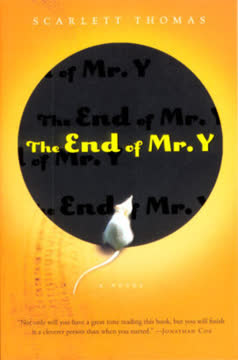
In a chance encounter at a secondhand bookshop, Ariel discovers a copy of The End of Mr. Y, a novel by Lumas rumored to be cursed—those who read it are said to die. Despite her skepticism, Ariel is drawn to the book's rarity and the mythos surrounding it, spending her last money to obtain it. The book's physical presence is intoxicating, and Ariel's excitement is tinged with fear and anticipation. This acquisition marks the crossing of a threshold: Ariel is no longer just a scholar but a participant in the book's dangerous legacy. The book's curse, whether real or imagined, becomes a catalyst for Ariel's transformation, as she is compelled to read and unravel its secrets, even as it threatens her sanity and safety.
Obsession and Isolation
As Ariel immerses herself in the book, her life becomes increasingly insular. She is haunted by the curse's legend and the mysterious disappearance of Burlem, her only academic anchor. Her relationships with others—her neighbor Wolfgang, her lover Patrick—become strained or transactional, highlighting her growing alienation. Ariel's intellectual pursuits, once a source of joy, now serve as a means of escape from her loneliness and existential dread. The book's missing page becomes a symbol of her fractured reality, and her inability to connect with others mirrors her inability to piece together the narrative. Ariel's obsession with the book and its mysteries isolates her further, as she becomes both detective and potential victim in a story that increasingly feels like her own.
The Troposphere Unveiled
Reading The End of Mr. Y leads Ariel to discover the Troposphere, a metaphysical realm described in the novel as a world of minds—a place where consciousnesses are interconnected and accessible through a mysterious recipe. The Troposphere is both exhilarating and terrifying: it offers the possibility of telepathy, time travel, and the dissolution of boundaries between self and other. Ariel's first journey into the Troposphere is a psychedelic experience, filled with symbols, tunnels, and the sensation of being both everywhere and nowhere. This realm challenges her understanding of reality, as she realizes that thought can shape matter and that the mind is not confined to the body. The Troposphere becomes a space of infinite possibility and danger, where the rules of physics and narrative are rewritten.
Dangerous Thought Experiments
Ariel's academic background in thought experiments—mental exercises that probe the limits of logic and reality—becomes central to her navigation of the Troposphere. She reflects on the history of science and philosophy, from Schrödinger's cat to Einstein's trains, and the ways in which stories and metaphors shape understanding. The novel explores the idea that reality itself may be constructed through language and thought, and that the boundaries between fiction and fact are porous. Ariel's journey becomes a living thought experiment, as she tests the limits of consciousness, identity, and causality. The interplay between science and narrative is both liberating and destabilizing, as Ariel confronts the possibility that the world is a simulacrum—a copy without an original.
The Missing Page
Ariel's search for the missing page from The End of Mr. Y becomes a quest for the key to the Troposphere. The page, hidden by Burlem, contains the recipe for the potion that enables entry into the world of minds. Its discovery is both a triumph and a curse, as it grants Ariel access to powers that are both wondrous and perilous. The act of hiding and finding the page mirrors the novel's themes of concealment, revelation, and the dangers of forbidden knowledge. The missing page is a symbol of the gaps in understanding that drive both scientific inquiry and personal obsession. Its recovery propels Ariel deeper into the mysteries of the Troposphere and the dangers that await those who seek to manipulate reality.
Into Other Minds
Armed with the recipe, Ariel begins to experiment with telepathy, entering the minds of others—humans, mice, even a cat. These journeys are disorienting and transformative, as Ariel experiences the world through radically different perspectives. The boundaries between self and other dissolve, and Ariel is forced to confront the ethical implications of her newfound abilities. The experience of inhabiting other minds is both exhilarating and traumatic, revealing the interconnectedness of all beings and the suffering that pervades existence. Ariel's empathy deepens, but so does her sense of alienation, as she realizes that true understanding may be impossible and that the act of entering another's mind is both a gift and a violation.
Enemies in Pursuit
The powers unlocked by the Troposphere attract the attention of sinister forces—former intelligence agents Martin Rose and Ed and their psychic child accomplices, the KIDS—who seek to control the recipe and the world of minds for their own ends. Ariel becomes a fugitive, pursued across physical and metaphysical landscapes. The threat is both external and internal, as the boundaries between hunter and hunted, reality and illusion, blur. The pursuit is relentless, and Ariel's survival depends on her ability to navigate both the dangers of the Troposphere and the treacheries of the real world. The novel's tension escalates as Ariel is forced to confront the consequences of her quest for knowledge and the costs of wielding power over consciousness.
The Recipe's Power
The recipe for the Troposphere potion is revealed to be both simple and profound—a homeopathic dilution of vegetable charcoal and holy water, activated by ritual and belief. Its power lies not in its ingredients but in the act of intention and the willingness to cross boundaries. The potion becomes a symbol of the permeability of reality and the ways in which belief can shape experience. The dangers of the potion are manifold: addiction, madness, and the risk of becoming lost in the world of minds. The recipe's simplicity belies its transformative potential, and its dissemination threatens to upend the balance between individuality and collective consciousness. The potion is both a key and a curse, opening doors that may be impossible to close.
The Underground Escape
As the pursuit intensifies, Ariel is forced to hide in literal and metaphorical undergrounds—a railway tunnel beneath the university, the subconscious depths of the Troposphere, and the hidden corners of her own mind. These escapes are fraught with danger and uncertainty, as Ariel navigates collapsing structures, shifting realities, and the ever-present threat of discovery. The underground becomes a space of both refuge and peril, a place where the rules of the surface world no longer apply. Ariel's journey through these hidden spaces mirrors her descent into the mysteries of consciousness and the risks of seeking knowledge that others would suppress or exploit.
The Science of Consciousness
In dialogue with Burlem and Lura, Ariel confronts the philosophical and scientific implications of the Troposphere. The novel explores theories of consciousness, the relationship between thought and matter, and the possibility that reality is constructed through language and collective belief. Lura's theory of "poststructuralist physics" posits that the laws of the universe are not fixed but are shaped by the thoughts of conscious beings. The Troposphere is revealed as a metaphorical hard drive, a space where all thoughts are encoded and accessible. The boundaries between science and fiction, self and other, creator and creation, are interrogated and destabilized. Ariel's quest becomes a search for the origins of consciousness and the limits of knowledge.
The Mouse-God's Bargain
In the Troposphere, Ariel encounters Apollo Smintheus, the mouse-god, who offers guidance and protection in exchange for a favor: to travel back in time and prevent the creation of laboratory mice, thereby sparing countless animals from suffering. This bargain is both a test and a temptation, as Ariel is given the power to alter history and the responsibility to use it wisely. The encounter with Apollo Smintheus deepens the novel's exploration of the relationship between thought, belief, and reality, as gods are revealed to be products of collective consciousness and prayer. The bargain forces Ariel to confront the ethical dilemmas of intervention and the consequences of wielding power over the past.
Pedesis and Paradox
Ariel and Adam, now united in the Troposphere, undertake a perilous journey through time and consciousness, using Pedesis—the ability to leap from mind to mind, ancestor to ancestor—to reach the origins of laboratory mice and, ultimately, the author Lumas himself. The journey is fraught with paradoxes and ethical quandaries: can the past be changed without unraveling the present? What are the consequences of erasing suffering or evil? The experience is both exhilarating and harrowing, as Ariel and Adam confront the limits of agency and the inevitability of unintended consequences. The paradoxes of time travel become metaphors for the complexities of memory, trauma, and the desire to rewrite one's own story.
The End of Mr. Y
Reaching the mind of Lumas, Ariel persuades him to destroy his manuscript, preventing the publication of The End of Mr. Y and erasing the possibility of the Troposphere's discovery. This act is both an erasure and a liberation, as Ariel fulfills her role as both protagonist and author, shaping the narrative from within. The destruction of the book is a moment of both triumph and loss, as the world is saved from the dangers of collective mind control, but the possibility of transcendence and infinite knowledge is also foreclosed. Ariel's journey comes full circle, as she confronts the costs of seeking ultimate understanding and the necessity of limits, endings, and mortality.
Infinite Choice
At the edge of the Troposphere, Ariel and Adam are confronted with infinite choice—the possibility of becoming lost in endless possibility or returning to the finite world of embodied existence. Their love, forged in the crucible of shared consciousness and suffering, becomes both a solace and a challenge. The novel ends with a vision of the origins of consciousness—a garden, a river, a tree—suggesting that the search for meaning is both endless and always beginning anew. Ariel's journey is both a cautionary tale and a celebration of the human capacity for wonder, connection, and the courage to choose, even in the face of uncertainty and the void.
Analysis
A postmodern meditation on knowledge, reality, and the selfThe End of Mr. Y is a dazzling, intellectually ambitious novel that uses the conventions of the thriller and the metaphysical mystery to explore profound questions about consciousness, language, and the nature of reality. Scarlett Thomas weaves together science, philosophy, and narrative in a way that is both playful and deeply serious, challenging readers to question the boundaries between fiction and fact, self and other, thought and matter. The novel's central lesson is both cautionary and hopeful: the pursuit of ultimate knowledge is fraught with danger—addiction, madness, the loss of self—but it is also the source of wonder, empathy, and the possibility of transcendence. The Troposphere, as both setting and metaphor, embodies the risks and rewards of collective consciousness, the power of stories to shape reality, and the necessity of limits, endings, and mortality. In a world where reality is increasingly mediated by language, technology, and belief, The End of Mr. Y asks us to consider what it means to choose, to act, and to love in the face of uncertainty and the void.
Review Summary
Reviews of The End of Mr. Y are deeply divided. Enthusiastic readers praise its thrilling blend of quantum physics, postmodern philosophy, and imaginative storytelling, particularly the concept of the Troposphere. Many found it a compulsive, mind-expanding read. Critics, however, found the philosophical name-dropping pretentious and superficial, the protagonist unlikeable, and the plot underdeveloped beneath its intellectual posturing. The fantasy elements polarized readers further. The book's ambition is widely acknowledged, even by detractors, though opinions on its execution range from brilliant to deeply frustrating.
Characters
Ariel Manto
Ariel is the novel's protagonist, a fiercely intelligent and emotionally complex PhD student whose obsession with forbidden knowledge drives the narrative. Her relationships are marked by ambivalence and longing—she is both deeply isolated and hungry for connection, both skeptical and credulous. Ariel's psychoanalytic profile reveals a mind haunted by trauma, abandonment, and the desire for transcendence. Her journey through the Troposphere is both a literal and metaphorical exploration of consciousness, identity, and the limits of knowledge. Ariel's development is marked by increasing empathy, self-awareness, and the willingness to confront the ethical implications of her actions. Her ultimate choice—to risk everything for love and understanding—embodies the novel's central tension between the desire for infinite knowledge and the necessity of limits.
Saul Burlem
Burlem is Ariel's missing supervisor, a scholar of Lumas and a man marked by both brilliance and melancholy. His disappearance is both a mystery and a warning, as he becomes a cautionary figure for Ariel's own descent into obsession. Burlem's psychoanalytic profile reveals a man driven by intellectual curiosity but undone by the dangers of forbidden knowledge. His relationships—with Ariel, with Lura, with his estranged daughter—are marked by regret, longing, and the inability to reconcile past and present. Burlem's development is a movement from authority to vulnerability, as he becomes both a guide and a fellow fugitive in the world of minds. His ultimate fate is ambiguous, embodying the novel's themes of exile, loss, and the search for meaning.
Lura
Lura is Burlem's partner and a retired physicist whose theories of "poststructuralist physics" provide the novel's philosophical backbone. She is both skeptical and visionary, struggling to reconcile scientific rigor with the metaphysical realities of the Troposphere. Lura's psychoanalytic profile reveals a mind marked by loss, resilience, and the desire to impose order on chaos. Her relationship with Burlem is both intimate and fraught, as they navigate the dangers of knowledge and the costs of survival. Lura's development is a movement from detachment to engagement, as she becomes both a mentor and a collaborator for Ariel. Her willingness to question everything, including her own theories, embodies the novel's commitment to uncertainty and inquiry.
Adam
Adam is a former priest whose crisis of faith and identity mirrors Ariel's own existential struggles. His journey is marked by trauma, loss, and the search for meaning beyond dogma. Adam's psychoanalytic profile reveals a man torn between the desire for self-annihilation and the longing for connection. His relationship with Ariel is both redemptive and tragic, as they find in each other the possibility of love, understanding, and transcendence. Adam's development is a movement from isolation to union, as he becomes both a companion and a co-creator in the world of minds. His ultimate fate—lost in the Troposphere, yet united with Ariel—embodies the novel's themes of sacrifice, acceptance, and the limits of salvation.
Wolfgang
Wolfgang is Ariel's neighbor, a melancholy German pianist whose wit and cynicism provide both humor and pathos. His psychoanalytic profile reveals a man marked by disappointment, addiction, and the struggle to find meaning in a world that seems indifferent to suffering. Wolfgang's relationship with Ariel is one of mutual support and gentle mockery, highlighting the novel's themes of friendship, loneliness, and the search for connection. His fate is ambiguous, serving as both a reminder of the world's absurdity and the possibility of redemption through small acts of kindness.
Patrick
Patrick is Ariel's married lover, a linguistics professor whose relationship with her is marked by intensity, secrecy, and the interplay of power and vulnerability. His psychoanalytic profile reveals a man driven by desire, guilt, and the need for control. Patrick's relationship with Ariel is both a source of pleasure and a symptom of her alienation, highlighting the novel's themes of sexuality, agency, and the costs of intimacy. His role in the narrative is both catalyst and cautionary tale, embodying the dangers of seeking fulfillment through others.
Thomas E. Lumas
Lumas is the 19th-century writer whose novel and theories form the novel's central mystery. His psychoanalytic profile reveals a mind marked by brilliance, eccentricity, and the inability to reconcile imagination and reality. Lumas's legacy is both a gift and a curse, as his work becomes the site of obsession, danger, and the possibility of transcendence. His ultimate fate—destroying his own manuscript—embodies the novel's themes of creation, destruction, and the limits of knowledge.
Apollo Smintheus
Apollo Smintheus is a metaphysical entity encountered in the Troposphere, a god created and sustained by the prayers of a handful of believers. His psychoanalytic profile reveals a being both powerful and vulnerable, dependent on the attention and belief of others. Apollo's relationship with Ariel is both transactional and transformative, as he offers guidance and protection in exchange for intervention in the world of suffering. His role in the narrative is both guide and trickster, embodying the novel's themes of faith, agency, and the constructed nature of reality.
Martin Rose and Ed
Martin and Ed are former intelligence agents who seek to exploit the powers of the Troposphere for personal gain. Their psychoanalytic profiles reveal minds marked by ambition, violence, and the willingness to sacrifice others for power. Their relationship with Ariel is one of pursuit and threat, embodying the dangers of knowledge without wisdom and the costs of treating consciousness as a commodity. Their ultimate fate is ambiguous, serving as a warning about the perils of unchecked desire and the limits of control.
The KIDS
The KIDS are psychic children used by intelligence agencies to manipulate minds in the Troposphere. Their psychoanalytic profiles reveal beings both innocent and monstrous, shaped by trauma and exploitation. Their relationship with Ariel is one of both threat and kinship, as she recognizes in them the dangers of power without agency and the suffering that underlies all consciousness. Their fate—dissolving into the care of a god—embodies the novel's themes of compassion, loss, and the hope for redemption.
Plot Devices
The Cursed Book
The cursed book, The End of Mr. Y, is the central plot device, serving as both MacGuffin and symbol. Its legend of fatal consequences for readers creates suspense and foreshadows the dangers of seeking forbidden knowledge. The book's physicality—its rarity, missing page, and hidden recipe—anchors the narrative's metaphysical explorations in material reality. The curse functions as both literal threat and metaphor for the risks of intellectual obsession, the dangers of crossing boundaries, and the costs of seeking ultimate understanding.
The Troposphere
The Troposphere is the novel's primary setting for its speculative and philosophical explorations. It is a world where consciousnesses are interconnected, accessible, and malleable—a space where thought shapes reality and the boundaries between self and other dissolve. The Troposphere functions as both a literal place and a metaphor for the collective unconscious, the internet, and the world of fiction itself. Its rules—telepathy, time travel, the possibility of infinite choice—allow for narrative experimentation and the interrogation of philosophical questions about identity, agency, and the nature of reality.
Pedesis
Pedesis, the ability to leap from mind to mind and ancestor to ancestor, is the mechanism by which Ariel and others navigate the Troposphere and travel through time. It is both a plot device and a metaphor for empathy, memory, and the transmission of trauma and knowledge. Pedesis enables the exploration of ethical dilemmas, paradoxes, and the consequences of intervention in the past. Its dangers—addiction, madness, the risk of becoming lost—mirror the risks of intellectual and emotional overreach.
The Missing Page
The missing page from The End of Mr. Y is a classic plot device, creating suspense and driving the narrative forward. Its concealment by Burlem and recovery by Ariel mirror the novel's themes of hidden knowledge, the gaps in understanding, and the dangers of revelation. The page's contents—the recipe for the Troposphere potion—are both a key and a curse, opening doors that may be impossible to close.
Infinite Choice
The motif of infinite choice—embodied in the Troposphere's breakdown at its edge—serves as both narrative climax and philosophical challenge. It represents the dangers and possibilities of absolute freedom, the risks of becoming lost in endless possibility, and the necessity of limits, endings, and mortality. The breakdown of narrative structure at the edge of the Troposphere mirrors the breakdown of meaning in the face of infinity, and the courage required to choose, act, and accept the consequences.








































