
Key Takeaways
Four billionaires are selling escape from reality as humanity's future
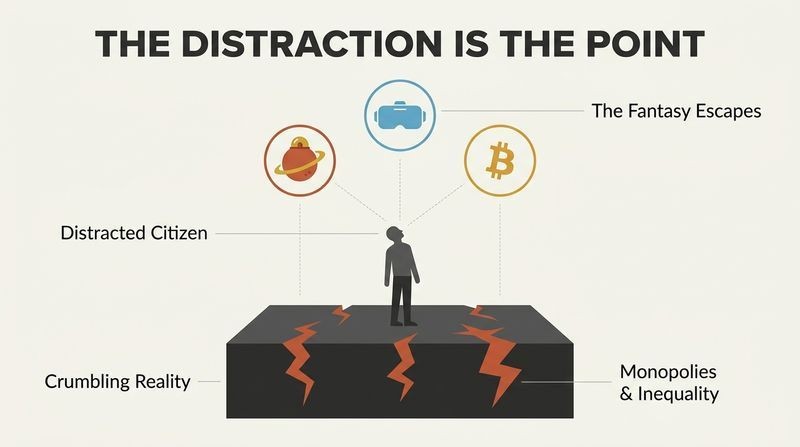
Meet the Technocrats. Jonathan Taplin argues that Elon Musk, Peter Thiel, Mark Zuckerberg, and Marc Andreessen form an interlocking club selling four fantasy projects: the Metaverse (virtual worlds), crypto currency, Mars colonization, and transhumanism (living to 160 or beyond). Taplin estimates these schemes could demand roughly $20 trillion, much of it public money, while real problems like climate, housing, and mental health go unfunded.
Why fantasy now? He frames our era as a Gramscian interregnum, where the old order is dying but the new cannot yet be born, producing what Gramsci called morbid symptoms. Into that vacuum, the Technocrats offer escape rather than repair. Their pitch echoes the Roman formula of bread and circuses: distract the masses from epic inequality with spectacle.
What's striking is how Taplin reframes Silicon Valley utopianism as a political project rather than mere techno-optimism. The connective tissue he draws (shared boards, shared ideology, shared dependence on government contracts) is genuinely documented. Skeptics might counter that grouping four very different men risks a conspiratorial flattening, and Zuckerberg in particular sits awkwardly beside Thiel's radicalism. Still, the central provocation holds: when a society's richest people invest in leaving reality rather than improving it, that choice itself is the story worth examining.
Social media spread distrust faster than any cable pundit ever could
Scale beats Tucker Carlson. Taplin notes that Carlson reaches maybe 3.3 million viewers on a good night, around 1% of Americans, while social platforms touch over 80% of the US population and Musk alone commands more than 100 million followers. Blaming individual loudmouths misses where disinformation actually metastasizes.
The correlation is chilling. When Facebook crossed 250 million users in 2009, US dissatisfaction with the country's direction sat at 62%. Today it approaches 87%. A 2022 poll found 44% of voters believe the federal government is controlled by a secret cabal, the core QAnon claim, including 41% of Independents. Taplin argues partisan rage is a feature, not a bug: anger drives engagement, and engagement drives ad revenue.
Correlation is not causation, and Taplin leans hard on timing arguments that other forces (the 2008 crash, wage stagnation, pandemic isolation) could equally explain. Yet the engagement-rage feedback loop is well supported by internal platform research and outside scholars like Jonathan Haidt. The deeper insight is structural: a business model that monetizes attention will always favor outrage over nuance because outrage holds eyeballs. This is less a moral failing of individuals than an incentive trap baked into ad-funded attention markets.
Today's tech billionaires inherited a century of anti-democratic libertarian thought
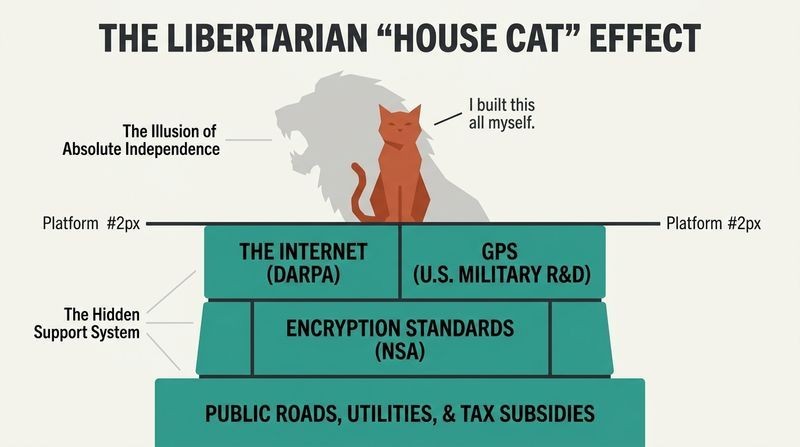
The roots run deep. Taplin traces a lineage from Italian futurism (which glorified speed, violence, and disruption before merging into Mussolini's fascism) through Albert Nock, Ayn Rand, and Murray Rothbard. Musk's own grandfather, Joshua Haldeman, led Technocracy Inc., a 1930s movement proposing that engineers, not elected officials, should rule society.
Rand is the through line. Her novels glorify the lone genius who defies the mob. Disturbingly, Rand modeled her ideal of heroic individualism partly on her fascination with an unrepentant 1920s child-murderer's contempt for society. Thiel has written that he no longer believes freedom and democracy are compatible and that women's suffrage damaged libertarian prospects. The pattern Taplin identifies: each generation insists technology freed from government can solve everything, and each drifts rightward toward authoritarianism.
The futurism-to-fascism arc is the book's most original historical move, and it carries real explanatory weight: Marinetti's 1909 manifesto reads uncannily like a move-fast-and-break-things mantra. The Rand-Hickman detail is accurate but rhetorically loaded, since Rand admired a fictionalized ideal of defiance rather than the murder itself. The broader claim, that libertarian rhetoric about freedom can curdle into coercion when the freedom-lovers gain state power, finds support across history, from Pinochet's Chicago Boys to Putin's oligarchs. Ideology rarely stays purely about liberty once power is within reach.
Data is the new oil, and tech runs the old extractive economy
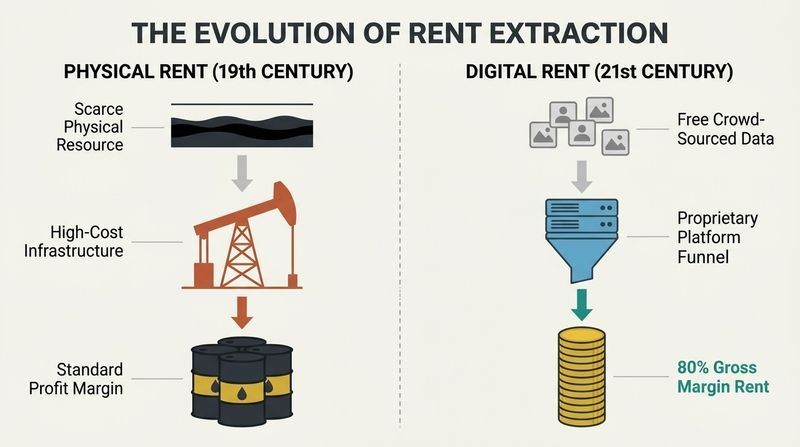
Not a revolution, an extraction racket. Taplin punctures the myth that the digital economy differs from the industrial one. Where Rockefeller extracted rents by monopolizing oil, Zuckerberg extracts rents by controlling the accounts of billions. In 1998 ExxonMobil was America's largest company; today Google, Facebook, and Amazon sit atop the index, accounting for nearly 14% of its value. Facebook's gross profit margin is a staggering 80%.
The genius is free content. Facebook makes nothing. Users supply the cat photos and political rants for free, the internet distributes them for free, and every hour spent reveals more exploitable data about desires and hatreds. Even Bitcoin mining consumes as much electricity as the Netherlands. The Technocrats wrap rent extraction in a narrative of openness, disruption, and enchantment that the robber barons never had.
The rent-extraction framing draws on a respectable economic tradition, from Keynes's call for the euthanasia of the rentier to recent work by Mariana Mazzucato on value extraction versus value creation. The 80% margin figure is genuinely revealing: such margins signal monopoly power, not competitive innovation. Where Taplin could push further is acknowledging that these firms did build genuinely useful infrastructure. The sharper critique is not that they extract value, but that network effects make their monopolies nearly impossible to dislodge, which centralizes both wealth and political influence in ways antitrust law has failed to address.
The internet centralizes power; it never decentralized anything
The great inversion. In 2003, futurists assumed networked technology would push the world toward decentralized, bottom-up power. Twenty years later the opposite happened. Google holds roughly 90% of search; Meta owns four of the five most-used social platforms. Tech analyst Ben Thompson's aggregation theory explains why: when services compete without geographic or marginal-cost constraints, dominance comes from controlling demand, and winners take nearly everything.
Content was never king. Taplin, a former film and music producer, watched Facebook flip the old media logic. Instead of spending to create content, it spent to acquire users. Once it had a billion, any newspaper became helpless, forced to surrender its work to reach the audience while Facebook kept the ad money. Crypto's promise of decentralization is, in his view, the same con relabeled: the venture capitalists own Web3.
This is one of Taplin's most durable insights, and it aligns with what economists call the platform paradox: tools that lower barriers for individuals simultaneously create unprecedented concentration at the platform layer. Jack Dorsey's admission that venture capitalists, not users, own Web3 is a damning insider concession. The nuance worth adding is that decentralization is not purely myth at the protocol level (email, the open web, Linux remain genuinely distributed). The lesson is that decentralized technology does not guarantee decentralized power; ownership and incentives determine who actually captures the value.
Fantasy entertainment trained us to abandon reality for spectacle
Culture leads politics. Taplin argues that decades of fantasy blockbusters primed America for collective unreality. Since Star Wars, the superhero and fantasy genre has dominated screens, displacing the oppositional, socially engaged culture of earlier eras. The Marvel formula offers transhuman heroes (Tony Stark was explicitly modeled on Musk) whose god-like powers have nothing to do with viewers' actual lives.
Re-enchantment with a dark side. Drawing on Max Weber's idea that science disenchanted the world, Taplin says fantasy culture re-enchants it, but on terms that glorify individual saviors over collective action. Meanwhile nihilistic prestige TV (The Sopranos onward) bred fatalism, the sense that only corrupt liars survive. Both genres, plus hip-hop's gangster mythology and the explosion of sports gambling, teach audiences that success is luck or corruption, never civic effort.
The Weber framing is intellectually rich, and the observation that the same actors who star in these films privately disdain them (Samuel L. Jackson, Martin Scorsese) adds texture. The causal claim, that fantasy media caused political unreality, is harder to prove than to assert, and risks the same moral-panic logic once aimed at comic books and rock music. Still, the cumulative argument is suggestive: when a culture's dominant stories feature either omnipotent saviors or inescapable corruption, the civic muscle for patient, collective problem-solving may atrophy from disuse.
The Metaverse is engineered to make ads inescapable, not life richer
Seven hours a day, by design. Zuckerberg's business plan, Taplin reports, projects users spending seven hours daily in the Metaverse, unable to look away from personalized billboards. Meta is even developing tech to read brain activity, so the system knows you want a jacket before you do. Andreessen frames this as serving the reality-deprived, claiming most people's real lives are too poor to bother improving.
The evidence says no thanks. VR causes headaches, nausea, and vergence-accommodation conflict; one study found 20 minutes harmed children's distance perception. Meta's own Horizon platform drew only about 200,000 monthly users against projections, with 9% of created worlds never visited by even 50 people. Internal memos show employees themselves do not use it. Meta employees openly worried the Metaverse could become an opium for the masses.
Taplin's strongest evidence here is internal: Meta's own vice president lamenting that staff do not love the product. The Huxley parallel (control through pleasure rather than pain) is apt and well-chosen. The Proteus Effect research he cites is real and unsettling: avatar appearance measurably changes offline behavior. Where the argument may overreach is treating adoption failure and dystopian inevitability as compatible claims; if nobody shows up, the opiate scenario dissolves. The honest synthesis is that the technology is both commercially struggling and, where it works, ethically fraught around addiction, surveillance, and harassment.
Crypto is a pyramid where whales dump tokens on the FOMO crowd
The con's mechanics. Taplin calls crypto libertarian magical thinking. Early holders, the whales (including Thiel, Musk, and Andreessen), accumulate tokens cheaply, then celebrity-fueled ad blitzes lure ordinary buyers in at the top. After the 2021 Super Bowl crypto-ad bonanza, Bitcoin fell from $60,000 toward $19,000, wiping out latecomers. The top 2% of accounts own 95% of Bitcoin.
It solves no real problem. Bitcoin processes about 7 transactions per second versus Visa's 2,000, consumes electricity equal to the Netherlands, and an appreciating currency would actually cripple a real economy through deflation. El Salvador adopted it as legal tender; within a year fewer than 5% of retail sales used it. The genuinely useful customers are criminals: ransomware, money laundering, sanctions evasion. FTX's Sam Bankman-Fried collapsed into fraud within a single week.
The multilevel-marketing analogy is the cleanest available description of crypto's wealth dynamics, and Taplin's targeting of predatory marketing to working-class and Black audiences (23% of Black Americans owned crypto versus 11% of white Americans) raises a real distributional-justice concern. The blanket dismissal underweights legitimate use cases (remittances, censorship-resistant transfers under authoritarian regimes), and conflating Bitcoin with outright frauds like Tether and FTX muddies categories. But the core macroeconomic point stands: a deflationary currency is a debtor's nightmare, which is precisely why no functioning economy has ever voluntarily chosen one.
A manned Mars colony is a $10 trillion ego trip robots could do cheaper
Buck Rogers economics. Musk pegs a Mars settlement at $10 trillion, nearly two years of the entire federal budget, most of it flowing through NASA to SpaceX at 30% margins. Taplin's reporting from Jet Propulsion Laboratory scientists is blunt: robots already do the science. Landing a rover needs about one metric ton; landing humans needs at least 100, plus return fuel and life support.
Mars wants you dead. The planet lost its magnetic field 4.2 billion years ago, so its surface gets 2.5 times the radiation of the Space Station. The atmosphere is 100 times thinner than Earth's and mostly CO2. The Biosphere 2 experiment proved humans cannot even maintain a sealed ecosystem on Earth: oxygen collapsed within a month. Musk's terraforming plan involves detonating nuclear bombs over the poles.
Taplin marshals genuine planetary science to deflate the romance, and the Goldsmith-Rees argument that automated explorers vastly outperform humans per dollar is the scientific mainstream view. The Biosphere 2 collapse is a powerful, concrete cautionary tale. The book is fairest when it separates Musk's real achievements (breaking Lockheed's launch monopoly, reusable rockets) from the colonization fantasy. A steelman Taplin underexplores: even pointless-seeming moonshots have produced spillover innovation. But his priorities critique lands hardest as a question of opportunity cost, since trillions aimed at Mars are trillions not spent on the planet we already inhabit.
Transhumanism would let the rich buy longer lives and smarter children
Death as a venture problem. Thiel, terrified of mortality since childhood, has funded parabiosis (transfusions of young blood), the Methuselah Foundation, and life-extension research, with the near-term goal of reaching 160. Saudi Arabia's Hevolution plans up to $1 billion a year on the same quest. Taplin warns these enhancements will never be cheap, so the unenhanced become a permanent underclass.
Frankenstein is the maker, not the monster. Taplin invokes Mary Shelley's tale: the real monster is the narcissistic scientist who never weighs consequences. CRISPR gene-editing already lets embryos be altered; a future menu of designer traits (IQ, eye color, disease risk) threatens the founding premise that all people are created equal. Francis Fukuyama called transhumanism the world's most dangerous idea precisely because it could dissolve the shared human essence underlying equal rights.
The equality argument is the most philosophically serious thread in the book. Fukuyama's worry, that political liberalism rests on a belief in a common human essence, is genuinely destabilized if wealth can purchase biological superiority. Sociologists already document how a college degree alone adds roughly $900,000 in lifetime earnings; heritable cognitive enhancement would compound such gaps across generations. The counterpoint worth noting is that many medical advances initially exclusive (insulin, IVF, antiretrovirals) eventually diffused broadly. The danger is not enhancement per se but enhancement under extreme inequality, where diffusion may never reach the bottom.
Killer robots let America wage invisible wars with no political cost
Software eats the Pentagon. Andreessen's Shield AI and Anduril build autonomous drones; Thiel's Palantir builds surveillance and targeting software. Taplin argues the Technocrats grasp what diplomat George Kennan warned in 1987: the military-industrial complex must keep inventing adversaries to survive. Their pitch combines a software-eats-the-world thesis with a scary-China narrative.
The human cost stays hidden. When wars are fought by drones piloted from trailers outside Las Vegas, citizens never see coffins and stop asking questions. Yet the New York Times found these strikes plagued by confirmation bias, mistaking rescuers and motorcyclists for fighters. Drone operators suffer a new form of PTSD: Captain Kevin Larson, who flew 650 missions, killed himself fleeing prosecution. In 2022, the US and Russia blocked a UN ban on autonomous weapons that 28 nations, including China, supported.
The invisibility thesis is sharp: democratic accountability depends partly on visible costs, and remote warfare severs that link. The confirmation-bias finding is crucial because it shows that automation does not eliminate human error, it launders and accelerates it. Larson's suicide humanizes an abstraction. Where the analysis could deepen is the genuine strategic dilemma: if adversaries build autonomous weapons regardless, unilateral restraint carries real risk, which is exactly why arms-control negotiations stall. The honest framing is not that these weapons are simply evil, but that they lower the threshold for war while concentrating life-and-death decisions in unaccountable code.
Refuse the four fantasies and rebuild a regenerative economy instead
Resistance is concrete. Taplin's prescription for families is plain: do not buy VR headsets, do not buy crypto or NFTs, do not fall for life-extension therapies, and do not let tax dollars fund a Mars colony. For government: repeal the Section 230 Safe Harbor shielding platforms from liability, force Meta to sell Instagram and WhatsApp, let gig workers unionize, and regulate crypto as securities.
A different economics. He champions regenerative economics, modeled on living systems that restore rather than deplete resources. Examples include the Mondragon cooperative (CEO-to-worker pay ratio of 5:1 versus the S&P 500's 324:1), Patagonia's clothing recycling, and 3D-printed houses costing $40,000 in under 24 hours, which could solve Los Angeles homelessness for a fraction of its current $600,000-per-unit spending. Innovation, his mentor taught him, happens at the edge, not the centralized core.
The personal-resistance list risks feeling quixotic, since individual consumer abstention rarely dents structural power, but it pairs with genuine policy teeth. The regenerative-economics vision draws on real precedents (Kate Raworth's doughnut economics, biomimicry, the B Corp movement) and the Mondragon pay ratio is a striking rebuttal to claims that extreme executive compensation is economically necessary. The 3D-printed housing math is the book's most actionable hope. The unresolved tension is political: the same concentrated power Taplin documents is precisely what makes his regulatory agenda so hard to enact, a bootstrap problem he names but cannot fully solve.
Analysis
Taplin writes as an insider turned apostate. Having produced records for Dylan and films for Scorsese, run a media M&A desk at Merrill Lynch, and launched an early streaming-video company, he brings rare standing to critique Silicon Valley from the inside of media, finance, and technology at once. That biography is the book's hidden strength: he is not a Luddite but a disappointed believer who watched the open web he once championed curdle into oligopoly.
The book's intellectual spine is the Gramscian interregnum: an old order dying, a new one unborn, morbid symptoms everywhere. Onto this Taplin maps a century of libertarian thought (futurism, Nock, Rand, Rothbard, Haldeman's Technocracy) to argue that today's four billionaires are not novel but the latest carriers of an anti-democratic strain that repeatedly drifts toward coercion once it touches power. This historical depth distinguishes the book from typical tech-critique journalism.
Its weaknesses are the flip side of its ambition. By bundling four very different men into a single conspiratorial-sounding category, Taplin sometimes flattens distinctions (Zuckerberg's opportunism differs sharply from Thiel's ideological project). His causal claims, especially that fantasy media and social platforms caused political unreality, rely heavily on suggestive timing rather than demonstrated mechanism, echoing earlier moral panics he would presumably dismiss. And his blanket dismissals of crypto and VR underweight legitimate niche uses.
Yet the core provocation is hard to dismiss and grows more relevant: when a society's wealthiest, most powerful actors invest fortunes in escaping reality (to Mars, into the Metaverse, beyond death) rather than repairing the world, that allocation of capital and genius is itself a moral and political choice with civilizational stakes. Taplin's pairing of this critique with regenerative economics and edge-innovation offers something most declinist books lack: a constructive alternative. The result is polemical, occasionally overreaching, but urgent and unusually well-grounded.
Review Summary
The End of Reality explores how four tech billionaires (Musk, Zuckerberg, Thiel, Andreessen) promote unrealistic projects like the metaverse, crypto, space travel, and transhumanism. Taplin argues these distract from real issues and perpetuate inequality. Reviews praise the book's insights but note some repetition and bias. Critics appreciate Taplin's insider perspective and cultural analysis, though some find his arguments overstated. The book is seen as timely and important, offering a critical look at tech moguls' influence on society and politics.
People Also Read






About the Author
Other books by Jonathan Taplin
Download PDF
Download EPUB
.epub digital book format is ideal for reading ebooks on phones, tablets, and e-readers.








































