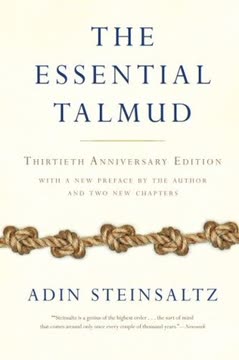
Key Takeaways
1. The Talmud: A Cornerstone of Jewish Thought and Practice
In many ways the Talmud is the most important book in Jewish culture, the backbone of creativity and of national life.
Central Pillar of Judaism. The Talmud, soaring from the foundations of the Bible, is the central pillar supporting the entire spiritual and intellectual edifice of Judaism. It has shaped Jewish life, influencing both theory and practice, and serving as a guide to conduct. The Jewish people have always been keenly aware that their continued survival and development depend on study of the Talmud.
A Unique Literary Work. The Talmud is a repository of thousands of years of Jewish wisdom, a conglomerate of law, legend, and philosophy, a blend of unique logic and shrewd pragmatism, of history and science, anecdotes and humor. It is a collection of paradoxes: its framework is orderly and logical, every word and term subjected to meticulous editing, completed centuries after the actual work of composition came to an end; yet it is still based on free association.
Study as an End in Itself. The Talmud is the embodiment of the great concept of mitzvat talmud Torah – the positive religious duty of studying Torah, of acquiring learning and wisdom, study which is its own end and reward. Study is not geared to the degree of importance or the practical potential of the problems discussed. Its main aim is learning itself.
2. The Talmud's Historical Tapestry: From Oral Tradition to Written Text
The formal definition of the Talmud is the summary of oral law that evolved after centuries of scholarly effort by sages who lived in Palestine and Babylonia until the beginning of the Middle Ages.
Origins in Oral Law. The Talmud's roots lie in the oral law (Torah shebe'al peh), which accompanied the written law (Torah shebikhtav) from ancient times. This oral tradition was essential for interpreting and applying the written law to changing circumstances. The oral law was transmitted from teacher to disciple over the centuries through oral instruction.
The Era of the Zugot and Tannaim. The era of the zugot (pairs) and the subsequent period of the tannaim saw the development of the oral law into a network of precisely formulated laws arranged by subject or mnemonic association. The scholars of the age were overmodest in adopting this title, since in fact this was an epoch of vital independent creativity in many spheres and of innovation of form and content.
Compilation of the Mishna and Talmud. Rabbi Yehuda Hanasi codified the oral law into the Mishna, a foundational text. Later, the Amoraim in Palestine and Babylonia expanded upon the Mishna, creating the Jerusalem and Babylonian Talmuds, respectively. The Babylonian Talmud, due to its comprehensive nature and thorough editing, became the more authoritative version.
3. Navigating the Talmud's Structure: Mishna, Gemara, and the Printed Page
The formal definition of the Talmud is the summary of oral law that evolved after centuries of scholarly effort by sages who lived in Palestine and Babylonia until the beginning of the Middle Ages.
Mishna and Gemara. The Talmud consists of two main components: the Mishna, a concise compilation of Jewish law, and the Gemara, a detailed commentary and analysis of the Mishna. The Gemara explores the reasoning behind the Mishna's rulings, often presenting multiple perspectives and debates.
Six Orders of the Mishna. The Mishna is organized into six orders (sedarim), each covering a different area of Jewish law:
- Zera'im (Seeds): Agricultural laws and blessings
- Mo'ed (Festivals): Laws of the Sabbath and festivals
- Nashim (Women): Laws of marriage, divorce, and family
- Nezikin (Damages): Civil and criminal law
- Kodashim (Holy Things): Laws of sacrifices and the Temple
- Tehorot (Purities): Laws of ritual purity and impurity
Layout of a Talmud Page. A standard page of Talmud features the Mishna and Gemara text in the center, surrounded by commentaries, primarily those of Rashi and Tosafot. This layout, established in the Bomberg edition, has been largely maintained in subsequent printings. The page also includes references to biblical verses, legal codes, and other relevant sources.
4. The Breadth of Talmudic Discourse: Law, Ethics, and the Human Condition
It is a conglomerate of law, legend, and philosophy, a blend of unique logic and shrewd pragmatism, of history and science, anecdotes and humor.
Beyond Legal Rulings. The Talmud is not merely a legal code; it encompasses a wide range of subjects, including ethics, history, science, and folklore. This reflects the Talmud's aim to provide guidance for all aspects of Jewish life.
Halakha and Aggada. The Talmud weaves together halakha (law) and aggada (narrative). Halakha provides practical guidance for Jewish observance, while aggada offers stories, parables, and ethical teachings that inspire and uplift.
A Mirror of Human Experience. The Talmud reflects the complexities of human life, addressing both abstract philosophical questions and practical everyday concerns. It explores the full spectrum of human emotions, from joy and sorrow to love and loss.
5. Life in the Talmudic Era: A Reflection in Halakha
Most of the issues with which the Talmud deals are abstract, and their significance and concern are not restricted to a particular period or way of life.
Agriculture and Economy. The Talmudic period was primarily agrarian, with most Jews engaged in farming. The Talmud reflects this reality, discussing agricultural laws and practices in detail. Jewish communities were largely concentrated in towns and villages entirely populated by Jews, the forms of Jewish local administration were still preserved.
Education and Study. Education was highly valued in Jewish society, with a system of schools and academies (yeshivot) providing instruction in Torah and Talmud. The Talmud describes a Jew who not know how to write as a תִּינוֹק שֶׁנִּשְׁבָּה בֵּין הַנָּכְרִים – “child taken into captivity by non-Jews.” Knowledge of the Bible was widespread and everyone was expected at least to know how to read it.
Synagogues and Batei Midrash. Synagogues served as centers for prayer, communal gatherings, and education. Batei Midrash (Torah academies) were dedicated to the study of Torah and Talmud, fostering intellectual debate and scholarship.
6. The Scholar's Path: Dedication, Discipline, and Community
During the period of the Mishna and the Talmud scholars represented a special social stratum, an elite empowered to make the most important decisions in every area of life.
Scholarly Elite. Scholars (talmidei hakhamim) held a position of high esteem in Jewish society, serving as leaders, judges, and teachers. This scholarly aristocracy was open to talented outsiders, although it occasionally expressed the desire for exclusivity.
Qualities of a Scholar. A true scholar was not only learned but also possessed high moral character, humility, and a commitment to serving the community. The Talmud emphasizes the importance of ethical conduct and righteous behavior.
Teacher-Student Relationship. The relationship between teacher and student was highly valued, with students often dedicating years to studying under a particular mentor. This close bond fostered intellectual growth and the transmission of knowledge.
7. Talmudic Exegesis: Unlocking Layers of Meaning
After the final redaction of the Talmud, the need arose for copies of the completed work for study purposes.
The Geonim and Early Commentaries. The Geonim, heads of the Babylonian academies, played a crucial role in interpreting and disseminating the Talmud. Their responsa (letters of response) provided guidance on practical halakha and theoretical questions.
Rashi and the Tosafot. Rashi's commentary on the Talmud is considered a foundational work, providing clear and concise explanations of the text. The Tosafot, written by Rashi's descendants and students, offer further analysis and debate on the Talmudic text.
Later Commentaries and Methods. Over the centuries, numerous commentaries have been written on the Talmud, each offering unique insights and perspectives. These commentaries reflect different approaches to Talmudic study, from the halakhic focus of the Sephardi tradition to the dialectical reasoning of the Ashkenazi tradition.
8. The Synagogue and Beit Midrash: Centers of Jewish Life and Learning
In the Second Temple period there were already synagogues both in Eretz Israel and outside it, wherever there was a Jewish community.
Synagogue as a Community Hub. The synagogue served not only as a place for communal prayer but also as a meeting-place where community needs were discussed. It also usually served as a school for children and occasionally for adults as well.
The Beit Midrash as a House of Study. The beit midrash served mainly as a fixed place for the study of Torah, in particular the study of Talmud. The beit midrash, sometimes called בית רבנן – “the house of the scholars” – was where scholars spent their time in study, either alone or, as was customary, in small groups.
The Role of the Scholar in the Community. The Torah scholars were generally also judges in their communities. They decided cases of civil law (דִּינֵי מָמוֹנוֹת), served as arbitrators in private suits, and were regarded as authorities in laws governing ritual matters (דִּינֵי אִיסוּר וְהֶיתֵּר).
9. The Role of Women: Tradition and Influence
Although talmudic law excludes women, in many ways, from several important spheres of life, they were active in many different spheres and made their presence felt not only through the activities they undertook as wives and mothers but also in what appeared to be exclusively male provinces.
Exemptions and Obligations. Talmudic law exempts women from certain positive commandments tied to specific times, such as wearing tefillin or reciting the Shema. However, women are obligated to observe negative commandments and are encouraged to engage in prayer and acts of kindness.
Women's Influence in the Home and Community. While women were excluded from formal leadership roles, they wielded considerable influence within the home and community. They played a vital role in educating children, managing households, and supporting their husbands' scholarly pursuits.
Learned Women and Female Scholars. Although formal Torah study was generally reserved for men, some women, particularly those from scholarly families, attained a high level of learning. Figures like Berurya, the wife of Rabbi Meir, were renowned for their wisdom and knowledge of Jewish law.
10. The Talmud's Enduring Relevance: A Guide for All Times
The Talmud Has Never Been Completed.
A Living Document. The Talmud is not a closed text but a living document that continues to be studied, interpreted, and applied to new situations. Its principles and methods of reasoning remain relevant for addressing contemporary challenges.
Ethical Guidance. The Talmud provides a framework for ethical decision-making, emphasizing the importance of justice, compassion, and integrity. Its teachings offer valuable insights for navigating complex moral dilemmas.
A Source of Inspiration. The Talmud's rich tapestry of stories, parables, and legal discussions continues to inspire and challenge readers. Its enduring wisdom offers guidance for living a meaningful and purposeful life.
Review Summary
The Essential Talmud is praised as a comprehensive introduction to the Talmud's history, structure, and content. Readers appreciate Steinsaltz's clear explanations and insights, though some find the organization lacking. The book is commended for its accessibility to both novices and scholars, providing valuable context and methodology. However, some reviewers note it assumes prior knowledge and lacks sufficient examples. Overall, it's considered a solid primer on the Talmud's significance in Jewish culture and law.
People Also Read

FAQ
1. What is The Essential Talmud by Adin Even-Israel Steinsaltz about?
- Comprehensive introduction: The book offers a thorough overview of the Talmud, explaining its history, structure, content, and methodology for readers of all backgrounds.
- Unique intellectual tradition: Steinsaltz presents the Talmud as a blend of law, legend, philosophy, and practical life, emphasizing its role as a living tradition central to Jewish culture.
- Three-part structure: The book is organized into historical background, the Talmud’s structure and subject matter, and the methods of study and thinking it employs.
- Contextualizes the Talmud: It situates the Talmud within the broader sweep of Jewish history, law, and spirituality, making its complexity accessible.
2. Why should I read The Essential Talmud by Adin Even-Israel Steinsaltz?
- Demystifies the Talmud: The book clarifies misconceptions and makes the Talmud’s intricate discussions accessible to those unfamiliar with traditional Jewish texts.
- Connects law and life: Steinsaltz shows how the Talmud shapes Jewish identity, community, and daily practice, not just legal rulings.
- Highlights enduring relevance: The book demonstrates the Talmud’s ongoing influence on Jewish thought, culture, and education, encouraging critical thinking and ethical sensitivity.
- Accessible for all readers: Whether a student, scholar, or curious reader, the book provides a clear entry point into the world of Talmudic study.
3. What are the key takeaways from The Essential Talmud by Adin Even-Israel Steinsaltz?
- Centrality of the Talmud: The Talmud is the backbone of Jewish intellectual, legal, and spiritual life, shaping Jewish culture for centuries.
- Living, unfinished tradition: The Talmud is not a closed book but an ongoing process of interpretation, debate, and innovation.
- Methodological uniqueness: Its study methods—questioning, debate, and dialectical reasoning—foster critical thinking and creativity.
- Integration of law and legend: The Talmud blends halakha (law) and aggada (narrative/ethics), reflecting the full spectrum of Jewish experience.
4. How does Adin Even-Israel Steinsaltz define the Talmud in The Essential Talmud?
- Central pillar of Judaism: The Talmud is described as the foundation supporting the entire spiritual and intellectual edifice of Jewish life.
- Oral law and commentary: It consists of the Mishna (legal code) and the Gemara (commentary and analysis), but encompasses much more than legal rulings.
- Blend of diverse elements: The Talmud includes law, legend, philosophy, history, science, anecdotes, and humor, reflecting a unique intellectual tradition.
- Repository of wisdom: It preserves thousands of years of Jewish thought, debate, and creativity.
5. What is the historical and cultural background of the Talmud according to The Essential Talmud?
- Origins in oral law: The Talmud evolved from the oral tradition that accompanied the written Torah, necessary for interpretation and application.
- Key historical periods: The book details the eras of the Zugot, Tannaim, and Amoraim, and the roles of sages in Palestine and Babylonia.
- Influence of empires: Roman and Persian rule, Jewish revolts, and cultural interactions with Greek and Babylonian societies shaped the Talmud’s development.
- Community structure: Jewish life was organized around institutions like the Sanhedrin, Rabbinical Courts, and leaders such as the nasi and exilarch.
6. How did the Mishna and the Talmud develop, as explained in The Essential Talmud?
- Need for organization: The vast oral law required classification and editing for effective transmission and study.
- Rabbi Yehuda Hanasi’s role: Around 200 C.E., he compiled the Mishna, arranging oral laws into six orders and numerous tractates.
- Babylonian Talmud’s redaction: The Gemara was developed in the academies of Babylonia and Palestine, with the Babylonian Talmud finalized by R. Ashi and Ravina.
- Living document: The Talmud was never officially completed, remaining open to ongoing interpretation and addition.
7. What is the structure and layout of the Talmud according to The Essential Talmud?
- Six orders of the Mishna: The Talmud is organized around Zera’im, Mo’ed, Nashim, Nezikin, Kodashim, and Teharot, each covering different aspects of Jewish law.
- Tractates and chapters: Each order contains tractates, which are divided into chapters and individual discussions (mishnayot).
- Page layout: The central text (Mishna and Gemara) is surrounded by commentaries (Rashi and Tosafot), with additional references and notes in the margins.
- Associative organization: Discussions often move associatively, linking diverse topics rather than following a strict linear order.
8. What subjects and areas of life does the Talmud cover, as described in The Essential Talmud?
- Comprehensive scope: The Talmud addresses law, ethics, philosophy, biology, psychology, legends, proverbs, and practical wisdom.
- Practical and theoretical: It covers both daily matters and abstract problems, treating all aspects of life as worthy of study.
- Limits on science: While including medical and scientific knowledge relevant to law, the Talmud avoids pure scientific speculation or classical philosophy.
- Integration of all life: The sages believed “everything is Torah,” so even mundane details are significant.
9. How does Adin Even-Israel Steinsaltz explain the methodology and way of thinking in the Talmud?
- Question and answer format: Inquiry is central, with the Talmud framed by questions, doubts, and exploration of all aspects of an issue.
- Dialectical reasoning: The Talmud uses models, concrete examples, and logical analysis (pilpul) to derive laws and reconcile contradictions.
- Active engagement: Study is a creative, participatory process, requiring students to question, analyze, and innovate.
- Pursuit of truth: The Talmud values the search for truth over practical outcomes, often exploring even unlikely scenarios to clarify principles.
10. What is the relationship between Halakha (law) and Aggada (narrative/ethics) in the Talmud, according to The Essential Talmud?
- Distinct but complementary: Halakha covers legal rulings and practical laws, while Aggada includes ethical teachings, legends, and theology.
- Educational and spiritual roles: Aggada inspires and instructs, often using stories and allegory to convey moral lessons alongside legal analysis.
- Scholarly balance: Most great scholars mastered both, and Aggada is regarded as an integral part of Torah study.
- Popular appeal: Aggada is more accessible and engaging for many, likened to wine complementing the meat of legal study.
11. How does The Essential Talmud by Adin Even-Israel Steinsaltz describe the status and role of women in Talmudic law?
- Exemptions and participation: Women are exempt from many time-bound commandments but actively participated in learning and halakhic discussions.
- Legal and social rights: The book details women’s rights in marriage, property, and civil law, highlighting their economic independence and influence.
- Ethical and spiritual recognition: Women are seen as having a distinct but respected religious role, with their spiritual contributions acknowledged by the sages.
- Examples of learned women: Figures like Berurya illustrate women’s involvement in scholarship and community life.
12. What is the significance of the Talmud’s unfinished nature and ongoing relevance, according to The Essential Talmud by Adin Even-Israel Steinsaltz?
- No official completion: The Talmud was never formally declared complete, remaining open to new insights and interpretations.
- Continuous challenge: Scholars are encouraged to add to its body of knowledge, with the tradition of “vedok” (continue to examine) underscoring ongoing study.
- Living tradition: The Talmud’s unfinished status is a source of vitality, making it a dynamic foundation for Jewish law and identity.
- Central to Jewish life: Its complexity and openness ensure that it remains relevant, shaping Jewish thought and practice across generations.
Download PDF
Download EPUB
.epub digital book format is ideal for reading ebooks on phones, tablets, and e-readers.








































