Key Takeaways
1. The Familial State: A Reimagined Foundation for Early Modern Governance
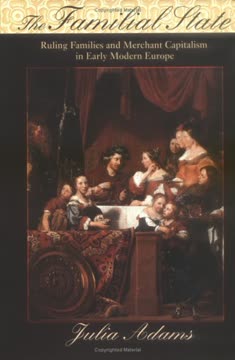
The familial state, far from being a mere precursor to modern bureaucracy, was a sophisticated and often highly effective mode of governance, particularly evident in the rise of the Dutch Republic.
Challenging traditional narratives. This book re-evaluates the conventional understanding of state formation, which often dismisses familial and patrimonial structures as primitive or inefficient. Instead, it posits that the "familial state"—where public authority and private interests were deeply intertwined through kinship and personal loyalty—was a distinct and powerful model, especially in the early modern period. This perspective shifts the focus from an inevitable march towards impersonal bureaucracy to an appreciation of diverse, historically contingent pathways to state power.
Netherlands as a case study. The Dutch Republic serves as the primary lens through which this theory is explored. Its remarkable ascent during the Golden Age, characterized by immense commercial success and political influence, is presented not despite its familial underpinnings, but often because of them. The book argues that the intricate web of family connections, personal allegiances, and inherited positions provided a stable, albeit personalized, framework for governance and economic enterprise.
Beyond anachronism. By framing the familial state as a legitimate and functional system, the book encourages a re-examination of historical assumptions. It suggests that applying modern notions of public-private separation to early modern polities can obscure the actual mechanisms through which power was exercised, resources were mobilized, and states were built. Understanding this model is crucial for grasping the unique dynamics of early modern European history.
2. Patrimonialism: The Personal Nexus of Power and Property
At the heart of the familial state lay the patrimonial nexus, where public office and state resources were often treated as extensions of personal property and family inheritance.
Defining patrimonialism. Patrimonialism describes a system where political power is derived from personal authority, and public offices or resources are regarded as the personal property of the ruler or officeholder, often passed down through family lines. This contrasts sharply with modern bureaucratic states where offices are impersonal and distinct from the individual holding them. In a patrimonial system, loyalty is personal, not institutional.
Impact on state structure. This intertwining of personal and public had profound implications for how states operated.
- Resource mobilization: Rulers could leverage personal wealth and family networks to fund wars or public projects.
- Administration: Governance was often carried out by family members or trusted retainers, blurring the lines between household and state.
- Legitimacy: Authority often stemmed from dynastic right or personal charisma, reinforced by familial ties.
Beyond corruption. While modern eyes might view patrimonialism as inherently corrupt, the book argues that in its historical context, it was a functional, albeit distinct, mode of governance. It provided a framework for stability, resource allocation, and the exercise of power in societies where formal institutions were nascent or weak. Understanding this foundational concept is key to appreciating the familial state's logic.
3. The Dutch Golden Age: Familial Networks as Engines of State Formation
The unparalleled commercial and political ascendancy of the Dutch Republic was not merely a triumph of republican ideals, but a testament to the strategic deployment of familial networks within a robust patrimonial framework.
Paradox of success. The Dutch Golden Age is often celebrated for its republicanism, mercantile prowess, and innovative financial institutions. However, the book reveals a deeper layer: the crucial role of familial connections in driving this success. Rather than being an obstacle, the intricate web of powerful families (regents) provided stability, facilitated capital accumulation, and ensured continuity in governance and trade.
Mechanisms of familial power:
- Political offices: Key positions in city councils, provincial estates, and the States General were often held by members of prominent regent families, creating a self-perpetuating elite.
- Economic ventures: Family ties underpinned major trading companies, banks, and investment syndicates, pooling capital and trust.
- Diplomacy and alliances: Marriages and kinship networks extended political influence and secured alliances both domestically and internationally.
Corporate conflict and cohesion. Despite internal conflicts among powerful corporate bodies (cities, guilds, trading companies), the underlying familial structures often provided a means to mediate disputes and maintain a degree of cohesion. The shared interests and intermarriages among regent families created a powerful, albeit informal, system of governance that effectively managed the complex dynamics of the burgeoning republic.
4. Chartered Companies: Blurring Public and Private in State Expansion
Chartered companies, such as the Dutch East India Company, epitomized the familial state's capacity to project power and wealth globally by seamlessly blending private entrepreneurial ambition with sovereign authority.
Hybrid entities. Seventeenth-century Europe saw the rise of powerful chartered companies like the Dutch East India Company (VOC) and the English East India Company. These were not purely private enterprises but hybrid entities granted extensive sovereign powers by the state, including the right to wage war, sign treaties, and administer territories. The book highlights how these companies were deeply embedded within the familial state model.
Familial ties in corporate power. The leadership and investment in these companies were often dominated by the same prominent families who held political power.
- Investment: Regent families provided significant capital, seeing these companies as extensions of their personal and collective wealth.
- Governance: Directors and key officials were frequently drawn from these same familial networks, ensuring alignment of interests between the company and the state.
- Loyalty: Personal loyalties within these networks were crucial for maintaining cohesion and trust in vast, complex global operations.
State-building through private means. These companies allowed states to expand their influence and extract resources globally without directly bearing the full financial and administrative burden. They were, in essence, instruments of the familial state, demonstrating how private capital and personal networks could be harnessed for national (or dynastic) power projection, blurring the lines between public and private interest in a highly effective manner.
5. Europe's Familial Tapestry: Diverse Manifestations of a Common Model
While the Dutch Republic offered a distinct variant, the familial state, with its inherent patrimonial problems and opportunities, was a pervasive feature across seventeenth-century Europe, shaping diverse political landscapes.
Beyond the Dutch example. The book expands its analysis beyond the Netherlands to demonstrate that the familial state was not an anomaly but a widespread phenomenon across Europe. While the specific forms varied—from monarchical patrimonialism in France to aristocratic networks in England—the underlying principles of intertwined public and private interests, driven by kinship and personal loyalty, were common.
Variations in patrimonialism:
- Monarchical states: In France, the king's household and personal domain often served as the core of the state, with offices and privileges granted as personal favors or sold.
- Aristocratic republics: In Venice or Genoa, powerful noble families dominated political and economic life, much like the Dutch regents.
- Emerging nation-states: Even as states centralized, familial connections remained crucial for building administrative capacity and securing loyalty in peripheral regions.
Common challenges and strengths. All these familial states grappled with similar issues:
- Succession and inheritance: Ensuring continuity of power within family lines.
- Factionalism: Managing rivalries between powerful families.
- Resource allocation: Balancing personal gain with collective state needs.
Yet, they also leveraged the strengths of these systems, such as deep trust networks, rapid decision-making, and the ability to mobilize private resources for public ends.
6. Dutch Decline: The Shifting Loyalties of a Patrimonial System
The decline of the Dutch Republic was not a simple failure of its familial structure, but a complex interplay between the evolving loyalties of its patriarchs and the perceived "betrayal" of a rising bourgeoisie whose interests diverged from the traditional patrimonial order.
Internal contradictions. The very strengths of the familial state in the Netherlands eventually contributed to its decline. As the Republic matured, the interests of the established regent families, who had long benefited from the patrimonial system, began to diverge from the broader economic needs of a rapidly changing society. This created internal tensions that weakened the state's ability to adapt.
The "betrayal" narrative. The book explores the idea that the "bourgeoisie"—the broader merchant and capitalist class—might have felt increasingly alienated or "betrayed" by a system that prioritized the entrenched interests of the regent families.
- Economic stagnation: Familial monopolies and conservative investment strategies might have stifled innovation and broader economic growth.
- Political exclusion: New wealth and talent found it difficult to penetrate the closed circles of power.
- Fiscal burden: The costs of maintaining the familial state, particularly in an era of increasing international competition, fell disproportionately on the broader populace.
Erosion of loyalty. The traditional loyalty of the "patriarchs" (the regent families) to the collective good of the Republic may have waned as their personal and familial interests became paramount. This shift, coupled with external pressures, ultimately undermined the cohesion and effectiveness of the Dutch familial state, paving the way for its relative decline in the 18th century.
7. Beyond the Netherlands: Contrasting State Evolution in France and England
The enigmatic eighteenth century witnessed France and England charting distinct paths away from, or through, their own familial and patrimonial legacies, offering a stark contrast to the Dutch experience and foreshadowing modern state forms.
Divergent trajectories. While the Netherlands grappled with the limitations of its familial state, France and England were undergoing their own transformations. The book contrasts these experiences, highlighting how different approaches to patrimonialism and familial influence shaped their respective paths to modernity. This comparative analysis underscores the varied ways states evolved in the early modern period.
France's absolutist patrimonialism. In France, the monarchy sought to centralize power, but often did so by incorporating, rather than eliminating, patrimonial elements.
- Venality of office: Offices were bought and sold, creating a class of officeholders with personal stakes in the system.
- Royal patronage: The king used personal favors and family connections to build loyalty and administer the realm.
- Resistance: Powerful noble families often resisted royal encroachment, leading to ongoing struggles over authority.
England's evolving balance. England, by contrast, saw a more gradual shift, with Parliament gaining power and a more institutionalized, albeit still aristocratic, state emerging.
- Parliamentary influence: The rise of Parliament provided a forum for broader (though still elite) representation, gradually limiting purely patrimonial rule.
- Fiscal-military state: England developed a more robust fiscal system, less reliant on the monarch's personal wealth, to fund its military.
- Elite integration: While familial networks remained important, they were increasingly integrated into a more formalized political and economic system.
These comparisons reveal that the transition from familial to more bureaucratic states was neither uniform nor inevitable, but a complex process shaped by unique historical, social, and political contexts.
8. Enduring Legacy: The Familial State's Echoes in Modern Governance
While seemingly relegated to history, the underlying dynamics of the familial state—the interplay of personal loyalty, private interest, and public authority—continue to resonate, albeit in transmuted forms, within contemporary governance and global capitalism.
Beyond historical artifact. The book's exploration of the familial state is not merely an academic exercise in historical reconstruction; it offers profound insights into the enduring nature of power. Even in ostensibly modern, bureaucratic states, elements of personal networks, informal influence, and the blurring of public and private interests persist, albeit often in more subtle or disguised forms.
Modern manifestations:
- Crony capitalism: The close relationship between business leaders and political figures, often based on personal ties, mirrors aspects of patrimonialism.
- Nepotism and patronage: While officially condemned, the practice of favoring family or friends in appointments remains a challenge in many systems.
- Informal networks: Powerful lobbies, think tanks, and social circles often exert influence through personal connections rather than formal channels.
Lessons for today. Understanding the familial state helps us critically analyze contemporary governance. It prompts questions about:
- The true nature of public service versus private gain.
- The role of trust and personal relationships in economic and political decision-making.
- The challenges of maintaining institutional integrity against the pull of personal and familial loyalties.
The book ultimately suggests that the "familial state" is not just a historical curiosity but a lens through which to better understand the complex, often messy, realities of power and governance across time.








































