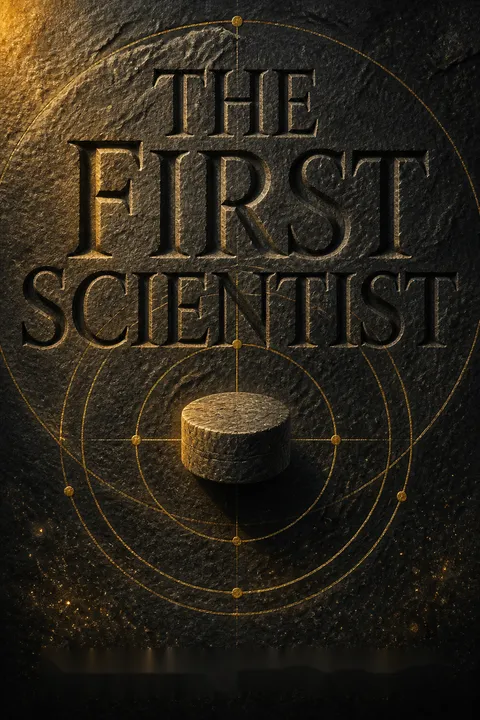

Key Takeaways
1. Anaximander's Radical Leap: Earth Floats in Open Space
In my opinion this idea of Anaximander’s [that the Earth is suspended in space] is one of the boldest, most revolutionary, and most portentous ideas in the whole history of human thinking.
A cosmological revolution. Anaximander, living twenty-six centuries ago in Miletus, made an intellectual leap that redefined humanity's understanding of the cosmos. While all other civilizations, from Egyptians to Mayans, believed the Earth was supported by something (more earth, turtles, or columns), Anaximander conceived of the Earth as a finite body floating freely in space, with the same sky beneath it as above. This wasn't just a refinement; it was a fundamental re-imagining of the universe's structure.
Beyond common sense. This idea was revolutionary because it contradicted direct human experience. Objects fall, so why wouldn't the Earth? Anaximander's genius was to flip the question: "Why should the Earth fall?" He argued that objects fall towards the Earth, not towards an absolute "down." Since the Earth itself is equally distant from all points in space, there's no preferred direction for it to fall. This insight introduced the relativity of "up" and "down," a conceptual shift akin to Galileo's understanding of relative motion or Einstein's relativity of simultaneity.
Inventing open space. Anaximander's model, though depicting a cylindrical Earth rather than a sphere, was the first to envision celestial bodies at varying distances within an open cosmos, not confined to a celestial vault. This move from a "closed box" universe to an "open space" was a monumental step, laying the groundwork for all subsequent astronomical and cosmological developments. It demonstrated that our perception of the world is limited and that reason, combined with observation, can reveal a reality far different from what appears obvious.
2. The Birth of Naturalism: Explaining the World Without Gods
At a certain point in humanity’s history, the idea came into being that it was possible to understand these phenomena—their interrelation, causes, and connections— without recourse to the caprices of gods.
From divine to natural causes. Before Anaximander, natural phenomena like rain, thunder, and earthquakes were universally attributed to the will and actions of gods (e.g., Zeus's lightning, Poseidon's earthquakes). Anaximander radically broke with this tradition by proposing purely naturalistic explanations. Rain, he suggested, comes from evaporated water, and thunder from colliding clouds. This wasn't just a different explanation; it was the birth of scientific inquiry, seeking causes within nature itself, independent of divine intervention.
Cosmological and biological naturalism. Anaximander extended this naturalistic approach to the origins of the world and life. His cosmogony described the world emerging from the separation of hot and cold, forming a fiery sphere around air and Earth, without any divine decree. Similarly, he posited that life originated in the sea, with species evolving and adapting to land as the Earth dried. These ideas, though rudimentary, foreshadowed modern cosmology and evolutionary biology, demonstrating a profound shift towards understanding the world through its own internal mechanisms.
Skepticism as a tool. Anaximander's naturalism stemmed from a healthy skepticism towards traditional, mythical explanations. This critical stance, exemplified by Hecataeus of Miletus who found Greek stories "ridiculous," allowed for the formulation of alternative, observable-based hypotheses. The water cycle, for instance, a concept taught in elementary schools today, was first articulated by Anaximander, connecting the disappearance of water from the ground with its reappearance as rain—a simple yet profound act of connecting observed phenomena.
3. Science as Continuous Critique: Building on and Correcting Masters
Anaximander was the first to pursue this third way. He was the first thinker able to conceive and put into practice what is now the fundamental methodological credo of modern scientists: make a thorough study of the masters, come to understand their intellectual achievements, and make these achievements their own. Then, on the basis of the knowledge so acquired, identify the errors in the masters’ thinking, correct them, and in so doing improve our understanding of the world.
The "third way" of knowledge. Unlike other ancient master-disciple relationships where reverence for the master's teachings was paramount (e.g., Mencius for Confucius, Pythagoreans for Pythagoras), Anaximander pioneered a new approach. He deeply engaged with his teacher Thales's ideas, embracing his problems and insights, but critically challenged his specific conclusions. Thales believed everything was water and the Earth floated on it; Anaximander disagreed, proposing the apeiron and a free-floating Earth.
Foundation of scientific progress. This method of respectful yet rigorous critique became the cornerstone of scientific advancement. It's the process by which:
- Copernicus built upon Ptolemy's astronomy but moved the Earth from the center.
- Einstein absorbed Galileo's and Newton's relativity and Maxwell's electromagnetism, then overturned the assumption of absolute simultaneity.
- Countless scientists today build on previous research, identifying limitations and proposing improvements.
Beyond blind adherence. This delicate balance—learning from the past while being ready to question any aspect of it—is what distinguishes scientific thinking. It fosters continuous improvement, preventing stagnation and dogma. The absence of such a critical tradition, as observed in Chinese civilization's long adherence to established knowledge, highlights its crucial role in fostering radical conceptual shifts and accelerating the growth of understanding.
4. Invisible Entities and Natural Laws: The Apeiron's Legacy
The fundamental insight here is that in order to explain the world’s complexity, it is useful to postulate or imagine the existence of something that is not part of the world of our direct experience but that can function as a unifying natural element to explain all things.
Postulating the unobservable. Anaximander's concept of the apeiron—an "indefinite" or "undifferentiated" primal substance from which all things originate—marked a crucial development. Unlike Thales's water, the apeiron was not a substance of everyday experience. This act of postulating an unobservable, yet natural, entity to explain observable phenomena is a hallmark of theoretical science.
A lineage of theoretical entities. The apeiron is the conceptual ancestor of many fundamental scientific concepts:
- Atoms: Democritus's and Dalton's unperceivable particles explaining matter.
- Fields: Faraday's and Maxwell's invisible electric and magnetic fields explaining forces and light.
- Curved spacetime: Einstein's geometric entity explaining gravity.
- Quarks and wave functions: Modern physics' fundamental, unobservable components of reality.
These entities are not directly seen but are indispensable for coherently accounting for the world's complexity.
The idea of natural law. Anaximander's surviving fragment speaks of things originating and vanishing "according to necessity" and "in conformity with the order of Time." This expresses the profound idea that the universe operates not by caprice, but by inherent, predictable laws. While Anaximander didn't specify these laws mathematically, his insight paved the way for Pythagoras's belief in mathematical laws, Plato's call to mathematize the world, and ultimately, the quantitative physics of Galileo and Newton, which describe how physical variables change "according to necessity" over time.
5. The Cradle of Science: Miletus's Unique Environment
Miletus, in short, was the heart of a first, flourishing humanism.
A unique cultural melting pot. Miletus, a prosperous Ionian city in the 6th century BCE, was a vibrant hub of trade and cultural exchange. Its strategic location at the crossroads of Greek, Egyptian, and Mesopotamian civilizations fostered an environment ripe for intellectual innovation. Unlike the centralized, monarchical, and priestly-dominated societies of the East, Miletus was a city of free citizens, exposed to diverse ideas and unburdened by rigid traditions.
The power of the phonetic alphabet. A critical factor was the Greek adaptation of the Phoenician alphabet. By using "leftover" Phoenician letters for vowels, the Greeks created the first complete phonetic alphabet, making reading and writing accessible to a broad segment of the population, not just professional scribes. This widespread literacy democratized knowledge, moving it from secret, guarded texts to publicly accessible prose, enabling broader discussion and critique.
Democracy and critical thinking. The political structure of the Greek polis, with its emphasis on free discussion, citizen participation, and the questioning of authority, mirrored the emerging scientific method. Just as citizens debated and criticized magistrates' ideas to find better solutions for communal life, Anaximander criticized Thales's ideas to advance understanding of the natural world. This shared foundation—the "discovery of the usefulness of criticism and dialogue among equals"—was crucial for the birth of both democracy and science, fostering an environment where challenging established views was a virtue, not a transgression.
6. Science as Evolving Worldview: Embracing Uncertainty, Not Certainty
The reliability of science is based not on certainty but on a radical lack of certainty.
Beyond definitive truths. The 20th century shattered the illusion that scientific theories are definitive. Newton's laws, once thought to be the ultimate truth, were shown to be approximations within specific domains, superseded by Einstein's relativity and quantum mechanics. This demonstrated that science is not about discovering immutable, final laws, but about continuously refining and replacing our understanding of the world with better, more effective models.
A continuous quest for understanding. Science is fundamentally an ongoing process of:
- Questioning assumptions: Challenging what seems obvious or universally accepted.
- Building new conceptual tools: Developing novel frameworks to interpret reality.
- Rethinking the world: Constantly revising our image of the cosmos and ourselves.
This visionary and rebellious spirit, rather than a pursuit of absolute certainty, is the engine of scientific progress. It's about exploring the "limitless, virtually infinite domain of the thinkable."
Reliability through provisionality. The strength of science lies precisely in its provisional nature. Scientific answers are not definitive, but they are the best available at any given moment, having withstood rigorous empirical testing and critical scrutiny. This readiness to abandon flawed ideas and adopt superior ones is what makes science trustworthy. It's a continuous learning process, much like navigating a new city, where one's map constantly improves with new experience, even if a perfect map remains elusive.
7. The Enduring Conflict: Understanding Reality With or Without Gods
The question raised by Anaximander remains relevant, even burning, today. It divides our civilization. Is it possible to understand reality, the world’s complexity, and our own lives, without attributing them to the caprices of gods, or the will of one God?
An implicit challenge. Anaximander's naturalistic project, by explaining the world solely through natural phenomena, implicitly challenged the cognitive function of religion. He demonstrated that the world could be understood without recourse to divine will, launching a conflict between naturalistic and mythical-religious thought that has persisted for millennia. This wasn't an explicit critique of religion, but a radical stance of ignoring the gods in the quest for knowledge.
A history of clashes. This conflict intensified with the rise of monotheism, which often asserted itself as the sole source of ultimate truth. The violent suppression of pagan thought and the destruction of centers of learning like the Library of Alexandria by early Christians exemplify this clash. While the Enlightenment sought a compromise, separating spheres of competence for science and religion, the fundamental tension remains: science demands questioning all truths, while many religious traditions rely on unquestionable dogma.
The ongoing debate. Today, the world remains divided on Anaximander's question. Many still believe that a true understanding of reality, morality, and purpose requires God or gods. Others argue that a world understood without divine intervention is more comprehensible and that relying on divine will for societal decisions is a dangerous relic. The choice between hiding in "empty truths" or embracing the "radical uncertainty of our knowledge" continues to shape our civilization, highlighting Anaximander's enduring legacy as a pioneer of intellectual freedom.
Review Summary
Reviews for The First Scientist are largely positive, averaging 4.06/5. Many readers praise Rovelli's passionate, accessible prose and his compelling argument that Anaximander pioneered scientific thinking by questioning established knowledge without divine explanation. Admirers highlight his broader meditation on science versus religion and embrace of uncertainty. Critics, however, note that Rovelli, lacking formal historical training, overstates his claims about Anaximander, relies on fragmentary evidence, and occasionally ventures beyond his expertise into intellectual history and cultural analysis with insufficient rigor.
People Also Read




About the Author



Download PDF
Download EPUB
.epub digital book format is ideal for reading ebooks on phones, tablets, and e-readers.








































