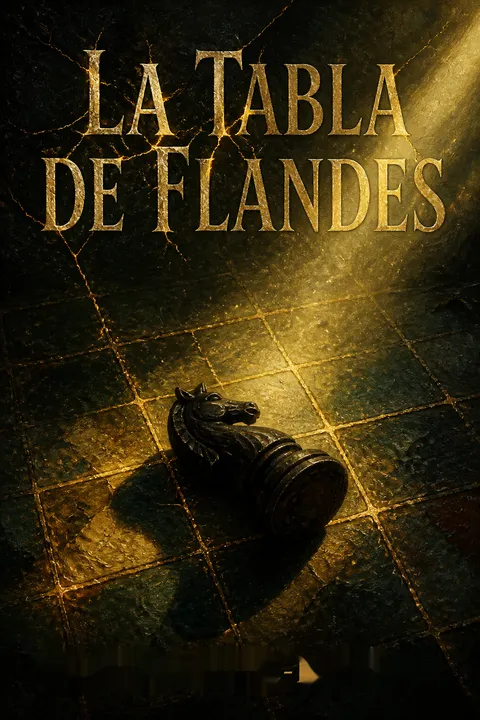

Resumen de la trama
Painting's Ancient Question
Julia, a young art restorer, discovers a cryptic Latin inscription—"Quis Necavit Equitem?" or "Who killed the knight?"—hidden beneath centuries of varnish in a 15th-century Flemish painting depicting a game of chess. The question is both literal and metaphorical, reverberating between the image, the artist Pieter Van Huys, and present-day viewers. Julia senses an enigma crafted into the very composition of the painting, inviting not only technical investigation but a personal journey to unravel a secret spanning five centuries. As she studies the painting's details, Julia becomes aware that unlocking its meaning may have profound consequences for her own life, fate, and those drawn into its circle.
Restorers and Hidden Puzzles
Intrigued and unsettled by the question, Julia consults colleagues in the art world, including her flamboyant mentor Cesar and the hard-edged gallery owner Menchu. Their lively interactions, mingling cynicism and adoration for beauty, reveal the social labyrinth of the art world: commerce, lust, envy, and ambition all swirl beneath the painting's surface. When expert advice is needed, Julia approaches her former lover, Alvaro, bringing complicated emotion into play. Together, they begin researching the painting's origins and attempting to decode the relevance of its figures—two noblemen playing chess and a watchful lady—each tethered to a labyrinth of court intrigue and passion.
The Meaning of the Inscription
Julia and Alvaro reconstruct the identities of the players: Ferdinand, Duke of Ostenburg; his consort Beatrice of Burgundy; and Roger de Arras, the knight—who was murdered in 1469, years before the painting was made. This anachronism raises deeper questions; the inscription appears to implicate someone in a political crime of passion stretching back centuries. The painting's dazzling technical mastery now frames not just a game but a riddle with lethal stakes for those depicted, and perhaps, for whomever dares to solve it now.
Chess, Love, and Betrayal
The intimate connections between those in the painting echo in the tangled relationships of the present. Julia's interactions with Cesar, Menchu, and Alvaro reveal stories of loyalty, unspoken love, and heartbreak—motives that seem to mirror the fatal tension at the heart of the painting's story. Alvaro's research uncovers suspicions: the knight was possibly killed over forbidden love with Beatrice, yet evidence remains elusive. The invisible thread from past to present begins to tighten as an atmosphere of danger seeps into Julia's world.
Gathering Allies and Rivals
As Julia pursues her research, Cesar's compassion and wisdom serve as ballast against the chaos of men like Alfonso, Menchu's shady former lover and a suspect in the painting's provenance. Meanwhile, art market intrigue grows as the painting is scheduled for auction, and greedy interests circle, sensing its growing value. Conversations between Julia, Cesar, Menchu, and the painting's owners turn contentious, revealing alliances and betrayals not only among the dead but among the living. The parallels between the art world's power games and the painting's symbolic references to chess become more evident.
Motives across the Centuries
Julia's research deepens, tracing not only the painting's documented history but hypothetical connections: the slain knight, the vengeful Duke, and Beatrice's enigmatic role. She comes to see the painting as an intentional cryptogram—a puzzle created by Van Huys to immortalize an unsolved murder. Julia's nights become haunted by dreams and historical reconstructions, blurring boundaries between observer and participant, and she senses that her search has drawn her dangerously close to the motivations that caused bloodshed centuries ago.
The Chessboard Investigation
With Cesar's insight, Julia focuses on the literal game of chess painted into the scene. They hypothesize that the inscription's "knight" refers not only to Roger de Arras but to a crucial move within the painted game. Yet neither Cesar nor Julia has the technical capacity to fully reconstruct the chess problem. The quest now requires a new kind of player—someone who navigates the intricacies of chess logic with the same rigor that Julia brings to art.
The Third Player Joins
Munoz, a withdrawn but brilliant chess player, is recruited to "play" the painted game backwards—employing retrograde analysis to reconstruct moves from a frozen position. His methodical, clinical approach provides a new lens: now the painting is no longer just art or evidence—it is a chessboard in which every piece and move may be a coded confession. As Munoz becomes obsessed, he and Julia grow close, their partnership laden with unease; there are hints that the invisible adversary might be alive and watching.
Modern Murder and Medieval Mystery
The story veers violently into the present. Alvaro is found dead in suspicious circumstances—a fall in the bath, or possible murder—days after his involvement with the painting. Inspector Feijoo launches a police investigation, swiftly implicating Julia and those around her. The boundaries between chess, art, and real danger blur as Julia endures threats—a mysterious phone caller, surveillance by a blue car, and repeated warnings that hint someone wishes her dead, as if the centuries-old violence of the painting is bleeding into her reality.
Pursued Across Madrid
Now hunted and increasingly paranoid, Julia investigates those in her circle: owners of the painting, their scheming relatives, Cesar's old rivalries, and Menchu's unstable web of lovers and exes. Further peril emerges: attempts on Julia's life, staged to look like accidents, and a network of betrayals. The threat takes the form of both ominous chess moves—mailed to her like taunts—and calculated attacks on her safety. Trust among friends fractures as suspicion infects every relationship.
Games of Seduction and Greed
As Julia and her allies contend with the rising body count and missing clues, seduction and ambition drive their adversaries. Montegrifo, the art world's smooth auctioneer, and Alfonso, the unscrupulous gambler, seek to manipulate Julia for profit and pleasure. Simultaneously, the symbolic chess game in the picture becomes a real competition for survival: the moves recited in threats correspond chillingly to real deaths in Julia's world. Each step brings her closer to an endgame she cannot yet foresee.
Solving the Painted Chess Problem
Through painstaking collaboration, Munoz reconstructs the moves from the painting, matching each capture to events in the narrative. It is discovered that each victim in the present corresponds to a captured "piece" in the painted game: first the knight, then the rook, soon the bishop. Julia realizes with mounting horror that the murderer is playing a live game, using art as blueprint, and real people as disposable pieces. Above all, the key question—who killed the knight?—begins to yield an answer, both in the painting and in Madrid.
The Threat Materializes
A string of deaths and threats culminates in the murder of Menchu—Julia's friend and business partner—and the theft of the painting. All clues point to Lola, Menchu's bitter rival and a woman revealed to be an adept chess player herself. Munoz and Julia narrow in on the possible suspects, but their certainty about Lola is punctured by the realization that the true "invisible player" may be closer than anyone imagines. The line between predator and victim grows fatally ambiguous.
The Final Gambit
The chess game, now nearly complete, becomes more than a metaphor—it's a roadmap for murder and confession. Each final move corresponds to tangible loss and trauma for the people tangled in the mystery. The killer's identity, like the solution to the chess problem, eludes Julia and Munoz until a final, fateful encounter: a voice on the phone, a clue hidden in a reference to Brueghel, and the realization that the killer is staging a conclusion as artistic as it is fatal.
Endgame Revelations
Julia and Munoz, armed with the last clues—a photograph, a chess magazine, and their shared logic—pay a nighttime visit to Cesar, her beloved mentor and surrogate father. In a drama as formal and cruel as a chess endgame, they force Cesar to lay out his role as both orchestrator and culprit: the murderer stalking their circle, the architect of Menchu's and Alvaro's deaths, the thief of the painting, and the mastermind behind the living chess problem. Cesar's confession is chilling—his motives part aesthetics, part personal vendetta, part a desperate bid for redemption and meaning before his imminent death.
Judgment in the Drawing-Room
The tone of the story shifts to a somber, intimate confrontation. Under Munoz's incisive questioning, Cesar reveals the psychological fissures exploited in his plot: humiliation, longing, loneliness, the split between light and darkness, and an almost supernatural identification with both art and crime. Chess is unmasked as not just a game but the language in which Cesar has encoded love, vengeance, and his own death wish. The three weigh the costs—lives lost, innocence forfeited, the beauty of art tarnished by murder.
Checkmate's Price
Cesar bestows upon Julia and Munoz the painting's legacy (a Swiss bank, clandestine profits, complex arrangements with bent auctioneers) and a confession that offers legal absolution at the price of unbearable knowledge. He assures Julia that none of his traps were meant for her, only for those he deemed necessary to "free" her—by ridding her of stifling relationships—through violence. The horror and sadness of his self-destruction, his impending terminal illness, and his self-chosen end leaves Julia stunned: checkmate comes, but at a cost the survivors will bear long after the game is over.
Elegy for the Fallen
The story closes in quiet devastation. Julia, inheriting the burdens and dubious treasures left by Cesar, walks into the Spanish night with Munoz. Her world, upended by love, betrayal, death, and resurrection, is uncertain and gray—neither evil nor good, but riven with pain and an ambiguous kind of wisdom. Elsewhere, across centuries, the cycle of guilt and memory plays on: Beatrice of Burgundy, now a nun, still haunted by love and betrayal; the memory of Roger de Arras echoing in eternity. The game has ended, and yet, in art, in memory, and in the haunting patterns of human longing, the pieces remain set for the next player.
Analysis
A modern reader finds The Flanders Panel as much a meditation on art, knowledge, and mortality as a murder mystery. Perez-Reverte sets up nested enigmas—historical, aesthetic, and psychological—that force the reader to grapple with the instability of meaning. The painting's central question—Who killed the knight?—mutates through the story from a point of historical curiosity to a catalyst for actual contemporary violence, suggesting that the drive to know and the drive to possess (beauty, love, truth) are intimately tied to destruction. Chess, both as symbol and structure, embodies the novel's philosophy: every move is calculated, yet passion, chance, and the rules of the game are inescapable; the players are both prisoners and gods. The ultimate checkmate arrives through betrayal by the most trusted, implicating intimacy and love in the origins of evil. Julia survives, but her wisdom is hard-won—a recognition that the world is gray, that knowledge is partial, and that loss and yearning are the eternal price of seeking answers to questions that will never fully yield. The novel leaves us with a paradox: the more deeply we look, the less certain we become, but the search itself confers purpose—however fleeting—on an existence bounded by death and mystery.
Resumen de reseñas
Reviews for The Flanders Panel are mixed, averaging 3.79/5. Admirers praise its clever integration of chess, art history, and murder mystery across two timelines—medieval Flanders and modern Madrid. Many found the puzzle-driven plot compelling and original, drawing comparisons to The Name of the Rose and Gödel, Escher, Bach. Critics, however, cite flat characterization, overwrought descriptions, contrived plotting, and an unsatisfying villain motivation. Chess knowledge enhances enjoyment, though non-players can still engage. The medieval subplot and retrograde chess analysis receive particular praise, while the modern thriller elements divide readers.
Characters
Julia
Julia is a meticulous, emotionally complex art restorer drawn into the mystery by a combination of professional curiosity, intellectual rigor, and a deep longing for connection and meaning. Her sensitivity both fuels her pursuit and renders her vulnerable—she's propelled not only by the technical challenges of her work but by unresolved loss (her father, her beloved mentor Cesar, past romances with Alvaro). Julia's journey is as much psychological as detective: she must confront her own desires and uncertainties as she faces the darkness triggered by the painting. Her relationships, especially with Cesar, reveal layers of dependence, admiration, and, ultimately, disillusionment.
Cesar Ortiz de Pozas
Cesar is Julia's closest confidant: a dandyish, cultured antique dealer with a history as colorful as his silk cravats. For years a stable presence, he is both guardian and tempter—a source of emotional wisdom, aesthetic guidance, and sometimes perilous advice. Beneath genial affection hides a tormented, divided spirit: Cesar's ultimate revelation as the "invisible player" and orchestrator of murders is inseparable from his suppressed desires, his sense of humiliation and defeat, and his yearning for beauty amid moral ambiguity. His monstrous acts are ultimately humanized by his vulnerability, self-awareness, and impending death.
Munoz
Munoz is the story's outsider: a humble office worker whose excellence at chess is matched only by his social awkwardness and existential detachment. He approaches problems with mathematical precision, displaying insight and rigor where others are distracted by emotion or self-interest. As the painter's "third player," he provides Julia with clarity and protection but is himself nearly destroyed by the encounter with a superior, self-destructive opponent. On a deeper level, Munoz embodies the idea that genius often resides on society's margins, and that logic, though powerful, cannot suppress the sorrows or paradoxes of the heart.
Menchu Roch
Menchu is a gallery owner, past her youthful prime but still vibrant, sexual, and calculating. She pursues opportunity—be it in art, commerce, or pleasure—always with an eye for advantage. Her crudeness and bravado conceal deep insecurities, especially about age and relevance. Menchu's hunger for money and recognition entwines her fate with Julia's, but she's ultimately outplayed both by her own appetites and by the lethal games others are playing. Her murder, staged as a chess move, is both a plot device and a cruel commentary on ambition, friendship, and female rivalry.
Alvaro Ortega
Alvaro is both Julia's former lover and a respected academic. His role in the story is that of catalyst and victim: he offers the research that initiates the quest, but his subtle evasions and compromised loyalties make him unreliable. Alvaro represents the persistence of the past—personal as well as historical—and his murder, perhaps more than any other, exposes how the logic of gamesmanship can destroy innocence. In psychoanalytic terms, Alvaro embodies lost or redirected desire, the cost of unresolved guilt.
Beatrice of Burgundy
Beatrice exists both as a painted image and a tragic historical figure whose beauty, melancholy, and (presumed) guilt drive the painting's encoded message. She is the black queen: both object and author of betrayal, her gaze evoking centuries of longing and regret. The interpretation that she engineered Roger de Arras's murder turns her into both victim and agent—a figure trapped in mourning, exile, and silence, whose fate mirrors Julia's existential predicament.
Roger de Arras
Roger is the knight both literally slain in 1469 and symbolically murdered in the solution of the chess problem. Rendered noble yet doomed, he is defined by unattainable love for Beatrice and fatal involvement in dangerous political games. In psychoanalytic terms, Roger is the archetype of masculine vulnerability—glorious, desired, but expendable in the machinations of others. His presence as a painted figure haunts the living with memory of what might have been.
Ferdinand Altenhoffen, Duke of Ostenburg
Ferdinand is the other main player in the painting's chess game: friend to Roger, husband to Beatrice, and would-be defender of Ostenburg. Though initially suspected of orchestrating Roger's murder, he is ultimately revealed as a passive, impotent figure, psychologically trapped between love, duty, and political weakness. In the narrative, Ferdinand's inability to take decisive action resonates with the paralysis experienced by the modern protagonists.
Paco Montegrifo
Montegrifo is the personification of 20th-century sophistication and amorality: an auction house director who courts Julia professionally and personally while playing all sides to his own advantage. Neither villain nor hero, he is a survivor who manipulates legal and financial risk as deftly as others move chess pieces. In the end, he is a beneficiary of Cesar's last arrangement, underscoring how power in any game often belongs to those least encumbered by conscience.
Lola Belmonte
Lola is niece and caregiver to Belmonte, owner of the painting. She is depicted as embittered, caustic, and repressed: a woman who excels at chess and enjoys power over her weak-willed husband. Though heavily suspected, she ultimately serves primarily as a red herring, a representation of the frustrations and rage that underlie the story's themes of aggression, inheritance, and desire.
Plot Devices
The Embedded Chess Problem
Central to the narrative is the painted chessboard whose mysterious arrangement, when solved by retrograde analysis, both implicates and exculpates characters past and present. Each captured piece in the game corresponds to a murder in the story, creating a deadly parallel between artistic enigma and real-world violence. The problem functions as metaphor, map, and riddle, creating suspense and guiding readers toward truth via logic that is emotionally and morally ambiguous.
Multi-Layered Narrative Structure
The plot weaves together three timelines: the 15th-century murder, the creation of the painting, and the modern investigation. Letters, documents, flashbacks, and analytic digressions blur boundaries between observer and participant, past and present, reality and simulation. Mirrors, literal and figurative, and nested levels of representation reinforce the novel's themes of recursion, ambiguity, and the cyclical nature of guilt and knowledge.
Foreshadowing and Red Herrings
The investigation is structured around clues—both symbolic (hidden inscriptions, mirrored images) and procedural (odd behaviors, suggestive pasts). As in a classic whodunit, a succession of suspects is introduced and eliminated by successive revelations, misdirection, and new evidence, producing suspense and tension that undermines certainty and invites rereadings.
Psychoanalytic Symbolism
Beyond the surface plot, the story relies on Freudian and Lacanian tropes: the roles of father/mother figures, unconsummated incest (Julia and Cesar), sublimated aggression, displaced guilt, and the intertwining of sexuality, death drive, and creativity. Chess becomes the ritualized dramatization of Oedipal conflict, with pieces as symbols and players as avatars of the self and its shadows.
Meta-Narrative and Self-Reflection
The novel continually draws attention to its own construction: as a riddle, a work of art, and a commentary on the impossibility of knowing truth, resolving contradiction, or escaping the cycle of repetition. The characters' discussions about mirrors, representations, and the limits of demonstration echo the book's structure and implicate the reader in the endless search for meaning. The death of the artist, the ambiguity of endings, and the dissolution of boundaries between fiction and reality are constants throughout.
Sobre el autor
Otros libros de Arturo Pérez-Reverte
Descargar PDF
Descargar EPUB
.epub digital book format is ideal for reading ebooks on phones, tablets, and e-readers.








































