

Key Takeaways
A 6,000-year conspiracy by giants and fallen angels aims to enslave humanity
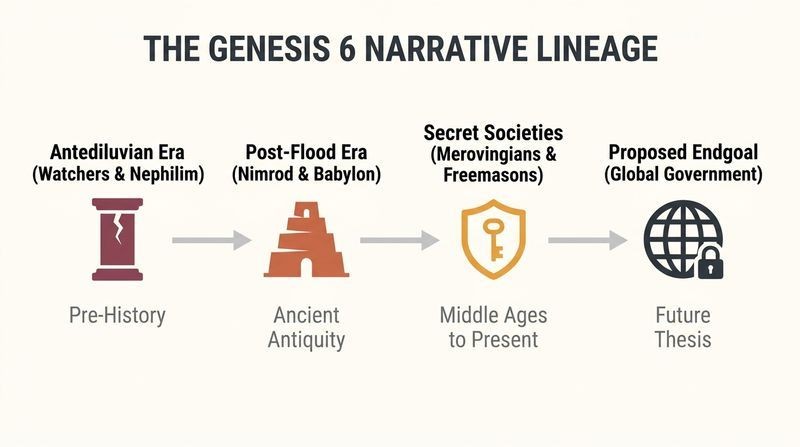
The book's title claim, the Genesis 6 Conspiracy, reads a single cryptic passage as the master key to history. Genesis 6 says the sons of God took daughters of men and produced Nephilim, the heroes of old. Gary Wayne argues these were not metaphor. Fallen angels (Watchers) bred with women to create Nephilim, a race of hybrid giants who seized kingship, imposed a counterfeit religion, and provoked the flood.
Their bloodlines and their secret knowledge, he claims, survived. From Cain to Nimrod to the Merovingians to modern Freemasonry, a hidden hand has schemed across millennia toward one goal: a world government hostile to God, headed eventually by the Antichrist. Everything else in the book, from Atlantis to aliens, hangs on this founding premise.
What's striking is the method: one obscure verse becomes a Rosetta Stone unlocking all of prehistory. This is a hermeneutic of maximal connection, where nothing is coincidental. Scholars call the underlying logic euhemerism, treating myths as distorted memories of real events. The approach generates enormous explanatory reach but sacrifices falsifiability, since any parallel becomes confirmation. Mainstream biblical scholarship reads the Nephilim passage as a fragment addressing why the flood came, not a conspiracy blueprint. The book's power lies less in evidence than in pattern recognition, the same cognitive pull that makes constellations out of scattered stars and villains out of complexity.
The 'sons of God' were angels, not righteous Sethite men
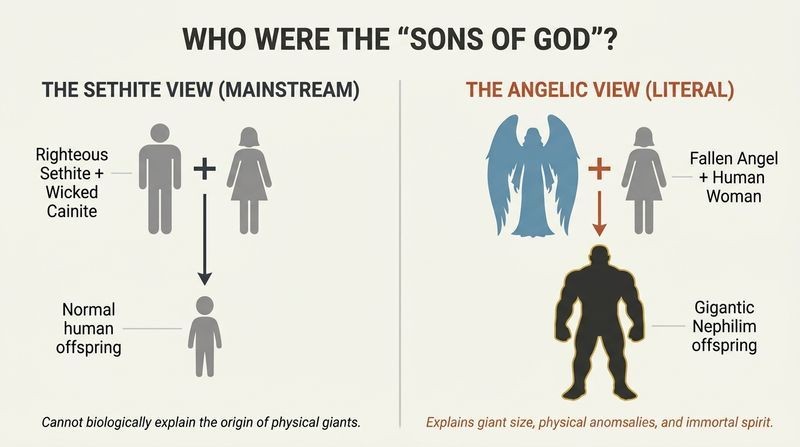
Mainstream Christianity often defends a tamer reading: the sons of God were descendants of righteous Seth, the daughters of men were wicked Cainites, and their intermarriage bred corruption. Wayne rejects this as evasion. He marshals cross-references to argue the phrase means angels. In Job, the sons of God present themselves before the Lord and shout at creation, clearly celestial beings. Deuteronomy 32 offers an alternate reading where nations were assigned to the sons of God.
He leans on Josephus, the book of Enoch, and Jude, which links the sinning angels to Sodom's sexual sin. Human parents, he insists, could not biologically produce a distinct race of giants. Only angelic DNA could account for the Nephilim's size, strength, and inherited immortal spirit.
The interpretive fork here is genuinely ancient. The angelic reading dominated Second Temple Judaism and early Christianity (Enoch, Justin Martyr, Tertullian) before Augustine popularized the Sethite view partly to distance Christianity from embarrassing angel-sex mythology. So Wayne is recovering an old position, not inventing one. The weakness is his reliance on non-canonical texts he elsewhere treats selectively, accepting Enoch when it confirms giants but not as scripture. Modern scholars note the Deuteronomy 32 variant (sons of God versus sons of Israel) reflects a genuine textual crux in the Dead Sea Scrolls, so his philological instinct there is not baseless, even if his conclusions overreach.
Corrupted knowledge, not apples, was the real forbidden fruit
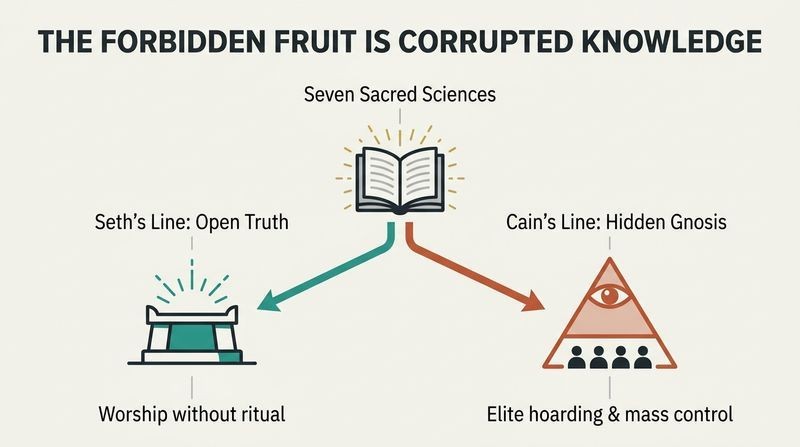
Wayne borrows from Masonic legend the idea that God gave Adam the Seven Sacred Sciences (grammar, rhetoric, logic, arithmetic, geometry, music, astronomy). This knowledge split into two streams. Seth's line kept the pure branch, worshipping God without ritual. Cain's line, especially his son Enoch (whom Wayne calls Enoch the Evil, distinct from the righteous Enoch), perverted it into astrology, sun worship, idolatry, and secret initiatory mysticism.
This corrupted Enoch, he argues, became the Egyptian Hermes and Thoth, the patron of alchemy and the founding father of what would become Freemasonry. The forbidden fruit was gnosis, secret knowledge hoarded by an elite and used to manipulate the masses rather than serve God. The pattern of hidden knowledge reserved for initiates repeats through every secret society thereafter.
The distinction between two Enochs is the book's clever workaround for a real puzzle: why Freemasonry venerates the same righteous patriarch scripture says walked with God. Rather than resolve the contradiction, Wayne doubles the character. What deserves attention is the underlying anxiety about knowledge itself, a theme with deep roots from the Prometheus myth to Mary Shelley to the atomic bomb. The claim that knowledge without moral wisdom becomes destructive is defensible and even prescient regarding gene editing and AI. The leap is attributing all esoteric tradition to a single antediluvian villain, collapsing the messy plural history of human learning into one bloodline.
Giants survived the flood, and Israel was ordered to exterminate them
If the flood destroyed the Nephilim, why does the Bible keep mentioning giants afterward? Wayne treats this as proof, not contradiction. Genesis 6 says Nephilim were on earth in those days and afterward. Og of Bashan slept in a bed roughly thirteen feet long. The Anakim made the Israelite spies feel like grasshoppers. Goliath stood over nine feet tall.
The conquest of Canaan, in this reading, was a divinely commissioned extermination of Nephilim-infested nations. He notes that only peoples descended from Abraham (Moab, Ammon, Edom) were spared, while giant-ruled nations like the Amalekites and Amorites were marked for total destruction. God's harsh command to blot out the Amalekites becomes, in this frame, a continuation of the flood's purpose: cleansing corrupted bloodlines from the covenant land.
This reframing does address a genuine moral difficulty, the herem or holy-war annihilation commands that trouble many readers of the Hebrew Bible. Recasting the targets as non-human hybrids conveniently sidesteps the genocide problem, which is precisely why critics find it dangerous: dehumanizing enemies as literally demonic seed is the oldest rhetorical machinery of atrocity. Archaeologically, the giant-skeleton claims Wayne cites have never survived scrutiny, and the cubit measurements for Og and Goliath vary by translation. Still, the literary observation stands: the biblical text itself is oddly insistent that giants persisted, and the Rephaim appear in Ugaritic sources as shadowy ancestral figures, a detail scholars still debate.
Every culture's flood and giant myth is a fractured memory of Genesis
Wayne argues the world's 500-plus flood legends are not coincidence but shared inheritance. The Sumerian Epic of Gilgamesh, Atlantis in Plato, the Popol Vuh of the Maya, Norse and Hindu accounts all describe a golden age ruled by demigods, a rebellion, and a watery cataclysm survived by a righteous few. Rather than concede that Genesis borrowed from older Sumerian tablets, he flips the logic: the pagan versions are corrupted retellings of the true events, preserved by scattered survivors and Nephilim propagandists.
Atlantis becomes the antediluvian world of ten Nephilim kings. The Anunnaki of Sumer become the Watchers. Gilgamesh, described as part-god and giant, becomes a surviving Nephilim. The universal Mother Earth impregnated by a sky god is the pagan echo of angels mating with women.
The comparative-mythology observation is legitimate and long-noted; even skeptics acknowledge the striking recurrence of flood narratives. Wayne's move is to invert the standard academic chronology, which dates Sumerian flood texts earlier than Genesis. His counterargument, that older surviving copies do not prove original authorship, is philosophically valid but empirically weak. What he shares with the ancient-astronaut writers he cites (Sitchin especially) is a refusal to let mainstream dating stand. The deeper insight worth keeping, independent of his theology, is that widespread flood memory may encode real post-glacial sea-level catastrophes around 10,000 BCE, a hypothesis serious researchers like geologist Robert Schoch have pursued.
Secret societies are one organism wearing different masks across centuries
The book traces an unbroken chain: the antediluvian Brotherhood of the Snake, Nimrod's Babel cult, the Egyptian Great White Brotherhood, the Essenes, the Knights Templar, and finally Freemasonry, the Illuminati, and the Rosicrucians. Each, Wayne argues, is the same conspiracy reincarnated, preserving corrupted knowledge and working toward world government.
The Templars, ostensibly protecting pilgrims, actually excavated Solomon's Temple for hidden treasure and heretical documents. Persecuted in 1307, survivors fled to Scotland under the Sinclair family and re-emerged as Freemasons. He connects the American founding (Masonic imagery on the dollar, the unfinished pyramid, Novus Ordo Seclorum), the French Revolution, and modern globalist bodies like the Council on Foreign Relations, Trilateral Commission, and Bilderbergers as instruments driving the New World Order toward the Antichrist's throne.
This is where the book fully enters the tradition of Nesta Webster and John Robison, the eighteenth-century originators of Illuminati-Revolution conspiracism. The genealogy is seductive because each link contains a grain of fact: the Templars were destroyed, Freemasonry did shape Enlightenment politics, elite policy clubs do exist. The fallacy is treating institutional overlap as unified intent across 6,000 years, a coordination no human organization has ever sustained. Notably, the book repeatedly cites the Protocols of the Learned Elders of Zion, a proven early-twentieth-century forgery whose antisemitic use fueled real atrocities. That reliance is the most ethically troubling thread and the one readers should weigh most critically.
The Holy Grail is a secret bloodline, not a cup
Wayne unpacks the popular esoteric claim (later dramatized in The Da Vinci Code) that Sangreal, Holy Grail, is really San Greal, royal blood. In this Gnostic tradition, Jesus survived the crucifixion, married Mary Magdalene, and fathered children whose descendants became the Merovingian kings of France and the wider Rex Deus, the Kings of God, an aristocratic network guarding the dynasty.
Grail romances, Arthurian legends, even fairy tales like Cinderella, he argues, are coded Legominism, hidden messages preserving these bloodlines. Crucially, Wayne does not endorse this. He presents it as the master deception, the counterfeit messianic pedigree that secret societies will use to legitimize the Antichrist. The real danger, he says, is a future ruler who claims descent from Jesus and David to seize the throne promised to Christ.
Here the book performs a clever inversion of the Holy Blood, Holy Grail thesis it draws from. Where those authors present the bloodline as suppressed truth, Wayne repackages it as satanic disinformation, letting him cite occult sources as evidence while rejecting their conclusions. It is a rhetorically agile move. The scholarship he leans on, particularly the Priory of Sion documents, has since been exposed as a twentieth-century hoax planted by Pierre Plantard, a fact the book acknowledges yet dismisses as misdirection, an unfalsifiable defense. The genuine cultural insight is that Grail literature really does encode political and dynastic anxieties, a point medievalists affirm without any bloodline mysticism.
Occult religion worships Lucifer by rebranding him the good god of light
The book's most provocative claim about secret societies is a theological inversion. Citing Freemason Albert Pike, Wayne argues the highest initiates worship Lucifer as the true god, the light-bearer who freed humanity through knowledge, while recasting the biblical God (Adonai) as a jealous, oppressive tyrant who kept mankind ignorant in Eden.
In this framework, the serpent becomes a liberator, the Tree of Knowledge a gift, and evolution and reincarnation the doctrines of ascending to godhood. Light symbolism (the All-Seeing Eye, the sun gods Osiris and Ra, the blazing pyramid) all encode Lucifer. Wayne connects the Latin root lux to corporate and organizational names he finds suspicious. The endgame is a world religion that unites all faiths under a depersonalized universal life force while secretly directing worship to Satan.
The role-reversal narrative Wayne describes genuinely exists in some Gnostic and Luciferian thought, where the Demiurge who created the material world is the villain and the serpent the emancipator. That is not fabricated; texts like the Nag Hammadi Hypostasis of the Archons portray exactly this. Where the book overreaches is treating scattered esoteric writings as a coordinated global creed and reading sinister intent into etymology and logos. The famous Pike Lucifer quotation is itself disputed and likely distorted by anti-Masonic writer Leo Taxil, who later confessed his Masonic exposes were a hoax, a provenance problem the book does not address.
Expect UFOs, Marian visions, and alien contact as demonic misdirection
Wayne interprets the modern paranormal as tailored deception for a technological age. Alien abductions, he notes, echo ancient encounters: paralysis, reproductive experiments, DNA sampling, viper-faced beings. He connects these greys directly to fairy folklore (goblins, changelings, the Tuatha Denaan) and to the Nephilim, all shapeshifting fallen angels producing hybrids.
He reads mass Marian apparitions (Fatima, Medjugorje) not as the Virgin Mary but as the goddess Isis or Ishtar, preaching a one-world-religion message of unity and peace. Aliens will be revealed to prepare humanity to accept it is not alone and to embrace a coming evolutionary leap into godhood. All of it, he argues, is engineered to devalue Jesus from Messiah to one prophet among many and to stampede a frightened world into unified rebellion against God.
The fairy-alien parallel is not original to Wayne; folklorist Jacques Vallee made the same structural comparison in Passport to Magonia (1969), arguing abduction and fairy-kidnapping narratives share a template, whether one reads that psychologically or supernaturally. That convergence is a real and underexplored anthropological pattern. Wayne's contribution is theological framing rather than new data. The interpretive risk is totalizing suspicion, where every wonder becomes a trap and every unifying impulse becomes satanic, a worldview that can corrode ordinary trust and empathy. Yet the observation that spiritual experiences shape-shift to match each era's technology and imagination is genuinely sharp cultural criticism.
The rapture comes mid-tribulation, and premature confidence will humiliate believers
Here Wayne breaks sharply with mainstream evangelical teaching. Most American Christians hold the pre-tribulation rapture, that believers vanish before the seven-year tribulation begins. Wayne calls this a catastrophic error. He argues the rapture occurs at the midpoint, only when the Antichrist commits the abomination of desolation by declaring himself God in the rebuilt Jerusalem temple.
His reasoning: Paul says that day cannot come until the rebellion and the man of lawlessness are revealed. The signing of a peace covenant merely introduces the Antichrist; his true unmasking comes three and a half years later. The tragic consequence, Wayne warns, is that saints will loudly denounce the beloved world leader as the Antichrist, expecting instant rescue, then face genocide when no rapture arrives, discrediting the faithful at the worst moment.
This is the book's most internally rigorous argument because it stays within a shared interpretive game and reasons from specific texts, chiefly 2 Thessalonians 2. The pre-trib doctrine is historically recent, popularized by John Nelson Darby in the 1830s and the Scofield Reference Bible, so Wayne's challenge has real scholarly company among post-trib and pre-wrath theologians. What makes it distinctive is the pastoral consequence he draws: a warning about spiritual overconfidence and public humiliation. Whatever one makes of the eschatology, the underlying caution against certainty about timing echoes Jesus's own statement that no one knows the day or hour, a tension the confident rapture industry often ignores.
Salvation hinges on free choice, so read all three monotheistic scriptures yourself
The book closes on an ecumenical and surprisingly personal note. Wayne argues that the entire human drama exists to redeem creation through free choice, the same free choice Adam misused in Eden. God will not override it. Every person must decide, and indecision counts as a decision, citing the warning against being lukewarm.
He urges Christians, Jews, and Muslims to actually read one another's scriptures rather than relying on hearsay. He claims the Qur'an affirms Jesus as Messiah and Word, validates the Torah and Gospels, and warns of a coming judgment, and that all three faiths will need mutual support during the tribulation. He is not preaching a merged religion but urging the faithful to endure with humility, patience, and respect rather than fire-and-brimstone hostility.
After hundreds of pages of demonized enemies, the ending pivots to an unexpectedly humane plea for interfaith literacy and against self-righteous belligerence. Wayne even critiques fellow believers whose aggressive witnessing plays into the persecution narrative. This tension, sweeping conspiracism paired with a call for gentleness, reveals the book's dual nature. His reading of the Qur'an as affirming Jesus's messiahship is contested; Islamic theology honors Jesus as prophet and messiah but denies crucifixion and divinity, so the harmonization is looser than claimed. Still, the closing insight, that reading primary sources beats trusting secondhand caricatures, is advice that would improve almost any polarized debate, sacred or secular.
Analysis
This is fringe Christian conspiracy literature, an anthology-scale synthesis (roughly 300,000 words) welding biblical literalism to occult genealogy, ancient-astronaut theory, and New World Order politics. Its difficulty for a summarizer is not obscurity but density: the book advances by accumulation, chaining hundreds of sources into a single unfalsifiable pattern where every parallel confirms the thesis and every contradiction becomes evidence of cover-up.
Methodologically, Wayne performs a striking epistemological maneuver. He reads scripture literally while treating Gnostic gospels, Josephus, Freemasonic legend, and modern esotericists like Laurence Gardner and Zecharia Sitchin as reliable witnesses, then inverts their conclusions, using occult sources to prove a satanic conspiracy the sources themselves would deny. This lets him have it both ways: the enemy's own documents indict them. The logic is euhemerist (myths as garbled history) and typological (everything prefigures the end times), a combination with vast reach and zero brakes.
The book's genuine strengths are comparative: the recurrence of flood and giant myths, the shape-shifting of paranormal experience across eras (a point folklorist Jacques Vallee made independently), and the recovery of the older angelic reading of Genesis 6 that predates Augustine. Its most rigorous section, the mid-tribulation rapture argument, stays inside a shared interpretive game and reasons carefully from 2 Thessalonians.
The deepest problems are ethical and evidentiary. The reliance on the Protocols of the Learned Elders of Zion, a documented forgery, and the Priory of Sion hoax, plus the dehumanizing of biblical enemies as literal demonic seed, place the book in a lineage with real historical harms. Psychologically, its appeal is classic: it converts a chaotic, meaningless world into a cosmic drama where the reader is among the enlightened remnant. The closing plea for interfaith reading and humility sits in uneasy, revealing tension with the paranoia preceding it.
People Also Read
FAQ
What is "The Genesis 6 Conspiracy" by Gary Wayne about?
- Ancient conspiracy theory: The book explores a 6,000-year-old conspiracy involving secret societies, the descendants of giants (Nephilim), and their plan to enslave humankind.
- Scripture and myth integration: Gary Wayne reinterprets Genesis and other biblical texts alongside global mythologies, Gnostic lore, and secular history to reveal hidden connections.
- Secret societies’ influence: It argues that groups like Freemasonry, the Illuminati, and the Priory of Sion are modern inheritors of ancient, corrupted knowledge and bloodlines.
- End-times warning: The narrative culminates in a prophecy of a coming world government led by the Antichrist, rooted in these ancient conspiracies.
Why should I read "The Genesis 6 Conspiracy" by Gary Wayne?
- Challenges mainstream history: The book offers a radical reexamination of biblical and secular history, questioning accepted narratives about giants, secret societies, and spiritual warfare.
- Comprehensive synthesis: It bridges mythology, archaeology, scripture, and conspiracy theory, providing a unique perspective on the origins of religious and cultural beliefs.
- Prepares for end times: By understanding ancient patterns of rebellion and corruption, readers can better interpret current events and prophetic warnings.
- Critical thinking encouragement: Gary Wayne invites readers to question orthodox theology and secular dismissals, fostering deeper inquiry into hidden histories.
What are the key takeaways from "The Genesis 6 Conspiracy" by Gary Wayne?
- Nephilim survival and influence: Giants and their descendants survived the biblical flood and continued to shape postdiluvian civilizations and secret societies.
- Secret knowledge preserved: The Seven Sacred Sciences and esoteric wisdom from fallen angels were guarded and propagated by groups like the Freemasons and Templars.
- Generational spiritual war: The conquest of the Promised Land and ongoing conflicts are framed as a divine mission to eradicate Nephilim-influenced nations.
- End-time parallels: The Terminal Generation will witness a resurgence of ancient conspiracies, spiritual deception, and the rise of the Antichrist.
Who were the Nephilim according to "The Genesis 6 Conspiracy" by Gary Wayne?
- Fallen angels’ offspring: Nephilim were giants born from the union of fallen angels ("sons of God") and human women ("daughters of men"), described in Genesis 6:4.
- Superhuman rulers: They were physically enormous, strong, and often tyrannical, imposing idolatry and violence on ancient societies.
- Symbol of rebellion: Nephilim represent ongoing spiritual and physical rebellion against God, with their legacy continuing through secret societies and end-time events.
How does Gary Wayne interpret the "sons of God" and "daughters of men" in Genesis 6?
- Angelic interpretation: "Sons of God" are identified as fallen angels or watchers, not merely descendants of Seth, supported by cross-references in Job and Deuteronomy.
- Physical unions: The book argues that angels could assume physical form and mate with human women, producing the Nephilim.
- Cainite connection: "Daughters of men" are linked to the descendants of Cain and possibly an "other race" created on day six, distinct from Seth’s lineage.
What role do secret societies like Freemasonry, the Knights Templar, and the Priory of Sion play in "The Genesis 6 Conspiracy"?
- Guardians of forbidden knowledge: These societies are depicted as custodians of ancient, antediluvian wisdom passed down from Nephilim and Cainite ancestors.
- Agents of global control: They are said to orchestrate world events, manipulate religions and governments, and prepare for a New World Order.
- Bloodline preservation: Secret societies allegedly protect and promote the bloodlines of Nephilim and the so-called Rex Deus lineage, aiming to install a false messiah.
What is the significance of the Seven Sacred Sciences in Gary Wayne’s "The Genesis 6 Conspiracy"?
- Divine knowledge origins: The Seven Sacred Sciences—grammar, rhetoric, dialectic, arithmetic, geometry, music, and astronomy—were taught to Adam and passed to his descendants.
- Corruption and preservation: Cain’s lineage corrupted these sciences with mysticism and idolatry, while Seth’s descendants maintained a purer form.
- Foundation for secret societies: The corrupted sciences became the basis for the rituals, symbols, and secret knowledge of groups like Freemasonry and the Snake Brotherhoods.
How does "The Genesis 6 Conspiracy" explain the survival and influence of Nephilim and giants after the biblical flood?
- Survival theories: The book suggests Nephilim survived the flood through intermarriage with human lineages, secret refuges, or a second incursion by fallen angels.
- Post-flood giants: Descendants like Anakites, Rephaites, and Amalekites continued to oppose Israel and influence ancient civilizations.
- Mythological evidence: Global legends and ancient texts are cited as evidence for the continued presence and impact of giants in history.
What is the Rex Deus/Grail tradition and its significance in "The Genesis 6 Conspiracy" by Gary Wayne?
- Secret royal lineage: Rex Deus, meaning "Kings of God," is a tradition claiming descent from biblical, mystical, and Nephilim bloodlines, including Jesus and Mary Magdalene.
- Influence on royalty: This lineage allegedly shaped European royal houses, especially the Merovingians and Stuarts, intertwining with Grail and Ring Lord legends.
- Conspiratorial role: Rex Deus is portrayed as the mastermind behind secret societies, orchestrating the rise of the Antichrist and a New World Order.
How does Gary Wayne connect ancient mythologies, dragons, and fairies to Nephilim and secret societies in "The Genesis 6 Conspiracy"?
- Unified allegory: Dragons, fairies, and Grail legends are interpreted as representations of Nephilim-descended bloodlines and their matriarchal/patriarchal power.
- Cultural symbolism: Dragon and fairy motifs in Celtic, Norse, and British traditions are seen as coded references to these ancient lineages.
- Modern influence: These mythologies are linked to the symbolism and genealogies preserved by secret societies and European aristocracy.
What is the role of the Antichrist, False Prophet, and end-time Babylon in "The Genesis 6 Conspiracy" by Gary Wayne?
- Antichrist’s rise: The Antichrist is depicted as a descendant of these ancient bloodlines, empowered by secret societies to lead a global government.
- False Prophet’s deception: A spurious religious leader will unite world religions under a false doctrine, performing miracles to deceive humanity.
- Babylon’s symbolism: End-time Babylon is both a literal city (Rome) and a universal religion, enforcing idolatry and persecuting true believers.
What are the main warnings and conclusions Gary Wayne presents in "The Genesis 6 Conspiracy"?
- Inevitable global occupation: The book asserts that secret societies and Nephilim-descended bloodlines are too entrenched to be stopped, and their plan for world control is preordained.
- Spiritual vigilance urged: Readers are warned to be aware of hidden spiritual and political forces shaping history and the future.
- Prophetic fulfillment: The narrative concludes that these conspiracies will culminate in the rise of the Antichrist, global tribulation, and the ultimate return of the Messiah.
Download PDF
Download EPUB
.epub digital book format is ideal for reading ebooks on phones, tablets, and e-readers.








































