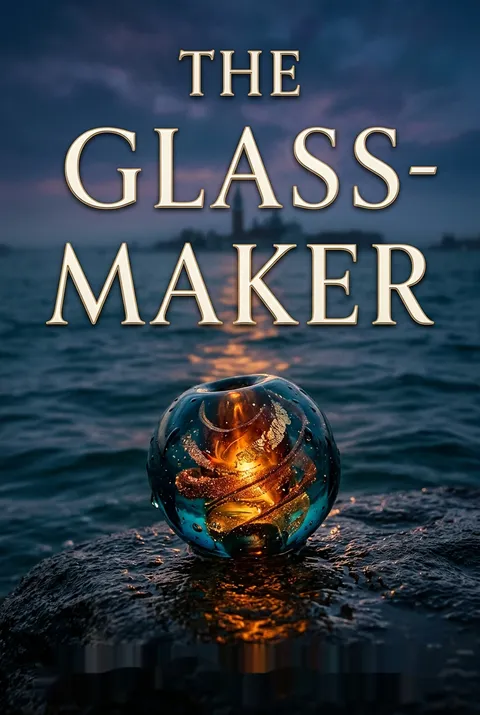
Plot Summary
Skipping Stones in Time
The narrative opens by likening the progression of time to a stone skimming across water, capturing the uncanny timelessness of Venice and Murano. Here, time exists on a different axis, flowing more slowly for artisans and glassmakers, paralleling the myth of glass slowly warping over centuries. This otherworldly sense of time sets the stage for generations of the Rosso family to endure upheaval, love, loss, and transformation, all while the world outside rushes forward. Venice's and Murano's unique pace fosters a culture of intense pride and guarded tradition, hinting that within this small enclave, lives will brush against hundreds of years of history with a single stone's jump.
Birth of a Glassmaker
The story of Orsola Rosso begins with her falling by accident—or design—into a canal at the age of nine, and warming herself by the forbidden furnace of the rival Baroviers. She, the daughter in a family of glassmakers, witnesses the formidable Maria Barovier, a rare woman in glass, and becomes obsessed with the world of molten artistry. This sets Orsola's path, marked by family rivalry, rigid gender roles, and the relentless rhythm of the glassmaking shop. Her early years are shaped not just by observation but by familial expectations and the undercurrent of change, as Venice's prosperity and the innovations of the Baroviers hover at the story's edge.
Family Shattered, Strength Forged
Suddenly, tragedy interrupts the daily dance of the workshop: Orsola's father dies, impaled by a sliver of glass in a freak accident, leaving the family, their business, and their hearts in turmoil. The funeral unites the community even as it exposes deep rifts among the siblings, challenging Orsola, her brittle brother Marco, and the steady Giacomo. Their mother, Laura, forced to take the reins, is revealed as a survivor—pragmatic, shrewd, and steely. Orsola's chance encounters with Maria Barovier become lifelines, introducing the idea that beads, considered secondary by men, might yet save the family. The family's survival now hinges on ingenuity and alliances outside patriarchal convention.
A Woman's Secret Flame
Forbidden from the furnace and sidelined by her brother, Orsola forges her own path in glass. With guidance from Elena Barovier, she learns the art of lampworking—making glass beads with a tallow lamp, all in secret. Laboring in the shadows, suffering failures, she gradually develops expertise, using honey and patience to train her hands. Her efforts, at first dismissed, gain value only as the family's fortunes dwindle, and her beads, quiet but beautiful, start filling vital gaps. Orsola's journey is not just technical but deeply internal: every struggle at the lamp becomes a metaphor for women's invisible work, resilience, and the slow, fiery process of forging a self against expectation.
Crossing to Venice
When Marco disappears in Venice after a failed business negotiation, Orsola and Giacomo, adrift in the labyrinthine canals and alleys, must find him—an odyssey that exposes their weakness, naiveté, and also their kinship. Guided by Antonio, a Venetian fisherman with dreams of glass, they spot the lines between Murano's insularity and Venice's seductive chaos. The journey is a mirror for Orsola: the foreign city, Antonio's allure, and Marco's recklessness all become catalysts for recognizing her own ambition and desire, even as the family crisis widens. The episode cements Antonio's entry into the Rosso household and sets in motion new threads of belonging, rivalry, and longing.
Beads of Survival
In hardship, Orsola's beadmaking becomes the quiet engine of survival. The shop adapts to new realities—beads for trade, for merchants, for Klingenberg. With skill and humility, Orsola's work, seen as an afterthought by men, now buys bread, wood, and security for the impending arrival of a sister. Meanwhile, Marco strains to reassert dominance, failing with every oversold goblet and rage-fueled outburst. Laura's feigned engagement scare is a cunning push to force the brothers into competence. Orsola's lampwork, meanwhile, matures; she learns to please merchants, to haggle when needed, and to teach herself and others that artistry can be both solace and salvation.
Love, Betrayal, and Loss
Love and ambition mingle and combust as Antonio's role expands from apprentice to near equal, even as he and Orsola dance around mutual attraction. Their eventual, brief union—sensual, joyful, forbidden—becomes a subversive counterbeat to the relentless male hierarchies of Murano. Yet betrayal lurks: Marco, feeling threatened, replaces Antonio with Stefano, a Barovier, triggering Antonio's decision to flee and take glassmaking secrets to terraferma. The choice devastates Orsola, but also crystallizes her as a figure of strength—an artisan who weathers broken hearts and shattered traditions, her entire life forever marked by the rhythm of leaving and loss.
Seeds of Reinvention
The family is forced to reinvent itself in the face of plague, political change, and commercial decline. Orsola, Monica, and the Vianello cousins consolidate the household, knitting strength from loss, managing children, laundry, and the production of humble but essential wares. Monica emerges as a new matriarch, practical and unflappable, helping secure the legacy of beadmaking not only through survival, but through mentoring younger generations. As the external world—Venice, Europe, Africa, and the New World—shifts with revolutions, empires, and epidemics, the women's quiet entrepreneurship ensures the Rosso name persists, even as it is forever evolving.
Plague and Memory
Plague's arrival resets the story: houses are boarded up, loved ones abruptly lost—Nicoletta, Maddalena, Nonna, Paolo—and the Rosso family confined, sometimes waiting for death, sometimes forstaving it through strict rituals and the invention of plague beads. Orsola's artistry now quivers between hope and futility as the beads are believed, for a moment, to protect against the plague. The world outside—boats of the banished, death on Lazzaretto Vecchio—seeps in through rumor and memory, and as the family emerges, changed by collective trauma, beads become not just adornment but talisman, relic, and the bearer of memory.
Bridges to Terraferma
As the centuries skip on, new bridges—literal and figurative—are built to the mainland. Orsola's nephew is lost to love and labor in Venice, marrying the formidable bead stringer Luciana. The Austrians build a railway bridge, collapsing further the boundaries that formed the Rosso family's world. At every leap, the old ways—patriarchy, insularity, the cult of Murano—lose ground to commerce, innovation, and the ambitions of the young. Each departure causes pain, but forces growth: the family's blood and name now spread between Murano and Venice, with new kinds of work and women taking the lead in both tradition and business.
The Family Remade
Through war and hardship, births and deaths, the household expands and contracts. Marriages blur the lines of rivalry between Venetian and Muranese clans; children multiply; siblings carve out new powers, many shifting away from glass as the world changes. Old rivalries—Marco's resentment, Orsola's suppressed desires, Stella's wild freedom—flame and recede, replaced by the colder calculations of commerce and survival. The very act of beadmaking and glassblowing becomes less about art and more about economic necessity, yet always underlain by the human need to create, to belong, and to persist despite upheaval.
War and Aftermath
The family endures through eras of revolution, invasion, depression, and world wars. From Napoleon to the Austrians to Mussolini to the World Wars, Venice and Murano are battered, and so are their old ways. Marco's fragile mastery gives way to Luciana's fierce leadership; the shop is repurposed for tourism; beadwork and lampwork are reinvented to suit modern tastes. Old griefs (the loss of Stella in London, the memory of Sebastiano's death at the front) are integrated into new patterns of daily life. Survival becomes innovation; memory becomes the raw material for perseverance, even as sons and daughters find new identities within and outside the city.
Glitter Amidst Decline
As Venice declines and glassmaking fights for relevance, the Rosso family adapts, opening a shop in San Marco, adding keychains and souvenirs for tourists, and finding pride in the creative artistry of lampwork and nostalgia for lost masterpieces. The work becomes more public, as demonstrations are staged, mirrors and beads are made for spectacle, and old glassmaking is merged with modern commerce. Murano's identity, threatened by Chinese imports and a shrinking population, persists through family pride, selective artistry, and adaptive entrepreneurship. Yet the preciousness of hands-on artistry lingers, even as the world accelerates around them.
New Blood, Old Fury
Dynamism between generations brings new ways of working and being, with the women—Orsola, Monica, Rosella, Angela, Luciana—at the creative and entrepreneurial heart. Disputes arise over business and tradition, but also over the basic claim to Murano, Venice, and glass itself. Battles over space, power, and recognition twist and resolve, and a new equilibrium emerges: respect for what is new, acceptance of what is gone, and the hard-won wisdom that change is inevitable, even in a city that feels frozen in time.
Water Rising, Tides Turning
The acqua grande of 2019 devastates shops, studios, and spirit, but also becomes a catalyst for renewal, solidarity, and wonder. Family members scramble to save work and property as the city drowns, realizing the fragility not only of glass, but of survival itself in a sinking world. Tourists disappear, and for a brief moment, Venice's waters clear, nature reasserts itself, and the city remembers its own beauty—dolphins return, momentarily, dispelling the myth that all change is loss, and suggesting a hope that beauty can still return, unexpectedly, amidst disaster.
Pandemic and Solitude
As the Covid-19 pandemic isolates Orsola, Stefano, and the remaining family, old patterns are mourned and new ones are forced: funerals are attended alone, family meetings happen on screens, and heritage is recast through memory and longing. Grief for lost loved ones—Stefano, Giacomo, and the irretrievable past—matures into acceptance. Orsola, now old, feels the weight of loss but also the humility of knowing she, too, is part of history's continual wave. What endures are small acts: a bead passed down, a dolphin returned, and the stubborn continuation of making beauty from hardship.
Real Dolphins Return
After disasters—personal and collective—Venice's ancient rhythm returns. Shops reopen, families meet again, and dolphins swim once more in the lagoon, symbols against hopelessness. Orsola allows herself to hope, not naively but rooted in endurance: Venice, Murano, and the Rosso family persist through centuries by yielding, adapting, finding new forms. The beadmaker's hands, now aged, still shape fragments of color, while the city outside bends but does not break. Nature's return reminds inhabitants that renewal is always possible, and, for a moment, magic seems real.
The Last Dolphin
Time, at last, lands in the present, as Orsola, aged and solitary, encounters the namesake descendant of Antonio, the man she loved and lost centuries before. The tradition of sending dolphins, carried by generations for reasons forgotten, returns one last time. Orsola must accept the finality of loss—and the way history bends into legacy. Her beads, her family, her city, and her very name are all part of the skimming stone's arc. The story closes with a gesture of hospitality, memory, and continuity—a promise that as long as there is someone to shape glass and someone to receive it, the ripples will continue.
Analysis
In The Glassmaker, Tracy Chevalier delivers a sweeping, intimate saga that dramatizes not merely the survival of a family or a trade, but the resilience of artistry itself—especially women's artistry—within the churn of history. Through its nonlinear structure, the novel collapses centuries' worth of war, plague, progress, and regression into a polyphonic meditation on what endures when everything is lost. Venice, Murano, and the Rosso family's shifting fortunes echo the larger modern question: "How does one persist as the world accelerates and traditions are swept aside?" The answer, Chevalier suggests, is that persistence lies not in grand gestures or noble blood but in humble, enduring acts: a bead, a meal, a secret skill passed from mother to daughter, a moment's solace given or received. By centering the narrative on female craft, emotion, and leadership, Chevalier excavates the hidden labor behind every glittering chandelier and every city that survives the tides of change. Ultimately, The Glassmaker is a hymn to adaptability—the bravery to mourn what's lost, shapeshift, and risk beauty again, even in a sinking world.
Review Summary
People Also Read






Characters
Orsola Rosso
Orsola is the central character, the girl who falls into a canal and emerges as a secret glassmaker, lampworker, and, eventually, matriarch and survivor. Always pulled between duty to her family and yearning for her own artistry and agency, she carves out space first in secret, then with determination. Her relationships with her brothers, her mother, and especially her lovers (Antonio, Stefano) shape her growth, but it is through adversity—plague, betrayal, loss, and generational conflict—that Orsola's resilience crystallizes. Psychoanalytically, she embodies the struggle for self-creation in the face of patriarchal limits and the tension between making beauty and surviving hardship. She is the unbroken thread running through five centuries of family and city.
Marco Rosso
The eldest brother, Marco inherits both the workshop and its burdens. Talented but vain, he struggles with responsibility, feeling overshadowed by his father, threatened by innovation, and alternately dismissive and dependent on the women around him. His journey from reckless maestro to embittered, sometimes drunken patriarch mirrors the family's own struggle to maintain relevance and dignity. Psychoanalytically, Marco personifies male fragility when confronted by change, especially change led by women. His need for control and recognition both damages and, at crucial moments, preserves the family's spirit.
Laura Rosso
Laura, Orsola's mother, transforms tragedy—her husband's death—into an opportunity for pragmatic leadership. With a cool head and sacrificial love, she deftly manages both household and workshop, unafraid to bluff, manipulate, or bargain for her children's future. Her stoic endurance and capacity for adaptation underpin the family through plagues, hardship, and generational strife. Psychologically, she is the embodiment of muscular motherhood—her strength laced with grief, and her love sometimes hard, sometimes unseen. Through her, the novel honors the quiet power of women marginalized by official history.
Antonio Scaramal
First appearing as a Venetian fisherman, Antonio becomes apprentice, rival, lover, and then exile. His background—Venetian, not Muranese—marks him as both tempting and forbidden, and his passion for glass and for Orsola is sincere. Yet his eventual decision to leave, taking glass secrets to terraferma, becomes both personal betrayal and symbol of the relentless pull of change and the limits of belonging. Antonio's descendants—and the tradition of the dolphin—become emblems of connection and loss transcending time.
Giacomo Rosso
Giacomo is the emotional anchor for Orsola and a foil for Marco's volatility. His steadiness in the workshop contrasts with his hidden struggles: an unspoken homosexuality, expressed only in hints (his bond with Paolo, later his exile with a male friend in Mestre). He represents those who love tradition but are out of step with its requirements, whose suffering is often invisible. His final choice—to live authenticity on terraferma—reflects the pressures and costs of conformity.
Stefano
Stefano, first a Barovier apprentice, becomes Orsola's husband by default, chosen for his skill and reliability, not passion. Though overshadowed by her attachment to Antonio, Stefano's patience and managerial skill are essential to the family's transition into new forms of business and survival. Psychologically, he represents the power of steady, unassuming partnership and the value of humility and competence over romantic drama.
Monica Vianello
Monica enters as a wet nurse and quickly becomes Marco's wife and mother of his children. Her personality—crystal-blue eyes, fishhook wit, robust work ethic—anchors the household through periods of crisis. Monica's relationship with Orsola is one of respect laced with rivalry, and her acceptance of family complexity is key to the family's endurance. She models the necessary, often underappreciated, flexibility required to keep tradition alive in changing times.
Luciana
A bead stringer from Cannaregio, Luciana marries Raffaele and becomes a formidable business leader. Initially resented for her audacity and appetite, she earns her place by mastering both beadwork and family management, eventually outmaneuvering old rivalries. Her ambition and adaptability mark her as a new force: the outsider who takes over, for better and worse. Symbolically, she challenges the Muranese notion of purity and lineage, reinvigorating the family with new blood and new rules.
Stella
Orsola's younger sister, Stella plays a secondary but essential role, representing the willful refusal to be tied to traditional paths. She is the messenger, the escape artist, and eventually a nurse in war-torn London, dying in the Blitz. Her departures leave wounds but also model for others the necessity—and the cost—of self-determination and movement beyond home.
Maria Barovier
Though not a major viewpoint character, Maria Barovier's historical role as pioneering woman glassmaker and inventor of the rosetta bead inspires Orsola and shapes the entire narrative. Her mentorship, advice, and quiet acts of support underscore the possibility of female agency within a male-dominated art. Her recurring presence, even after death, is that of a spiritual ancestor—proof that women's artistry can change the world, however slowly.
Plot Devices
Skipping Stone: Nonlinear time alla Veneziana
The novel's distinct narrative structure employs the image of a stone skipping across water as an organizing motif for time's passage. In each "landing," the plot accelerates or decelerates, skipping across centuries or closer intervals as if by magic. This narrative device both foregrounds Venice's suspension outside the normal flow of history and allows the Rosso family's saga to feel both epic and intimately immediate. By refusing strict chronology, the novel shows that generational trauma, love, and artistry are ever-present, their resonance unfaded by time.
Beads and Glass as Metaphor
The process of making beads and working glass—its heat, fragility, endless practice, and capacity for renewal—serves as a flexible metaphor for female creativity, the endurance of the family, and the evolution of Venice and Murano. Glass is both subject and symbol: it is shaped, threatened, commodified, and sometimes nearly lost, yet it persists. Beads in particular stand in for the humble, everyday beauty that truly endures; glass's ambiguity (liquid or solid, transparent or opaque) mirrors the uncertain boundaries of identity and tradition.
Plague and Quarantine: Foreshadowing Modern Crisis
Repeated plagues—historical and modern—are presented as both microcosmic and allegorical. They isolate, force households to re-entrench, and demand new strategies for survival (plague beads, barter, improvisation). Quarantine also enables reflection on belonging, the value of touch, and the lineage of trauma across generations. By book's end, COVID-19 revisits these dynamics, fusing past and present.
Generational Repetition and Reinvention
Each successive generation replays old battles—over artistry, gender, ambition, belonging—and yet each must invent new solutions: alliances with outsiders, changing business models, adapting artistry to commerce. These patterns are presented not as cycles but as evolving spirals, each iteration deeper and more complex.
The Dolphin Motif
The recurring gift of glass dolphins—originating in romance, continuing as an unexplained tradition—serves as a tangible symbol of connection across time, loss, and forgetting. At the novel's close, the motif becomes a bridge from myth to present, passing meaning and memory to new hands, whether or not the original story is known.

Download PDF
Download EPUB
.epub digital book format is ideal for reading ebooks on phones, tablets, and e-readers.








































