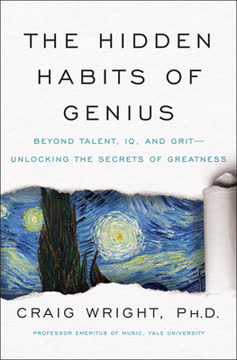
Key Takeaways
1. Genius is a Blend of Innate Traits and Relentless Work
Genius involves the complicated expression of too many hidden personal traits to be reduced to a single location and process in our brain or on our chromosomes.
Beyond IQ scores. The traditional view of genius as solely tied to a high IQ is a misconception. While natural gifts play a role, exceptional accomplishment stems from a "Many Traits Quotient" (MQ's) encompassing intelligence, resilience, curiosity, visionary thinking, and obsessive behavior. Standardized tests like the SAT and IQ tests are poor predictors of genius, often failing to recognize individuals like Charles Darwin, Winston Churchill, or Steve Jobs, who were academic underachievers.
Nature and nurture cooperate. Genius is not purely hereditary; it's an "emergenesis" or "perfect storm" of genetic predispositions and environmental influences. While talents like perfect pitch can be inherited, the transformative impact of genius is not generational, as seen in the lack of brilliant painter offspring from Picasso or the singular success of Secretariat despite its bloodline. The interplay of genes and environment, influenced by epigenes, suggests that we can cultivate our potential through effort.
Hard work is indispensable. Despite natural gifts, geniuses are habitually hard workers, often driven by obsession. Michelangelo, Vincent van Gogh, Bill Gates, and Elon Musk all emphasized relentless effort, with Edison famously stating, "Genius is one percent inspiration and ninety-nine percent perspiration." The "10,000-hour rule" for expertise, while popular, often confuses cause and effect; natural ability makes practice enjoyable and encourages more of it, but true genius goes beyond mere performance to create something new.
2. Societal Bias Suppresses Female Genius
It was impossible for any woman, past, present, or to come to have the genius of Shakespeare.
Historical exclusion. Throughout history, genius has been largely defined by and for men, leading to the marginalization of women. Virginia Woolf's "A Room of One's Own" highlighted the systemic barriers—lack of education, financial independence, and time—that prevented women from achieving recognition. Many female geniuses, like Jane Austen and George Eliot, resorted to male pseudonyms to get their work published and read.
Deeply embedded biases. Cultural and implicit biases, held by both men and women, continue to hinder female accomplishment. Studies show that male applicants are often preferred over equally qualified female applicants, even by female reviewers. This "looking-glass" effect, as Woolf described it, makes women appear "half size" to ensure men appear "twice as large," perpetuating a cycle of underestimation and lack of opportunity.
The extra dose of grit. To become recognized as a genius, women have historically needed an "extra dose of grit." Toni Morrison, a single mother working as an editor, carved out time to write by rising at 4:00 A.M., a stark contrast to Ernest Hemingway's privileged writing conditions. This resilience in overcoming systemic obstacles underscores that the "missing nine" potential geniuses are lost due to cultural bias, not a lack of genetic gifts.
3. Avoid the Prodigy Bubble; Embrace Life's Crises
If they have not begun to develop a personal creative “voice” by the age of seventeen or eighteen, they may never do so.
Prodigy vs. genius. A prodigy is a young person with talents far beyond their years, excelling in rule-governed domains like chess or math, but they primarily mimic or perform. A true genius, however, creates and changes the world through original thinking. Most prodigies, like Jay Greenberg or Alma Deutscher, do not develop a distinctive creative voice and often disappear from public notice once their precocity fades.
The crucible of crisis. A life crisis or early trauma often precipitates the emergence of an artist's voice or a scientific vision, forging independence and resilience. Mozart's colossal failure and the death of his mother in Paris at age twenty-two, for example, were defining moments that led him to break free from his controlling father and create his masterpieces. This suggests that "genius is the child of sorrow," as John Adams said, and that struggle can lead to profound art.
Beyond mentors and early specialization. Mentors, while helpful for success, often teach the status quo and how to mimic it, not how to create something new. Geniuses like Einstein and Picasso often disparaged their teachers and found their own paths. The "prodigy bubble" of unmitigated positive reinforcement, strict rules, and narrow specialization can stunt intellectual growth and social development, making it crucial for aspiring creators to develop independence and the capacity to deal with failure.
4. Cultivate a Childlike Imagination and Insatiable Curiosity
Imagination is more important than knowledge.
The power of childlike vision. Geniuses like Mary Shelley, J. K. Rowling, Pablo Picasso, and Albert Einstein retained a childlike imagination into adulthood, allowing them to see the world differently. Shelley's "wakeful dream" birthed Frankenstein, Rowling's train ride sparked Harry Potter, and Picasso worked to "paint like a child." Einstein, who thought in "memory pictures" and "free play with ideas," believed that "we never cease to stand like curious children before the great mystery into which we were born."
Neoteny: the retention of youth. Neoteny, the human capacity to perpetuate juvenile characteristics like curiosity, play, and imagination into adult life, is crucial for discovery and innovation. Walt Disney, who asked, "Why do we have to grow up?", exemplified this by creating fantasy worlds for the "child in all of us." This ability to maintain a "beginner's mind" allows great inventors to constantly seek improvement, even in things seen a thousand times.
A lust for learning. An insatiable curiosity, a "divine discontent" between what is and what might be, drives geniuses to seek solutions. Elizabeth I, Benjamin Franklin, Nikola Tesla, and Elon Musk were lifelong autodidacts, learning experientially or vicariously through voracious reading. Franklin's diverse inquiries led to inventions like the lightning rod and bifocals, while Musk's extensive reading helped him master "rocket science." This deep-seated desire to understand, often more powerful than self-discipline, pushes them beyond conventional borders.
5. Leverage Your Differences: Disability Can Be an Enabler
Human salvation lies in the hands of the creatively maladjusted.
Genius and mental illness. While not all geniuses are mentally ill, a significant percentage, particularly artists and writers, have experienced mood disorders. Vincent van Gogh, Virginia Woolf, and Yayoi Kusama channeled their psychic pain into their art, using creation as a form of self-therapy and survival. Kusama, who lives in a psychiatric hospital, translates her hallucinations into "psychosomatic art," demonstrating how mental "disorder" can both disable and enable.
Disability as an advantage. Physical disabilities, rather than being insurmountable barriers, can force geniuses to develop unique "workarounds" that lead to groundbreaking insights. Beethoven's deafness, for instance, compelled him to discover musical sound internally, leading to the unprecedented power and abstract textures of his later works. Chuck Close, with "face blindness," developed a unique painting technique by atomizing faces into incremental units, creating a new direction for modern art.
The creatively maladjusted. Stephen Hawking, diagnosed with ALS at 21, learned to do complex physics calculations entirely in his head, thriving in his "black hole" of isolation. His disability, as his biographer noted, increased his inclination to concentrate and "grow up." These examples suggest that neurological differences can be alternative modes of intelligence, and that "creatively maladjusted" individuals, by challenging norms and finding new ways to cope, push humanity forward.
6. Be a Rebellious Fox: Challenge Norms and Think Opposite
The fox knows many small things, while the hedgehog knows one big thing.
Rebellion against the status quo. Geniuses are inherently nonconformists, rebels, and troublemakers who "think different" and push the human race forward. Steve Jobs, Galileo Galilei, Martin Luther, and Andy Warhol all defied conventions, often facing initial scorn or persecution. Society, preferring the status quo, initially resists these disruptive ideas, but over time, the "crazy notion" can become the new norm, as seen in the eventual recognition of Harriet Tubman as an American hero.
Cross-border thinking. Like the fox, geniuses roam widely, exploring diverse fields and combining disparate ideas. Lady Gaga integrates music, fashion, and performance art, while Benjamin Franklin's polymathic pursuits spanned physics, oceanography, and urban planning, leading to inventions like bifocals and the lightning rod. Steve Jobs connected calligraphy to computer fonts and combined the iPod with the telephone to create the iPhone, demonstrating that "creativity is just connecting things."
The power of contrarian thought. "Thinking opposite" is a core strategy for innovation. Christopher Columbus sailed west to reach the East, Edward Jenner injected cowpox to prevent smallpox, and Jeff Bezos brought goods to the customer instead of vice versa. Elon Musk's reusable rocket boosters and Mark Zuckerberg's "move fast and break things" ethos exemplify this. This approach allows for solutions that are counterintuitive, flexible, and often lead to breakthroughs in science, art, and industry.
7. Luck Favors the Prepared, the Bold, and the Mobile
In the observational sciences, luck (le hazard) favors only the prepared mind.
Opportunity meets preparation. Genius and success are not solely about innate talent or hard work; they also require opportunity. Mark Twain noted that greatness is explained by the "atmosphere in which the talent was cradled," including nurture, study, and external recognition. As Louis Pasteur famously stated, "luck favors only the prepared mind," meaning that serendipitous discoveries, like Wilhelm Röntgen's X-rays or Alexander Fleming's penicillin, are recognized and exploited by those with the necessary knowledge and observational skill.
The lottery of birth and posthumous fortune. While extreme wealth or poverty rarely produce geniuses, being born into the middle class often provides the right balance of opportunity and incentive. Posthumous luck can also elevate a genius's standing; Shakespeare's global impact grew with the English language, and the theft of the Mona Lisa dramatically increased Leonardo's fame. These external factors, beyond the creator's control, shape their legacy.
Bold moves and mobility. Geniuses habitually make conscious decisions that lead to better outcomes, often involving significant risk. Mark Zuckerberg's bold moves—hacking Harvard, double-crossing competitors, dropping out of college, and moving to Silicon Valley—were crucial to Facebook's genesis. The "Genius Anti-inertia Law" suggests that great minds move to metropolises or universities—like Shakespeare to London, Picasso to Paris, or Zuckerberg to Silicon Valley—where diverse ideas, competition, and financial support create a critical mass for innovation.
8. Embrace Creative Destruction and Productive Obsession
Destruction is more than just an unfortunate side effect of creation. It is part and parcel of the same thing.
The price of progress. Creative destruction, a concept formulated by Joseph Schumpeter, posits that new technologies and industries cannot emerge without displacing existing ones. Steve Jobs, a "tech-savvy visionary," disrupted numerous industries with the personal computer and iPhone, creating new jobs while eliminating others. This process, though often "unfortunate" for those displaced, is an inevitable part of societal advancement.
Genius and character flaws. Geniuses often exhibit destructive personal traits, such as arrogance, cruelty, or lack of empathy, as seen in Ernest Hemingway, Steve Jobs, Thomas Edison, Isaac Newton, and Pablo Picasso. Jobs's "prickly behavior" was driven by perfectionism and impatience, but also by a "habit of simply being hurtful." Edison's cluelessness about empathy led to the public electrocution of Topsy the elephant to discredit AC current.
Obsession as a driving force. Geniuses are often consumed by an "overpowering necessity to create," relegating personal relationships to second place. This obsessive passion, while causing personal damage, fuels compulsive productivity. Shakespeare wrote 37 plays and 154 sonnets, Mozart composed 800 works in 30 years, and Edison registered 1,093 patents. This relentless drive, though sometimes leading to "self-centered jerks," is crucial for opening new frontiers and generating beneficial innovations.
9. Master the Art of Alternating Focus and Relaxation
All the really good ideas I’d ever had come to me while I was milking a cow.
Creative relaxation. Counterintuitively, many geniuses find their best ideas not through intense focus but during periods of "mindless" relaxation. Archimedes had his "eureka" moment in a bath, Grant Wood while milking a cow, and Paul McCartney's "Yesterday" emerged from a dream. This state, often during REM sleep, allows the brain to free-associate across memory banks, making distant and disparate connections.
The power of dreams and movement. Neurotransmitters like acetylcholine, prevalent during REM sleep, facilitate this relaxed, associative thinking, leading to better problem-solving and creative insights, as demonstrated by Dmitri Mendeleev's periodic table and Otto Loewi's discovery of acetylcholine itself. Physical activity, such as walking or running, also enhances cognitive function and divergent thinking, as practiced by Aristotle, Charles Dickens, and Nikola Tesla, who conceived the polyphase electrical motor during a walk.
Disciplined concentration and ritual. While relaxation is key for ideation, execution requires intense, analytical concentration. Picasso, Leonardo, Einstein, and Mozart all possessed extraordinary powers of focus, often working in their "mental silo" oblivious to distractions. Establishing a daily routine or "ritual" for work, like John Cheever's morning suit-wearing or Twyla Tharp's cab ride, creates a "safe zone" for constructive concentration, ensuring that ideas are not only conceived but also brought to fruition.
Review Summary
The Hidden Habits of Genius received mixed reviews. Many readers found it interesting and insightful, praising its exploration of traits shared by historical geniuses. However, some critics felt it relied too heavily on anecdotes and made broad generalizations from a limited sample. The book's definition of genius and its focus on certain individuals were contentious points. While some appreciated the author's analysis and writing style, others found it repetitive or lacking depth. Overall, readers valued the historical information and thought-provoking content, despite disagreements with some of the author's conclusions.
People Also Read

FAQ
What is The Hidden Habits of Genius by Craig Wright about?
- Beyond IQ and talent: The book explores what truly constitutes genius, moving past traditional measures like IQ, talent, or grit to uncover the hidden personal traits and habits that enable greatness.
- Historical and cultural journey: Wright traces the concept of genius from ancient times through the Renaissance to today, showing how definitions and societal recognition have evolved.
- Focus on actionable habits: The book identifies key habits—such as curiosity, originality, resilience, and contrarian thinking—that foster genius across disciplines.
- Inspiration for creativity: While not a manual for becoming a genius, it encourages readers to reflect on how to live more creatively and nurture potential in themselves and others.
Why should I read The Hidden Habits of Genius by Craig Wright?
- Demystifies genius: The book dispels myths that genius is solely about innate talent or high IQ, offering a nuanced, accessible understanding.
- Actionable insights: Wright provides practical tips for cultivating creativity, such as embracing relaxation, adopting daily rituals, and leveraging differences.
- Challenges biases: It addresses traditional biases, including gender and educational elitism, prompting readers to rethink how society defines and nurtures exceptional accomplishment.
- Personal transformation: The author shares how understanding genius habits changed his worldview, suggesting readers may experience similar growth.
What are the key takeaways and habits from The Hidden Habits of Genius by Craig Wright?
- Curiosity and lifelong learning: Geniuses maintain a childlike imagination and insatiable desire to learn, fueling creativity and innovation.
- Cross-disciplinary thinking: They combine knowledge from diverse fields, avoiding tunnel vision and embracing complexity.
- Oppositional and contrarian thinking: Geniuses often think in paradoxes and opposites, using these mental tools to unlock new ideas.
- Balance of obsession and relaxation: Intense passion and focus are balanced by rituals, routines, and periods of relaxation that foster insight.
How does Craig Wright define “genius” in The Hidden Habits of Genius?
- Originality and societal impact: Genius is defined as “a person of extraordinary mental powers whose original works or insights change society in some significant way for good or for ill across cultures and across time.”
- Creativity that effects change: Genius requires both original thinking and a receptive society; without impact, even brilliant ideas do not constitute genius.
- Distinct from talent or IQ: Genius is not just about hitting a visible target, but about seeing and hitting a target no one else can see.
- Culturally relative: The concept of genius varies by culture and era, and what is considered genius in one context may not be in another.
What does The Hidden Habits of Genius by Craig Wright say about the nature vs. nurture debate?
- Complex interplay: Genius arises from a mix of innate gifts (nature) and hard work/environment (nurture), with no simple answer.
- Examples of both: Some, like Mozart, had extraordinary natural gifts, while others, like Cézanne, achieved greatness through persistent labor.
- Epigenetics and effort: Modern science suggests genes require environmental triggers to express themselves, meaning personal effort can influence potential.
- IQ is overrated: Many geniuses had average or poor academic records, highlighting the limits of nature-only explanations.
How does The Hidden Habits of Genius by Craig Wright critique IQ and standardized testing as measures of genius?
- IQ’s limitations: IQ tests measure logic and verbal skills but miss creativity, originality, and other essential genius traits.
- False positives and negatives: Many high-IQ individuals do not become geniuses, while many geniuses had average or low IQ scores.
- Standardized test flaws: Tests like the SAT correlate with socioeconomic status and academic performance, not creative or transformative potential.
- Proposal for better metrics: Wright suggests a “Genius Aptitude Test” measuring traits like curiosity, passion, resilience, and self-confidence.
What is the difference between a prodigy and a genius according to The Hidden Habits of Genius by Craig Wright?
- Prodigy defined: A prodigy is a young person with exceptional performance skills, often excelling in rule-based domains like music or math.
- Genius defined: A genius creates original, transformative work that changes society; creativity and innovation are key, not just early skill.
- Prodigy bubble risk: Many prodigies burn out or fail to develop a personal creative voice, while most geniuses are “later bloomers.”
- Parental guidance: Fostering independence, resilience, and creativity is more important for genius development than treating gifted children as prodigies.
How does The Hidden Habits of Genius by Craig Wright address gender bias in recognizing genius?
- Historical exclusion: Women have been systematically excluded from recognition as geniuses due to cultural, educational, and institutional barriers.
- Extra resilience required: Female geniuses often needed more grit and faced hostility, even from other women, due to implicit biases.
- Highlighting overlooked women: The book spotlights figures like Marie Curie and Rosalind Franklin, urging recognition of “the missing nine” women suppressed by bias.
- Call for change: Wright advocates for equal opportunity, respect, and encouragement for women’s creative potential.
What does “Be the Fox” mean in The Hidden Habits of Genius by Craig Wright?
- Fox vs. hedgehog metaphor: Drawing from Isaiah Berlin, foxes know many things and pursue diverse ideas, while hedgehogs focus on one big idea; geniuses often embody the fox’s adaptability.
- Cross-training and integration: Geniuses integrate knowledge across fields, like Mozart blending music and math or Picasso drawing from diverse influences.
- Avoiding tunnel vision: The fox mindset helps prevent cognitive entrenchment and encourages openness to new perspectives and solutions.
- Encourages creative connections: Being a “fox” means embracing complexity and making novel connections across disciplines.
How does “Thinking Opposite” contribute to genius in The Hidden Habits of Genius by Craig Wright?
- Definition and benefits: “Thinking opposite” means considering the reverse or contrary of a problem or idea to discover hidden solutions and increase mental flexibility.
- Historical examples: Watson and Crick’s DNA discovery, Bach’s musical inversions, and Shakespeare’s oxymorons all illustrate oppositional thinking.
- Practical strategies: Wright recommends backward planning, using devil’s advocates, and employing contrarian humor to enhance creativity.
- Embracing paradox: Geniuses often thrive by holding and exploring contradictory ideas.
What role do relaxation and concentration play in genius according to The Hidden Habits of Genius by Craig Wright?
- Relaxation fosters insight: Many geniuses gain breakthroughs during relaxed states—sleep, walks, showers—when the brain’s associative networks are active.
- Concentration enables execution: After ideation, geniuses apply intense focus and discipline to analyze problems and produce work.
- Rituals and routines: Geniuses often use rituals and safe spaces to maintain productivity and balance between relaxation and concentration.
- Examples from history: Einstein played violin to think, Beethoven composed during carriage rides, and Stephen Hawking concentrated intensely despite physical limitations.
What practical advice does The Hidden Habits of Genius by Craig Wright offer for cultivating genius habits?
- Stay curious and cross-train: Engage with diverse subjects and disciplines to foster creative connections.
- Embrace oppositional thinking: Challenge assumptions by considering opposites and paradoxes to unlock new ideas.
- Balance work and rest: Use relaxation, sleep, and physical activity to enhance creativity, then apply focused routines to execute.
- Take risks and seek opportunity: Be bold in pursuing ideas and position yourself in environments rich with resources and collaborators.
- Prepare for luck: Cultivate skills and networks so you can capitalize on chance events when they arise.
Download PDF
Download EPUB
.epub digital book format is ideal for reading ebooks on phones, tablets, and e-readers.








































