

Key Takeaways
Most cherished traditions are recent inventions dressed up as ancient
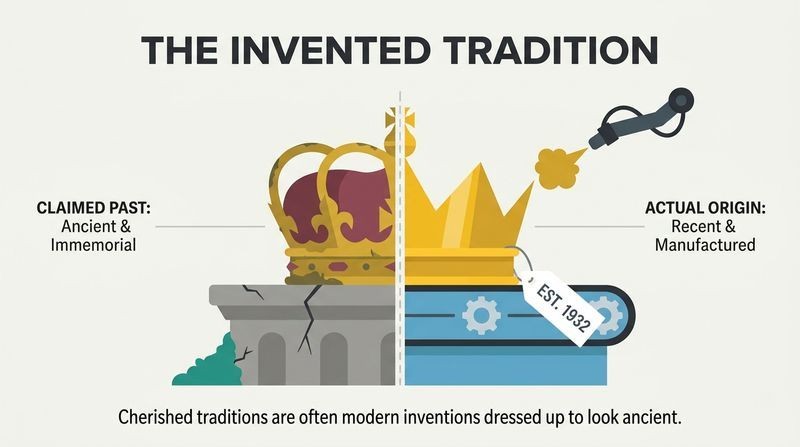
The central thesis. Traditions that claim immemorial antiquity are frequently manufactured, sometimes overnight, sometimes over a few years. Hobsbawm defines an invented tradition as a set of ritual or symbolic practices that instill values through repetition, automatically implying continuity with a suitable historic past, a continuity that is largely fictitious.
The pageantry around the British monarchy feels a thousand years old but took its splendid modern form only in the late nineteenth and twentieth centuries. The Scottish kilt was designed by an English Quaker industrialist after 1707. King's College Cambridge's Festival of Nine Lessons spread only through radio. The royal Christmas broadcast began in 1932. What matters, Hobsbawm insists, is not whether these survive, but the moment they appear and why societies suddenly need them.
What's striking is how this reframes nationalism itself. Benedict Anderson's later concept of nations as imagined communities runs parallel: both argue that collective identity is constructed, not inherited. The claim can be overstated, though. Critics note that invented traditions usually recombine genuinely old materials rather than fabricate from nothing, so the line between invention and organic evolution blurs. Still, the diagnostic value is enormous. Once you learn to ask when a tradition actually began, you notice the trick everywhere: corporate founding myths, national holidays, even university rituals. The instinct to backdate the new as the timeless is nearly universal, and usually revealing of present anxieties.
Distinguish invariant tradition from flexible custom to see who benefits

Tradition freezes, custom flexes. Hobsbawm draws a sharp line. Custom, which governs so-called traditional societies, functions as both engine and flywheel: it sanctions change by dressing it as precedent. A village claiming common land "from time immemorial" is usually asserting present power, not historical fact. Custom cannot afford to be truly unchanging because life is not.
Invented tradition, by contrast, aims at invariance. It imposes fixed, formalized practices. His vivid illustration: in a courtroom, what the judge actually does is custom, while the wig, robe, and ritual paraphernalia are (invented) tradition. Objects gain symbolic power precisely when they lose practical use. Cavalry officers' spurs matter more for tradition once there are no horses. Lawyers' wigs became significant only after everyone else stopped wearing them.
This distinction is the book's sharpest analytical tool, and it echoes debates in anthropology about the difference between living practice and ritualized display. The spurs-without-horses observation anticipates work in semiotics on how signs detach from function to become pure signifiers of status. There is a productive tension worth flagging: the boundary is not always clean. Many practices drift from custom into tradition gradually, and codification (writing custom down) is exactly what freezes it. Colonial administrators did this constantly, turning fluid African practice into rigid law. The lesson for readers: whenever a rule resists all practical justification, ask what social hierarchy its very uselessness protects.
Societies mass-produce traditions when rapid change snaps old social bonds
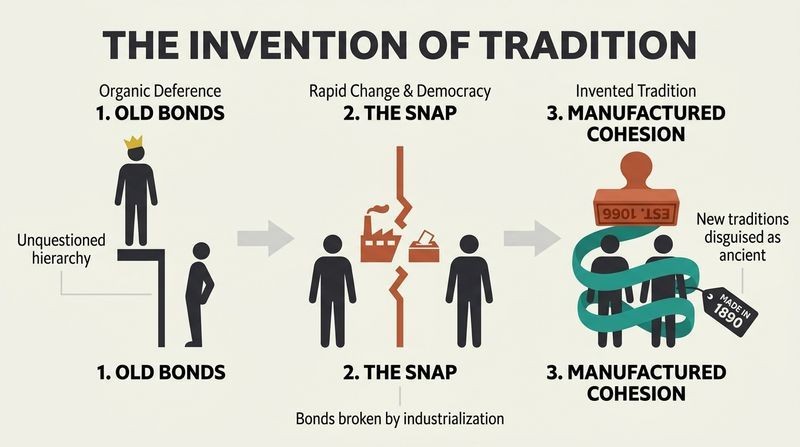
Timing reveals function. Invented traditions cluster when a society transforms so fast that inherited patterns of authority and belonging break down. The three or four decades before 1914 saw an extraordinary global flowering of them, precisely because industrialization, mass migration, and the arrival of mass electoral politics dissolved older ties of rank, corporation, and hierarchy.
When subjects became citizens who voted, rulers faced a new problem: how to secure loyalty from people no longer bound by deference. New devices were needed. Between roughly 1870 and 1914, most European states, plus the Americas, acquired capitals, flags, anthems, and ceremonial paraphernalia. Some, like Italy after unification, started nearly from scratch: "We have made Italy, now we must make Italians." The invention was a response to novelty, disguised as antiquity.
This is Hobsbawm's Marxist historiography at its most persuasive: material change (industry, franchise expansion, urbanization) generates a superstructural crisis of legitimacy, which invented tradition papers over. The framework connects neatly to Durkheim's contemporaneous worry about anomie and his search for a civic religion to bind fragmenting societies. A modern extension: the same mechanism operates in fast-changing organizations and digital communities today, which rapidly generate onboarding rituals, mascots, and origin stories. One caveat: correlation is not proof. Traditions were invented in stable eras too. But the concentration Hobsbawm documents around 1870 to 1914 is genuinely striking and hard to explain any other way.
British royal ritual became magnificent only as real royal power vanished
Pomp replaced power. David Cannadine shows that for most of the nineteenth century, British royal ceremony was shabby and badly managed. At George IV's coronation, prizefighters kept order among guests. Victoria's was unrehearsed; the archbishop jammed the ring onto the wrong finger. The monarch still wielded real political power, which made grand ritual dangerous and unnecessary.
Everything reversed between roughly 1877 and 1914. As the crown lost genuine authority, it gained ceremonial splendor. A politically neutered monarch could safely become the symbolic father of nation and empire. Improved transport made royal coaches romantically anachronistic, a cheap yellow press broadcast the spectacle, and the English musical renaissance (Elgar's "Land of Hope and Glory") supplied the soundtrack. The British then convinced themselves they had always been good at ceremony.
Cannadine's insight inverts intuition: the more decorative the monarchy, the less it actually governs. This maps onto Walter Bagehot's distinction between the dignified and efficient parts of a constitution, and onto the general principle that ceremonial visibility often compensates for eroded substance. The comparative dimension sharpens it: Germany, Russia, and Austria staged grand ritual around monarchs who still held power, and their dynasties were swept away by 1918, leaving Britain the last survivor and therefore seemingly the most traditional. A useful modern parallel: institutions frequently ramp up branding and ceremony precisely as their real influence declines, mistaking symbolic reassurance for restored relevance.
Scotland's kilt and clan tartans were invented after 1707
A national costume built on forgery. Hugh Trevor-Roper's essay is the book's most delicious demolition. Highland culture, far from ancient, was long an impoverished offshoot of Ireland. The kilt as worn today was designed around 1727 by Thomas Rawlinson, an English Quaker ironmaster, who wanted a practical garment for Highlanders felling timber and tending his furnace.
Distinct clan tartans came even later. In 1745 there was no system linking patterns to families; Highlanders bought "the newest patterns." The clan-tartan scheme was largely fabricated for George IV's 1822 Edinburgh pageant, promoted by tartan manufacturers eager for a market, and cemented by the Sobieski Stuart brothers, charming imposters who forged a fifteenth-century manuscript, the Vestiarium Scoticum. The whole apparatus that Scots worldwide now wear with tribal pride is barely two centuries old.
The economic engine here deserves emphasis: a textile firm, Wilson and Son of Bannockburn, had commercial reasons to proliferate differentiated patterns and stimulate competitive demand. Invented tradition, in other words, was partly a marketing operation, a point that resonates loudly in an age of manufactured heritage brands. Trevor-Roper writes with evident relish, and some later Scottish historians have pushed back, arguing he overstated the Irish derivation and understated genuine Highland continuities. Even granting nuance, the core claim stands: the tartan a Texan or Tokyoite wears to feel authentically Scottish descends from an English industrialist, romantic forgers, and a Hanoverian king's costume party.
A dying culture can be resurrected as glorious myth by desperate patriots
Wales rebuilt a past it had lost. Prys Morgan describes a paradox: the same eighteenth-century scholars who mourned the decay of Welsh language, music, and custom were the ones who reinvented it, sometimes wholesale. When genuine tradition proved threadbare, they manufactured a grander one.
The supreme figure was Edward Williams, "Iolo Morganwg," a laudanum-addicted stonemason who invented the Gorsedd of Bards, claiming Welsh poets were heirs of the ancient Druids in unbroken apostolic succession. He staged the first ceremony on Primrose Hill in London in 1792, complete with fabricated rituals and forged medieval poems. The eisteddfod, though genuinely old, absorbed his neo-Druidic pageantry from 1819. Welsh national costume (the tall hat and red cloak) was assembled in the 1830s by Lady Llanover from surviving peasant dress. "Land of My Fathers" dates only to 1856.
Morgan's chapter illuminates a recurring pattern in stateless nations: lacking political institutions, they pour energy into cultural invention, and lacking scholarly gatekeepers, forgery flourishes. He explicitly links Iolo to Macpherson's Ossian in Scotland and Hanka's fake Czech manuscripts, a whole European genre of patriotic fabrication. The comparison to modern identity movements is instructive. When a group feels its distinctiveness eroding, imaginative reconstruction can be psychologically stabilizing even when historically false. Morgan is notably sympathetic, arguing the myth-makers performed a genuine healing function, letting Welsh people lose their real past and regain an inspiring version of it. Invention here is survival strategy, not mere deception.
Colonizers invented African tradition, then trapped Africans inside it
Codification froze fluid custom. Terence Ranger argues that pre-colonial Africa was not a static world of rigid tribes and unchanging custom. People moved between multiple identities: subject of a chief one moment, cult member or clan initiate the next. Boundaries were porous, authority competitive and shifting.
Colonial administrators, disposed by their own neo-traditionalism to respect what looked ancient, misread this flexibility as fixed law. They codified "customary" land rights, tribal membership, and chiefly authority, thereby hardening loose practice into inflexible prescription. "The British wrongly believed Tanganyikans belonged to tribes; Tanganyikans created tribes to belong to." Elders used this invented custom against the young, men against women, chiefs against subjects. The most far-reaching inventions occurred precisely when Europeans believed they were faithfully preserving age-old African ways.
Ranger's chapter became foundational for African studies and later generated its own critique, with Ranger himself revising "invention" toward "imagination" to acknowledge African agency. The deeper point endures: written codification is inherently freezing, because a text cannot flex the way oral practice does. This connects to James Scott's later work on how states impose legibility, simplifying messy reality into administrable categories. There is genuine tragedy in the mechanism: officials sincerely trying to protect indigenous culture instead fossilized a colonial-era snapshot and empowered whoever held authority at the moment of codification. Modern debates over restoring authentic tradition should reckon with how much of it was administratively manufactured.
Britain exported neo-traditions of governance to rule an empire
Command dressed as heritage. In colonial Africa, Ranger shows, Europeans deployed invented traditions to define themselves as natural masters. Surplus "neo-traditional capital" (younger sons steeped in public school, regimental, and university rituals) found no secure place at home, so it shipped out and clung all the harder to gentlemanly status abroad.
These traditions offered Africans clearly marked points of entry, almost always subordinate ones. King's College Budo in Uganda transplanted the English public school onto a Bagandan coronation hill, complete with house spirit and a motto adapted from Cecil Rhodes. African soldiers were drilled into mirror images of British privates. Above all, Britain elevated the monarchy into an almost divine symbol, telling African audiences the king personally knew and cared for each subject, thus dignifying practical collaboration with a shared imperial theology.
The mechanism is subtler than brute force: subordination becomes attractive when it comes packaged with prestige, ritual, and a route to modernity. This anticipates Gramscian analyses of hegemony, rule secured through consent and cultural framing rather than coercion alone. There is a boomerang irony Ranger draws out beautifully. The same socialization that produced obedient subjects also gave nationalists their vocabulary; early independence movements demanded to be treated as the truer heirs of the empire's stated ideals. Kenneth Kaunda drew inspiration from Arthur Mee's Books for Boys. Invented traditions of control thus carried, embedded within them, the tools of their own eventual overthrow.
Mass movements invent rituals from below, not just from above
May Day was not decreed; it grew. Hobsbawm distinguishes political traditions (made by states and organized movements) from social ones (arising among informal groups). But his richest example blurs the line. May Day began in 1890 as a single one-day strike for the eight-hour day, its date borrowed pragmatically. Leaders did not plan it as a festival; some Marxists actively opposed festivity on principle.
Yet the workers themselves demanded annual repetition, and the date's ancient spring symbolism proved irresistible. Red flags, carnations, and poppies appeared spontaneously. It became a quasi-religious holiday, a workers' Easter, its power greatest where it stayed a defiant strike rather than a tame Sunday march. The proletarian flat cap and the football Cup Final similarly crystallized as unplanned badges of working-class identity around 1890 to 1914.
This is the book's crucial corrective to top-down conspiracy theories of culture. Hobsbawm insists that even manipulated traditions succeed only when they broadcast on a wavelength the public is already tuned to. Official attempts to make Kaiser Wilhelm I a beloved founding father flopped; 470 municipalities spontaneously raised Bismarck columns. The distinction matters for anyone studying culture: tastes and fashions are discovered and shaped, not simply imposed. It also complicates his own thesis in a healthy way. If invention requires resonance with felt need, then invented traditions are never purely arbitrary fabrications; they answer real emotional demands, which is exactly why some stick and most fail.
An anxious middle class bonded through sport and patriotism
Belonging engineered through amateurism and flags. Hobsbawm's most speculative chapter tackles a hard case: how does a large, fluid, internally ranked middle class forge identity? Too numerous for club-like intimacy, too divided for class solidarity, it turned to invented markers.
Education became the universal sorting mechanism. Old boy dinners and associations multiplied in the 1890s; the old school tie was invented; American alumni chapters and fraternity houses proliferated. Sport did double duty. Institutionalized between 1870 and 1914 (Wimbledon 1877, the Davis Cup by 1900, the revived Olympics 1896), it drew class lines through rigid amateurism, separating gentlemen from professionalized workers. Tennis notably gave middle-class women their first public individual role. But the deepest bond, Hobsbawm suggests, was nationalism: the middle class recognized itself most easily as the quintessentially patriotic class.
The claim that patriotism functioned as middle-class social cement is provocative and only partly proven, as Hobsbawm concedes. Yet the supporting evidence is suggestive: right-wing nationalist mass organizations in Germany drew overwhelmingly from the middle strata, and German gymnasts abandoned the old liberal tricolor for the imperial black-white-red almost en masse by 1898. The amateur-professional divide as a class filter is a sharp observation, still visible in how elite sports gatekeep. A modern extension: credentialism, brand affiliations, and lifestyle signaling now perform the identity work that old school ties once did for a class that struggles to define itself except by what it is not.
Symbolic language shifted from ornate display to theatrical mass ritual
From statues to stadiums. Hobsbawm notes a change in the very grammar of public symbolism around World War I. The nineteenth century's mania for allegorical statuary and decorated buildings (French "statuomania," Germany's monument-building frenzy) declined suddenly between the wars, alongside the vogue for art nouveau.
What proved durable instead was the theatrical mode: parades, mass gatherings, ritual spaces. New venues appeared for public spectacle, sports stadiums, the Sportspalast, the Vélodrome d'Hiver, purpose-built for crowds. The emphasis moved from elaborate backdrops that could be read like a tapestry toward the movement of the actors themselves, and increasingly toward merging performers and audience. Fascist regimes systematized formal ritual spaces (Red Square from 1918, the Nuremberg grounds), favoring monumental simplicity over Victorian allegorical clutter. This shift, Hobsbawm suggests, tracks the democratization of politics.
The observation prefigures Guy Debord's society of the spectacle and Walter Benjamin's warning about the aestheticization of politics under fascism. When the audience becomes the performer, mass ritual can generate powerful collective emotion, which democratic and totalitarian movements alike learned to exploit. Hobsbawm's contrast between reading a static allegory and participating in a dynamic rite is genuinely illuminating for media history: it anticipates the move from monument to broadcast to interactive spectacle. One might extend it further. Television, then social media, completed the trajectory, dissolving the last distance between spectator and spectacle. The number-plate example he offers half-jokingly hints that future invented traditions would be ever more individualized and consumer-driven.
Analysis
This 1983 anthology, edited by Marxist historian Eric Hobsbawm and Africanist Terence Ranger, launched a phrase and a research program that reshaped the humanities. Its structure, a theoretical introduction followed by six case studies (Scottish kilts, Welsh Druids, British monarchy, Victorian India, colonial Africa, and late-Victorian Europe), gives it both conceptual force and empirical texture, though the anthology form means quality and argument vary across contributors.
The book's enduring power lies in a single reframing: that continuity with the past is often a claim, not a fact, and that studying when and why such claims arise reveals present-day power struggles otherwise invisible. This is historicism turned into a diagnostic instrument. Hobsbawm's materialist reading, tradition invented to manage the legitimacy crises of industrial capitalism and mass democracy, remains compelling, and his insistence that manipulation succeeds only when it meets genuine popular need saves the argument from crude functionalism.
Three tensions deserve flagging. First, the invention-versus-evolution boundary is porous; most invented traditions recombine authentic materials, so the rhetoric of pure fabrication can mislead. Second, the emphasis on elite manufacture underplays popular agency, a critique Ranger himself later accepted, softening "invention" toward "imagination." Third, the concept risks overuse: if everything is invented, the category loses discriminating value.
Still, the book anticipated and complements Benedict Anderson's Imagined Communities (also 1983), Ernest Gellner on nationalism, and later James Scott on state legibility. Its influence radiates into heritage studies, brand history, and debates over authenticity in an age of manufactured nostalgia. The Scottish and Welsh chapters are irresistible intellectual entertainment; the African chapter carries the heaviest political stakes, exposing how colonial codification manufactured the very tribalism later blamed on Africans. Read today, the volume trains a permanently useful reflex: whenever an institution invokes timeless tradition, ask what recent anxiety that invocation is working to soothe, and whom the fiction serves.
Review Summary
The Invention of Tradition, edited by Eric Hobsbawm and Terence Ranger, examines how many supposedly ancient traditions were actually invented relatively recently. The collection of essays explores British monarchy ceremonies, Scottish kilts and tartans, Welsh cultural symbols, and colonial traditions in India and Africa. Reviews praise Hobsbawm's accessible theoretical framework explaining how traditions emerge during rapid social change to create cohesion and legitimize authority. While some find certain chapters dry or overly specific to British history, most appreciate the book's eye-opening analysis of how societies construct their cultural identities and pasts.
People Also Read


FAQ
1. What is The Invention of Tradition by Eric J. Hobsbawm about?
- Core argument: The book investigates how many traditions that seem ancient are actually recent inventions, often deliberately created to serve social, political, or cultural purposes.
- Scope and context: It focuses on Europe and colonial Africa from the 19th to early 20th centuries, examining how invented traditions shaped national identity, authority, and social cohesion.
- Interdisciplinary approach: Historians and anthropologists contribute to understanding the mechanisms and impacts of invented traditions in modern societies.
- Challenging assumptions: The work questions the authenticity of traditions and highlights their role in legitimizing institutions and managing change.
2. Why should I read The Invention of Tradition by Eric J. Hobsbawm?
- Critical perspective: The book offers a fresh lens for understanding how societies construct and manipulate traditions to maintain power and social order.
- Relevance to modern issues: It provides insight into nationalism, colonialism, and the creation of collective identities, which remain pressing topics today.
- Challenging historical narratives: Readers are encouraged to question accepted histories and recognize the fluidity and inventiveness of cultural practices.
- Broader implications: The analysis helps explain how traditions can be both tools of control and sources of resistance or renewal.
3. What are the key takeaways from The Invention of Tradition by Eric J. Hobsbawm?
- Traditions are often recent: Many practices presented as ancient are actually modern inventions, created to address new social needs or legitimize authority.
- Role in nation-building: Invented traditions are central to the formation of national identities, especially in times of rapid change or crisis.
- Social cohesion and hierarchy: These traditions help establish group membership, reinforce hierarchies, and socialize individuals into specific roles.
- Colonial and imperial dynamics: In colonial contexts, invented traditions were used to control, socialize, and sometimes empower both colonizers and the colonized.
4. How do Hobsbawm and Ranger define "invented tradition" in The Invention of Tradition?
- Formal definition: Invented tradition is a set of practices, governed by accepted rules and of a ritual or symbolic nature, which seek to inculcate values and norms by repetition, implying continuity with the past.
- Artificial continuity: These traditions often create a factitious link to history, presenting themselves as ancient when they are not.
- Purposeful creation: They are typically established in response to novel situations, especially during periods of rapid social transformation.
- Examples provided: The royal Christmas broadcast and the British Football Cup Final are cited as invented traditions.
5. What are the main types of invented traditions identified in The Invention of Tradition by Eric J. Hobsbawm?
- Social cohesion: Traditions that foster group identity and a sense of belonging, often the most prevalent type.
- Legitimizing authority: Practices that establish or reinforce institutions, status, or hierarchical relations.
- Socialization: Traditions aimed at inculcating beliefs, values, and norms of behavior, shaping individuals’ roles within society.
- Overlap and prevalence: These types often overlap, with social cohesion usually encompassing elements of the other two.
6. How do invented traditions differ from customs and routines according to The Invention of Tradition?
- Tradition vs. custom: Traditions are formalized, ritualized, and aim for invariance, while customs are flexible and evolve over time.
- Tradition vs. routine: Routines are pragmatic and lack symbolic or ritual significance, unlike traditions which are ideologically charged.
- Symbolic paraphernalia: Traditions often involve symbolic objects or dress that transcend practical use.
- Function and change: Customs and routines adapt to practical needs, whereas traditions resist change to maintain perceived continuity.
7. How does The Invention of Tradition by Eric J. Hobsbawm explain the role of invented traditions in modern nationalism and statehood?
- Nation as a construct: Modern nations use invented traditions—flags, anthems, ceremonies—to claim ancient origins and legitimize themselves.
- Social engineering: Nationalism often involves deliberate creation and promotion of traditions to foster unity and loyalty.
- Legitimizing authority: Invented traditions provide legitimacy to new or changing institutions, especially during state formation.
- Historians’ influence: The book highlights how historians and intellectuals contribute to constructing national myths and images.
8. What are some key examples of invented traditions in Britain and its monarchy discussed in The Invention of Tradition?
- Royal ceremonial evolution: British royal rituals, such as coronations and jubilees, were reinvented or formalized in the 19th and 20th centuries to symbolize continuity and imperial authority.
- Scottish Highland tradition: The kilt and clan tartans, often seen as ancient, were largely invented in the 18th and 19th centuries to create a romanticized Scottish identity.
- Welsh cultural revival: The eisteddfod and Gorsedd of Bards were revived or invented to foster Welsh national identity during the Romantic period.
- Media and spectacle: The rise of mass media and public ceremonies helped popularize and legitimize these invented traditions.
9. How did invented traditions function in colonial and imperial contexts according to The Invention of Tradition by Eric J. Hobsbawm?
- Imposition of European models: Colonial powers introduced military, educational, and religious traditions to assert control and create social hierarchies.
- Legitimizing colonial authority: Invented rituals and symbols were used to co-opt local rulers and present colonial rule as legitimate and continuous with the past.
- African adaptation: African elites and communities sometimes adopted, adapted, or resisted these traditions, using them for their own purposes.
- Creation of ethnic identities: Colonial authorities and African elites invented or codified tribal identities and customs to facilitate indirect rule.
10. What role did education and missionary schools play in the invention of tradition in colonial Africa, as described by Hobsbawm?
- Socialization into neo-traditions: Mission schools inculcated British public school values, discipline, and loyalty among African elites.
- Formation of a ruling class: Education was used to train Africans for subordinate administrative roles, reinforcing colonial hierarchies.
- Ambiguity and resistance: While fostering loyalty, education also enabled Africans to reinterpret traditions and challenge colonial authority.
- Cultural blending: Educated Africans blended European and indigenous traditions, sometimes fostering nationalist movements.
11. How does The Invention of Tradition by Eric J. Hobsbawm relate the concept of invented tradition to broader social and political changes in Europe (1870–1914)?
- Mass production of traditions: The late 19th and early 20th centuries saw a surge in the deliberate creation of traditions to foster national identity and social cohesion.
- Role of state and education: Governments institutionalized public holidays, monuments, and rituals to bind citizens to the nation.
- Class and nationalism: Invented traditions helped define class identities, especially among the middle classes, and were central to the rise of mass politics.
- Response to modernization: These traditions addressed anxieties and disruptions caused by rapid social and technological change.
12. What are the best quotes from The Invention of Tradition by Eric J. Hobsbawm and what do they mean?
- On invented tradition: “Invented tradition is taken to mean a set of practices, normally governed by overtly or tacitly accepted rules and of a ritual or symbolic nature, which seek to inculcate certain values and norms of behaviour by repetition, which automatically implies continuity with the past.”
This quote encapsulates the book’s central definition and the artificial nature of many traditions. - On social change: “Invented traditions are symptoms and evidence of fundamental social and political change.”
Hobsbawm highlights that the creation of new traditions often signals deeper transformations in society. - On the role of history: “The past, real or invented, is an essential element in these exercises.”
This underscores how history—whether factual or constructed—is used to legitimize present-day practices and institutions. - On the function of tradition: “The object and characteristic of ‘traditions’, including invented ones, is invariance.”
This points to the resistance to change that defines traditions, even when their origins are recent and artificial.
About the Author
Other books by Eric J. Hobsbawm

Download PDF
Download EPUB
.epub digital book format is ideal for reading ebooks on phones, tablets, and e-readers.








































