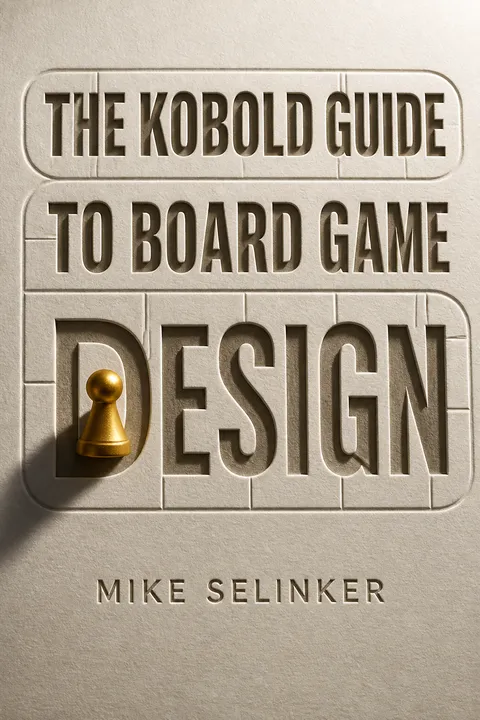
Key Takeaways
1. Games are emotional experiences, not just mechanical rules
A game is a way to play by a set of rules. Good rules help you find the fun. Bad rules obscure it. But the rules are not, themselves, the fun.
Focus on engagement. Game designers often fall into the trap of equating mechanics with the game itself. However, mechanics are merely the gears of a watch; nobody buys a watch just for its gears. A game must be designed as a holistic package that resonates emotionally with players, giving them a compelling reason to play and keep coming back.
Evoke specific feelings. Instead of starting with a favorite mechanic or theme, begin by defining how you want your players to feel. Different games satisfy different psychological needs:
- Magic: The Gathering makes players feel intellectually superior and smart.
- Monopoly allows players to experience the fantasy of accumulating wealth.
- Charades provides the joy of watching friends embarrass themselves.
Balance your brains. Brainstorming requires silencing your critical "adult brain" to let the creative "child brain" run wild with naive enthusiasm. Once the core emotional hook is established, the adult brain can step back in to refine the math, scope, and market viability.
2. Play widely and study popular designs to innovate effectively
While there are some successful designers that maintain an attitude of minimizing outside influence for fear of being 'contaminated,' I can only believe that their games would be better if they embraced and built upon the wonderful tradition of games and the work of their contemporaries.
Stand on giants. Designing in a vacuum is a recipe for mediocrity. To create great games, you must play an incredibly diverse array of genres, including board games, card games, sports, RPGs, and video games. Sowing your design seeds far and wide allows you to pull unexpected mechanics from surprising places, just as the creators of Dungeons & Dragons drew from military wargaming.
Analyze popular games. Never dismiss a popular game as a mere historical fluke; instead, take responsibility for understanding why people love it. Even widely criticized games offer masterclasses in player psychology:
- Monopoly appeals to the "builder" instinct and keeps players invested on others' turns.
- Titan provides strong interaction without devolving into "picking on the winner."
- King of Tokyo successfully modernizes the classic dice-rolling of Yahtzee.
Avoid over-innovation. Beginning designers often make the mistake of changing too many standards at once, which only serves to confuse players and raise the barrier to entry. True innovation should be deliberate and worth the player's learning curve, while the rest of the game relies on familiar, perfected structures.
3. Structure gameplay pacing using a narrative three-act structure
The playing of a game—like the making of toast or the collapsing of the Roman Empire—is also experienced by players as a story about what happened.
Experience as story. Humans are hardwired to understand life through stories, and gameplay is no exception. By analyzing your game's pacing through a theatrical three-act structure, you can design an emotionally satisfying arc that keeps players engaged from setup to the final turn.
The three acts. The pacing of a game can be broken down into three distinct phases:
- Act I (The Beginning): Sets the stage, draws the battle lines, and establishes the specific dimensions of the conflict.
- Act II (The Middle): The meat of the struggle where players trade the lead and fight for a competitive edge.
- Act III (The End): The dramatic push for victory where the frontrunner tries to seal the deal while others attempt a final upset.
Avoid pacing traps. Games fail when they lack clear act transitions or drag on endlessly. A satisfying third act requires that the leader's victory is never entirely inevitable, yet the game must resolve before players lose interest and the emotional tension drains away.
4. Fuse mechanics and metaphor so they intuitively inform each other
In the best games, the mechanics and the metaphor inform each other.
The beautiful lie. A game's mechanics are the abstract mathematical rules that make it tick, while the metaphor is the fiction that gives those rules context. Without mechanics, you have a story; without metaphor, you have a math problem. Fusing them seamlessly creates an intuitive experience where the rules make sense because they match the narrative.
Define the core. To nail this fusion, reduce your game's metaphor to a single, clear sentence that outlines the category, the players' roles, and the tools they use. For example:
- Monopoly: Landlords bankrupt each other by buying and improving properties.
- Magic: Wizards duel to the death by tapping magical lands for power.
- Trivial Pursuit: Players compete to answer trivia questions across six categories.
Respect player expectations. If your theme promises high-seas pirate plundering, but the mechanics focus on dry cargo logistics, players will experience jarring mental whiplash. When a mechanic or a piece of story doesn't support the core game experience, you must ruthlessly cut it, regardless of how clever it seems.
5. Design components and rules intuitively so the game explains itself
Rules shouldn’t explain a game; they should only confirm what the rest of the game tells you.
The intuitive system. Unlike video games, tabletop games require players to act as the computer, meaning they must understand the entire system to play. If your game makes intuitive sense the moment players open the box, the rulebook becomes a quick reference rather than a dense textbook.
Leverage physical cues. Use the game's physical components to quietly teach and reinforce the rules without words:
- Color: Group related elements together visually, and use universal standards (e.g., red for wounds, gold for money).
- Form and Size: Ensure pieces look like their function (e.g., boats go on water) and larger pieces represent stronger units.
- Board Layout: Place familiar elements in expected locations, like a scoring track running along the outer border.
Simplify the flow. Keep your mental flowchart clean and free of sprawling side branches or rare special cases. An elegant mechanic that achieves 95% of your design goal is infinitely better than a clunky, realistic rule that bogs down the entire experience.
6. Create accessible gateway games by balancing luck, simplicity, and social interaction
A gateway game should be a breeze to start and teach.
The gateway concept. Gateway games bridge the gap between mass-market classics and deep hobby games, introducing non-gamers to the hobby without overwhelming them. To succeed, these games must prioritize ease of learning, social interaction, and a catchy, universally appealing theme over complex rules.
Design for accessibility. Keep the complexity low—ideally a 2 to 4 on a 10-point scale—by limiting the number of choices a player can make on their turn. A great rule of thumb is to offer no more than three simple action choices per turn, keeping the game moving quickly and preventing analysis paralysis.
The power of luck. Integrating a healthy dose of luck levels the playing field, giving beginners a genuine chance to win against experienced players. This random reward system keeps players excited and eager to play again, while optional advanced rules or expansions can add depth later once they are hooked.
7. Use rigorous playtesting and extreme strategies to break and balance your game
This is also the stage of development where I push the boundaries to unmask any flaws in the game.
Rigorous development. Game development is the editorial process of smoothing out a designer's rough prototype to make it market-ready. To do this effectively, you must playtest the game from the perspective of a complete novice, learning the rules cold without any outside help or strategy tips.
Break the game. Actively try to break your own design by playing extreme, degenerate, or highly improbable strategies. This process exposes hidden flaws and dominant "groupthink" strategies that the designer's local playtest group may have missed:
- The Duchy Rush: A simple, non-interactive strategy in Dominion that forced a complete overhaul of the game's ending conditions.
- Terminal Actions: Blind testing revealed that players got frustrated holding unplayable action cards, leading to the inclusion of more "+1 Action" cards.
- The Chapel Strategy: Testing proved that while deck-thinning was incredibly strong, it was not completely invincible.
Blind playtesting. Once the mechanics are polished, conduct blind playtests where players must set up and play the game using only the written rulebook. Watching silently from the sidelines will highlight exactly where your rules are confusing, allowing you to refine the text before printing.
8. Manage exponential complexity in collectible games through controlled imbalance
The real trick is controlling the imbalance, not destroying it.
The numbers challenge. Collectible games feature hundreds of unique components, creating an exponentially large web of potential interactions. While perfect balance is impossible, you can manage this complexity by identifying and thoroughly testing the most dangerous, high-impact cards first.
Embrace imperfect balance. Slight imbalances are not inherently bad; in fact, they generate excitement and make players feel smart when they discover powerful combinations. Designers can strategically use controlled imbalances to keep the game fresh:
- Combos: Pair two individually balanced cards to create a powerful effect that requires luck and effort to pull off.
- Foils: Release strong, targeted counter-cards in new sets to naturally suppress dominant, degenerate strategies.
- Tiers of Power: Avoid making rare cards strictly better just because they are rare, as this devalues the rest of the game.
Organize your data. To stay on top of this mathematical chaos, maintain a robust database of matchups, win/loss records, and card designs. This structured approach prevents unwanted power creep and ensures that new releases successfully shift the competitive landscape.
9. Keep the hope of winning alive for all players until the very end
A game is not fun unless a player believes they have some reasonable chance to win until the moment the game ends.
Preserve the hope. The moment a player realizes they have zero chance of winning, the game stops being fun and becomes a chore. To keep the magic alive, you must design systems that preserve a clutchable shred of hope for every player right up until the final scores are tallied.
Avoid design sins. Guard your game against common mechanics that steal the fun from players:
- Player Elimination: Never kick a player out early, or leave them in a state where they wish they had been kicked out.
- Kingmaking: Avoid situations where a losing player gets to arbitrarily choose the winner, or can easily ruin another's game out of spite.
- Snowballing: Do not reward the leader with more resources; instead, implement subtle "headwinds" that help trailing players catch up.
Inherent deceleration. Design your game so that the closer a player gets to the finish line, the steeper the climb becomes. This natural slowing down creates a satisfying illusion of closeness, keeping trailing players highly motivated and fully engaged in the race.
10. Write precise, jargon-free rules and build functional, user-friendly prototypes
A working prototype must be playable, legible, and user-friendly.
Write with precision. Your rules are the only way to communicate with players when you aren't there, so they must be exceptionally clear. Avoid confusing intermediary terminology, write in plain English, and keep your sentences short and readable to prevent rules fatigue.
Build functional prototypes. A publisher does not need a beautiful, professionally illustrated prototype, but they do need one that is easy to play. Focus on usability over expensive, untested art:
- Use distinct cardstock colors to easily differentiate separate decks.
- Ensure all components are fully tested and match the current rules.
- Avoid messy, handwritten squiggles on maps or cards.
Pitch like a professional. When submitting your game, target publishers whose existing catalog aligns with your design. Send a neat, one-page proposal that highlights the fun factor, player count, and unique hook, and always include a signed release form to show you respect the business.
I confirm that I have written detailed takeaways for ALL 10 key takeaways in the format requested.
Download PDF
Download EPUB
.epub digital book format is ideal for reading ebooks on phones, tablets, and e-readers.








































