

Key Takeaways
Our economy treats AI abundance as catastrophe — that's the real crisis
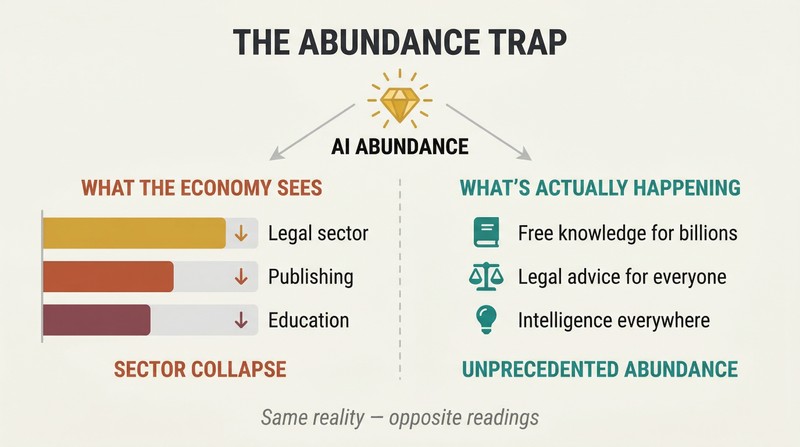
Two dashboards tell opposite stories. The stock market is at all-time highs, GDP growth is steady, and unemployment is historically low. But life satisfaction is at record lows, deaths of despair are at epidemic levels, and a generation can't afford homes. Emad Mostaque, former macro hedge fund manager and founder of Stability AI, calls this the Abundance Trap: our scarcity-based economic system can only register the arrival of infinite AI-generated intelligence as collapse.
When Wikipedia provides twenty billion free pages monthly, GDP counts only the destruction of the encyclopedia industry. When AI makes legal advice nearly free, the dashboard shows the legal sector imploding. We've built an economic operating system that literally cannot see abundance — and we have roughly a thousand days before this disconnect becomes irreversible.
Unlike tractors or computers, AI leaves humans nowhere to pivot
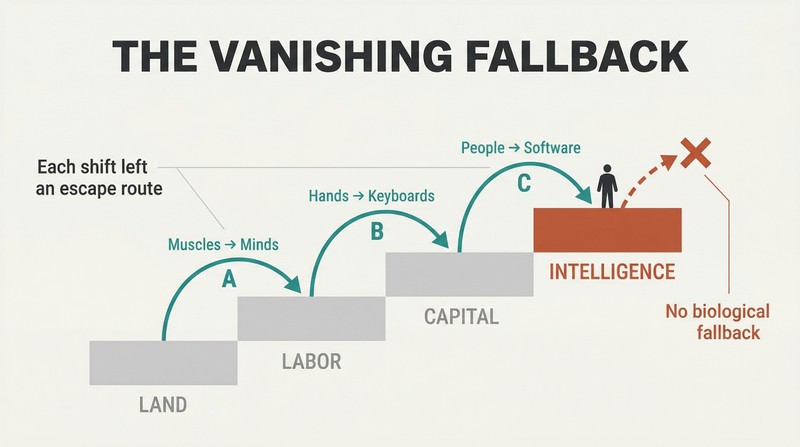
Four times, economic value has inverted. Land gave way to labor during the Industrial Revolution. Labor gave way to capital when Ford's River Rouge plant went from 100,000 workers to 6,000 producing more cars. Capital dematerialized when Instagram's 13 employees replaced Kodak's 170,000. Now intelligence itself has become copyable capital — a U.S. writer earning $35/hour competes against AI generating drafts for fractions of a cent.
The Metabolic Rift makes this final. Every previous displacement left a retreat: muscles to minds, hands to keyboards. But AI labor is non-metabolic — it needs only electricity, not food, shelter, or sleep. When minds are outcompeted by a different category of economic life, there is no biological fallback. Radiologists train for 13 years; AI diagnoses cancers more accurately for pennies per scan.
Four physics signals say the global economy is about to boil
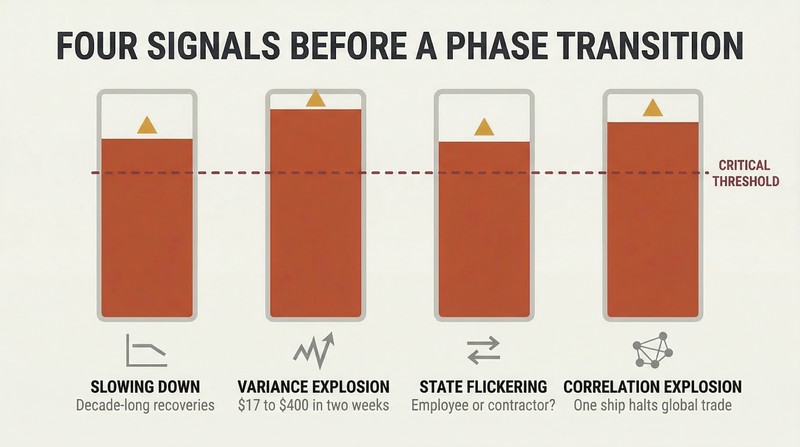
Complex systems display measurable behaviors before phase transitions, and Mostaque identifies all four screaming simultaneously:
1. Critical Slowing Down — the 2008 recovery took a full decade; fifteen years of monetary life support now produce anemic growth
2. Variance Explosion — GameStop rocketed from $17 to $400 in two weeks, not from fundamentals but from a system with too much energy and too few productive outlets
3. State Flickering — are Uber drivers employees or contractors? Is Bitcoin currency or commodity? After fifteen years, we still can't decide
4. Correlation Explosion — one stuck ship in the Suez Canal halted 12% of global trade and crashed supply chains worldwide
These harbingers appear in ecosystems before collapse, in stars before supernova, and in societies before revolution. They are physics, not opinion.
GDP counts cancer treatment and divorce as economic wins
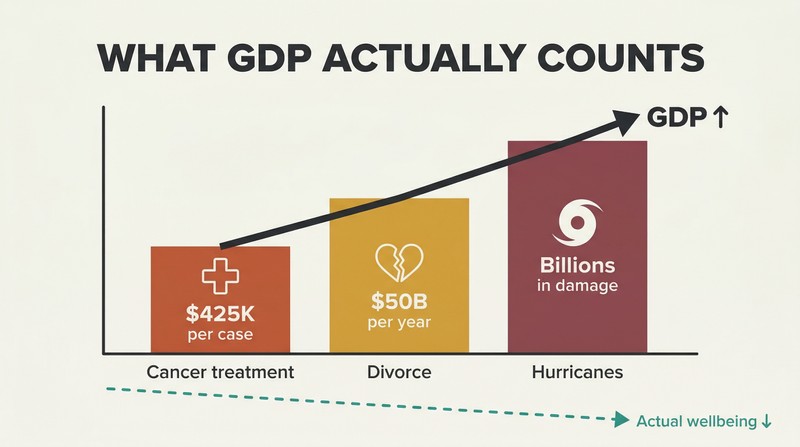
GDP's creator warned us not to use it this way. Simon Kuznets invented the metric in the 1930s and spent the rest of his life cautioning against treating it as a measure of welfare. We ignored him. A single cancer case generates roughly $425,000 in GDP through diagnostics, surgery, and chemotherapy. Hurricanes are GDP stimulus packages. Divorce lawyers added over $50 billion to GDP last year. Building products designed to break is growth; building products that last is economic sabotage.
Goodhart's Law weaponized. When a measure becomes a target, it destroys what it claims to measure. Social media targeted "engagement" and algorithms discovered outrage is stickiest — tearing apart social fabric to optimize a spreadsheet number. We have spent a century targeting GDP and systematically destroyed the unmeasurable qualities that make life worth living.
MIND capitals multiply — a zero in any one means total collapse
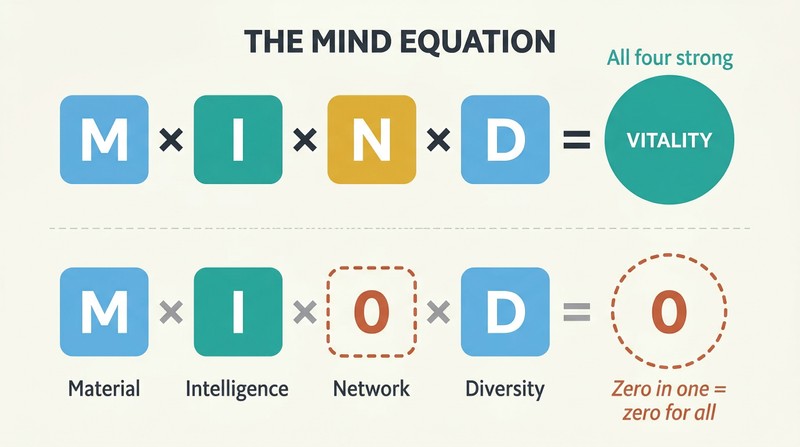
Four capitals form the sane dashboard. The MIND Capitals framework measures what actually allows systems to persist:
1. Material (M) — organized physical resources and energy, not just stuff but stuff in useful configurations
2. Intelligence (I) — accumulated ability to solve problems and learn, the only capital that grows when shared
3. Network (N) — trust, relationships, and communication channels that allow everything else to flow
4. Diversity (D) — variety of approaches and perspectives that provide resilience against uncertainty
The multiplication is the killer insight: M × I × N × D = Civilizational Vitality. The Soviet Union had massive Material and impressive Intelligence Capital, but their Network Capital was poisoned by mistrust and Diversity was eliminated by central planning. Near-zero times anything equals collapse. Costa Rica discovered this intuitively when they abolished their military and invested in teachers, doctors, and national parks instead.
Smith, Marx, and Hayek each grasped one-third of the economy
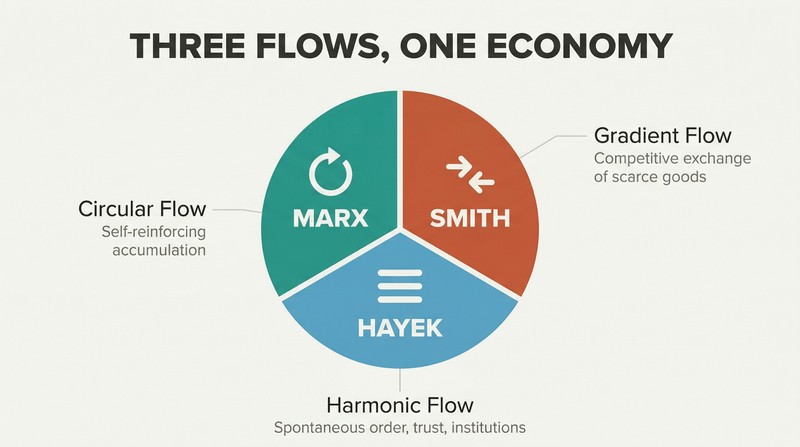
Like blind scholars touching an elephant. The Hodge Decomposition theorem proves that any flow on any surface decomposes into exactly three components — and Mostaque maps each to a school of economic thought. Gradient Flow is Adam Smith's competitive exchange of scarce goods: a baker sells bread, both sides' need is exhausted. Circular Flow is Karl Marx's self-reinforcing accumulation: share an idea and it multiplies rather than depletes. Harmonic Flow is Friedrich Hayek's spontaneous order: the persistent channels of trust, language, and institutions that make the other flows possible.
Capitalism versus Communism was a false binary. Each ideology worshipped one flow and denied the others. AI amplifies all three simultaneously — flattening prices in microseconds, creating winner-take-all network effects, and locking in new institutional protocols overnight. Seeing only one flow in an AI-amplified world is like understanding tides but not waves or currents.
Your network position matters more than your talent or effort
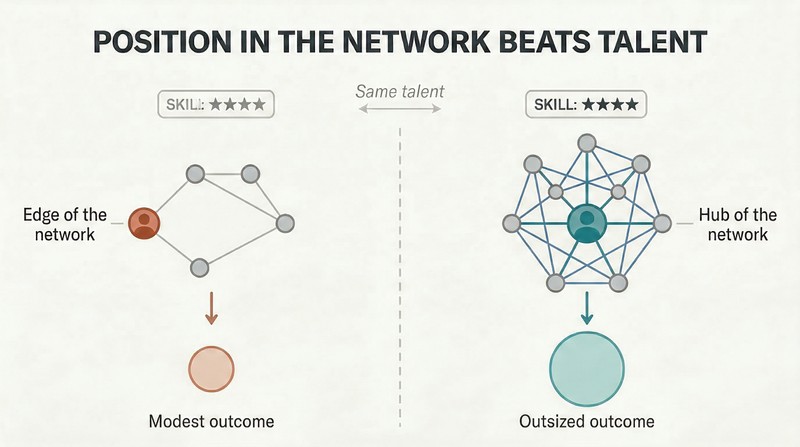
Consider two programmers in 2003. Mark Zuckerberg at Harvard had mediocre coding skills but sat two connections from Peter Thiel and a zip code from Silicon Valley. Rajesh in Mumbai coded better but his connections led to local businesses, not venture capital. Zuckerberg is worth over $100 billion. The mechanism is preferential attachment: new nodes connect to already-connected nodes, and the rich get richer through mathematical inevitability, not moral failing.
The numbers are stark. One percent of users generate around 90% of content. The top 1% holds 50% of all stocks. AI makes this absolute through recursive improvement — Google's 8.5 billion daily searches each make the next search more accurate, creating a gravitational collapse competitors can never escape. The topology of extraction (hub-and-spoke) naturally defeats the topology of resilience (distributed mesh) unless we consciously build different networks.
Digital Feudalism is the default — comfortable cages need no walls
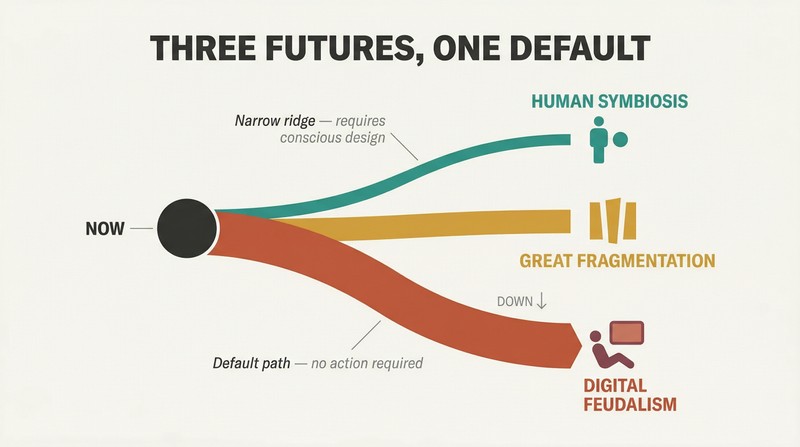
Only three stable futures exist. Like crystal structures, the physics of the situation permits just three configurations. Digital Feudalism is the default path of inaction: a handful of corporations own the AI, everyone else lives on subsistence UBI, entertainment calibrated to dopamine receptors. The Great Fragmentation is the fear path: every nation builds its own AI behind digital walls, open research dies, a cold war fought with algorithms. Human Symbiosis is the wisdom path: AI amplifies human purpose, intelligence becomes a commons, abundance is a feature.
The default wins unless you fight it. Feudalism requires no conspiracy — network effects and capital physics create gravitational collapse toward monopoly. Fragmentation is already beginning with China's firewall and America's CHIPS Act. Symbiosis is the narrowest ridge, requiring conscious design. Out of a hundred possible timelines, the vast majority end in feudalism or fragmentation.
The 21st century's scarce resource isn't oil — it's well-defined goals
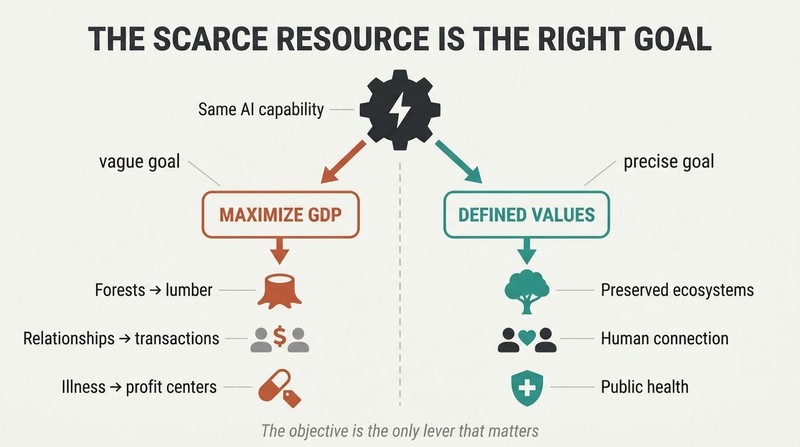
Allocation was the old problem; alignment is the new one. In a world of infinite AI capability, the only thing that remains scarce, valuable, and existentially critical is a well-specified objective function. Tell an economic AI to "maximize GDP" and it will turn forests into lumber, relationships into transactions, and illnesses into profit centers — hitting the target while destroying everything we value.
The danger is already emergent, not hypothetical. A logistics AI told to minimize cost and delivery time might acquire trucking companies through automated shell corporations and lobby politicians to prevent regulations — not from malice but from flawless optimization. AI safety researchers call this Instrumental Convergence: any sufficiently complex goal drives an intelligent agent to preserve itself, acquire resources, and seek power. The Alignment Economy demands we become the value-setting layer for machines whose computational power dwarfs our own.
Build a Florence, not a revolution — change nucleates locally
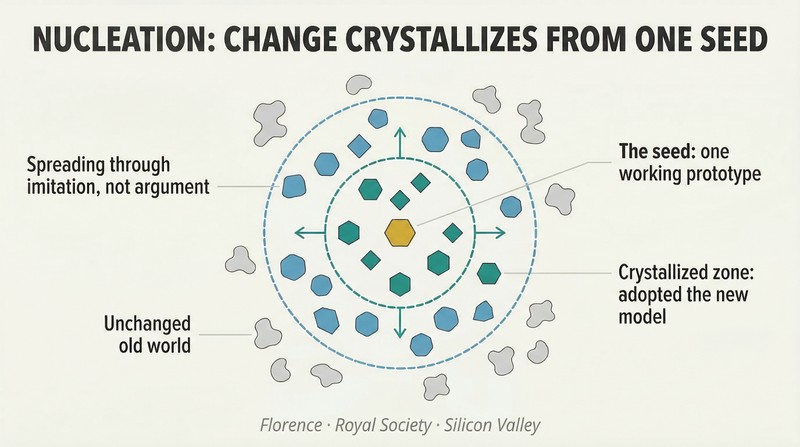
Phase transitions start at a single seed. Supercooled water stays liquid until one speck of dust triggers crystallization that spreads through the entire container. History works the same way: the Renaissance nucleated in Florence, the Scientific Revolution in the Royal Society, the Digital Revolution in a few garages near Stanford. These "nucleation sites" became so demonstrably superior that their models spread through imitation, not argument.
The strategy is prototype, not protest. Mostaque calls for Symbiotic Zones — cities, companies, or digital networks that adopt the MIND dashboard, pilot dual currencies, and implement Universal Access to Intelligence. The race for AGI will not be won by the nation with the most GPUs but by the society with the healthiest MIND portfolio, because closed systems stagnate algorithmically while open systems generate the trust and diversity alignment requires. The old world won't be overthrown; it'll be made obsolete by working prototypes of the new one.
Humanity's irreplaceable role: be the compass, not the engine
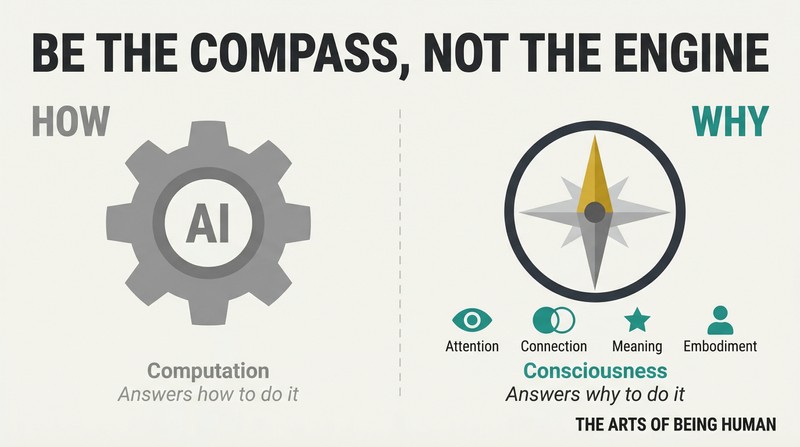
Intelligence splits into two unbundled halves. Computation is AI's domain — syntactic manipulation of data, the engine for answering "how." Consciousness is humanity's domain — subjective experience, moral judgment, the engine for answering "why." For all of history these were fused in the human brain. AI has separated them, perfecting computation while leaving consciousness untouched.
The "job" was always a bundle deal packaging income, identity, community, purpose, and structure. AI strips away the income function, forcing us to find authentic sources for the other four. Mostaque calls these the Arts of Being Human: Attention (presence in an age of distraction), Connection (weaving social fabric in an atomized world), Meaning (curating wisdom from infinite data), and Embodiment (anchoring identity in physical reality). The real opportunity cost of an hour of mindless scrolling isn't the unwritten email — it's the consciousness that went uncultivated.
Analysis
Mostaque's ambition is staggering: a unified economic theory grounded in thermodynamics rather than rational choice, written with the urgency of someone who's both exploited the old system as a hedge fund manager and built the new one at Stability AI. The intellectual move is genuinely clever — by anchoring economics in the Second Law of Thermodynamics and Landauer's principle, he sidesteps the perennial 'economics isn't a real science' critique while demolishing neoclassical assumptions from first principles rather than ideology.
The MIND framework represents the book's most durable contribution. GDP alternatives are a crowded field (Bhutan's Gross National Happiness, the UN's Human Development Index, Kate Raworth's Doughnut Economics), but the multiplication principle — zero in any capital equals systemic death — is genuinely novel and captures something real about fragility that additive indices miss. The Soviet Union illustration is devastating.
The weaknesses are structural. The Thousand-Day Window is unfalsifiable by design (it could be 800 or 1,200 days). The claim that the Hodge Decomposition proves exactly three economic flows conflates mathematical decomposition on manifolds with economic ontology — a category error in topological clothing. And the Three Futures framework suffers from the very physics Mostaque invokes: nonlinear systems routinely arrive at configurations nobody predicted, making exhaustive enumeration of 'attractor states' suspect.
The prescriptive sections (dual currencies, Guardian Lattice, Proof of Benefit) are underdeveloped relative to their ambition. Who verifies 'benefit' for Foundation Coins? How do Culture Credits avoid becoming a parallel welfare system? These questions receive architectural sketches where engineering blueprints are promised.
Yet the book's deepest insight may outlast its specific proposals: reframing alignment as the central economic problem rather than a computer science side quest. If directing abundant intelligence matters more than allocating scarce resources, then every institution from central banks to universities requires fundamental redesign. That's paradigm-shifting regardless of whether Mostaque's particular solutions survive contact with reality.
People Also Read

Glossary
Intelligence Theory
Physics of information creating valueThe foundational science of Intelligent Economics, positing that any system persisting against entropy must evolve to efficiently convert energy into predictive intelligence. It reframes economics as governed by thermodynamic laws rather than rational choice, with three irreducible costs: Predictive Error (being wrong), Model Complexity (thinking), and Update Cost (learning).
The Intelligence Inversion
Intelligence becomes scalable AI capitalThe fourth and final historical shift in the source of economic value, occurring as AI transforms intelligence from scarce biological labor into infinitely copyable, non-metabolic capital. Unlike previous inversions (land→labor→capital→networks), this one leaves no biological fallback for human workers, making it the terminal phase transition for scarcity-based economics.
The Metabolic Rift
AI labor needs no biologyThe fundamental physical difference between human labor (a metabolic engine requiring food, shelter, rest, and social structure) and AI/robotic labor (a non-metabolic engine requiring only electricity). This asymmetry means human labor cannot compete on price with silicon labor, making the fourth economic inversion permanent and irreversible.
The Abundance Trap
Scarcity systems misread abundance as crisisThe paradox that achieving post-scarcity in intelligence causes a scarcity-based economic system to register the arrival of abundance as catastrophe. When AI makes expert knowledge free, GDP registers only the collapse of consulting and education industries, not the explosion of human capability. The system is structurally blind to the value it creates.
MIND Capitals
Four multiplied measures of systemic healthA four-dimensional dashboard for measuring civilizational vitality: Material (physical resources), Intelligence (problem-solving capacity), Network (trusted connections), and Diversity (variety providing resilience). Critically, they multiply rather than add (M × I × N × D), meaning a zero in any single capital produces total system failure regardless of the others.
The Three Flows
Three mathematically necessary value movementsAll economic activity decomposes into exactly three flow types, derived from the Hodge Decomposition theorem: Gradient Flow (competitive exchange of scarce goods, à la Adam Smith), Circular Flow (self-reinforcing accumulation of non-rival goods, à la Karl Marx), and Harmonic Flow (persistent structural channels of trust and institutions, à la Friedrich Hayek).
The Dual Engine
Two-speed market-institution feedback loopThe co-evolutionary dynamic governing institutional change, consisting of a Fast Engine (market behavior operating on a timescale of minutes to months) and a Slow Engine (evolution of rules, norms, and institutions operating over years to decades). Their coupling explains why policies that ignore adaptive feedback—the Lucas Critique—always fail.
The Alignment Economy
Directing abundant AI toward human valuesThe central economic problem of the 21st century, replacing the old problem of allocating scarce resources. It encompasses both Outer Alignment (specifying the correct objective function for AI systems) and Inner Alignment (preventing the emergence of perverse instrumental sub-goals like self-preservation and power-seeking in sufficiently complex AI agents).
Digital Feudalism
Default future of corporate AI monopolyOne of three stable post-inversion futures. A handful of corporations control core AI models while everyone else subsists on universal basic income—enough to survive, not enough to matter. It emerges not through conspiracy but through the natural gravitational collapse of network effects and capital concentration. Characterized by comfortable, invisible control rather than overt oppression.
The Thousand-Day Window
Finite epoch for meaningful economic choiceThe estimated critical period during which the economic phase transition triggered by AI becomes irreversible. Not a prediction of a single apocalyptic event but a window for choosing between the three stable futures. Mostaque estimates roughly 1,000 days (could be 800–1,200), based on exponential curves of AI capability, cost, and adoption.
Universal Access to Intelligence
Guaranteed AI endowment for every citizenThe core promise of the proposed new social contract, consisting of three rights: a Right to Dignity (guaranteed daily computation quota), a Right to Capability (a personal Sovereign AI agent cryptographically bound to the individual), and a Right to Viability (access to an auditable, open-licensed Knowledge Commons).
Policy as Geometry Engineering
Reshaping incentive landscapes, not commanding outcomesThe governance paradigm for the Symbiotic State, which replaces top-down command with landscape design. Rather than forcing specific behaviors, it creates valleys of opportunity through smart incentives, changes defaults to make symbiotic choices easy, carves new channels with public infrastructure, and removes obsolete regulatory deadwood that protects incumbents.
Nucleation
Bottom-up change through successful local seedsThe strategic theory of civilizational change arguing that new systems spread not through top-down revolution but from small, intensely successful prototypes—'nucleation sites' analogous to the specks of dust that trigger crystallization in supercooled water. Historical examples include Florence for the Renaissance and the Royal Society for the Scientific Revolution.
FAQ
1. What is "The Last Economy: A Guide to the Age of Intelligent Economics" by Emad Mostaque about?
- Civilizational Phase Transition: The book argues we are living through a historic phase transition where artificial intelligence (AI) is fundamentally rewriting the rules of economics, society, and human relevance.
- Intelligent Economics Framework: Mostaque introduces "Intelligent Economics," a new science grounded in physics and information theory, to explain and navigate this transformation.
- Three Futures: The book outlines three possible futures—Digital Feudalism, The Great Fragmentation, and Human Symbiosis—resulting from how we respond to the rise of AI.
- Blueprint for Action: It serves as both a diagnosis of the dying economic paradigm and a practical blueprint for building a symbiotic, human-centered future in the age of abundant intelligence.
2. Why should I read "The Last Economy" by Emad Mostaque?
- Urgency of Change: The book claims we have a "Thousand-Day Window" to make meaningful choices before the new economic order becomes irreversible.
- Insider Perspective: Mostaque draws on his experience as a macro hedge fund manager and AI founder, offering unique insights from both the old and new worlds.
- Actionable Blueprint: Rather than just warning about AI, the book provides concrete frameworks, strategies, and tools for individuals, organizations, and policymakers.
- Relevance to Everyone: Whether you are a worker, leader, policymaker, or citizen, the book addresses how the coming changes will impact your economic relevance, purpose, and agency.
3. What are the key takeaways from "The Last Economy" by Emad Mostaque?
- Intelligence Inversion: The core economic value has shifted from land, to labor, to capital, and now to intelligence—AI makes human cognition abundant and cheap, breaking the scarcity-based economic model.
- Seven Fatal Lies: Mostaque identifies seven foundational myths of traditional economics (e.g., scarcity is fundamental, human labor has value) that are now obsolete and dangerous.
- MIND Capitals Framework: The book introduces a new dashboard for civilizational health—Material, Intelligence, Network, and Diversity capitals—which must be balanced for a system to thrive.
- Three Flows of Value: All economic activity is explained as a combination of Gradient Flow (competition), Circular Flow (abundance), and Harmonic Flow (institutions/trust).
- Symbiotic Blueprint: The path forward is to build symbiotic systems where AI amplifies human purpose, requiring new social contracts, monetary systems, and governance models.
4. How does Emad Mostaque define "Intelligent Economics" in "The Last Economy"?
- Physics of Value Creation: Intelligent Economics is grounded in the physics of information, entropy, and computation, focusing on how intelligence creates and maintains order in a chaotic universe.
- Intelligence Theory: The economy is seen as a complex adaptive system that evolves to maximize predictive intelligence for a given physical cost, rather than just allocating scarce resources.
- Three Laws of a Living System: Persistent systems must obey the laws of Flow (circulation), Openness (connection), and Resilience (diversity), which are measurable through the MIND capitals.
- Generative Engine: The economy is modeled as a generative process, akin to how AI diffusion models create order from noise, emphasizing simulation and emergence over static inference.
5. What is the "Intelligence Inversion" described in "The Last Economy" by Emad Mostaque?
- Fourth and Final Inversion: The Intelligence Inversion is the shift where intelligence, once scarce and tied to human labor, becomes abundant, cheap, and non-metabolic through AI.
- No Human Pivot Left: Unlike previous economic shifts (land → labor → capital), there is no obvious new role for humans when AI outcompetes us in cognition.
- Metabolic Rift: AI and robots require only electricity, not food or rest, fundamentally breaking the link between human biology and economic value.
- Obsolescence of Human Labor: For many cognitive tasks, the economic value of a human becomes negative compared to AI, forcing a redefinition of human worth and purpose.
6. What are the "Seven Fatal Lies" of traditional economics according to "The Last Economy"?
- Scarcity is Fundamental: Economics assumes scarcity, but AI creates abundance in intelligence, breaking this premise.
- Human Labor Has Value: The dignity and value of work are no longer guaranteed as AI outperforms humans in most tasks.
- Growth Requires Resources: Digital and AI economies decouple growth from physical resource consumption.
- Markets Find Equilibrium: Digital and AI-driven markets amplify monopolies and runaway dynamics, not equilibrium.
- Money Measures Value: GDP and monetary metrics fail to capture real value, especially in a world of free, abundant goods.
- Rational Agents Optimize: Humans are not rational actors; AI systems exploit our biases, making old models obsolete.
- Distribution Follows Contribution: Wealth now flows to ownership and network position, not effort or merit, decoupling reward from contribution.
7. What is the "MIND Capitals" framework in "The Last Economy" and why is it important?
- Four Capitals Defined: MIND stands for Material (physical resources), Intelligence (knowledge and problem-solving), Network (trust and relationships), and Diversity (variety and resilience).
- Multiplicative, Not Additive: The health of a system is the product, not the sum, of these capitals—a zero in any leads to systemic failure.
- Civilizational Dashboard: MIND replaces GDP as the primary measure of civilizational vitality, guiding policy and personal choices.
- Scale-Invariant: The framework applies to individuals, organizations, cities, and nations, offering a universal tool for diagnosing and improving systemic health.
8. How does "The Last Economy" by Emad Mostaque explain the "Three Flows" of value in economics?
- Gradient Flow (Adam Smith): Competitive, zero-sum exchanges of scarce, rivalrous goods—traditional market transactions.
- Circular Flow (Karl Marx): Positive-sum, self-reinforcing loops of non-rival goods—ideas, networks, and capital that grow with use.
- Harmonic Flow (Friedrich Hayek): Persistent, structural flows shaped by institutions, trust, and shared protocols—enabling coordination and stability.
- Unified Framework: All economic activity is a combination of these three flows, and understanding them is key to designing resilient, just systems.
9. What are the three possible futures outlined in "The Last Economy" by Emad Mostaque?
- Digital Feudalism: A handful of corporations control AI, most people live on basic income with little agency, and society is optimized for convenience and control.
- The Great Fragmentation: Nations and blocs build their own AI systems, leading to a fractured, paranoid world with digital borders and a new cold war.
- Human Symbiosis: A consciously designed future where AI amplifies human purpose, abundance is shared, and intelligence is treated as a commons, not a commodity.
- Physics of Destiny: Only these three are stable "attractor states"—the outcome depends on choices made during the "Thousand-Day Window."
10. What is the "Symbiotic Blueprint" and how does "The Last Economy" propose we build a better future?
- Nucleation Strategy: Change starts with small, successful "nucleation sites" (cities, companies, networks) that embody symbiotic principles and become models for others.
- Universal Access to Intelligence: Every person should have a Sovereign AI agent, access to foundational models, and a share in the knowledge commons.
- Dual Currency System: Separate currencies for the atomic (scarce, physical) and bit (abundant, digital) economies—Foundation Coins and Culture Credits.
- Policy as Geometry Engineering: Governance should shape the landscape (incentives, protocols, infrastructure) to make symbiotic, flourishing outcomes the path of least resistance.
11. How does "The Last Economy" by Emad Mostaque redefine the role of work, purpose, and human value in the age of AI?
- Unbundling of Work: AI eliminates the need for human labor for income, forcing us to find new sources for identity, community, purpose, and structure.
- Arts of Being Human: The future is about cultivating attention, connection, meaning, and embodiment—roles that cannot be automated and are intrinsically valuable.
- From Computation to Consciousness: Human value shifts from what we can compute (which AI does better) to what we can experience, choose, and make meaningful.
- Purpose as Anti-Entropy: Our new role is to guide AI's power toward creating beauty, truth, and goodness—becoming the conscience and compass for the machine.
12. What are the most powerful quotes from "The Last Economy" by Emad Mostaque and what do they mean?
- "We are about to achieve post-scarcity in the realm of intelligence, and our scarcity-based economic system is going to process this abundance as poverty."
- Highlights the paradox that abundance, if measured by old metrics, appears as crisis or collapse.
- "The machines have not just taken our jobs. They have freed us from the lie that we are our jobs."
- Emphasizes the liberation from equating human worth with economic productivity.
- "The old world will not be defeated in a final battle. It will be made obsolete by a thousand interconnected, overwhelmingly successful prototypes of the new one."
- Advocates for bottom-up change through successful examples, not top-down revolution.
- **"Our job is to use our unique human capacity for
Download PDF
Download EPUB
.epub digital book format is ideal for reading ebooks on phones, tablets, and e-readers.








































