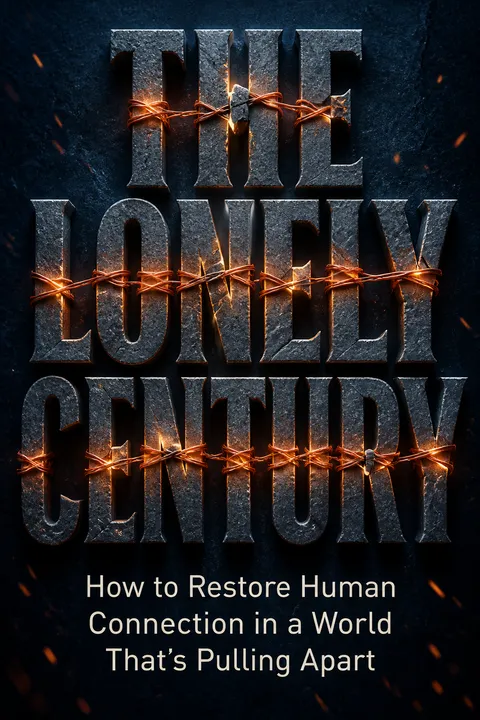

Key Takeaways
1. Loneliness is a systemic crisis of political, economic, and social exclusion
I define loneliness as both an internal state and an existential one – personal, societal, economic and political.
A broader definition. Loneliness in the twenty-first century is not merely a personal deficit of love or friends. It is a structural condition shaped by globalization, urbanization, and inequality. It encompasses feeling abandoned by our employers, ignored by our politicians, and powerless in our daily lives.
The neoliberal legacy. This crisis is the direct result of the neoliberal capitalist ideology that took hold in the 1980s. By prioritizing hyper-competitiveness, self-interest, and extreme individualism, society shifted from a collective mindset to a dog-eat-dog world.
- Collectivist words like "belong" and "share" have been replaced by "achieve" and "personal."
- Income inequality has skyrocketed, leaving vast swaths of the population feeling like "losers" in a rigged game.
- We have been reduced to homo economicus, rational actors consumed only by self-interest.
A self-perpetuating cycle. When we believe that we must look out only for ourselves because no one else will, we stop practicing the very behaviors that prevent loneliness. To reverse this, we must reconnect capitalism to the common good and put care, compassion, and cooperation back at the center of society.
2. Chronic isolation is a physical killer on par with smoking
Statistically, loneliness is equivalent to smoking fifteen cigarettes a day.
The biological toll. Loneliness is not just a state of mind; it has profound corporeal manifestations. When the body experiences chronic isolation, it enters a sustained "fight or flight" stress response. This keeps the amygdala on high alert, sending cortisol and cholesterol coursing through our veins.
Chronic inflammation. Unlike temporary stress, chronic loneliness lacks an "off switch," leading to persistent, low-grade inflammation. This overworks the immune system and leaves the body highly vulnerable to severe diseases.
- A 29% higher risk of coronary heart disease.
- A 32% higher risk of stroke.
- A 64% higher risk of developing clinical dementia.
The protective community. Conversely, strong social ties act as a powerful health shield, as seen in "Blue Zones" like Okinawa or the Haredi community in Israel. Engaging in altruism and volunteering triggers a "helper's high," releasing endorphins and oxytocin that actively lower blood pressure and reduce mortality risk.
3. The lonely mind is hyper-vigilant, hostile, and ripe for populist exploitation
The lonely mind sees snakes all the time.
The hostile brain. Loneliness fundamentally alters how we perceive the world and process social cues. Neurological studies show that in lonely individuals, the part of the brain responsible for empathy decreases in activity, while the visual cortex associated with threat-monitoring becomes hyper-alert.
Political consequences. This hyper-vigilance and lack of trust make lonely people highly receptive to the divisive rhetoric of right-wing populists. Leaders like Donald Trump, Marine Le Pen, and Matteo Salvini masterfully exploit these feelings of abandonment, offering a false sense of exclusive, tribal belonging.
- Populists pit the "forgotten people" against a demonized elite.
- They weaponize immigration, blaming "others" for the economic and social pain of the isolated.
- They offer highly theatrical, community-mimicking rituals like political rallies to satisfy the hunger to belong.
Loss of status. Populism thrives where traditional social support structures—like trade unions, churches, and community centers—have collapsed. For working-class men in particular, the loss of secure, dignified work has stripped away their social standing, making the populist promise to restore their respect incredibly alluring.
4. Modern cities are designed to isolate us through transience and hostile architecture
In the city, people are always around but seldom does it feel like they are ‘with you’.
Urban estrangement. Despite being packed cheek-by-jowl with millions of other people, city dwellers are among the loneliest on earth. The sheer density of urban environments forces us to adopt psychological coping mechanisms, such as wearing headphones or staring at screens, to avoid sensory overload.
The transient neighborhood. High housing costs and the rise of renting have made urban neighborhoods highly transient, preventing people from putting down roots. When tenants move every few months, they rarely learn their neighbors' names, let alone build the trust required for mutual support.
- Over half of Manhattan residents live entirely alone.
- Fewer than half of city dwellers trust their neighbors with their house keys.
- The rise of solo living has led to solitary eating, with people turning to virtual dining surrogates like mukbang.
The power of weak ties. To counter this, we must recognize the immense value of "micro-interactions" with strangers, such as chatting with a barista or a postman. Even brief, thirty-second exchanges of pleasantries have been proven to boost happiness and foster a sense of shared humanity.
5. The contactless economy is eroding the vital micro-interactions of daily life
In taking up the morally dubious task of protecting neighbourhoods from those deemed ‘undesirable’, hostile architecture denies us all shared spaces in which to sit together, hang out together, come together.
Frictionless isolation. The rapid rise of the contactless economy—accelerated by the COVID-19 pandemic—is systematically removing human touch from our daily transactions. While self-checkouts, delivery apps, and automated grocery stores like Amazon Go offer convenience, they strip away the spontaneous social encounters that bind us.
Hostile design. At the same time, our physical public spaces are being actively designed to keep people apart. "Hostile architecture" uses physical barriers to repel those deemed undesirable, but in doing so, it destroys the shared spaces where community is built.
- Benches with multiple armrests to prevent the homeless from lying down.
- "Mosquito" devices emitting high-pitched sounds to disperse teenagers.
- "Poor doors" in luxury developments segregating low-income tenants from communal areas.
The cost of exclusion. When we segregate our cities and starve our public libraries, parks, and youth clubs of funding, we lose the spaces where we learn to peacefully co-exist with people different from us. We must reinvest in inclusive social infrastructure to prevent our societies from fracturing further.
6. Smartphones and social media create a performative, empathy-deprived existence
We are increasingly living our lives like avatars in an online video game.
Together, yet alone. Our smartphones have become digital appendages, checked hundreds of times a day. This constant state of partial attention means we are rarely fully present with those around us, leading to the neglect of our partners, friends, and children.
The empathy deficit. By replacing rich, in-person communication with thinned-out text messages and emojis, we are eroding our capacity for empathy. Face-to-face interaction allows us to read facial expressions and subconsciously synchronize our brain waves, a biological process essential for deep connection.
- Children who spend excessive time on screens struggle to read basic human emotions.
- Social media platforms are designed like digital slot machines to exploit our psychological vulnerabilities.
- The pursuit of "likes" fosters a toxic culture of social comparison and public rejection (BOMP).
The curated self. To gain online validation, we present highly curated, idealized versions of our lives. This performative behavior alienates us from our authentic selves, leaving us with the hollow feeling that people only like our digital avatars, not who we truly are.
7. The modern workplace actively isolates employees through open-plan designs and hot-desking
People who don’t have a friend at work are seven times less likely to be engaged with their job intellectually and emotionally.
The open-plan paradox. Although open-plan offices were designed to foster collaboration, research shows they do the exact opposite. The lack of privacy and constant noise of these layouts trigger a defensive response, causing employees to socially withdraw, put on noise-canceling headphones, and communicate via email instead of talking.
The vagrant worker. This isolation is compounded by "hot-desking," which deprives workers of a personal space and prevents them from sitting next to the same colleagues long enough to form friendships. Without stable social anchors, employees feel expendable, invisible, and disconnected from their teams.
- 60% of UK employees report feeling lonely at work.
- Hot-deskers are significantly more likely to feel alienated from their colleagues.
- The decline of the communal office lunch has stripped away a vital daily ritual for bonding.
The remote work challenge. While remote working offers flexibility, it often leads to severe professional and personal isolation. Employers must balance remote work with structured, in-person social opportunities, recognizing that workplace friendships are a powerful driver of productivity, retention, and employee morale.
8. Surveillance capitalism and algorithmic management disempower and alienate workers
In the Age of the Panopticon Workplace what’s not measured does not matter.
The digital whip. Modern workers are increasingly subjected to invasive digital surveillance and algorithmic management. From keystroke logging to facial-recognition software, employers are using technology to monitor every second of the workday, treating human beings like mere cogs in a machine.
The rating trap. In the gig economy, workers are at the mercy of customer rating systems that reduce their professional worth to a single, highly volatile number. This constant pressure to perform forces workers to self-censor and genuflect to avoid low ratings, stripping away their agency and dignity.
- Warehouse scanners tracking workers' movements down to the millisecond.
- Remote-work software taking random screenshots and photos of employees.
- Algorithmic hiring tools (like HireVue) using facial-scanning to judge job candidates.
The power imbalance. This extreme information asymmetry leaves workers feeling profoundly powerless and insecure. To restore dignity to work, we need robust labor laws that limit invasive surveillance, protect gig workers' rights, and ensure transparency in algorithmic decision-making.
9. The rise of social robots threatens to replace complex human relationships with subservient machines
I believe that eventually – say, twenty or thirty years from now – artificial emotions will be as convincing as human emotions, and therefore most people will experience the same or very similar effects when communicating with an AI as they do with a human.
Artificial intimacy. As the loneliness crisis deepens, a massive market for social and sex robots is emerging. From robotic pets like Aibo to highly realistic humanoid sex dolls like Harmony, machines are being programmed with emotional AI to simulate empathy, affection, and love.
The easy option. While these robots can provide comfort to the isolated, they pose a profound existential threat to human relationships. Because robots are entirely predictable, non-judgmental, and subservient, we risk coming to prefer their uncomplicated company over the messy, challenging work of relating to real humans.
- Elderly people in Japan increasingly relying on robot carers like PaPeRo.
- Children forming deep emotional attachments to storytelling robots.
- The rise of hyper-realistic sex robots that cannot say "no."
The erosion of care. If we outsource our caregiving to machines, we risk losing the very capacity for mutual sacrifice and reciprocity that underpins a compassionate society. We must ensure that technology remains a supplement to, rather than a replacement for, genuine human connection.
10. Rebuilding connection requires structural economic reform and active civic participation
Because society isn’t only done to us, we ‘do’ society too, we participate in it and shape it.
A systemic reset. Reconnecting a fractured world requires us to move beyond individualistic solutions and demand structural change. We must transition from a neoliberal model of capitalism to one that prioritizes social infrastructure, public services, and the common good.
Reclaiming the local. On a local level, we must protect and fund our "third places"—the independent bookstores, local cafés, and public parks that serve as the social glue of our neighborhoods. These are the spaces where we encounter people different from ourselves and practice the daily habits of civility.
- Implementing "wellbeing budgets" that prioritize social connection over GDP.
- Funding public libraries, youth clubs, and community centers.
- Supporting local, independent businesses over global e-commerce giants.
Active citizenship. Ultimately, the future is in our hands. We must make a conscious effort to put down our phones, engage with our neighbors, and participate in deliberative democratic initiatives like citizens' assemblies. By choosing community over convenience, we can turn the tide of this lonely century.
Review Summary
People Also Read
Download PDF
Download EPUB
.epub digital book format is ideal for reading ebooks on phones, tablets, and e-readers.








































