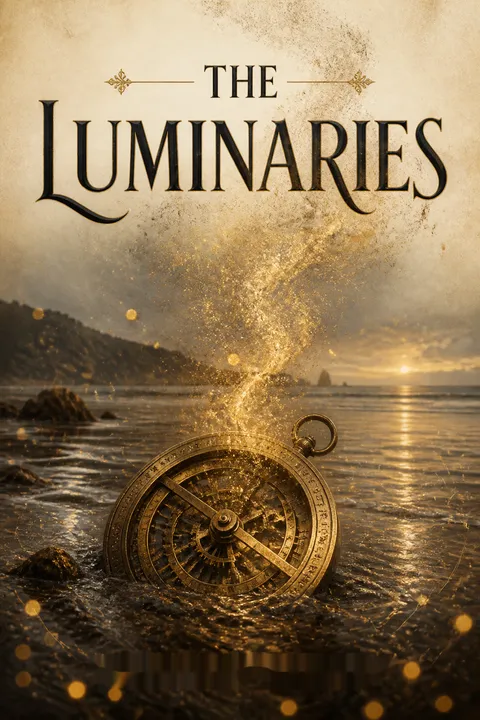

Plot Summary
Hokitika's Thirteen Strangers
In a smoke-filled room in 1866 Hokitika, thirteen strangers gather, each wary of being watched and each holding a hidden agenda. Into their midst comes Walter Moody, a lawyer running from a shadowed past, seeking anonymity and fortune. What seems happenstance is soon revealed to be fate as the assembled men—gold-hunters, merchants, bankers, natives, and foreigners—test the boundaries of trust and concealment. The gold-rush town bristles with secrets, and tales of violence and lost fortunes hang in the air. This tense beginning fertilizes the narrative: each man, forced into confessional storytelling, inadvertently exposes not only his history, but also the intricate ties that bind all present to a deepening mystery—a death, a disappearance, a legacy of gold, and the inexorable web of cause and chance.
The Blackmail of Lauderback
Alistair Lauderback, a political figure, finds his private reputation threatened by a complex blackmail orchestrated by the enigmatic Francis Carver and the cunning Lydia Wells. Years prior, Lauderback's affair with Lydia, then the wife of another, left him vulnerable. Carver wields a "twinkle"—damning knowledge, possibly forged documents—tying Lydia's supposed marital connection to stolen gold and a shipping contract. Forced, Lauderback gives up his beloved barque Godspeed, believing his previously concealed sins now weapons against him. The price of discretion is paid—first in gold, then in self-alienation—sowing further deceit and setting the stage for future betrayals as Lauderback's shame and Carver's ambition entwine fatefully with the conspiracies of Hokitika.
Fortuna's Golden Dresses
Lydia Wells, at once a widow and a schemer, constructs an elaborate method for spirited wealth out of reach: she sews gold into the linings of her dresses, cleverly masking the illicit fortune's origin. Anna Wetherell, a camp whore haunted by accreting shame and longing, unwittingly inherits these gowns as they change hands amidst shipwreck, salvage, and shifting alliances. Each gown's hidden treasure weaves Anna, Lydia, and Carver into a fraught kinship: Anna's unwitting complicity in Lydia's designs will spark suspicion, envy, and violence; Carver's controlling ambition intersects with Anna's addictive self-forgetfulness. The physical gold's movement—secret, heavy, nearly invisible—will catalyze a chain of misunderstandings, betrayals, and desperate reinventions.
The Hermit and the Whore
Crosbie Wells, a drunkard recluse, is discovered dead by Lauderback's party in the Arahura Valley, while Anna survives an apparent suicide attempt—insensate in the Christchurch road, opium and despair thick upon her skin. The simultaneous misfortunes intertwine their fates, centering the novel's puzzle: hidden gold of uncertain provenance, Anna's "crime," and mysterious connections linking the living, the dead, and the missing. Each tragedy serves as both a mirror and a cipher for the other: the hermit's estate, believed paltry, yields hidden riches; Anna's life, deemed worthless by outsiders, will come to bear unexpected value. These dual miseries haunt more than themselves, admitting new actors and suspicions as Hokitika spirals into ever-rippling echoes of fortune and calamity.
Aurora's Secret Fortune
Beneath the surface of an unimpressive gold claim—the Aurora mine—a secret fortune is extracted by Quee Long, the Chinese digger. His clandestine smelting and marking of gold squares with Aurora's name mask a substantial yield, concealed from official scrutiny but eventually drawing the greedy and desperate eyes of many. Connections between retorted gold, mysterious dress seams, and missing persons become increasingly tangled as Anna's innocence is compromised and Staines's partnership with Carver is exploited. The discovery and subsequent theft of this "bonanza" set off a domino effect of suspicion, betrayal, and ghostly consequence, proving that luck and self-making, in Hokitika, are always double-edged.
Lost and Found Identities
The theme of mistaken or assumed identity—literal and emotional—drives the drama forward. Francis Carver, former convict, becomes "Francis Wells" when it suits his schemes; Anna, adrift and addicted, is both "Magdalena" and herself, merging the mythic whore with the woman who yearns for rescue. Crosbie Wells is revealed by a bundle of unsent letters to be Lauderback's bastard half-brother, a revelation kept secret for years by shame and pride, fraying the fabric of everyone's stories. Guilt, self-hatred, and secrecy mount: men and women are undone by both the names they inherit and the names they choose, until only the gold—unspeaking, heavy, indifferent—proves immune to reinvention.
Reluctant Kindred and Mates
While the gold fever breeds suspicion and conflict, unlikely kinships and partnerships also begin to form. Anna and Staines, opposites bound by a mystical, astral "twinhood," confide, collide, and effect one another's fates in ways neither can fully articulate. The council of conspirators, first wary, then bound by shared jeopardy and secret, learns the influence of collective guilt and chance. Lauderback, haunted by the half-brother he never acknowledged, finds his own conscience on trial. Loyalty, whether self-serving or genuine, is dangerous currency in the world of The Luminaries—a force both generative and undoing.
Anna, Anna, Magdalena
Anna Wetherell, continually subject to others' designs, presses forward through addiction, shame, and loneliness, seeking solace but denied agency by circumstance and vice. As the "Magdalena" archetype, her suffering is witnessed, condemned, and appropriated by men seeking their own absolution or advantage. But Anna's inner life and desires—her loyalty to Crosbie, her longing for Staines, her stubborn resistance—will, eventually, echo outwards, complicating others' fates and returning her, unexpectedly, a measure of power. Anna's journey, from pawn to agent, will be as much about forgiveness as survival.
Gold, Smoke, and Deceit
Opium, gold, and duplicity suffuse the narrative: Anna's and Staines's "twin" addictions—he to gold, she to smoke (and then, vice versa)—and Sook Yongsheng's deadly feud with Carver, all point to the pervasive hunger and moral erosion of the goldfield. Lies—casual, deliberate, and desperate—proliferate: signatures are forged, accusations fly, evidence is buried, stories are crafted. Justice slips out of reach as men and women, altered by chance and vice, lose track of both guilt and innocence. Deceit is omnipresent, muting clear cause and effect, blurring fates as the boundaries between the living and the dead, the lucky and the ruined, become ever more unstable.
The Conspirators' Night Council
The "council" at the Crown Hotel brings together a dozen-odd men linked by both complicity and suspicion. Each brings a fragment: a suspicion, a debt, rumors, or a trauma. Collectively, they attempt to reconstruct the truth about Crosbie Wells's fortune, Anna's supposed crime, Staines's disappearance, and Carver's blackmail. Yet, as secrets are exchanged as currency, new dangers emerge—oaths are broken, alliances fracture, and envy and fear bloom in the shadow of the Gold Rush's promise of self-reinvention. The council's atmosphere—part court, part theatre, part confessional—cements the sense that, in Hokitika, shared knowledge is far more perilous than isolation.
A Twinkle on the Captain
Through confessions and confrontations, the tale's dark heart emerges: Carver's use of blackmail (the "twinkle") to ensnare Lauderback; Mannering and others seeking leverage by hearing or withholding secrets; the uncanny psychic "twinkling" between Anna and Staines, whose fates now feel inseparable—from birth date to addiction, from night to vision. Betrayal, often done in the name of advantage or protection, is shown to have consequences that spiral outward, destroying not only the intended mark but every bystander. The law, everyone recognizes, can enact only partial justice—fate and conscience are stricter judges.
Trial by Shadows
The climax converges in a pair of interconnected trials: Staines, the lucky, faces judgment for embezzlement and dereliction; Anna, the Magdalene, endures accusations of attempted murder and lunacy. Testimony uncovers old wounds and forgotten kinships, the roles of women and foreigners, the violence and futility of a system invested in appearances more than truth. Defended by Walter Moody, Anna's acquittal and Staines's sentence feel as much a solution as an exposure of the novel's project: the "truth" is ultimately mosaic, ambiguous, and often decided by those with the courage—or capacity—to forgive.
Resurrections and Ruins
Wreck and discovery mark The Luminaries' conclusion. Godspeed, that symbol of transit and hope, comes to ruin, and so do the plans built upon theft, deception, and envy. Relationships must be rebuilt from the ruins: Anna and Staines, finally recognizing their "twin" destinies, forge a new life together beyond roles of victim and rescuer. Fortunes lost are replaced by a deeper, more uncertain treasure—selfhood, empathy, and connection. Even the gold, once the instrument of ruin, recedes into the earth, its secret again entombed.
The Widow's Séance
Lydia Wells, ever resourceful, stages a séance to summon Staines's ghost—whether for profit, justice, or further deception is unclear. What unfolds is at once farcical and haunting—a trick with real consequences, an exposure of the town's hunger for signs, and a mirror of the deeper psychic connections between Anna and Staines. Lydia's performance blurs the limits of truth and illusion, echoing the novel's wider argument: that, in the era of gold and chance, everyone seeks communion, but few are ever truly seen, or answered.
Destinies in Conjunction
Celestial and human conjunctions—fortunes, fates, histories—align, misalign, and realign. Letters lost and found force reckonings (Lauderback and Crosbie); Anna's and Staines's "astro-twinhood" offers both curse and possible salvation. Criminal acts—both small and cosmic—are revealed as threads in a vaster, more mysterious pattern, where even apparent endings (fortunes lost, lovers reunited) are merely transits: phases toward new beginnings, new questions, and, perhaps, new compassion.
Revelations on the Bar
As gold, guilt, and confessions surface—sometimes literally, as with Crosbie, sometimes in rumor or forged document—violent justice overtakes the careful schemes of the living. Carver's end is brutal, and Shepard's vengeance tragic; gold circulates but no longer brings certainty or fortune. Those who survive are marked by their choices, their betrayals, or their refusals to betray—by the lines they have drawn in blood or fortune.
Testimony and Undoing
The law's attempt to make sense of Hokitika's calamities means taking and performing testimony—rarely the "whole truth," always a contest of narrative, memory, and interest. The act of telling and retelling is both a form of self-making and self-undoing: Anna and Staines, together and apart, must finally step into their own stories, accepting, denying, and remaking their destinies, even as past mistakes and the ghosts of the lost echo onward.
Beginning, Again, With Rain
The novel's ending bends the circle to its start: rain falls as Anna and Staines, having survived trial, ruin, discovery, and love, lie together, each changed but bound by mysterious affinity. In their reunion, the cycles of gold-rush desire and self-undoing both close and open again—the endless transits of hope, fortune, shame, and redemption. The fortune is buried, but a truer treasure is admitted: the possibility of choosing—again, and again—a new beginning.
Analysis
Eleanor Catton's The Luminaries is a dazzling meditation on the interplay of fate, chance, and self-creation set against the fever dream of the 1860s New Zealand gold rush. At its core, the novel interrogates what it means to make—and remake—oneself: the ways in which fortune, trauma, secrecy, and myth shape not only what we do, but who we believe ourselves (and others) to be. The astrological structure is more than a game: it dramatizes the always-shifting relation between the deeply personal and the impersonal or cosmic; lives are influenced by the tides of chance, but also by the slow revolutions of shame, desire, and legacy. The book's nested storytelling—confessions within councils, trials within trials—demonstrates that truth is not unitary: it is always refracted through self-interest, wounded feeling, and the hunger to belong. Anna and Staines's arc, a mythic doubling, offers hope that transformation is possible—not by denying pain or luck, but by stepping toward forgiveness and self-recognition. Above all, The Luminaries warns that fortunes, like identities, are always uncertain: dug from the earth, hidden in plain sight, or lost on the tides. The lesson is ancient: that to be human is to be unfinished, our stories always beginning again—especially in the rain.
Review Summary
The Luminaries is a complex historical novel set in 1860s New Zealand during the gold rush. Readers praise Catton's intricate plot, vivid characters, and clever structure based on astrological charts. Many found the book engrossing despite its length, appreciating the Victorian-style prose and mysterious storyline. Some criticized the slow pace and excessive detail. Overall, reviewers admired Catton's ambitious storytelling and meticulous craftsmanship, though opinions were divided on whether the novel's elaborate construction enhanced or detracted from the reading experience.
People Also Read

Characters
Anna Wetherell
Anna is the fulcrum of the novel's moral and emotional drama: a young working-class woman drawn to New Zealand by the promise of fortune and freedom, only to be ensnared by addiction, debt, and exploitation. Her relationships—with Lydia as sometime benefactress and rival, with Carver as abuser, with Crosbie as lost father, and with Staines as astral twin and redeemer—map the ways women are made into symbols, scapegoats, and objects in the goldfield's male-centric economy. Anna's battles with opium and trauma are never simply her own: socially, she becomes both victim and outcast, the "Magdalena"—yet she is also possessed of stubborn hope, wit, and capacity for loyalty. Her psychoanalytic journey is one of slow self-reclamation: from pawn in others' schemes, she learns to insist, quietly but fiercely, on her own agency; her love for Staines, which becomes an uncanny form of psychic "twinhood," opens the possibility for mutual recognition, and a new life beyond shame.
Emery Staines
The youngest and most "fortunate" man in Hokitika, Emery carries the burden of seeming blessed—a golden boy whose optimism, generosity, and naivety both charm and endanger him. His partnership with Carver (initially a bid for advancement) is his downfall, and his fate as an "astral twin" to Anna exposes his psychic vulnerabilities as well as his romantic longing for rescue, connection, and purity. Emery is alien to the world's calculations of profit and vengeance; his downfall—addiction, disappearance, injury—is both literal and mythic, mirroring Anna's own falls. His psychic "link" with Anna is both a curse and a gift, forcing him to confront guilt, helplessness, and the limits of good luck. In the end, Staines chooses: love, loyalty, and honesty over gold, fortune, and self-protection—a rare feat, and its own reward.
Lydia Wells (née Greenway, Carver)
Lydia is at once victim and architect of the novel's labyrinth: ambitious, flamboyant, theatrical, and ruthless. Her marriage to Crosbie is a business transaction; her later maneuvers—involving Carver, Lauderback, gold, and occult performance—are attempts to harness the energy of chance, fortune, and gendered power. Lydia is polarizing: some characters are drawn to (or ensnared by) her wit, confidence, and resourcefulness; others perceive only her duplicity and cruelty. Psychoanalytically, Lydia is relentless in her refusal to be outmaneuvered or consigned to a minor role—her need to "spin fortune's wheel" is at once a compensation for past powerlessness and a perpetuation of trauma. Her relationship to Anna is especially fraught: friend, mentor, rival, and, in the end, opponent in the court of fate.
Francis Carver
Carver, the story's avatar of "Force," is a former convict, violent and cunning, with a talent for reinvention (aliases, forged documents, and adaptive morality). He is the primary engine of blackmail, extortion, and violence: his manipulation of Lauderback, his partnership and eventual betrayal of Lydia, his abusive domination of Anna, and his spectral impact on half the town make him both a figure of dread and an expression of the era's darker energies. Psychoanalytically, Carver is a study in projection and repetition: wounded, rageful, ever fleeing a past that he cannot erase, he destroys or dominates those who threaten to expose his shame. His end—violent, unlamented, and marked—suggests that force alone cannot construct a permanent identity or fortune.
Crosbie Wells
The "hermit" at the narrative's heart, Crosbie embodies both otherness and longing: the bastard son of privilege, denied family and fortune, fleeing into self-exile and self-invention. His pathos is deep—documented in unsent, unanswered letters—and his fate, dead alone but surrounded by secret wealth, tests the town's very notions of value and belonging. Psychoanalytically, Crosbie is the disavowed child, bearing the marks of shame but determined to prove himself worthy of kin and community. His relationships—with Anna, Staines, Tauwhare—provide glimpses of unlikely kindredness, alliance, and mutual salvation.
Alistair Lauderback
Lauderback builds a self on power, visibility, and control, yet his deepest secret is the half-brother he disavows; his greatest vulnerability is the very "luck" he projects as deserved. He is both shamer and shamed: blackmailed by Carver, publicly repenting for private "sins," and (belatedly) forced into reckoning with his past. Psychoanalytically, Lauderback is a portrait of the divided self—outwardly confident, inwardly wracked. He desires meaning, lineage, and dignity, but the price of public success is private disconnection, and, ultimately, exposure.
Walter Moody
Moody operates as both participant and observer—a lawyer, recently rocked by trauma, who brings a "modern" analytic mind to the chaos of Hokitika. Pulled into the network of secrets, he becomes listener, investigator, and (eventually) advocate for Anna and Staines. His capacity for skepticism and pattern-seeking is both a survival tool and a defense against involvement. Moody is haunted by his family—estranged father, out-of-reach brother—mirroring, in miniature, the novel's larger themes of kin, guilt, and reinvention.
Sook Yongsheng (Ah Sook)
Ah Sook is fueled by a quest for justice—attempting to avenge his father's death at Carver's hands, carrying an inheritance of trauma and exclusion. His capacity for empathy (especially with Anna) and spiritual resilience is set against a world hostile to "outsiders," and his tragic end—at the hands of George Shepard—dramatizes both the violence of empire and the limits of survivorhood. Psychoanalytically, Sook is compelled by repetition: history's cycles of betrayal and vengeance return again and again, even as he seeks, via Anna or revenge, some final reckoning or peace.
Te Rau Tauwhare
Tauwhare, a Maori greenstone carver, stands at the edges of the white colonists' ambitions and enterprises, representing a different sense of continuity, naming, and belonging. His loyalty to Crosbie Wells, silent wisdom, and intermittent acts of intervention mark him as a figure of care and memory—one who watches patterns repeat with sorrow and insight. His marginality is never simple passivity; psychoanalytically, he both bears and resists the violence of history, seeking in kinship and craft a different order from that of gold or shame.
Benjamin Löwenthal
Löwenthal, the Jewish editor of the West Coast Times, stands for both the power and the limits of narrative. His attempts to give the community a "public" version of their stories often thwart or expose themselves. He is at once involved (in councils, in testimony) and removed. Psychoanalytically, he is the superego or chronicler, invested in truth but wary of his own position—eager to believe in reform or "progress," but always aware of the darkness circulating in both public and private lives.
Plot Devices
Astrological Structure and Destiny
The Luminaries' astrological architecture isn't mere ornament: each chapter and character is mapped to sign, planet, or celestial event, suggesting that the chaos of human experience is always shadowed by grander, impersonal patterns. Characters are aligned with celestial bodies (Anna as Venus, Staines as Sun, Carver as Saturn), and both plot and chapter structure mirror astronomical cycles—conjunction, opposition, eclipse, return. This cosmic structure foregrounds themes of fate vs. agency, repetition, self-undoing, and renewal. Foreshadowing is not simply present in prophecy or dream, but embodied in the very structure: events feel both accidental and inescapable. The narrative itself spirals, telescoping inward as chapters shorten, mimicking lunar phases, and knitting the story into myth, pattern, and archetype as much as psychology or history.
Multi-layered Testimony and Interpolated Storytelling
The Luminaries repeatedly explores the gap between what is known, what is said, and what is believed: confessions, trials, councils, séances, and letters all operate as overlapping narrative devices, each performed for a particular audience and shadowed by doubts as to motive, memory, and audience. This makes "the truth" inherently unstable—always partial, always shaped by power, guilt, and desire. The polyphonic narrative structure enacts this: multiple characters, each with their own voice, tell and retell, correct and subvert one another's versions. Testimony is both exposure and self-protection; performance is always a double-edged sword, producing both sympathy and new wounds.
Reinvention, Doubling, and Astral Twinship
Central to both the plot and astro-philosophy is the motif of doubling—literal (Anna and Staines's shared birthdate, psychic link, and fate), psychological (characters split by shame, guilt, or ambition), and social (aliases, masks, and forgeries). The goldfields, like the frontier itself, are a site of self-reinvention—where pasts are left behind and new selves are both constructed and denied. Key mysteries (the fortune in the dresses, the missing brother, the "ghost" aboard ship) are often resolved, not by revelation, but by the acceptance of multiplicity. Throughout, the same story is shadowed by its "other"—a reminder that every truth has its twin, and every ending, its beginning.
Harry Potter Series Series
Download PDF
Download EPUB
.epub digital book format is ideal for reading ebooks on phones, tablets, and e-readers.








































