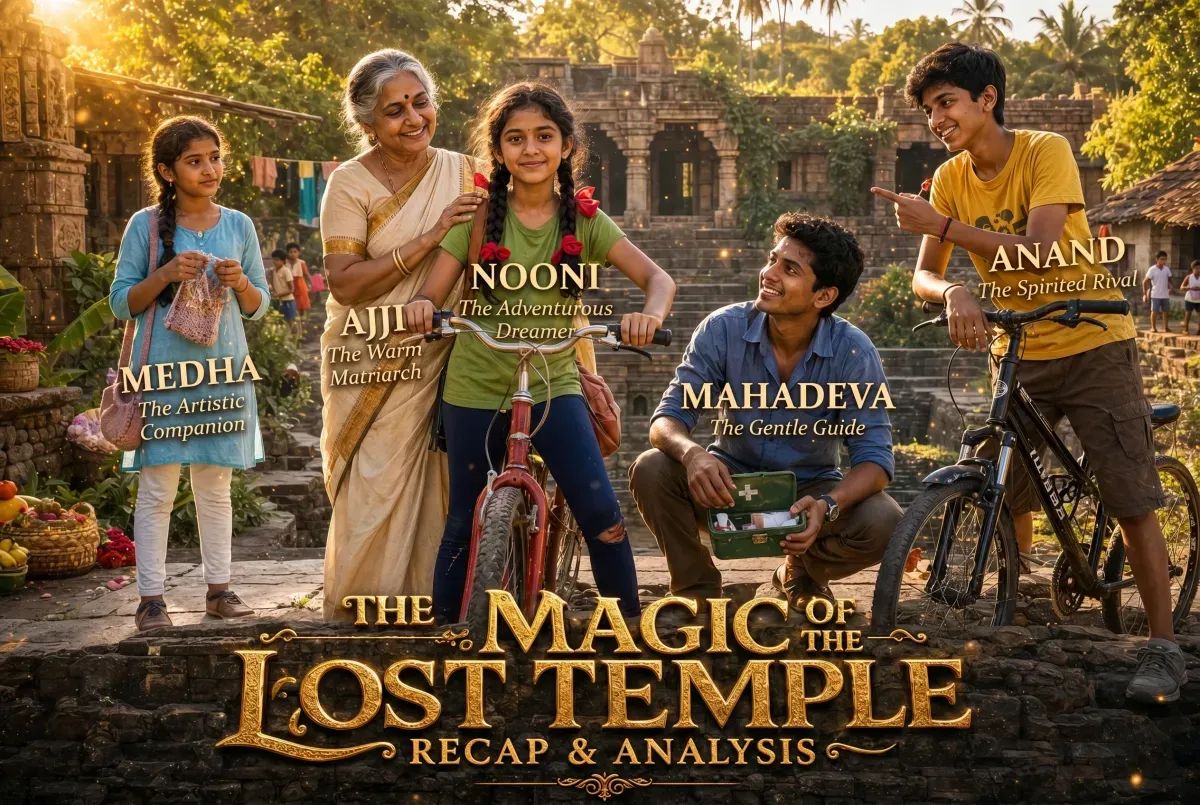



Plot Summary
Prologue
Sudha Murty opens with a memory: thirty years ago her young daughter Akshata hid two of her gold bangles during a game and forgot where. The bangles vanished, and the author eventually stopped searching.
Decades later, Akshata's daughters play the same game, knock over an ancient vase, and out tumble the long-lost bangles, glinting in the afternoon light. The author marvels that a child's mistake became a buried treasure, that innocence and curiosity see what adults overlook.
She dedicates the book to her granddaughter Nooni,1 declaring her the heroine: bold, determined, sporty, and forever hunting new adventures. The anecdote frames the whole novel as a quiet argument that children, unburdened by routine, are the ones who find what was lost.
The framing anecdote does more than charm; it installs the book's thesis before the story begins. A buried treasure surfaces only through a child's unselfconscious play, establishing curiosity as a form of vision adults have trained themselves out of. Murty equates innocence with discovery, suggesting that schedules, embarrassment, and competition narrow grown-up perception. The vase that never moved across decades becomes a symbol of inherited continuity, while the bangles passed grandmother to granddaughter foreshadow the novel's preoccupation with legacy, water, and the past resurfacing. By naming Nooni the heroine in advance, the author signals that the coming adventure rewards the same out-of-the-box attention the prologue celebrates.
Summer Plans Fall Apart
Twelve-year-old Nooni,1 a tomboy from Bangalore who would rather climb and read than sit through cartoons, brings home a tenth-place report card and braces for her father's disappointment. The annual resort trip to Coorg is suddenly cancelled when her mother Usha5 is called to a six-week, non-negotiable bank training in Delhi.
Her doctor father Shekhar4 cannot mind her alone, and Delhi's heat rules her out. After weighing options, the parents land on Shekhar4's childhood village, Somanahalli, on the banks of the Varada river, where her grandparents still live. Lured by a family wedding, cows in the shed, open fields, and a river to swim in, Nooni1 chooses the village herself, trading summer camps for something unknown.
The opening quietly indicts urban middle-class childhood: ranked, scheduled, optimized for competitive exams. Nooni's tenth rank matters only because her father has absorbed the anxiety of a hypercompetitive world, a worry the novel will gently dismantle. The cancelled resort, with its identical routines, frames her ordinary life as comfortable but airless. Crucially, the decision is handed to the child, honoring her agency and seeding her defining trait, that once she chooses, nothing deters her. The village is introduced through Shekhar's ambivalence, his discomfort with dust and joint-family memory, setting up a generational tension between escape and belonging that the discovery plot will eventually resolve.
A Doctor's Daughter Arrives
Driven down at dawn, Nooni1 reaches Somanahalli to find villagers crowding her father for free medical advice. Her grandmother, called Ajji,2 insists the child sleep in her own room for the stories and the night air; her grandfather, Ajja,3 promises morning walks and animals she has never seen.
Before leaving, Shekhar4 hands her a cell phone, a privilege she would never get in Bangalore, telling her to call when the network holds. Ajja3 introduces her circle for the summer: shy, artistic cousin Medha;7 Delhi-raised Amit,8 grandson of the pharmacist everyone calls Doctor Kaka; bookish Anand,9 the new headmaster's son; and eighteen-year-old Mahadeva,6 the studious boy Ajja3 sponsors through college. A bicycle leaning against the wall sparks her first ambition.
Arrival reframes Shekhar's discomfort as the village's pride; the doctor who fled is its returning hero, exposing how the city dweller misreads what he left. Ajji's refusal to let Nooni sleep alone is not coddling but pedagogy, insisting on proximity, oral storytelling, and natural rhythms over apartment isolation. The borrowed phone is a deliberate tether and tool, technology rationed rather than banished. The ensemble of children is engineered as a deliberate cross-section: rural artisan, army cosmopolitan, academic, and a working-class scholarship boy, a microcosm of cooperative India. The leaning bicycle functions as a small thrown gauntlet, converting envy into the summer's first concrete project.
Racing the Wind at Last
Embarrassed that village children all ride bicycles given by the government while she cannot, Nooni1 begs Anand9 and then Mahadeva6 to teach her on the school playground. Mahadeva6 runs behind, gripping the carrier, coaching her to keep pedalling and never to brake in a panic. The moment she glances back to find him no longer holding on, she crashes.
He teaches by stages: balance, turning slowly, handling potholes, even riding against oncoming traffic and with weight on the carrier. She skins her knee badly, but bandages it and refuses to quit. Within days she completes his full curriculum and can ride Somanahalli's rough, untarred roads alone. The achievement, earned through falling and rising, gives her a freedom the city never offered.
Cycling is the novel's first parable of mastery through failure, deliberately opposed to the city's grade-driven, parent-assisted success. Mahadeva's curriculum treats falling as data, not disgrace, and his closing maxim, that excellence is habit rather than accident, reframes effort as virtue. Nooni's refusal to stop despite a bloody knee establishes the grit that will later power the excavation. The detail that the state gives village children bicycles, while her elite school does not, inverts the usual urban-rural hierarchy, suggesting the village teaches competence the city outsources. Mobility here is literal and psychological: the bike enlarges her radius, enabling the wanderings that lead to discovery.
Maidens From the Moon
After helping roll laddoos for cousin-of-cousin's village wedding, Nooni1 lies in Ajji2's moonlit room and demands a story. Ajji2 tells of King Somanayaka, who once glimpsed seven celestial women descend a ladder from the moon to drink from a hidden stepwell of Lord Shiva, prized because earth's water tasted sweeter than heaven's.
The maidens let his people use the well on strict conditions: bathe before entering, take only one pot, never enter on full moon nights, or the well and kingdom would vanish. His proud queen, Ratnavati, jealous and certain the land was hers to rule, defied the rules, bathed in the water, and polluted it. Thunder swallowed the well, the kingdom emptied, and only a name, Somanahalli, survived.
The embedded folktale is the novel's mythic engine, planting the stepwell that the plot will literally excavate. Its moral economy is ecological and ethical at once: water is sacred, finite, and contingent on humility before nature's terms. Ratnavati embodies hubris, the belief that ownership confers immunity from consequence, a fable for modern resource exploitation. By delivering it as oral tradition in moonlight, Murty contrasts the village's transmission of memory with the city's screen-lit amnesia. The conditional curse, that pollution destroys the source, is a child-legible environmental lesson, and the survival of the name alone teaches that landscapes carry buried histories waiting for someone curious enough to listen.
A Legend Twice Told
At the pumpkin farm, Ajja3 gives Nooni1 a different version: a grateful king funded the stepwell with hidden gold after sheltering a sick architect, who warned that contaminating the water would doom everything.
Here it is the king's arrogant son, Prince Shashi Shekhara, who swims in the well on a full moon, lifts the rationing, and triggers an epidemic that empties the kingdom.
Later, at dinner, the well-read headmaster Shankar Master10 shares what his history professor told him over Skype: inscriptions confirm a real Somanayaka who built temples, tanks, and stepwells around a thousand years ago, but the carving was found fifty miles away, and every excavation near the village has turned up nothing. The marvellous stepwell, he concludes, almost certainly does not exist.
The deliberate retelling layers myth, family lore, and academic history, training the reader to hold competing truths. Both legends converge on the same warning, that disrespecting water invites catastrophe, reinforcing the theme through repetition rather than novelty. Shankar Master's scholarly skepticism is the structural pivot: by declaring the well probably fictional, the narrative manufactures the very doubt the climax will overturn, raising the stakes of discovery. The Skype detail signals that the village is not backward but selectively modern, blending oral tradition with global connectivity. Ajja's parting lesson, to heed elders and conserve water, fuses ancestral obedience with conservation ethics, quietly arming Nooni with the conviction that the story might be real.
Lessons the City Forgot
Between wedding chores, Nooni1 absorbs a curriculum no school offers. Ajji2 oils her hair and tours her medicinal garden, naming jasmines, tulsi varieties, turmeric, and snake-repellent bushes, and roasts jackfruit seeds for her.
On a river picnic Ajja3 supervises her swim, explaining the Varada's origin and why he calls the river she. She witnesses the cow Kamadhenu deliver a calf under the midwife Taiawaa13's hands.
Hiking to Varada Hill, she feeds ants and squirrels as Ajji2 asks, hears how a freedom fighter named Varada died for the Quit India movement, and learns of the village gomala commons. The children trade tales of Mohenjodaro and Vikramaditya's buried throne, planting in Nooni1 the thrilling idea that treasures lie beneath ordinary ground.
This immersive stretch is the novel's heart, converting slice-of-life into moral education: ecology, compassion for animals, water thrift, communal land, and historical sacrifice. Ajji's habit of feeding displaced creatures models reciprocity with nature, while the calf's birth teaches that animals share human feeling. The gomala and the patriot's hill embody collective ownership over private gain, the antidote to Ratnavati's possessiveness. Crucially, the children's stories of unearthed civilizations seed the climax with narrative permission: buried wonders are real and findable. Murty stages knowledge as inheritance passed hand to hand, contrasting the village's experiential wisdom with the city's textbook competition, and showing Nooni humbled by how little her elite schooling actually taught her about the living world.
The Hailstorm That Shouldn't Be
Sensing rain, Ajji2 rushes to finish drying papads, enlisting the children to ferry them to the terrace and guard them from crows. Instead of the usual brief summer shower, the sky blackens at midday and unleashes a two-hour storm with wind and hailstones as large as lemons.
Half the papads are lost, banana trees topple, tender coconuts fall, and the mango crop is devastated, though Ajji2's hardy jasmine survives. Fascinated, Nooni1 watches the garden turn to a pond.
Against Ajji2's worried warnings about mud and flooded roads, she resolves to see the swollen Varada river. Ajja,3 who prizes her freedom, permits a hike through the forest the next day under Mahadeva6's care, while Ajji2 frets that the adventurous child does not know the terrain's dangers.
The freak storm is both naturalistic and providential, the geological agent that will loosen the earth over the buried well. Murty uses it to dramatize agrarian vulnerability, the farmer's livelihood at the mercy of weather, deepening the book's reverence for nature's power. The contrast between Ajji's protective caution and Ajja's belief in letting a child roam crystallizes the novel's parenting argument: growth requires permitted risk. Nooni's hunger to witness the river in flood, when most would stay home, marks her as the prologue's promised heroine, drawn toward exactly what others avoid. The storm thus operates as a hinge, ending the immersive idyll and propelling the plot toward unexpected discovery.
The Boot and the Pillar
Choosing a forest route to the flooded river, the children forage mangoes and learn shikakai, touch-me-not, and pepper-leaf along the way. Reaching for wild berries, Nooni1 sinks into mud up to her ankles; Mahadeva6 hauls her out, but her boots stay trapped under a rock. Refusing to abandon them, she digs and shifts the rock, which tumbles into a pit as the mud keeps draining away, proof that something hollow lies below.
Convinced it is no ordinary hole, she squeezes inside with a torch and matches and finds an exquisitely carved black pillar half-buried in sand. The children fetch shovels and ropes from Ajja3's farm, secretly clear rubble for hours, and uncover three carved steps before darkness sends them home.
This is the inciting discovery, and Murty stages it through the prologue's exact logic: a child's stubborn, almost trivial insistence, on retrieving lost boots, becomes the accidental key to buried treasure. The earlier foraging lessons pay off as competence, while Nooni's emergency kit, torch, matches, and folding stick, rewards her habitual preparedness others mocked. Her refusal to dismiss the falling mud as a mere pit dramatizes the difference between adult resignation and childlike inquiry. The half-buried pillar collapses the boundary between Ajji's legend and physical reality, validating story as a map to the world. That the children act first and confess later captures youthful daring tempered by the sense to recruit grown-ups.
A Whole Village Starts Digging
Nooni1 tells Ajja3 everything, and he praises her rather than scolding. He summons the energetic panchayat head Hanumegowda11 and Shankar Master,10 who explain the law: the Archaeology Department must be informed, but the village can begin careful clearing.
Wary that rumors of buried gold might bring looters, they assign trusted men as round-the-clock guards. Nooni1 asks her father for a birthday gift, not a mall trip but a contact, and Shekhar4 connects them to a former patient, Abdul Rasheed,12 who heads Bangalore's archaeology office.
Rasheed12 arrives with four assistants to start unofficially, impressed that an entire village volunteers free labor and food. Ajji2 converts her backyard into a kitchen feeding the workers daily, and the dig steadily exposes carved pillars, steps, and small temples.
The discovery's social aftermath is the book's civic vision realized: a village that owns its heritage rather than waiting on the state. Hanumegowda's worry about gold-seekers and his insistence that any treasure go to the government dramatize ethics over greed, the communal antithesis of Ratnavati's possessiveness. Shekhar's reluctant phone call marks his first concrete reinvestment in the home he abandoned, the legend pulling the prodigal back. Ajji's command of the volunteer kitchen reveals female leadership as logistical backbone, while Rasheed's astonishment at the unity exposes how rare collective ownership has become. Nooni's birthday request, trading consumer reward for a useful connection, signals her transformation from city consumer to purposeful agent.
Sweeter Than Nectar
Over weeks the team uncovers eight temples and twenty-one steps, but the pond is dry. When Ajja3 falls feverish amid a village outbreak, Shekhar4 reluctantly visits and grasps how badly the place needs a doctor.
The dig finds a sealed stone behind a carved cow's mouth; releasing it, sweet spring water rises clear to the bottom step. Rasheed12 drinks first after a prayer, Ajji2 honors him with a traditional offering for his wife, and Nooni1 drinks too. An inscription confirms King Somanayaka built the well in 1000 CE, blessing all who would one day restore it.
At the send-off feast, the village honors its forty volunteers and the five children, Shekhar4 pledges a monthly free clinic and funding for Mahadeva,6 and Nooni1 leaves with Ajji2's heirloom pearl necklace, promising to return.
The climax fuses myth, science, and ethics: the legend's sweet water literally flows, the inscription validates oral memory, and the curse's logic, that respect sustains the source, becomes policy through Hanumegowda's conservation rules. The cow-mouth water spout, an actual Indian engineering and ritual convention, marries faith to hydrology. Rasheed's namaz and Ajji's Hindu offering quietly enact pluralism, the well belonging to all communities as Somanayaka decreed. Shekhar's pledges complete his arc from ashamed escapee to invested son, the discovery healing the generational rupture the opening established. Nooni's final request, toilets for visiting children, shows curiosity matured into civic responsibility, and the inherited necklace seals the prologue's theme: treasures, and values, passed forward through the bold young.
Analysis
Beneath its gentle children's-adventure surface, the novel argues that curiosity, the willingness to take stories and small mysteries seriously, is a moral and cultural faculty modern urban life suppresses. Murty structures the book as a sustained contrast between Bangalore and Somanahalli: ranked schooling, competitive parents, and rationed screen time against experiential knowledge, communal ownership, and oral tradition. Nooni1's journey is less a treasure hunt than a re-education of perception. Stripped of routine, she learns to see plants, animals, rivers, and finally a buried civilization, fulfilling the prologue's claim that children, unbiased and innocent, recover what adults overlook. The twice-told stepwell legend operates as the book's ethical and ecological spine. Both versions warn that disrespecting and contaminating water destroys the source, a lesson rendered urgent for a country facing real water crises. Hubris, whether Ratnavati's possessive arrogance or a prince's reckless indulgence, is punished by the loss of the very resource life depends on, while humility before nature's terms preserves abundance. The excavation's conservation rules translate myth into policy, making the past a guide for present stewardship. Equally central is the vision of communal self-reliance: a whole village volunteering labor and food, refusing to wait on the state, insisting any treasure belongs to all and to the nation. Rasheed12's namaz beside Ajji2's Hindu offering quietly insists the heritage is plural, transcending community. Shekhar4's arc, from ashamed escapee to invested benefactor, heals the generational rupture between rootedness and ambition, suggesting one can serve both. Ultimately the inherited pearl necklace and Nooni1's request for toilets fuse the book's themes, that treasures, values, and responsibilities pass forward through the bold and curious young, and that genuine education enlarges not just the mind but one's obligations to land and community.
Review Summary
The Magic of the Lost Temple is highly praised for its simple yet engaging storytelling, nostalgic portrayal of village life, and valuable life lessons. Readers appreciate the contrast between city and rural living, the adventurous plot, and the relatable characters. Many found it heartwarming and suitable for both children and adults. The book's illustrations and cultural snippets were also commended. Some reviewers noted its educational value, while a few felt certain parts were repetitive or boring. Overall, it's considered a delightful, feel-good read that connects readers to their roots.
Characters
Nooni (Anoushka)
Curious, fearless heroineA twelve-year-old Bangalore tomboy who prefers T-shirts, climbing, and books to dresses and screens. Indifferent to school ranks but anxious to please her father, she is governed by a single iron trait: once she decides something, nothing stops her. Her childlike fascination with everyday things, plants, animals, rivers, old stories, makes her see what jaded adults overlook. Initially a city girl ignorant of village nature lore, she absorbs knowledge hungrily and feels humbled beside her better-informed friends. Her stubbornness, often comic when retrieving stuck boots or eating papad dough, becomes heroic when she insists a muddy pit is more than a hole. Brave, generous, and increasingly civic-minded, she embodies the book's faith that innocent persistence unearths lost treasure.
Ajji
Storytelling grandmotherNooni1's paternal grandmother, a pearly-clean, perpetually cooking matriarch who runs her household and garden like clockwork. An avid learner who never attended college, she is the village's beloved storyteller, keeper of the moon-maiden legend and a walking pharmacy of home remedies and medicinal plants. Strict about cleanliness and water thrift, tender toward animals and displaced creatures she feeds, she teaches through doing rather than lecturing. She frets over Nooni1's recklessness yet ultimately marshals an entire volunteer kitchen for the excavation, revealing organizational steel beneath her warmth. Her belief that the stepwell would one day be found makes her the legend's true believer, and her parting heirloom necklace passes memory and value to the next generation.
Ajja
Generous farmer grandfatherNooni1's paternal grandfather, a content, talkative retired farmer and temple trustee who gives away more produce than he sells. He champions Nooni1's freedom to roam and explore, overriding his wife's caution with the conviction that children learn by experience and risk. Patient and respected, he draws wisdom from younger educated men like Shankar Master10, proving curiosity has no age. He narrates the architect version of the stepwell legend and, when the children discover the pit, responds with pride and decisive action rather than alarm, mobilizing the panchayat. His quiet love and steady judgment anchor the village's communal response and model a generous, unhurried way of living the city has lost.
Shekhar
Conflicted city doctor fatherNooni1's father, a Bangalore physician who fled village joint-family life at sixteen and built an urban identity. He dotes on his daughter, indulging her clothing and food choices to spare her his own childhood frustrations, yet has absorbed the city's obsession with academic competition. Uncomfortable with village dust and inefficiency, he initially dismisses the excavation as rural idleness. Over the summer he reconnects with his roots, eventually pledging a monthly free clinic and support for Mahadeva6, his arc tracing reconciliation between escape and belonging.
Usha
History-loving banker motherNooni1's mother, a bank officer and history graduate whose compulsory Delhi training sets the plot in motion. She loves monuments and tells Nooni1 stories of old buildings, seeding her daughter's fascination with the past. Unlike Shekhar4 she enjoys village life and insists Nooni1 do her own project work rather than have parents do it. Practical and warm, she ultimately argues that life's lessons exceed books, defending Nooni1's extended stay.
Mahadeva
Devoted scholarship helperAn eighteen-year-old whom Ajja3 sponsors through college, dreaming of horticulture and his own nursery. Living with the grandparents, he teaches Nooni1 to cycle with patient, staged instruction and guides the children safely through forest and river. Strong, knowledgeable about plants and animals, and reliable, he becomes Nooni1's protector and partner in the discovery, descending into the pit with her and leading the early digging. His diligence earns Shekhar4's promise of future funding.
Medha
Shy artistic cousinSarasu Ajji's granddaughter and Nooni1's cousin, a seventh-grader gifted at rangoli, sketching, knitting, and needlework. Shy and cautious, slow to make friends but deeply helpful and skilled at household work, she often voices the sensible reluctance the bolder Nooni1 overrides. She knits Nooni1 a parting purse, embodying the warm, domestic creativity of village girlhood.
Amit
Army-raised Delhi boyDoctor Kaka's grandson, son of an army colonel, who summers in the village to know his roots. Confident, fluent in Hindi, fond of cricket, swimming, and showing off cycling tricks, he brings cantonment perspective and patriotic stories. Knowledgeable about plants and birds, he is eager but sometimes impatient, contributing energy and a cosmopolitan flavor to the children's band.
Anand
Bookish headmaster's sonSon of the new headmaster Shankar Master10, an eighth-grader recently moved from Mysore. Intelligent, well-read, and computer-savvy thanks to his academic household, he knows much about nature, history, and science, often gently correcting Nooni1. He first inspires her to learn cycling and supplies thoughtful tales, including the buried-throne story that primes the discovery.
Shankar Master
Learned village headmasterAnand9's father and the village high school's new headmaster, a well-traveled history scholar who Skypes his old professor. He supplies the historical inscriptions about the real Somanayaka and his initial skepticism that the stepwell exists. Appointed to oversee the dig until archaeologists arrive, he bridges folklore and scholarship and represents modern learning rooted in the village.
Hanumegowda
Energetic panchayat headThe village panchayat head in his late thirties, an educated entrepreneur who runs a flower greenhouse and built toilets and bus service for Somanahalli. Decisive and civic-minded, he organizes the excavation's labor and security, guards against treasure-looters, and drafts conservation rules to protect the well, embodying responsible local self-governance.
Abdul Rasheed
Visiting archaeology chiefHead of Bangalore's Archaeology Department and a former patient of Shekhar4's. Experienced and humble, he comes with assistants to excavate unofficially before formal funding, moved by the village's rare unity. He interprets the inscriptions, locates the water source, and his prayer of thanks at the well, beside Ajji2's Hindu offering, quietly affirms the monument's shared, plural heritage.
Savita and Taiawaa
Household and cattle helpersSavita is Mahadeva6's mother, who cooks and assists Ajji2 daily. Taiawaa is the experienced old cattle midwife, fond of paan, who safely delivers the cow Kamadhenu's calf. Both ground the household in everyday village labor and care.
Vivek
Father's friendly colleagueA young doctor colleague of Shekhar4's who accompanies the drive to the village for company. His questions about Shekhar4's childhood draw out the family's joint-family history, and he is briefly considered as an alternate guardian for Nooni1.
Plot Devices
The Stepwell Legend
Myth that becomes realityTold twice, first by Ajji2 as the moon-maiden tale, then by Ajja3 as the architect-and-prince version, the legend of King Somanayaka's sacred Shiva stepwell saturates the narrative before any digging begins. Both versions hinge on the same warning: contaminate the water and the well, and the kingdom, will vanish. Treated by Shankar Master10's scholarship as probably fictional, the story functions as both moral framework and treasure map. When the children unearth carved pillars and steps, then sweet water and a confirming inscription, the legend collapses into fact. The device dramatizes the book's belief that oral tradition encodes real history and ethical truth, rewarding those curious enough to take a children's story seriously.
Nature Lessons
Experiential rural educationThroughout the village chapters, elders and children teach Nooni1 about medicinal plants, jasmines, tulsi, shikakai, touch-me-not, river origins, cattle delivery, gomala commons, and freedom-fighter history. Initially these read as charming digressions that humble the city girl, who knows far less than her friends. But they accumulate into practical competence: knowing forest plants, foraging safely, and carrying an emergency kit all prepare her for the discovery. The device contrasts the village's hands-on inheritance of knowledge with the city's textbook, exam-driven schooling, and quietly arms the protagonist with the observational habits that let her recognize a buried monument where adults would see only a muddy pit.
The Unusual Hailstorm
Catalyst loosening the earthA freakish two-hour summer storm with lemon-sized hail devastates crops, floods roads, and reshapes the saturated ground. Naturalistically rendered as agrarian catastrophe, it doubles as the providential mechanism that loosens the soil over the hidden stepwell. By driving the adventure-hungry Nooni1 to seek the swollen river through a forest route the next day, the storm sets up the precise circumstances of discovery: sinking mud, a dislodged rock, and draining earth that reveals a hollow below. The device marks the structural hinge from immersive idyll to active plot, linking nature's destructive power to revelation.
The Borrowed Cell Phone
Rationed link to the cityShekhar4 lends Nooni1 a cell phone only for the village stay, a deliberate tether for safety and a tool she quickly masters. It lets her photograph farm life, serves as a torch inside the pit, and becomes the crucial conduit when she asks her father, as a birthday gift, to connect the village to archaeologist Abdul Rasheed12. The phone bridges rural discovery and urban resources without letting technology dominate, embodying the book's balanced stance: modern tools serve communal, place-rooted ends rather than replacing them.
The Cow-Mouth Water Source
Faith meets engineeringAt the well's bottom, a carved cow's face conceals a sealed stone blocking the spring. The legend insisted the water was sweeter than nectar, and Indian tradition holds that a water source should flow through a cow. When Rasheed12's team disassembles the carving and removes the stone, clear sweet water rises to the bottom step, validating both myth and the architect's clever method of sealing the source before burying the well. The device fuses ritual symbolism with practical hydrology, delivering the climactic proof that transforms a doubted folktale into a confirmed heritage monument.
FAQ
Synopsis & Basic Details
What is The Magic of the Lost Temple about?
- Summer adventure unfolds: A young girl named Nooni spends her summer vacation in her grandparents' village, where she learns about local customs, makes new friends, and embarks on an exciting adventure to uncover a lost stepwell.
- Village life enchants: Nooni immerses herself in the simplicity and beauty of village life, discovering the warmth of the community and the richness of its traditions.
- Stepwell mystery beckons: Driven by curiosity and inspired by local legends, Nooni and her friends set out to find the lost stepwell, leading to a journey of discovery and self-growth.
Why should I read The Magic of the Lost Temple?
- Nostalgic village charm: The book offers a heartwarming glimpse into rural Indian life, evoking a sense of nostalgia and appreciation for simpler times.
- Inspiring adventure story: Nooni's quest to uncover the lost temple is an engaging adventure that encourages curiosity, perseverance, and the importance of heritage.
- Themes of community and friendship: The story celebrates the power of community, the value of friendship, and the importance of connecting with one's roots.
What is the background of The Magic of the Lost Temple?
- Rural Karnataka setting: The story is set in the fictional village of Somanahalli in North Karnataka, reflecting the region's rich cultural heritage, agricultural practices, and traditional way of life.
- Historical context of stepwells: The narrative draws upon the historical significance of stepwells in India, which served as vital water sources and architectural marvels, often adorned with intricate carvings and religious symbolism.
- Social dynamics of village life: The book portrays the social dynamics of a close-knit village community, highlighting the importance of family, tradition, and collective responsibility.
What are the most memorable quotes in The Magic of the Lost Temple?
- "Falling down is a part of learning.": This quote encapsulates the theme of perseverance and resilience, emphasizing that setbacks are inevitable on the path to success. It highlights Ajji's wisdom and encouragement.
- "Water is a source of energy. If this source of water gets contaminated, then our entire effort will have failed.": This quote underscores the importance of respecting and preserving natural resources, connecting to the themes of environmental responsibility and sustainable living.
- "Anyone who loves our village and believed in the existence of a stepwell would have done the same.": This quote reflects Nooni's deep connection to her heritage and her unwavering belief in the power of community, highlighting her sense of belonging and purpose.
What writing style, narrative choices, and literary techniques does Sudha Murty use?
- Simple and accessible prose: Murty employs a straightforward and engaging writing style, making the story accessible to young readers while conveying complex themes.
- Third-person narration: The story is told from a third-person perspective, allowing the reader to gain insights into the thoughts and feelings of multiple characters, enhancing the narrative depth.
- Folklore and storytelling: Murty incorporates elements of folklore and traditional storytelling, weaving in local legends and historical anecdotes to enrich the narrative and connect the reader to the cultural context.
Hidden Details & Subtle Connections
What are some minor details that add significant meaning?
- Ajji's medicinal garden: The detailed descriptions of Ajji's garden, filled with medicinal plants and herbs, highlight the importance of traditional knowledge and self-sufficiency in rural communities. This connects to the theme of respecting nature and its healing properties.
- The bells on the cows: The mention of each cow having a bell of a different color adds a layer of personalization and care to the depiction of village life, emphasizing the close relationship between humans and animals.
- The brand new cell phone: Shekhar buying Nooni a cell phone only for her time in the village highlights the contrast between city and village life, and the different priorities and freedoms associated with each.
What are some subtle foreshadowing and callbacks?
- Ajji's stories about the stepwell: Ajji's repeated telling of the Somanayaka stepwell story subtly foreshadows Nooni's eventual discovery, creating anticipation and intrigue throughout the narrative.
- Shekhar's discomfort with village life: Shekhar's initial reluctance to send Nooni to the village and his desire to return to Bangalore quickly foreshadows his eventual change of heart and appreciation for his roots.
- The unusual rain: The unusual rainstorm that destroys the mango crop foreshadows the challenges and obstacles that Nooni and the villagers will face during the excavation, highlighting the unpredictable nature of life.
What are some unexpected character connections?
- Shankar Master and Gowri's marriage: The detail that Shankar Master's wife, Gowri, is Ajji's friend's daughter creates a sense of interconnectedness within the village community, emphasizing the importance of relationships and social bonds.
- Doctor Kaka's grandson Amit: The connection between Doctor Kaka, the village pharmacist, and his grandson Amit, who studies in Delhi, highlights the blend of traditional and modern influences in the village.
- Shekhar's patient Abdul Rasheed: Shekhar's connection to Abdul Rasheed through his medical practice underscores the importance of community and how seemingly unrelated individuals can come together to achieve a common goal.
Who are the most significant supporting characters?
- Mahadeva: The knowledgeable guide: Mahadeva's deep understanding of the local terrain, flora, and fauna makes him an invaluable guide for Nooni and her friends, highlighting the importance of local knowledge and mentorship.
- Shankar Master: The educated headmaster: Shankar Master's knowledge of history and his ability to connect the stepwell discovery to broader historical contexts adds depth to the narrative, emphasizing the importance of education and intellectual curiosity.
- Hanumegowda: The proactive panchayat head: Hanumegowda's leadership and his ability to mobilize the community for the excavation project demonstrate the importance of civic engagement and collective action.
Psychological, Emotional, & Relational Analysis
What are some unspoken motivations of the characters?
- Shekhar's desire for validation: Shekhar's initial discomfort with village life stems from a desire for validation from his urban peers, highlighting his internal conflict between his roots and his aspirations.
- Ajji's longing for connection: Ajji's eagerness to share stories and traditions with Nooni reflects her longing to pass on her knowledge and connect with the younger generation, emphasizing the importance of intergenerational relationships.
- Nooni's need for independence: Nooni's adventurous spirit and her determination to explore the village on her own reflect her need for independence and self-discovery, highlighting her journey towards maturity.
What psychological complexities do the characters exhibit?
- Shekhar's internal conflict: Shekhar's struggle to reconcile his urban lifestyle with his rural roots reveals the psychological complexities of migration and cultural identity, highlighting the challenges of balancing tradition and modernity.
- Ajji's fear of losing tradition: Ajji's concern about the younger generation's disconnect from village life reflects her fear of losing traditional values and customs, emphasizing the psychological impact of cultural change.
- Nooni's evolving sense of self: Nooni's initial apprehension about spending the summer in the village gradually transforms into a deep appreciation for her heritage, showcasing her evolving sense of self and her growing connection to her roots.
What are the major emotional turning points?
- Nooni's decision to stay: Nooni's decision to extend her stay in the village after her parents arrive marks a significant emotional turning point, demonstrating her growing independence and her deep connection to the community.
- Shekhar's realization of Nooni's growth: Shekhar's realization that Nooni has learned valuable life lessons in the village marks a turning point in his perspective, highlighting his newfound appreciation for the importance of experiential learning.
- The discovery of water in the stepwell: The discovery of water in the stepwell is an emotional climax, symbolizing the restoration of hope and the fulfillment of a long-held dream, bringing joy and unity to the entire community.
How do relationship dynamics evolve?
- Nooni and Ajji's bond deepens: The relationship between Nooni and Ajji evolves from a simple familial connection to a deep bond of friendship and mutual respect, highlighting the transformative power of shared experiences.
- Nooni's friendships blossom: Nooni's friendships with Medha, Amit, and Anand deepen as they embark on adventures together, demonstrating the importance of peer support and shared interests in building strong relationships.
- Shekhar's relationship with his parents strengthens: Shekhar's decision to provide free medical care to the villagers strengthens his relationship with his parents and his community, highlighting the importance of giving back and connecting with one's roots.
Interpretation & Debate
Which parts of the story remain ambiguous or open-ended?
- The exact fate of King Somanayaka: The story leaves the exact fate of King Somanayaka ambiguous, allowing readers to speculate about the historical accuracy of the legend and the reasons for the stepwell's abandonment.
- The long-term impact of the discovery: The story does not explicitly state the long-term impact of the stepwell discovery on the village's economy and social structure, leaving readers to imagine the potential benefits and challenges of increased tourism and development.
- The future of Mahadeva's education: While Shekhar offers to provide capital for Mahadeva's project after graduation, the story does not reveal whether Mahadeva will ultimately pursue his dream, leaving his future open to interpretation.
What are some debatable, controversial scenes or moments in The Magic of the Lost Temple?
- Nooni's initial disregard for safety: Nooni's impulsive decision to enter the pit without proper safety precautions could be seen as reckless, raising questions about the balance between curiosity and responsibility.
- The villagers' reliance on tradition: The villagers' initial reluctance to seek modern medical care for Ajja's fever could be viewed as a controversial reliance on traditional remedies, sparking debate about the role of tradition in healthcare.
- The decision to exclude the media initially: The decision to keep the stepwell discovery a secret from the media could be seen as a controversial attempt to control the narrative, raising questions about transparency and public access to information.
The Magic of the Lost Temple Ending Explained: How It Ends & What It Means
- Community celebrates heritage: The story concludes with a celebration of community and heritage, as the villagers come together to honor the volunteers and acknowledge the significance of the stepwell discovery.
- Commitment to preservation: The ending emphasizes the importance of preserving cultural heritage and respecting natural resources, as the villagers implement rules to protect the stepwell and ensure its sustainability.
- Nooni's transformative journey: Nooni's return to Bangalore marks the end of her transformative journey, as she carries with her a deeper appreciation for her roots, a stronger sense of self, and a commitment to making a positive impact on the world. The "Magic of the Lost Temple ending explained" reveals that the true magic lies not just in the discovery, but in the personal growth and community unity it inspires.
Download PDF
Download EPUB
.epub digital book format is ideal for reading ebooks on phones, tablets, and e-readers.








































