

Key Takeaways
Luther never nailed the Ninety-Five Theses to any door
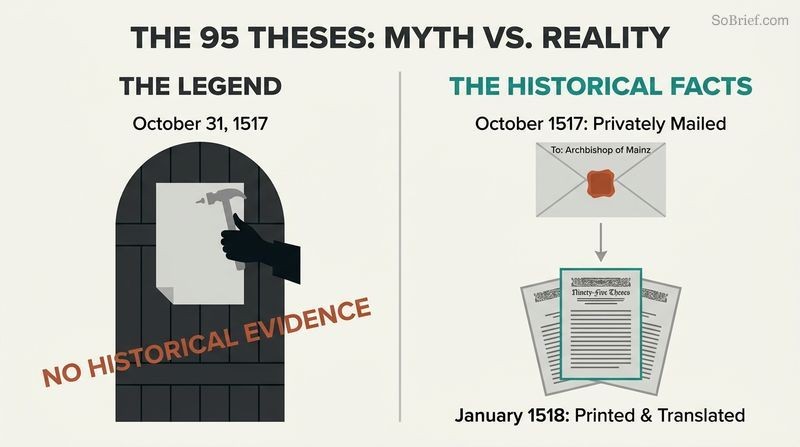
The founding legend is myth. The iconic image of a defiant friar hammering his protest to the Wittenberg Castle Church door on October 31, 1517 has almost no reliable evidence behind it. Luther himself never mentioned it. The story first appears in a preface Philip Melanchthon wrote after Luther's death in 1546, and Melanchthon only arrived in Wittenberg in 1518, a year after the fact. What actually happened: Luther mailed his theses to the Archbishop of Mainz and a couple of bishops, where they sat in bureaucratic obscurity for weeks.
The theses spread in January, not November. The famous claim that they raced through Germany in a fortnight is also inflated. The real explosion came in January 1518, when Nuremberg humanists began circulating and translating them. Halloween 1517 was a Saturday; Wittenberg disputations happened on Fridays.
What's striking is how a routine bureaucratic act (posting notices on church doors was ordinary) became a Romantic parable of individual rebellion. The legend survives because it flatters modern sensibilities about the heroic self versus the system. Rex invokes Kolakowski's law of infinite cornucopia: for any position one wishes to hold, arguments are never lacking. This is a useful epistemic warning for all historiography, where inherited images calcify into fact. The parallel to how founding myths function in national identity (Washington's cherry tree, Newton's apple) is instructive: societies retroactively construct crisp origin moments because diffuse causation is psychologically unsatisfying.
Luther's whole theology was a desperate hunt for absolute certainty
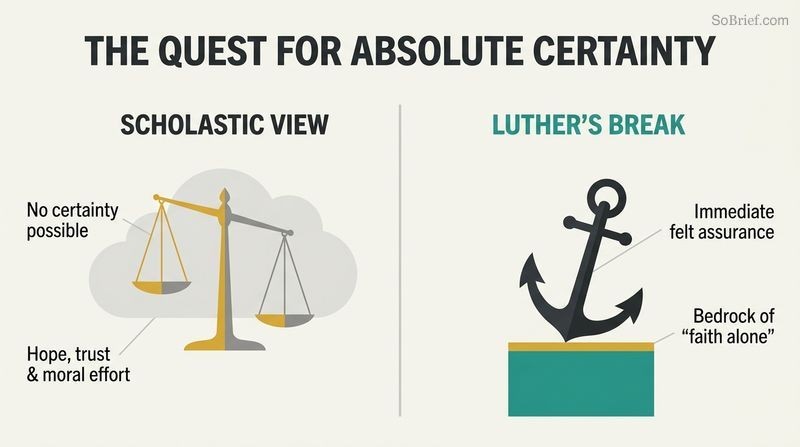
Certainty was the engine. Rex's central argument is that the key to understanding Luther is not rebellion but his craving for utter, unwavering certainty of salvation. The Bible had to be an absolutely certain source of truth, the truth derived from it certain, and the believer's sense of enjoying God's grace certain beyond all doubt. This is what "justification by faith alone" really meant: not a doctrine about earning heaven, but a guarantee of immediate, felt assurance that one is saved.
A break with a thousand years. For centuries, scholastic theologians (Aquinas, Scotus, and the rest) had unanimously answered that a Christian could NOT be certain of being in a state of grace, except by rare special revelation. They offered hope, trust, and moral confidence instead. Luther, in 1518, at age thirty-five, demanded certainty as the normative Christian experience.
Rex reframes Luther as a psychological type as much as a theologian, someone temperamentally unable to tolerate doubt. This connects to modern clinical psychology: Luther's Anfechtungen (spiritual torments) read like scrupulosity, a recognized subtype of obsessive-compulsive anxiety in which sufferers cannot achieve subjective certainty of moral cleanness. Viewed this way, Luther universalized his own pathology into a theology, insisting all Christians needed the reassurance he craved. The irony Rex draws is sharp: Luther, who demanded total certainty, became an ancestor of the "masters of suspicion" (Marx, Nietzsche, Freud) who taught the modern world to doubt everything. Certainty and radical doubt spring from the same intolerance of ambiguity.
The rebel spent years as a devout, obedient Catholic
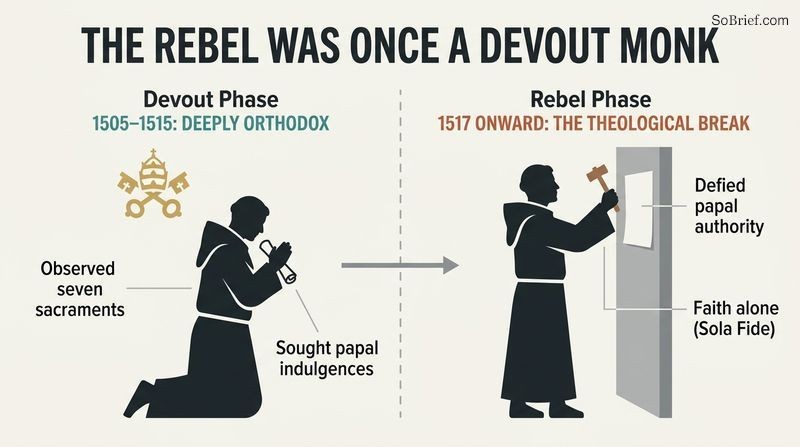
No Reformation in his early work. For roughly the first decade of his religious life, Luther was thoroughly orthodox. His early lectures on the Psalms (1513-1515) endorsed the seven sacraments, the Mass as sacrifice, obedience to bishops and the pope, purgatory, and even the validity of indulgences. He wrote that Christians are "co-workers with God," a cooperative view of grace utterly incompatible with his later theology. He quoted the Epistle of James approvingly: "faith without works is dead."
Made a monk by a thunderstorm. In 1505, terrified by a lightning strike, Luther vowed to Saint Anne (patron of miners, his father's trade) that he would become a friar. The remarkable thing was not the panicked vow but that he kept it, abandoning law studies against his father's wishes. He was a scrupulous, anxious, devoted Augustinian friar who traveled to Rome in 1510 mainly to collect indulgences.
Rex demolishes the retrospective illusion, common in Protestant hagiography, that Luther was always secretly a Lutheran. This matters methodologically: Luther edited his own early writings out of his collected works precisely because they embarrassed his later self, and he rewrote his memories to make his development look inevitable. Historians who mine the early lectures for proto-Reformation seeds are, Rex argues, reading the conclusion back into the premises. The broader lesson concerns how radicals construct usable pasts. Autobiography is always theology masquerading as memory. Compare how converts of all kinds narrate their prior lives as a darkness pointing toward the light they eventually found.
His radical doctrine was the logical extreme of the system he attacked
Justification as the ultimate indulgence. Rex offers a brilliant paradox: Luther's doctrine of salvation "free of charge, by faith alone" was essentially a universal, plenary indulgence available at no cost, no donation, not even a prayer. The medieval theory of indulgences rested on Christ's infinite "treasury of merits," drawn upon like checks on a bank account. Luther did not so much reject this framework as push it to its absolute conclusion: God's grace covers everything, instantly, gratis.
He thought it did not go far enough. In 1517, Luther attacked indulgences for offering cheap, false security and creating moral hazard (the risk people would sin freely, assuming forgiveness was guaranteed). Within a year he was offering salvation on even cheaper terms. His opponents promptly turned the moral-hazard critique against him, and Protestants spent the century battling the charge of "antinomianism."
This is Rex's most counterintuitive claim, and it is genuinely illuminating. Intellectual revolutions rarely spring from nowhere. They radicalize the internal logic of the thing they overthrow. The commercial metaphors baked into medieval soteriology (treasury, account, payment) conditioned Luther's imagination even as he repudiated the institution. There is a parallel in how secular modernity extends Christian universalism (human dignity, equality) while rejecting its theological base, a point made by thinkers from Nietzsche to Charles Taylor. Luther could not have conceived his solution without the problem the scholastics had so elaborately constructed. The critic and the criticized share a grammar.
A single misread sentence of Augustine reshaped Christianity
One Latin slip, enormous consequences. Augustine had written that in baptism, concupiscence (the fleshly inclination to sin) "is remitted not so that it does not exist, but so that it is not imputed as sin." Working from memory in his Romans lectures, Luther repeatedly dropped the word "concupiscence" and spoke only of "sin." From this he concluded that baptism does NOT wash away all sin, that sin remains in the believer, no longer counted against them. This contradicted a thousand years of Christian teaching and Augustine's own explicit position.
The birth of a paradox. This became the famous formula simul iustus et peccator, "at once justified and a sinner." For Luther it was a profound truth about the permanent imperfection of human life. For his Catholic opponents it was a flat contradiction in terms. It also fed his conviction that even good works are, in themselves, sins.
Rex's attention to a scholarly error propagating into world-historical doctrine is a gift to anyone interested in the transmission of ideas. It recalls how mistranslations shaped religion before (Jerome's "horns" on Moses, the "camel through a needle's eye" debates). Luther's prodigious but unreliable memory, Rex notes elsewhere, vitiated much of his otherwise impressive scholarship. The deeper point: foundational convictions can rest on contingent accidents that later get rationalized as revelation. Luther eventually defended the position from Paul directly rather than Augustine, which shows how motivated reasoning backfills justification once a conclusion feels true. The felt rightness came first; the proof-texting followed.
Print turned an obscure friar into Europe's first media celebrity
Technology made the theology travel. Luther's ideas spread because he exploited the printing press with unmatched skill. His works were leaflets and pamphlets that sold like hotcakes; anything with his name sold. By the Reichstag at Worms in 1521, the Elector's household ran a printing press churning out campaign material, and it was "raining pamphlets." Portraits of Luther as a haloed friar with the Holy Spirit's dove above his head sold so fast the papal envoy Aleander could not even obtain one to send to Rome.
Winning the narrative. After Worms, Luther's camp got their account, What Happened at Worms, into print within days, modeling his story on Christ's passion before the imperial authorities could respond. A pamphlet called the Passion of Martin Luther cast the living reformer as a Christ figure. He mastered what Rex calls the "attack ad" while opponents like Eck fumbled in print.
Rex's framing anticipates contemporary media theory: Luther was a first-mover in a new attention economy, and the medium shaped the message. The printed vernacular pamphlet rewarded punchy, emotional, visual communication, exactly Luther's gifts, and punished the measured Latin disputation that scholastics excelled at. R.W. Scribner's work on the "cult of Luther" (haloes, miracle stories, incombustible portraits) shows how quickly the machinery of saint-veneration reattached to a Protestant hero who theoretically rejected it. The uncomfortable modern parallel: the reformer who best manipulates a new communications technology outcompetes more rigorous rivals. Virality and truth are independent variables, then as now.
Making the true Church invisible destroyed the pope's authority
A masterstroke of redefinition. Cornered in debate over papal authority, Luther in 1520 spiritualized the Church out of the physical world. The true Church, he argued, is the invisible body of genuine believers, known only to God, since "nobody can see who believes." Therefore it can have no earthly head, needs no pope, and cannot be identified with any visible institution. His syllogism was ruthless: what we believe in is invisible; we can plainly see the Roman Church; therefore the Roman Church cannot be the true Church.
The price of the move. This solved the authority problem but shattered the concept of a governable Christian community. If the real Church is invisible, external governance passes to secular rulers (Luther's later "two kingdoms" doctrine). And you could know your own salvation but never anyone else's, planting a radical individualism at the core of the new faith.
Rex identifies this as arguably the most consequential single idea Luther generated for the Protestant tradition, even though Luther coined the actual phrase "invisible church" only afterward. The intellectual maneuver is elegant and desperate at once: relocate the contested object beyond the reach of the opponent's evidence. Philosophically it resembles moving a claim from the falsifiable to the unfalsifiable. Sociologically it dissolved the institutional glue holding Christendom together, and Rex argues it seeded an individualism Luther himself would have found appalling, since he loathed letting people think for themselves. The tension between his anti-authoritarian theology and his authoritarian politics runs through everything that followed.
"Scripture alone" could never deliver the unity it promised
The principle devoured itself. Luther's foundational move was to place the bare text of Scripture, read in its plain literal sense, above popes, councils, and Church Fathers, all of them merely human and fallible. At Leipzig in 1519, debater Johannes Eck skillfully drove Luther to admit that even general councils had erred, leaving Scripture as the sole authority. But once no human institution could authoritatively interpret the text, interpretation splintered.
"This is my body." The classic case: four words of the Last Supper. Luther insisted they be taken literally (real presence). Zwingli in Zurich insisted they were figurative (mere symbol). Catholics read the "body" literally but "bread" figuratively (transubstantiation). All three claimed the plain sense of Scripture. Luther himself freely used figurative readings when it suited him while denouncing opponents for doing the same. The guiding principle of Protestantism proved incapable of producing the certainty it was built to establish.
Rex lands his sharpest structural critique here: the scripture principle was self-undermining. This is not a hostile Catholic point so much as a logical one, and Brad Gregory's The Unintended Reformation develops it at length, tracing modern pluralism and relativism partly to this unresolved interpretive anarchy. Luther's response, that disagreement merely proved his opponents lacked his certainty, is a textbook case of unfalsifiable reasoning: any dissent confirms the dissenter's error. Two centuries later Protestants reframed the resulting chaos as a virtue, "private judgment," the very thing Luther despised. The episode is a permanent lesson about how appeals to a self-evident text always smuggle in an interpreter.
"Here I stand" was a stand for truth, not for conscience
Worms, April 1521. Summoned before Emperor Charles V and asked to recant, Luther refused unless convinced by Scripture or plain reason, declaring his conscience captive to the Word of God. The famous addendum "I can do no other, here I stand" appears in some accounts but not the earliest ones. Luther expected to be burned like Jan Hus a century earlier, who had been executed at Constance despite a safe-conduct. He left Worms alive, was spirited away in a staged "kidnapping," and hid at the Wartburg fortress for nearly a year.
Not modern conscience. Rex insists Luther was not defending the right to individual conscience in the modern liberal sense. Like his opponent Thomas More, he made a stand in conscience for what he held to be objective truth. His conscience was bound to the plain text of Scripture, More's to the Catholic Church. Neither believed people should simply follow their own inner light.
This corrective matters because Worms is routinely enlisted as the birth cry of liberal individualism and freedom of belief. Rex shows that both Luther and More operated inside a shared medieval concept of conscience: a faculty that binds you to truth, and against which acting is mortal sin. The novelty was not conscience itself but appealing to it against the Church's dogmatic authority. The genealogy of modern free conscience runs through Luther's rhetoric, not his intentions, an example of how ideas escape their authors. He supplied the vocabulary of resistance; later generations detached it from his theology and repurposed it toward a tolerance he would have condemned.
Luther crushed the peasants to prove he was no revolutionary
Caught between two fires. In 1524-1525 the German Peasants' War erupted, with rebels invoking Luther's rhetoric of Christian liberty. Luther faced a dilemma: he depended entirely on the protection of Elector Frederick and other princes, yet a popular uprising claimed his banner. His first response, an Admonition to Peace, was relatively measured. But as violence spread he issued Against the Thieving, Murderous Hordes of Peasants, urging rulers to stab, smite, and slay rebels as one would a mad dog, calling such bloodshed a good work pleasing to God.
Politics trumped theology. His ferocity shocked friends and foes, and even contradicted his own principles, as the Catholic Cochlaeus gleefully noted. But it worked. By siding brutally with authority, Luther consolidated his role as a pillar of social order and made Lutheranism, as Rex puts it, one of the most congenial versions of Christianity ever offered to the powerful.
Rex exposes the deep fault line in Luther: an individualist theology yoked to a conformist, ultimately authoritarian politics, with politics winning. Luther grounded obedience to rulers in the fourth commandment (honor your father), building a patriarchal theory of the state that shaped Lutheran deference to power well into the twentieth century, a lineage some historians controversially trace toward German quietism before 1933. The episode also illustrates the ruthless logic of patronage: a reformer surviving on princely protection cannot bite the hand that shields him. Luther's genuine horror of disorder was real, but so was the political necessity. The blood of the peasants bought his respectability.
His hatred of Erasmus revealed the crack in his certainty
The debate over free will. Erasmus, the great humanist and mildest of Luther's critics, finally broke with him in 1524 over free will. Luther's reply, The Enslaved Will (1525), flatly denied human freedom in salvation to exalt God's grace and predestination. But Erasmus had drilled into a genuine fault line: if God saves only a chosen fraction, are Scripture's universal offers of mercy sincere? Luther's answer split God into a "revealed will" (the merciful biblical promises) and a "hidden will" (the inscrutable decree of who is actually saved).
The tell. This appeal to a hidden divine will sat awkwardly with a theology resting on Scripture alone as a transparent text. Rex suggests Luther's extraordinary, lifelong venom toward the gentle Erasmus, whom he vowed to "kill with my pen," betrayed the mental discomfort of a man whose fortress of certainty had been probed at its one soft spot.
Rex's psychological reading is compelling: the intensity of Luther's contempt is disproportionate to Erasmus's mild provocation, suggesting a wound rather than a disagreement. The hidden-God move (deus absconditus) is theologically daring but concedes that the plain text does not, in fact, mean what it plainly says about universal salvation. Modern decision theory and theodicy still wrestle with the same knot: reconciling a benevolent, universal offer with selective outcomes. Erasmus embodied a different temperament entirely, comfortable with probability, ambiguity, and unresolved questions, which is precisely why Luther found him intolerable. The clash was less about doctrine than about whether a thinking person can live without certainty.
Luther's problems were medieval; only his answers were new
A profoundly medieval mind. Rex's closing verdict: Luther is misread as the first modern man. His obsessions were thoroughly medieval, intense guilt over sin, the drama of confession, devotion to the suffering Christ, and dread of the Antichrist. His Christ-centered piety was the fruit of late-medieval devotion, not a break from it. He even kept two "Catholic" positions most other Protestants dropped: the real presence in the Eucharist and the use of religious images.
New solutions to old questions. What was genuinely novel were three ideas that each overturned a thousand years of teaching, including his hero Augustine: the invisible Church, the persistence of sin after baptism, and the certainty of grace through faith alone. Luther started from Augustinian insights and pushed them until they shattered the Augustinian framework itself. He never intended to found a new religion; he thought he was recovering the old one.
This is the interpretive payoff of Rex's whole approach: dissolving the anachronism that makes Luther a proto-modern hero of autonomy and progress. He was a man wholly inside his century's mental furniture who happened to rearrange it catastrophically. The framing recalls Herbert Butterfield's warning against "Whig history," reading the past as a march toward the present. Luther's charge that Catholicism was "Pelagian" (works-righteousness) stuck so well that even now many textbooks uncritically repeat his caricature, a testament to how a polemicist's frame can colonize scholarship for five centuries. Understanding him requires resisting the very narrative he so brilliantly authored about himself.
Analysis
Richard Rex's The Making of Martin Luther is a work of intellectual history with a revisionist thesis: to understand Luther you must understand his ideas, and his ideas were driven not by a Romantic appetite for freedom but by a near-pathological hunger for certainty. This reframing is the book's spine, and it reorganizes the familiar Reformation narrative around theology rather than "great social forces." Rex's method is deliberately narrow: he reads Luther's own vast output and that of his contemporaries rather than distilling the unmanageable secondary literature. This gives the book unusual freshness but also a polemical edge; Rex, a Cambridge Catholic historian, is frankly unpersuaded by Protestant hagiography and enjoys puncturing it.
The book's great strengths are its demolitions of legend (the door-nailing, the fortnight of fame, the always-already-Lutheran young monk) and its structural critiques (that justification by faith was the indulgence system's logical extreme; that "scripture alone" could never yield unity; that the invisible-church move dissolved the institution it opposed). Rex is especially good on contingency: a misremembered sentence of Augustine, the accident of the imperial interregnum, the exploitation of print. His portrait of a touchy, self-dramatizing, brilliant, memory-unreliable man is vivid and humane even when unflattering.
The book's limitations follow from its virtues. By insisting so hard that Luther was medieval, not modern, Rex risks underplaying how genuinely the ideas mutated in transmission; intentions and effects diverge, as he himself concedes regarding conscience and individualism. His Catholic vantage occasionally shades description into prosecution, particularly on Luther's egotism. And the deliberate avoidance of social and economic context, defensible as a corrective, leaves the reader wondering why these particular ideas found such combustible tinder. Still, as a lucid, argument-driven account of what Luther actually thought and how he came to think it, the book is exceptional. It restores theology to the center of a story too often told as sociology, and it models how to read a revolutionary without worshipping or demonizing him.
Download PDF
Download EPUB
.epub digital book format is ideal for reading ebooks on phones, tablets, and e-readers.








































