Key Takeaways
1. The Century's Genesis: Unveiling Hidden Realities
"Our century has been dominated intellectually by a coming to terms with science."
A New Era Dawns. The year 1900 marked a profound shift in intellectual thought, characterized by groundbreaking scientific discoveries that fundamentally altered humanity's understanding of itself and the universe. These breakthroughs, often revealing hidden forces and structures, laid the foundation for the century's intellectual landscape. This period saw the emergence of foundational concepts that would redefine reality.
Pivotal Discoveries. Key scientific advancements around 1900 introduced revolutionary ideas across diverse fields. Sigmund Freud's The Interpretation of Dreams unveiled the unconscious mind and repression, challenging conventional views of human nature. Arthur Evans's excavation of Knossos revealed the previously unknown Minoan civilization, suggesting a deeper, earlier European cultural origin. Max Planck's quantum theory posited that energy is emitted in discrete packets, not continuously, fundamentally altering physics.
Interconnected Insights. These seemingly disparate discoveries shared a common thread: the identification of hidden, inaccessible forces or entities. Gregor Mendel's rediscovered work on genetic inheritance, explaining Darwin's evolution at the individual level, further solidified the scientific understanding of life's variability. J.J. Thomson's electron discovery initiated particle physics, revealing the atom's complex internal structure. This confluence of ideas signaled a new scientific era, where fundamental, invisible elements governed the observable world.
2. Darwin's Double-Edged Legacy: Progress and Peril
"Social Darwinists, into which class Nietzsche essentially fell, have often made this mistake."
Evolution's Broad Reach. Charles Darwin's theory of evolution, particularly the concept of "survival of the fittest," quickly extended beyond biology to influence social and political thought. This led to the rise of Social Darwinism, which sought to explain and justify societal structures, economic competition, and even imperial expansion through a biological lens. Figures like Herbert Spencer coined terms like "survival of the fittest" and applied them to human societies, often with stark and controversial implications.
The Eugenics Movement. The application of Darwinian ideas to human populations fueled the eugenics movement, which gained significant traction in the early 20th century. Concerns about "degeneration" due to urbanization and industrialization, coupled with perceived declines in health and education, led to calls for selective breeding and even forced sterilization. Scientists like Francis Galton and Georges Vacher de Lapouge attempted to objectively measure and categorize human "inferiority" and "superiority," often with racist undertones.
Contrasting Interpretations. Not all interpretations of Darwinism were inherently negative. While some, like Nietzsche, saw it as a justification for a "will to power" and the dominance of "stronger" races, others, like Peter Kropotkin, emphasized cooperation as a natural law in the animal kingdom. Joseph Conrad, in Heart of Darkness, used Darwinian themes to explore the savagery lurking beneath civilized human nature, critiquing imperialism as a "vile scramble for loot." This period showcased the profound and often contradictory ways scientific theories could be adapted to explain human society.
3. War's Aftermath: A World in Fragments, Seeking New Forms
"The Great War and other events in 1936–7 turned the scale and thereafter I knew where I stood. Every line of serious work that I have written since 1936 has been written, directly or indirectly, against totalitarianism and for democratic socialism, as I understand it."
The Great Disillusionment. World War I shattered the prevailing belief in linear progress and left a profound sense of disillusionment across Europe. The unprecedented carnage and military stalemate, exemplified by battles like the Somme, ingrained a new mentality of waste and futility. This era saw a shift in artistic and intellectual expression, as traditional forms struggled to convey the horror and fragmentation of modern experience.
Modernist Responses. Artists and writers responded by breaking with past conventions, emphasizing new forms and challenging established notions of beauty and meaning.
- Richard Strauss's operas Salomé and Elektra used dissonance and psychological themes to reflect societal tensions.
- Arnold Schoenberg pioneered atonality and serialism, seeking a "new grammar" for music.
- Pablo Picasso's Les Demoiselles d'Avignon and the Cubist movement assaulted traditional art, exploring fragmented realities and "primitive" mentalities.
- Literary masterpieces like T.S. Eliot's The Waste Land and James Joyce's Ulysses used myth and stream-of-consciousness to grapple with the "futility and anarchy" of contemporary history.
The Rise of New Ideas. The war also spurred practical and philosophical shifts. Medical advancements in blood transfusion and cosmetic surgery emerged from the sheer scale of casualties. Psychology gained new legitimacy through the study of "shell shock." Ludwig Wittgenstein's Tractatus Logico-Philosophicus explored the limits of language and logic, while the Dada movement, born in neutral Zurich, questioned the very possibility of art in a world gone mad, embracing chance and absurdity. This period was a crucible for intellectual and artistic experimentation, reflecting a world grappling with profound loss and uncertainty.
4. The American Mind: Pragmatism, Mass Culture, and Social Inquiry
"The business of America is business."
Pragmatism's Ascendancy. In contrast to Europe's post-war disillusionment, the United States maintained a pragmatic and optimistic intellectual outlook. American universities, influenced by the German research model, expanded rapidly, fostering a practical approach to knowledge. William James's philosophy of pragmatism, emphasizing practical utility over abstract dogma, resonated deeply with the American spirit, advocating for ideas that had "practical cash value."
Shaping Modern Life. This pragmatic ethos manifested in tangible innovations and a distinctive cultural landscape.
- The skyscraper, born in Chicago, became an icon of urban efficiency and ambition.
- The Wright brothers' pioneering flights, driven by methodical experimentation, revolutionized transportation.
- The Ashcan School of painting captured the raw, everyday life of American cities, reflecting a down-to-earth realism.
- D.W. Griffith's cinematic innovations, like parallel editing and the close-up, transformed storytelling and gave rise to the concept of the movie star.
A New Social Fabric. The 1920s saw the emergence of a mass culture shaped by new media and consumerism. Sinclair Lewis's Babbitt satirized the conformist, materialistic values of middle America, while the Lynds' Middletown provided a sociological blueprint of a typical American town, revealing the profound impact of cars, movies, and radio on daily life and social stratification. The Harlem Renaissance, a vibrant flourishing of black arts and letters, offered a powerful counter-narrative to prevailing racial prejudices, asserting the richness and validity of African American culture. This era solidified America's unique intellectual identity, distinct from its European counterparts.
5. Totalitarian Shadows: Ideology, Inquisition, and the Eclipse of Ethics
"The crisis of India... is that of a decaying civilisation, where the only hope lies in further swift decay."
The Rise of Totalitarianism. The interwar period witnessed the alarming rise of totalitarian ideologies in Europe, particularly Nazism and Stalinism, which profoundly impacted intellectual life. Oswald Spengler's The Decline of the West resonated with a sense of impending doom for Western civilization, advocating for a "Prussianism and Socialism" that would later influence Nazi thought. The punitive Versailles Treaty, critiqued by John Maynard Keynes, fueled German resentment and provided fertile ground for extremist narratives.
Inquisition and Exile. Both Nazi Germany and Soviet Russia systematically suppressed intellectual freedom, leading to widespread persecution, exile, and even death for artists, scientists, and scholars.
- Hitler's "degenerate art" exhibitions and purges targeted modern artists and Jewish intellectuals, forcing many like Einstein, Gropius, and the Frankfurt School into exile.
- Stalin's Great Terror decimated the Russian intelligentsia, with figures like Nikolai Vavilov and Osip Mandelstam perishing in the Gulag for ideological non-conformity.
- The Lysenko affair in Soviet biology demonstrated the catastrophic consequences of political interference in science, prioritizing ideology over empirical truth.
The Eclipse of Ethics. These regimes represented an "eclipse of ethics," where truth and morality were subordinated to state power and ideological purity. Philosophers like George Lukács, initially skeptical of Bolshevism, eventually justified terror in the name of socialist revolution. Hannah Arendt's later analysis of Adolf Eichmann's trial, describing the "banality of evil," highlighted how ordinary individuals could commit monstrous acts by simply "obeying orders" within a totalitarian system, revealing a chilling absence of personal conscience. This era underscored the fragility of reason and humanism in the face of unchecked ideological power.
6. The Atomic Age: Physics Reshapes Reality and Warfare
"If, as I have reason to believe, I have disintegrated the nucleus of the atom, this is of greater significance than the war."
Splitting the Atom. The period from 1919 to 1932 marked a "golden age" for physics, fundamentally altering humanity's understanding of matter and energy. Ernest Rutherford's groundbreaking experiment in 1919, demonstrating the artificial disintegration of the nitrogen atom, heralded the dawn of nuclear physics. This was followed by James Chadwick's discovery of the neutron in 1932, completing the understanding of the atom's basic constituents.
Quantum Leaps. Niels Bohr's work in Copenhagen unified atomic structure with the periodic table, explaining chemical behavior through electron shells. Werner Heisenberg's uncertainty principle and Erwin Schrödinger's wave mechanics introduced "quantum weirdness," challenging classical notions of observation and reality at the subatomic level. These theoretical advancements, often born from intense intellectual rivalry and intuition, laid the groundwork for unprecedented technological applications.
The Bomb and its Aftermath. The discovery of nuclear fission by Otto Hahn and Lise Meitner in 1938, and the subsequent realization by Frisch and Peierls that a chain reaction was possible with a small amount of uranium, propelled the world towards the atomic bomb. The Manhattan Project, a massive collaborative effort, culminated in the devastating bombings of Hiroshima and Nagasaki, forever changing the nature of warfare and global politics. This scientific triumph, while ending World War II, also ushered in the Cold War and a new era of existential threat, forcing a re-evaluation of science's role in human affairs.
7. The Human Condition Reimagined: Self, Sex, and Society
"The problem with no name became The Feminine Mystique."
Post-War Reassessment. The aftermath of World War II prompted a profound re-evaluation of the human condition, particularly in Western societies. The widespread experience of war, coupled with growing affluence and the rise of mass media, led to new sociological and psychological insights into individual and collective identity. Thinkers like David Riesman, in The Lonely Crowd, described a shift from "inner-directed" to "other-directed" personalities, driven by a desire for social approval and conformity in an increasingly interconnected world.
The Sexual Revolution. This period saw a dramatic transformation in attitudes towards sex and gender. Simone de Beauvoir's The Second Sex (1949) became a foundational text for feminism, challenging traditional roles and exposing the societal construction of "woman as the other." Alfred Kinsey's groundbreaking reports on human sexual behavior (1948, 1953) revealed a vast discrepancy between public norms and private practices, normalizing discussions around masturbation, premarital sex, and homosexuality. William Masters and Virginia Johnson's physiological studies (1966) further demystified orgasm, particularly for women, contributing to a new understanding of sexual fulfillment.
Psychology's New Frontiers. Psychology moved beyond traditional Freudian concepts, which faced increasing empirical scrutiny. Erik Erikson's theory of "identity crisis" resonated with the burgeoning adolescent generation, while Bruno Bettelheim's work with autistic children offered new therapeutic approaches. B.F. Skinner's behaviorism, though controversial, challenged the notion of an autonomous "mind," focusing instead on environmental reinforcement. John Bowlby's research on maternal deprivation highlighted the critical importance of early childhood bonding. These diverse psychological explorations, alongside the sexual revolution, reshaped perceptions of self, family, and societal well-being.
8. Global Perspectives: Decolonization, Culture, and Deep History
"The African makes very little use of his frontal lobes. All the particularities of African psychiatry can be put down to frontal laziness."
Decolonization and Identity. The post-WWII era witnessed the rapid decolonization of Africa and Asia, leading to a powerful reassertion of non-Western cultures and histories. This global shift challenged Eurocentric intellectual paradigms and fostered new perspectives on identity, culture, and the evolution of civilizations. Writers like Chinua Achebe, in Things Fall Apart, vividly portrayed the disruption of traditional African societies by colonialism, while simultaneously celebrating the richness and complexity of indigenous cultures.
Reclaiming History. Scholars actively worked to reconstruct and re-evaluate the histories of formerly colonized regions. Basil Davidson's Old Africa Rediscovered (1959) unveiled the sophisticated ancient civilizations of Africa, countering the "dark continent" stereotype. Archaeological discoveries, like the Bering land bridge, provided new evidence for the ancient peopling of the Americas, challenging earlier diffusionist theories. These efforts underscored that civilization had emerged independently in diverse parts of the world, not solely from a single "mother culture."
Cultural Relativism and its Critics. Anthropology, particularly through the work of Franz Boas's students Margaret Mead and Ruth Benedict, emphasized cultural relativism, arguing that societies must be understood on their own terms, free from Western biases. Claude Lévi-Strauss's structuralist analysis of myths revealed universal underlying logics across cultures, further eroding the notion of "primitive" versus "civilized" minds. However, this relativist stance faced challenges, as seen in Derek Freeman's critique of Mead's work in Samoa, highlighting ongoing debates about the interplay of culture and biology in shaping human behavior.
9. The Biological Revolution: Genes, Origins, and Human Nature
"If I were to give an award for the single best idea anyone has ever had, I’d give it to Darwin, ahead of Newton and Einstein and everyone else."
Unlocking the Genetic Code. The discovery of the double helix structure of DNA by Watson and Crick in 1953 revolutionized biology, ushering in the era of molecular biology and genetic engineering. This breakthrough, though born from intense rivalry and serendipity, provided the fundamental mechanism of heredity. Subsequent advancements in cloning and gene sequencing, pioneered by scientists like Stanley Cohen and Herbert Boyer, enabled the manipulation of genetic material, opening unprecedented possibilities for medicine and biotechnology.
Revisiting Evolution. The latter half of the century saw a resurgence of Darwinian thinking, with neo-Darwinists like E.O. Wilson and Richard Dawkins aggressively applying evolutionary principles to explain social behavior and human nature. Wilson's Sociobiology argued that genes exert a powerful influence on culture, while Dawkins's The Selfish Gene posited that genes are the fundamental units of selection, explaining altruism and other complex behaviors through the lens of genetic self-interest. This led to a "universal Darwinism," applying algorithmic thinking across diverse fields.
Debates and Discoveries. This period was marked by vigorous debates and new discoveries that refined our understanding of life's origins and human evolution.
- A.G. Cairns-Smith proposed that life originated from self-replicating clay crystals, preceding complex organic molecules.
- The "Cambrian Explosion" revealed a rapid diversification of animal life, challenging gradualist evolutionary models.
- The discovery of the K/T boundary impact crater provided a catastrophic explanation for the extinction of dinosaurs.
- Mitochondrial DNA analysis by Allan Wilson and Rebecca Cann traced human origins to Africa, dating modern humanity to approximately 200,000 years ago.
- The "Turkana Boy" fossil and the Laetoli footprints pushed back the timeline for bipedalism and tool-making, reshaping the narrative of human ancestry.
10. The Digital Cosmos: Information, Universes, and the Limits of Knowledge
"The theory predicts that it cannot predict: it tells us that there are things it cannot tell us."
The Space Age Dawns. The launch of Sputnik in 1957 by the Soviet Union ignited the space race, propelling humanity beyond Earth's atmosphere. This intense Cold War rivalry, epitomized by the moon landing in 1969, spurred unprecedented technological and scientific advancements. The development of powerful rockets and sophisticated spacecraft transformed our understanding of the solar system and the universe, making space travel a tangible reality.
Cosmic Revelations. Beyond the moon landing, the 1960s and beyond brought revolutionary insights into the cosmos.
- The accidental discovery of cosmic background radiation confirmed the Big Bang theory, providing a "relict" echo of the universe's fiery birth.
- The identification of quasars and pulsars revealed exotic celestial objects, leading to theories of black holes and neutron stars, and completing the sequence of stellar evolution.
- Steven Weinberg's The First Three Minutes synthesized these discoveries into a coherent narrative of the universe's origin and elemental formation.
The Information Revolution. Parallel to cosmic exploration, the development of the Internet, originating from ARPA's defense research in the 1960s, revolutionized communication. Packet-switching and email transformed how information was shared, leading to the World Wide Web and a global interconnectedness. This digital revolution, alongside the Human Genome Project, marked a new era where information itself became a primary commodity and a driving force of societal change.
Limits of Knowledge. Despite these triumphs, the late 20th century also saw a growing recognition of the limits of scientific knowledge. Stephen Hawking's A Brief History of Time popularized complex cosmological theories, including black holes and the possibility of multiple universes, while acknowledging the breakdown of physical laws at singularities. Kurt Gödel's incompleteness theorems had already demonstrated inherent limits to mathematical systems. John Barrow's Impossibility argued that science itself has inherent boundaries, suggesting that some fundamental questions about the universe may be "mysteries" rather than "problems" solvable by current scientific methods.
11. Culture's Crossroads: Canons, Critiques, and the Scientific Ascendancy
"The mind’s dialogue with itself is not primarily a social reality. All that the Western Canon can bring one is the proper use of one’s own solitude, that solitude whose final form is one’s confrontation with one’s own mortality."
The Erosion of High Culture. The late 20th century witnessed a profound challenge to the traditional concept of "high culture" and the Western canon. Thinkers like T.S. Eliot and F.R. Leavis had championed a cultural elite and a shared tradition, but the rise of mass media, postmodern theories, and diverse global voices eroded this consensus. The "culture wars" of the 1980s, exemplified by Allan Bloom's The Closing of the American Mind, fiercely debated the curriculum and the very definition of liberal education, often with accusations of elitism and political correctness.
Postmodernism's Influence. Postmodern thought, articulated by figures like Jean-François Lyotard and Richard Rorty, questioned the existence of universal truths and "metanarratives." They argued that knowledge is "local," context-dependent, and often shaped by power structures. Michel Foucault's "archaeologies" of institutions revealed how "normalcy" is a social construct, while Jacques Derrida's deconstruction challenged the inherent meaning in language itself. These ideas, often dense and paradoxical, influenced literary criticism, history, and the burgeoning field of cultural studies, which sought to expose the ideological underpinnings of all cultural forms.
Science's Ascendancy. Paradoxically, as traditional humanities faced fragmentation, science gained unprecedented authority. The "two cultures" debate, ignited by C.P. Snow, highlighted the growing chasm between scientific and literary intellectuals, with science increasingly seen as the dominant mode of knowledge. The commercial success of popular science books, like Stephen Hawking's A Brief History of Time, signaled a shift in public interest. While some, like Thomas Nagel, continued to explore traditional philosophical problems, others, like E.O. Wilson, advocated for "consilience," arguing that science could ultimately explain all aspects of human culture, ethics, and religion. This era marked a significant evolution in knowledge forms, with science emerging as the primary narrative for understanding the world.
Review Summary
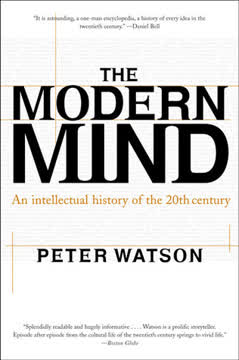
The Modern Mind receives generally high praise for its ambitious scope, chronicling 20th-century intellectual history across science, arts, philosophy, and economics. Readers admire Watson's erudition and narrative breadth across 800+ pages, frequently citing it as transformative reading. Common criticisms include its Western-centric perspective, lack of a cohesive through-line, and superficial treatment of some ideas due to its encyclopedic nature. Many note the demanding reading experience but consider the effort worthwhile, particularly praising the concluding chapter's optimistic synthesis.