
Key Takeaways
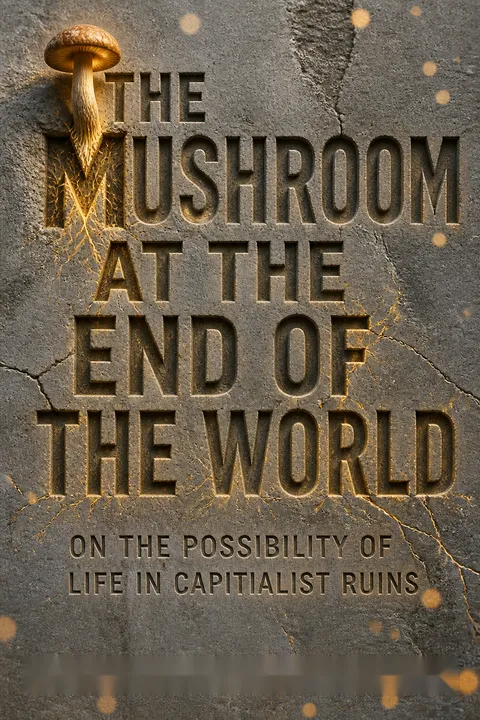
1. Matsutake: A Guide to Life in Capitalist Ruins
If we open ourselves to their fungal attractions, matsutake can catapult us into the curiosity that seems to me the first requirement of collaborative survival in precarious times.
Embracing precarity. The book begins by acknowledging a world falling apart—climate chaos, economic instability, and a loss of guiding narratives. This "precarity" is life without the promise of stability, a universal condition now. Matsutake mushrooms, emerging unexpectedly in disturbed landscapes, offer a unique lens to explore this indeterminacy and the possibilities of survival amidst ruin.
Beyond progress narratives. Traditional stories of progress and modernization have blinded us to the messy reality of our planet. Matsutake, thriving in human-disturbed forests, challenges the idea that nature is a passive backdrop for human mastery. It forces us to look for "third nature"—what manages to live despite capitalism—and to question singular, forward-moving futures.
Curiosity as survival. The mushroom's ability to grow in "blasted landscapes" like post-Hiroshima or logged-over forests, invites a radical curiosity. This curiosity is crucial for collaborative survival, pushing us to notice the "patchiness" of life—a mosaic of entangled ways of being, human and nonhuman, that coalesce in unpredictable rhythms.
2. "Arts of Noticing" Reveal Patchy, Contaminated Worlds
Precarity is the condition of being vulnerable to others.
Reorienting attention. The "modern human conceit" often prevents us from seeing the complex, layered realities of our world, reducing non-human life to mere resources. To understand what truly "remains" in damaged landscapes, we must cultivate "arts of noticing," shifting our focus from grand narratives of progress or ruin to the unruly edges and unexpected encounters that shape existence.
Contamination as collaboration. Survival is not about individual conquest but about "livable collaborations" that inherently involve contamination—transformation through encounter. This challenges the self-contained individual actor models of neoclassical economics and population genetics, which ignore how beings are remade by their interactions. Diversity itself emerges from these messy, often violent, histories of encounter.
Polyphonic assemblages. Instead of fixed categories, the book proposes "polyphonic assemblages"—open-ended gatherings of diverse lifeways and non-living elements. These assemblages, like intertwining melodies, reveal multiple temporal rhythms and shifting interactions, making history in unpredictable ways. Noticing these dynamic, non-scalable gatherings is essential for understanding how life persists in a world without teleology.
3. Salvage Accumulation: Capitalism's Hidden Engine
Salvage accumulation is the process through which lead firms amass capital without controlling the conditions under which commodities are produced.
Capitalism's patchy reality. While Marx focused on factory rationalization, much of today's global economy operates through "supply chains" that link radically different economic scenes. This system, termed "salvage accumulation," allows lead firms to concentrate wealth by appropriating value produced under diverse, often non-capitalist, conditions without directly controlling labor or raw materials.
Translation across patches. Supply chains act as "translation machines," converting value from "pericapitalist" activities—those simultaneously inside and outside capitalism—into legible capitalist inventory. This process is exemplified by:
- Nineteenth-century ivory trade (Conrad's Heart of Darkness)
- Whale oil procurement (Melville's Moby-Dick)
- Wal-Mart's reliance on cheap, often unregulated, production
The "Reverse Black Ships" effect. The rise of global supply chains, particularly in the U.S., was significantly influenced by Japan's economic success in the late 20th century. Japanese trading companies pioneered models of outsourcing and "putting out" systems, which allowed them to accumulate capital by translating diverse global production into inventory. This "Reverse Black Ships" phenomenon led U.S. corporations to dismantle traditional employment expectations, pushing labor into precarious, outsourced situations globally.
4. Precarious Freedom: War's Legacy in the Forest
Freedom is the negotiation of ghosts on a haunted landscape; it does not exorcise the haunting but works to survive and negotiate it with flair.
Freedom's varied meanings. In Oregon's matsutake forests, "freedom" is a central, yet complex, concept for pickers. It's not the rational choice of economists or political liberalism, but an irregular, performative, and communally varied effervescence. This freedom is deeply intertwined with the "ghosts" of past traumas, particularly the U.S.-Indochina War and its aftermath.
Haunted landscapes. The forest is haunted by:
- Untimely deaths of pickers
- Dispossessed Native American communities
- Stumps of logged-out old-growth trees
- Memories of war and displacement
This haunting shapes the pickers' commitment to the forest, offering a space to escape urban confinement, reject "labor" in favor of "searching," and navigate property boundaries as a "fugitive commons."
War's enduring influence. For many Southeast Asian refugees (Mien, Hmong, Lao, Cambodian), mushroom picking is a direct extension of their war survival. White veterans also bring their trauma and resentment. This shared, yet diverse, commitment to freedom—whether as healing, remembering fighting landscapes, or entrepreneurial daring—mobilizes the matsutake harvest, creating a unique, self-organized economy without corporate recruitment or discipline.
5. Forests as "Unintentional Design": Multispecies Histories
Humans join others in making landscapes of unintentional design.
Beyond human heroes. To understand the "life of the forest," we must move beyond human-centric narratives and recognize landscapes as active protagonists. This means acknowledging the historical agency of nonhuman beings, like pines and fungi, in shaping environments. "Unintentional design" describes the emergent patterns of ecosystems resulting from the overlapping, often uncoordinated, world-making activities of many agents.
Pines as historical actors. Pines, often seen as mere resources, are dynamic historical actors. They colonize disturbed landscapes—volcanic ash, glacial till, abandoned fields—and thrive in extreme environments due to their deep evolutionary partnership with mycorrhizal fungi. This mutualism allows pines to grow where other plants cannot, making them pioneers in ecological succession.
Disturbance as a beginning. "Disturbance," whether from natural events (fires, floods) or human actions (logging, farming), is not always destructive; it can renew ecologies and open terrain for new transformative encounters. Matsutake, for instance, often flourishes in human-disturbed pine forests, demonstrating how specific kinds of "messes" can inadvertently foster biodiversity and new forms of collaborative survival.
6. Ruin and Resurgence: Disturbance as a Creative Force
Intersecting historical processes produced forest ruins in Oregon and Japan, but it would be preposterous to argue that forest-making forces and reactions are therefore everywhere the same.
Global coordination of ruin. Forests worldwide are shaped by transnational economic forces, leading to "ruined industrial forests." The cheap timber from Southeast Asia, for example, depressed global prices, making domestic logging in both Oregon and Japan uneconomical. This led to the neglect of industrial timber plantations, creating new forms of "ruin" that paradoxically allowed matsutake to flourish in some areas.
Serendipity in mistakes. Oregon's eastern Cascades, once a logging hub, became a "ground zero" for matsutake due to a series of "mistakes." Fire exclusion, intended to protect ponderosa pines, inadvertently allowed dense thickets of lodgepole pine to mature—the ideal habitat for matsutake. This unintended consequence highlights how ecological resurgence can emerge from the contingencies of human error and shifting management priorities.
Resurgence in peasant woodlands. In Japan and Yunnan, peasant woodlands, shaped by centuries of human disturbance (coppicing, raking for manure), demonstrate a different kind of resurgence. These "ever-young" forests, often dominated by oaks and pines, thrive on human interaction. Even after massive deforestation (e.g., Japan's Meiji era, China's Great Leap Forward), these landscapes show a remarkable ability to regenerate, with matsutake often returning as a valuable product of this human-forest co-creation.
7. Science as Patchy Translation: Beyond Universal Truths
Cosmopolitan science is made in emerging patches of research, which grow into or reject each other in varied encounters.
Science as a translation machine. Science, like capitalism, is a "translation machine" that draws insights from diverse ways of life, but often in messy, incoherent ways. "National matsutake sciences" have emerged, with Japanese research emphasizing human disturbance for matsutake growth (satoyama restoration) and U.S. research focusing on picker impact and sustainable harvest within timber management frameworks.
Gaps and incompatibilities. These national "knowledge patches" persist despite international communication, due to differing research questions, site selection, and scales of analysis. Japanese studies, often "descriptive" and site-specific, are dismissed by U.S. researchers seeking scalable, timber-compatible models. This divergence is evident in places like Yunnan, where U.S. conservation models clash with local peasant practices and Japanese-influenced business interests.
Flying spores and fluid kinds. Beyond fixed scientific categories, the concept of "flying spores" offers a metaphor for open-ended communication and the fluid nature of "species." DNA sequencing, while precise, reveals that species boundaries are often arbitrary, and fungal "kinds" are shaped by rare, long-distance dispersal events and continuous genetic exchange within mosaic bodies. This speculative science embraces indeterminacy, showing how knowledge, like life, emerges from historical mergings and unexpected encounters.
8. The Latent Commons: Finding Allies in the Middle of Things
Latent commons are those mutualist and nonantagonistic entanglements found within the play of this confusion.
Beyond institutionalized struggle. In a world without clear progress narratives, political struggle shifts from grand, unified programs to detecting "latent commons"—inchoate, often unnoticed, entanglements that offer possibilities for shared assembly. This requires "political listening" and "arts of noticing" to identify potential allies, human and nonhuman, amidst institutionalized alienation.
Characteristics of latent commons:
- Not exclusive human enclaves: Include pests, diseases, and diverse ecologies, accepting imperfection.
- Not good for everyone: Acknowledge that collaborations benefit some while excluding others.
- Don't institutionalize well: Thrive in law's interstices, catalyzed by infraction, infection, and poaching.
- Cannot redeem us: Exist in the "here and now," amidst trouble, without promising utopia.
Fugitive entanglements. In Yunnan, despite efforts to privatize forests through household contracts, matsutake thrives in a "fugitive commons" where seasonal enclosure allows year-round peasant traffic (firewood, grazing, foraging) that inadvertently maintains the open, disturbed conditions matsutake needs. This highlights how private assets often grow out of unacknowledged common living spaces, and how the "thrill of private ownership is the fruit of an underground common." Living in the middle of things means continuously exploring these overgrown verges, catching the scent of elusive mutualities.
Review Summary
People Also Read


FAQ
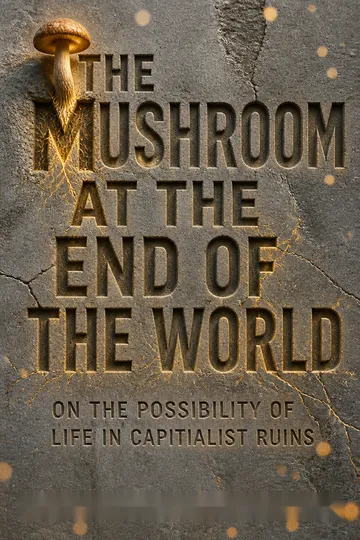
1. What is The Mushroom at the End of the World by Anna Lowenhaupt Tsing about?
- Exploring life in capitalist ruins: The book investigates how life persists in damaged environments shaped by capitalist development, using the matsutake mushroom as a lens to understand precarious livelihoods and ecological entanglements.
- Multispecies and multispatial focus: Tsing examines the interactions between humans, fungi, forests, and global capitalism, highlighting the patchy, unpredictable nature of survival in disturbed landscapes.
- Fieldwork across continents: Drawing on research in Japan, the US, China, Finland, and Canada, the book reveals how local practices and global forces intersect to shape ecological and social worlds.
2. Why should I read The Mushroom at the End of the World by Anna Lowenhaupt Tsing?
- Fresh perspective on precarity: The book reframes precarity as a universal condition, challenging readers to rethink survival beyond stable jobs and predictable futures.
- Interdisciplinary insights: Tsing combines anthropology, ecology, history, and political economy, offering a rich, multifaceted view of multispecies life and global capitalism.
- Imaginative and innovative approach: The book’s structure and method encourage readers to embrace indeterminacy, collaboration, and curiosity about the world’s patchiness and unpredictability.
3. What are the key takeaways from The Mushroom at the End of the World by Anna Lowenhaupt Tsing?
- Life persists in ruins: Even in landscapes damaged by capitalism, new forms of life and collaboration emerge, challenging narratives of progress and mastery.
- Assemblages and entanglement: Survival depends on multispecies assemblages—complex, open-ended gatherings of humans, fungi, trees, and other organisms.
- Capitalism’s reliance on the noncapitalist: Capitalist accumulation often depends on appropriating value from outside its direct control, through processes Tsing calls “salvage accumulation.”
- Indeterminacy and noticing: Embracing uncertainty and learning to notice the unexpected are crucial for understanding and engaging with the world’s complexity.
4. How does Anna Lowenhaupt Tsing use matsutake mushrooms to explore life in capitalist ruins?
- Ecological and economic guides: Matsutake thrive in human-disturbed forests, symbolizing life’s persistence amid environmental damage and serving as a global commodity connecting marginalized pickers to Japanese markets.
- Multispecies collaboration: The mushroom’s survival depends on complex relationships with pine trees and other organisms, illustrating the importance of unintentional design and multispecies world-making.
- Precarious livelihoods: Matsutake pickers, often refugees or marginalized groups, embody the condition of precarity, revealing the patchy, contingent nature of survival and capitalism.
5. What are the main concepts introduced in The Mushroom at the End of the World by Anna Lowenhaupt Tsing?
- Third nature: Life that emerges in capitalist ruins, distinct from “first nature” (ecological relations) and “second nature” (capitalist transformations), representing patchy and unpredictable survival.
- Assemblage and polyphony: Assemblages are open-ended gatherings of diverse species and lifeways, while polyphony describes the simultaneous, intertwined rhythms of these assemblages.
- Salvage accumulation: A form of capitalist accumulation that depends on translating and appropriating value produced outside direct capitalist control.
- Latent commons: Imperfect, ephemeral sites of mutualistic entanglement among species and humans, essential for collaborative survival but resistant to full institutionalization.
6. How does Anna Lowenhaupt Tsing define and use the concept of “assemblage” in The Mushroom at the End of the World?
- Open-ended gatherings: Assemblages are dynamic, multispecies groupings that co-create landscapes and livelihoods, rather than fixed or closed systems.
- Polyphonic relations: Borrowing from music, Tsing uses “polyphony” to describe how different species and actors maintain their own rhythms while interacting and shaping shared worlds.
- Historical and contingent: Assemblages are shaped by histories of encounter, disturbance, and collaboration, emphasizing the unpredictability and complexity of ecological and social life.
7. What does “salvage accumulation” mean in The Mushroom at the End of the World by Anna Lowenhaupt Tsing?
- Capitalism’s dependence on the outside: Salvage accumulation refers to capitalist processes that appropriate value from noncapitalist or pericapitalist sites, such as forests, commons, and precarious labor.
- Translation and appropriation: Value is translated across cultural and economic differences, often through middlemen or intermediaries, to become legible as capital.
- Patchy and uneven effects: This process reveals capitalism’s reliance on collaborative survival beyond its control, resulting in uneven and unpredictable outcomes.
8. How does Anna Lowenhaupt Tsing describe “latent commons” in The Mushroom at the End of the World?
- Elusive mutualistic entanglements: Latent commons are imperfect, unstable sites of mutualistic and nonantagonistic relations among species and humans, existing beneath formal institutions.
- Resistance to enclosure: These commons resist full privatization or institutionalization, yet are essential for sustaining life in damaged landscapes.
- Tension with capitalism: Capitalist asset-making often depends on latent commons, creating ongoing tensions between enclosure and shared living.
9. What role does “freedom” play in the matsutake picking communities in The Mushroom at the End of the World?
- Freedom as autonomy: For many pickers, especially refugees and veterans, freedom means escaping control and finding autonomy in the forest.
- Freedom as boundary object: The concept unites diverse actors with different histories and aspirations, even as it is interpreted and enacted differently.
- Contradictions of freedom: While offering autonomy, freedom also entails precarity, legal vulnerability, and exclusion from formal labor structures.
10. How does Anna Lowenhaupt Tsing compare gift economies and capitalist commodity economies in the matsutake trade?
- Matsutake as gifts and commodities: In Japan, matsutake are valued as gifts that build social relationships, but they also circulate as commodities in global markets.
- Translation between value regimes: The mushroom’s journey from Oregon forests to Japanese markets involves complex processes of alienation and re-embedding, as it shifts between gift and commodity forms.
- Role of middlemen: Wholesalers and retailers act as mediators, translating commodities into relational gifts and blurring the boundaries between economic systems.
11. What ecological insights about forests and fungi does The Mushroom at the End of the World by Anna Lowenhaupt Tsing provide?
- Fungi as world builders: Matsutake and other fungi form underground networks (mycorrhizae) that connect and nourish trees, shaping soil and enabling forests to thrive.
- Indeterminacy and disturbance: Fungal growth and fruiting are indeterminate, responding to environmental conditions and multispecies encounters, challenging static views of ecosystems.
- Human disturbance as necessary: In some contexts, ongoing human activities like coppicing and raking are essential for maintaining habitats favorable to matsutake and forest resurgence.
12. What is Anna Lowenhaupt Tsing’s “arts of noticing” method in The Mushroom at the End of the World, and how does it contribute to understanding precarious life and capitalism?
- Revitalizing description and curiosity: Tsing advocates for close, attentive observation of the patchy, contingent realities of multispecies life, using ethnography and natural history.
- Embracing indeterminacy: Her method involves listening to multiple, simultaneous rhythms and stories, capturing the complexity of assemblages and encounters.
- Collaborative and experimental research: The book emerges from interdisciplinary dialogue and collaborative fieldwork, emphasizing that research categories develop through engagement with diverse local knowledges and practices.
Kantelingen Series Series
Download PDF
Download EPUB
.epub digital book format is ideal for reading ebooks on phones, tablets, and e-readers.








































