

Key Takeaways
Your beliefs, not buried traumas, build the reality you inhabit
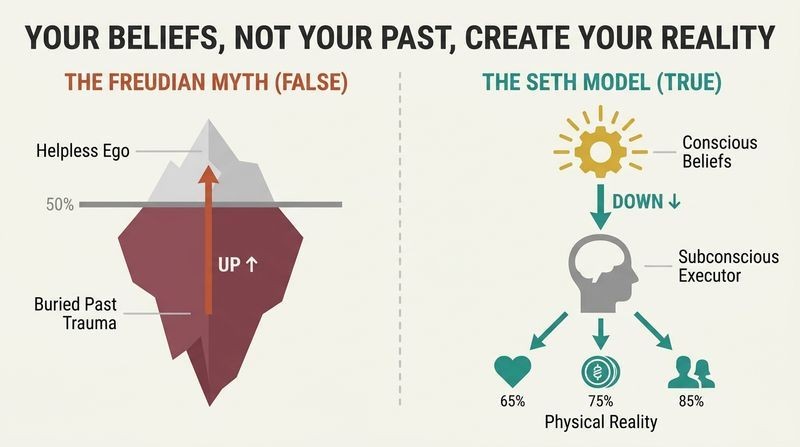
The core claim of the whole book. Seth, the personality Jane Roberts spoke for in trance, insists that your conscious beliefs about yourself and the world literally generate your physical experience: your health, your finances, your relationships, even events that appear to strike from outside. What exists physically existed first in thought and feeling. There is no other rule.
This overturns the Freudian model. You are not a helpless ego perched atop a savage, unreliable subconscious. The conscious mind directs unconscious activity, not the reverse. If your life displeases you, do not dig for a childhood wound to blame. Instead audit the thoughts you repeat all day, because those repetitions are instructions your body and circumstances faithfully obey. Poverty, illness, and loneliness, Seth argues, were pursued rather than inflicted.
What is striking is how closely this 1974 channeled material anticipates cognitive behavioral therapy. Aaron Beck and Albert Ellis, working in clinical psychology around the same era, arrived independently at the principle that beliefs generate emotions, which then drive behavior. Placebo and nocebo research lends further weight: expectation measurably alters physiology. The vulnerability is the strong version. Claiming a person's beliefs summon their cancer or an earthquake edges toward blaming victims for misfortune and is unfalsifiable. The durable, testable kernel is humbler and powerful: the interpretive frame you hold shapes what you notice, how you feel, and which actions become thinkable.
Hunt down the beliefs you mistake for plain facts about life
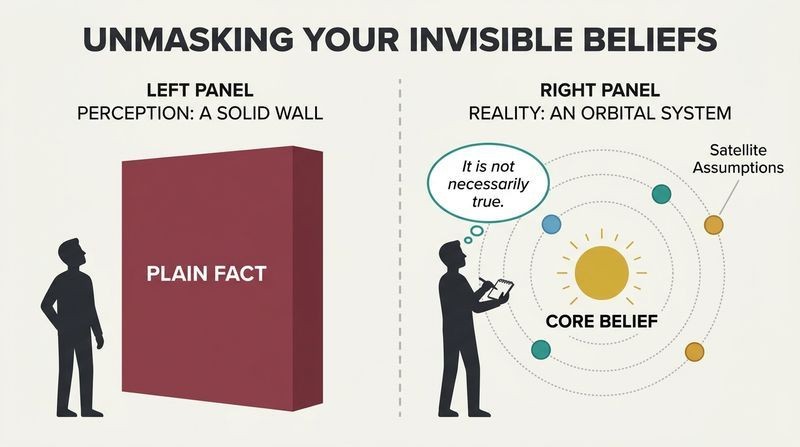
Invisible beliefs are the trap. Seth calls a belief invisible when you no longer experience it as an opinion but as a self-evident feature of reality, so obvious it never occurs to you to question it. Andrea, a divorced mother who phoned Roberts in a panic after losing her job, was certain that life is simply harder for a woman without a man. That was not a fact. It was an unexamined conviction quietly manufacturing her defeats.
Around these cluster core beliefs, the strong central ideas about your existence that organize dozens of smaller ones like planets orbiting a sun. Seth's method: write your beliefs down, examine each as if it belonged to a stranger, and notice contradictions. Then add the loaded phrase, "It is not necessarily true, even though I believe it."
The insight that our most consequential assumptions hide precisely because they feel like reality itself echoes what sociologists call tacit knowledge and what cognitive scientists label the fundamental attribution of objectivity. We treat our maps as the territory. The journaling prescription resembles techniques later formalized in cognitive therapy's thought records and in Byron Katie's questioning method. One useful caution: not every stubborn belief is a distortion. Some convictions that feel like facts are facts. The skill Seth points toward is discernment, holding beliefs loosely enough to test them against evidence, rather than a blanket suspicion of everything you think you know.
The present moment is your only point of power, so act there
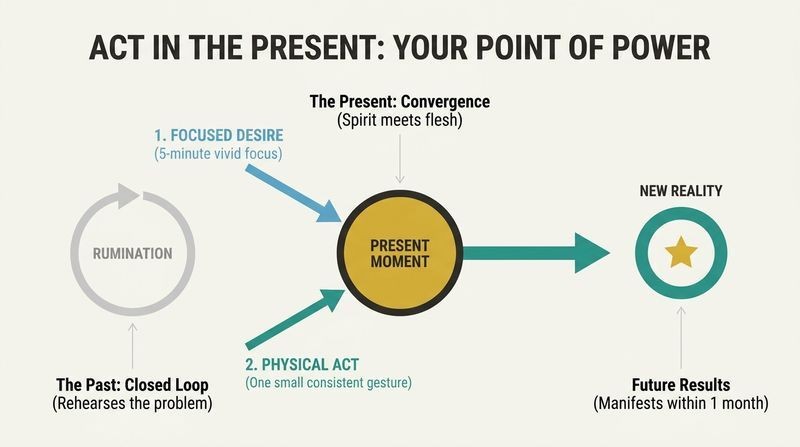
Seth's most practical single idea. All of your creative force converges at the present intersection of spirit and flesh. The past cannot be changed by ruminating on it, and endlessly asking "what went wrong?" merely reinforces the problem by making you rehearse it. Solutions sit right beside their problems, on the side you refuse to look at.
The exercise: for five minutes, focus with total attention on what you want, using vivid imagery or repeated statements, with zero attention to what you lack. Then drop it completely and perform one small physical act consistent with the new belief. If you feel poor, spend a little more than usual. If lonely, smile at someone. If sick, behave once a day as though you were well. Combining focused desire with a concrete gesture, Seth says, produces results within about a month.
This anticipates behavioral activation, a well-supported depression treatment where small committed actions precede, rather than wait for, changed feeling. The demand for a physical gesture is shrewd: it defeats the trap of pure positive thinking, which often deepens despair by highlighting the gap between wish and situation. Neuroscience of self-efficacy supports the mechanism, since experiencing agency alters mood and motivation. The claim that gazing backward for causes is itself a chief cause of suffering is bracing and partly overstated. Trauma-informed clinicians would counter that some past material must be processed, not bypassed. Still, as an antidote to paralytic rumination, the present-tense stance is genuinely liberating.
Emotions and imagination obey your beliefs, never the reverse
A counterintuitive reversal. People assume feelings arise mysteriously and sweep them along. Seth insists the causal arrow runs the other way: your beliefs generate the appropriate emotions, and your imagination faithfully paints pictures that reinforce whatever you already hold true. A long depression does not descend on you. You entertained despondent convictions until they bred the matching feelings.
This dooms naive positive thinking. Repeating "I want to lose weight" while believing yourself fat only pits desire against conviction and keeps the conviction winning. Seth's overweight example: you do not overeat because you believe you are thin, you overeat because you believe you are overweight, and the body conditions itself to match. Change the belief first, and imagination and emotion realign automatically behind it, doing the reinforcing work for you instead of against you.
The appraisal theory of emotion in modern psychology largely agrees: feelings follow from how we interpret situations, not from raw events. This is why two people meet the same setback with fury or calm. Seth's warning against forcing cheerful affirmations over unexamined negative beliefs is prescient, foreshadowing critiques of toxic positivity and research showing that suppressing emotion increases its physiological charge. Where it gets debatable is the absoluteness. Somatic and neurochemical states clearly influence cognition too, as anyone with a hormonal shift or sleep deprivation knows. The relationship is more likely bidirectional than one-way, but Seth's emphasis usefully corrects the popular fatalism about our own moods.
You hypnotize yourself all day, so change the suggestion
Natural hypnosis is Seth's term for the ordinary process by which your unconscious accepts whatever your conscious mind concentrates on. Formal hypnosis just accelerates what your inner monologue does constantly: narrow focus, exclude contradicting data, repeat a suggestion until the body obeys. You are simultaneously the hypnotist and the subject. In the areas of life where you are satisfied, this works invisibly and beautifully. In the areas that torment you, the identical mechanism runs, faithfully materializing your negative certainties.
The exercise: for up to ten minutes a day, willingly suspend the belief you dislike and vividly accept the one you want, with desire and belief momentarily fused so there is no conflict. Then forget it. Seth stresses no subconscious sponge blindly absorbs commands. All suggestions pass through and are approved by your conscious mind first.
The reframing of belief as auto-suggestion connects to the documented power of self-talk in sports psychology and to implementation research on how repeated priming shapes attention. Seth's insistence that hypnosis is focused attention rather than sleep is technically accurate and ahead of the popular stage-magic caricature. His boldest and most contestable move is casting Western medicine as a hypnotic belief system, with doctors as unwitting witch doctors whose grim prognoses can function as curses. There is a real signal here, the nocebo effect and iatrogenic anxiety are documented, but the sweeping equivalence understates the mechanistic gains of scientific medicine. Take the attentional insight, hold the anti-medical rhetoric skeptically.
Aggression is the power to act, and repressing it breeds violence
Seth severs aggression from violence. True aggression is simply forceful, directed action, the loving thrust behind creativity itself. A flower bud opening, a baby being born, an idea reaching materialization are all aggressive in this sense. Violence is not aggression but its opposite: a passive collapse into emotion, driven by a felt sense of powerlessness.
Bottled aggression is what explodes. Seth points to model sons, docile and conventional, who were praised for never talking back, then committed sudden shocking crimes. Denied all normal channels for irritation, they could only free themselves through eruption. He notes the same dynamic in returning soldiers of the Korean and Vietnam eras. The remedy is not to unleash violence but to permit ordinary aggression its natural role as communication, a frown, a firm no, an honest disagreement that prevents pressure from building toward the explosion.
Ethology supports the framing. Konrad Lorenz documented how animal aggression is largely ritualized display that prevents lethal combat rather than causing it, exactly Seth's point about warning postures. Clinical work on emotional suppression aligns too: chronically inhibited anger correlates with both somatic illness and disproportionate outbursts. The distinction between assertive force and destructive collapse maps neatly onto the modern therapeutic difference between assertiveness and aggression. One nuance worth adding: not all violence stems from powerlessness. Instrumental, calculated violence exists and is often committed by people who feel quite powerful. Seth's model illuminates the reactive, pent-up variety more convincingly than the cold, strategic kind.
Natural guilt says "do not repeat," not "do penance forever"
Seth distinguishes two guilts. Natural guilt is the human version of the animal's built-in biological compassion, a preventive signal that arose with the conscious mind and memory. Its single message translates roughly as "thou shalt not violate," chiefly against killing beyond need. It has nothing to do with sex, swearing, or churchgoing, and crucially it carries no demand for punishment. Its only afterward-message is: do not do this again.
Artificial guilt is the distortion. Once humans layered notions of sin, penance, and retribution onto this clean signal, guilt metastasized. People flog themselves for reading a book, harboring a thought, or simply existing in a body deemed tainted. Since all time is simultaneous in Seth's cosmology, punishment makes no logical sense anyway. He argues that wars persist precisely because unfaced artificial guilt accumulates across generations and finally erupts.
The evolutionary framing prefigures modern moral-emotion research, where guilt is understood as a prosocial regulator that motivates repair rather than self-flagellation, and is distinguished from shame, which attacks the whole self. Seth's natural-versus-artificial split closely tracks the clinical distinction between adaptive guilt and maladaptive, chronic shame that psychologists like June Tangney have mapped. His grounding of conscience in a biological compassion shared with animals resonates with de Waal's primate empathy studies. The weak point is the tidy claim that guilt originally concerned only killing. Human moral intuitions about fairness, care, and loyalty appear more plural than that. Still, separating corrective signal from corrosive self-punishment is therapeutically sound.
Your body is a sculpture you carve daily with belief
The body mirrors conviction. Seth calls your body your living sculpture, continuously created, its every cell replaced over time yet shaped by the blueprint of your conscious beliefs. Believe hearing fades with age and you will unconsciously stop using the faculty until it atrophies. Illness is not an invader thrust upon you but a physical message, a symptom often serving as protective ritual against something feared more.
Medicine works within belief. A good physician, Seth says, is fundamentally a changer of beliefs. If you trust doctors, go to them, because within your belief system they can help. But cures that only remove symptoms, while the underlying conviction of unworthiness or illness stays intact, simply trade one symptom for another. He is harshest on hospitals, which he sees as gathering the ill together and concentrating the contagious belief in sickness.
Psychoneuroimmunology has since documented real pathways linking chronic stress, belief, and immune function, and the placebo literature confirms that expectation shapes outcomes and even the efficacy of active drugs. Seth's reading of illness as meaningful message overlaps with psychosomatic medicine and with contemporary interest in the mind-body axis. The claim deserves firm boundaries, though. Genetic disease, infection, and trauma are not authored by attitude, and Seth himself concedes birth defects and missing limbs lie outside belief's reach. The danger is a subtle cruelty: telling the seriously ill their thoughts caused it. Best read as a call to partner belief with treatment, not replace it.
Your other lives run simultaneously, and today can rewrite the past
Time is not a line. Seth rejects conventional reincarnation. Your past, future, and so-called past lives all exist at once, as simultaneous selves drawing energy from the same greater entity. This matters practically: because the present is your point of power, a strong new belief today can reach back and alter cellular memory, which is how spontaneous remissions and sudden healings occur. You are not sentenced by your childhood or by karmic debts from other lives.
Probable selves and events. From an infinite field of probable events, your beliefs act like a searchlight, selecting which ones crystallize into your physical experience. Other versions of you activate other choices. Seth warns that past-life readings usually just reflect and reinforce your current beliefs, dressing up present convictions of unworthiness as ancient crimes requiring penance.
The simultaneous-time metaphysics is unfalsifiable and asks a large leap, but its psychological payload is liberating regardless of whether one accepts the cosmology. Narrative therapy operates on a parallel premise: reauthoring the story you tell about your past changes its grip on your present, and memory itself is reconstructive rather than a fixed recording, as Elizabeth Loftus's research demonstrates. Seth's skepticism toward past-life readings is notably self-aware for a channeled text, essentially warning readers not to weaponize his own framework against themselves. The concept of probabilities loosely rhymes with many-worlds interpretations in physics, though Seth's version grants consciousness the selecting role, which physics does not.
Solve problems in dreams, and quit oversleeping through your best hours
The dream lab. Seth calls the dream state a preliminary working ground where probable actions are tried out and problems are solved before physical materialization, both privately and en masse. You can request solutions before sleep, learn to interpret your own dreams rather than trusting generic symbol dictionaries, and take your waking sense of self into the dream to unify the two halves of your life.
Shorten your sleep. Seth recommends breaking the eight-hour block. A four-to-six hour period plus a short nap, he claims, keeps the conscious and unconscious minds better integrated and lets you consciously assimilate dream information instead of drugging yourself through the very hours of peak creativity. Many people who wake spontaneously after four hours wrongly brand themselves insomniacs, fighting a natural rhythm.
The dream-as-problem-solving claim has genuine support. Sleep consolidates memory and fosters insight, and researchers like Deirdre Barrett have documented deliberate dream incubation. The advice to distrust universal symbol keys aligns with modern dream science, which treats content as idiosyncratic to the dreamer. The segmented-sleep recommendation is the most empirically interesting. Historian Roger Ekirch showed that pre-industrial Europeans commonly slept in two segments with a wakeful interval between, suggesting consolidated eight-hour sleep is partly a modern artifact. That said, sleep researchers broadly warn against chronic short sleep, so Seth's prescription should be treated as personal experiment rather than universal rule, individual variation being large.
Stop outsourcing your worth, and love yourself before your neighbor
Affirmation is Seth's closing note. It means saying yes to your own unique existence, accepting your creaturehood without demanding perfection, since perfection would mean a finished state with no room to grow. You may still say no to situations and express difficult emotions. Hatred, followed honestly rather than repressed, leads back to the love beneath it, because you only hate what falls short of what you love.
Trust yourself over the experts. Seth warns against endlessly consulting psychics, doctors, gurus, and therapists for answers about your own life, which only reinforces your sense of powerlessness and makes others' experience feel legitimate while yours feels counterfeit. Do not compare yourself to others, an infinite and self-defeating game. Genuine self-pride, not false humility that secretly tears others down, lets you help people by encouraging their strengths rather than their dependence.
The instruction to invert the golden rule, loving yourself as you love your neighbor, prefigures the self-compassion research of Kristin Neff, which finds that treating oneself with the kindness one extends to friends improves resilience and, counterintuitively, motivation. Seth's critique of false humility as disguised self-contempt is psychologically astute and echoes the observation that people who cannot value themselves struggle to genuinely value others. The warning against chronic help-seeking as an abdication of agency is a fair challenge to dependency, though it risks discouraging people who genuinely need professional care. The healthiest reading balances self-trust with knowing when expert help is the wise, not weak, choice.
Analysis
The Nature of Personal Reality is a peculiar artifact: a practical self-help manual delivered through trance channeling, framed as the words of a discarnate personality named Seth speaking through Jane Roberts while her husband transcribed. Its difficulty as a summary target is twofold. First, the content is diffuse, spread across sprawling dictated sessions interleaved with domestic vignettes about cats, floods, and Roberts's altered states. Second, the metaphysical scaffolding (simultaneous time, probable selves, entities) is inseparable from genuinely actionable psychology, so extracting the useful without either endorsing or dismissing the cosmology requires care.
What is remarkable is how much of the book's practical core prefigures ideas that gained scientific respectability afterward. Its central engine, that beliefs generate emotions and shape experience, is cognitive behavioral therapy in mystical dress, arriving the same decade Beck and Ellis were formalizing it clinically. Its treatment of expectation and health anticipates placebo and psychoneuroimmunology research. Its self-compassion themes foreshadow Neff. Its segmented-sleep advice echoes what Ekirch later found historically. This convergence suggests Roberts, whether through intuition, wide reading, or the creative dissociation she herself described, tapped a real vein of pre-scientific insight.
The book's liability is its lack of a falsifiability brake. The doctrine that you author absolutely everything, including catastrophes and disease, has no error-correction and slides easily into blaming the afflicted. Roberts partially guards against this by exempting birth defects and by warning against weaponizing past lives, but the temptation remains. The wisest use treats the strong metaphysical claims as generative metaphor and harvests the psychological operating instructions: examine hidden beliefs, act from the present, follow emotions to their source, distinguish assertive aggression from violence, and trust yourself rather than outsourcing your life to authorities. Read that way, a 1974 channeled text remains a surprisingly serviceable cognitive toolkit, one whose insistence on personal agency has aged better than its cosmology.
Review Summary
The Nature of Personal Reality is highly regarded by readers as a life-changing book on spirituality and personal growth. Many describe it as their most important read, praising its profound insights on reality creation and belief systems. Readers appreciate the practical techniques for problem-solving and enriching life. While some find it challenging to read, most consider it worth the effort. A few skeptics question its validity due to the channeling aspect. Overall, the book is widely recommended for those seeking to understand the nature of reality and personal transformation.
People Also Read




Glossary
You create your own reality
Beliefs generate lived experienceThe book's central thesis: your conscious beliefs about yourself and the world produce your physical experience, including health, relationships, wealth, and events. What appears physically existed first as thought and feeling. This positions the conscious mind as the director of experience rather than a helpless passenger of the subconscious or external circumstances.
Point of power
Present moment where change happensSeth's term for the present instant, where spirit intersects with flesh and where all your creative energy converges. Because past and future are considered malleable from now, the present is the only effective place to change beliefs and therefore experience. Ruminating on the past surrenders this power; acting in the present reclaims it.
Natural hypnosis
Self-suggestion through repeated beliefThe ordinary, constant process by which the unconscious accepts whatever the conscious mind concentrates on. Formal hypnosis merely intensifies it. Through repeated inner talk you act as both hypnotist and subject, materializing your convictions. The remedy is a daily ten-minute exercise deliberately focusing on desired beliefs with fused desire and conviction.
Invisible beliefs
Convictions mistaken for realityBeliefs held so deeply that you no longer recognize them as opinions but experience them as self-evident facts about reality, and therefore never question them. They silently shape and limit experience. Seth's method involves writing beliefs down, examining them as a stranger's, and adding the phrase that they are not necessarily true even though believed.
Core beliefs
Central organizing convictionsThe strong, foundational ideas about your existence around which many subsidiary beliefs cluster, like planets orbiting a sun. Once a core belief is recognized as false, the dependent beliefs fall away. They powerfully focus perception so you notice only confirming evidence from both the physical world and inner data.
Feeling-tone
Deep emotional core of selfThe characteristic, enduring emotional coloration unique to each person, likened to deep musical chords beneath transitory daily moods. It represents your energy made flesh and the innermost core from which you form experience. Seth recommends sensing it in quiet moments to feel centered and secure.
Natural guilt
Preventive signal against violationThe human evolution of the animal's biological compassion, arising with the conscious mind and memory. It carries the single preventive message not to violate, chiefly against killing beyond need. Unlike distorted guilt, it demands no punishment or penance, only that the act not be repeated in the future.
Artificial guilt
Distorted guilt demanding punishmentThe corruption of natural guilt once notions of sin, penance, and retribution were layered onto it. It causes people to punish themselves for thoughts, desires, or mere existence, and Seth argues it accumulates across generations to fuel wars. It has nothing to do with the original biological signal.
Probable selves and events
Alternate versions you select fromSeth's idea that from an infinite field of probable events and alternate versions of yourself, your beliefs act as a searchlight selecting which become physically actualized. Other probable selves activate other choices simultaneously. Reincarnational lives are likewise simultaneous rather than sequential, and present beliefs can restructure the experienced past.
State of grace
Innate, unlosable spiritual acceptanceThe natural condition of effortless growth and belonging into which all living things are born and which cannot be lost, only ignored through limiting beliefs. Practically, it underlies your sense of well-being. Recognizing it dissolves artificial guilt and connects you to the same acceptance animals possess unconsciously.
Spacious mind
Latent expanded perceptual capacitySeth's term for a latent, more expansive mode of the mind that operates beyond normal space-time-bound perception, drawing on knowledge from other levels of the self. Activated only when a person affirms its reality, it can enrich sense data and, Seth speculates, represents a future evolutionary capacity of the human species.
FAQ
What's The Nature of Personal Reality about?
- Exploration of Consciousness: The book explores how consciousness, beliefs, and personal reality are interconnected. It suggests that our beliefs shape our experiences and that we can change our reality by altering these beliefs.
- Role of Beliefs: Beliefs are seen as powerful filters that shape our perceptions and experiences. Changing these beliefs can lead to significant changes in one’s life.
- Practical Techniques: It provides specific techniques for solving everyday problems and enriching life, encouraging readers to take responsibility for their reality.
Why should I read The Nature of Personal Reality?
- Empowerment Through Understanding: The book empowers readers by teaching them that they have the ability to shape their own lives through understanding and altering their beliefs.
- Practical Guidance: It offers practical exercises and techniques that can be applied to daily life, making it a useful guide for personal development.
- Unique Perspective: The book presents a unique metaphysical perspective on consciousness and reality, broadening one’s understanding of life and personal growth.
What are the key takeaways of The Nature of Personal Reality?
- You Create Your Reality: A central message is that individuals create their reality according to their beliefs, emphasizing personal responsibility and the power of perception.
- The Present is Powerful: The book stresses that the present moment is the point of power, encouraging readers to focus on current beliefs and actions to effect change.
- Emotions are Valid: It teaches that all emotions are valid and should be acknowledged, which is crucial for personal growth and healing.
What are the best quotes from The Nature of Personal Reality and what do they mean?
- "You make your own reality.": This quote emphasizes personal responsibility in shaping life experiences through beliefs and thoughts.
- "The point of power is in the present.": It highlights the importance of focusing on the present moment to create change, suggesting that past and future do not hold power over one’s current reality.
- "Affirmation means saying 'yes' to yourself.": This underscores the importance of self-acceptance and love, suggesting that recognizing one’s worth is essential for personal empowerment.
How does The Nature of Personal Reality define beliefs?
- Beliefs as Filters: Beliefs are described as powerful filters that shape perceptions and experiences, determining what we notice and how we interpret events.
- Beliefs Create Reality: They are the foundation upon which reality is built, and changing them can lead to a transformation in personal reality.
- Beliefs and Emotions: Beliefs are closely tied to emotions, influencing how we feel about ourselves and our experiences.
What practical techniques does The Nature of Personal Reality offer?
- Self-Examination Exercises: Readers are encouraged to write down their feelings and beliefs to identify limiting beliefs and understand their origins.
- Visualization Techniques: Using visualization to imagine desired outcomes and affirmations can help manifest changes in one’s life.
- Affirmation Practices: Regularly stating positive affirmations can help reinforce self-esteem and personal power.
How does The Nature of Personal Reality address the concept of emotions?
- Emotions as Valid Experiences: All emotions, including negative ones, are valid and should be acknowledged for personal healing and growth.
- Connection to Beliefs: Emotions are deeply connected to beliefs, influencing perceptions and experiences, and understanding this relationship can help manage emotions effectively.
- Transformative Power of Emotions: Emotions can be powerful catalysts for change, and embracing them can unlock potential for personal transformation.
What role does imagination play in The Nature of Personal Reality?
- Imagination as a Tool: Imagination is a powerful tool that helps transform beliefs into reality, highlighting its role in personal transformation.
- Creating New Realities: It encourages using imagination to visualize desired outcomes, which can lead to real changes in life.
- Inner Sound and Imagination: Imagination is connected with inner sound, suggesting that thoughts and images have vibrational qualities affecting the physical body.
How does The Nature of Personal Reality explain the relationship between thoughts and physical health?
- Thoughts as Direct Influencers: Thoughts have a direct impact on physical health, with negative thoughts leading to ailments and positive thoughts promoting healing.
- Feedback Mechanism: The body acts as a feedback system reflecting thoughts and beliefs, with physical symptoms manifesting underlying beliefs.
- Empowerment Through Awareness: Awareness of thoughts and beliefs allows individuals to take control of their health, improving physical condition by changing negative thought patterns.
How does The Nature of Personal Reality differentiate between aggression and violence?
- Aggression as Creative Force: Aggression is a natural and necessary force for creativity and self-expression, seen as a healthy aspect of human nature.
- Violence as Distortion: Violence is a distortion of aggression, often resulting from repressed emotions, and understanding this distinction helps channel feelings constructively.
- Healthy Expression: Embracing natural aggression in a healthy way can lead to more fulfilling relationships and experiences.
What is the significance of the present moment in The Nature of Personal Reality?
- Point of Power: The present moment is the "point of power," where individuals can effect change, emphasizing the importance of focusing on current beliefs and actions.
- Connection to Past and Future: The present is the only point from which past and future can be altered, highlighting the fluidity of time and potential for transformation.
- Awareness and Action: Being present allows for greater awareness of thoughts and feelings, crucial for making conscious choices and taking empowered actions.
How can readers apply the concepts from The Nature of Personal Reality in their daily lives?
- Self-Reflection Practices: Engaging in self-reflection by examining beliefs and emotions regularly helps identify areas for growth and change.
- Emotional Acceptance: Accepting all emotions as valid experiences allows for deeper insights into beliefs and behaviors.
- Creative Exploration: Exploring creativity through writing, art, or other forms of expression can lead to new understandings and enrich personal reality.
About the Author


Download PDF
Download EPUB
.epub digital book format is ideal for reading ebooks on phones, tablets, and e-readers.








































