

Key Takeaways
Stop choosing between tough and nice; great managers refuse the trade-off
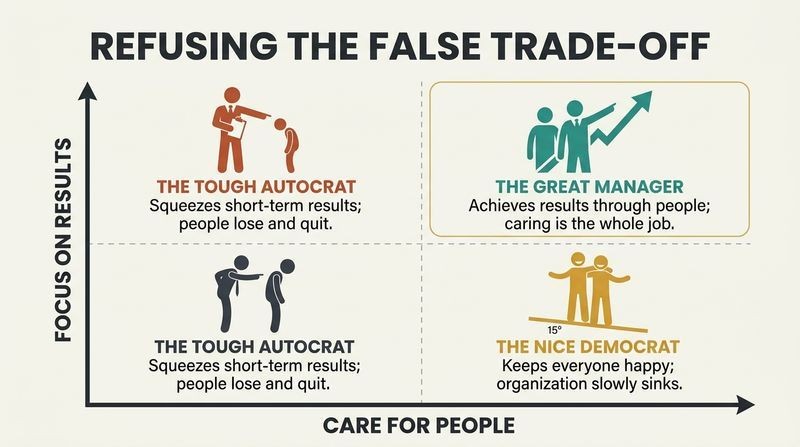
Half a manager is no manager. The book opens with a young man scouring the globe for an effective boss and finding two broken templates. The "tough" autocrat squeezes results while his people quietly lose, priding himself on being hard-nosed and profit-minded. The "nice" democrat keeps everyone happy while the organization slowly sinks, calling himself supportive and humanistic. Both insist they have always managed this way and see no reason to change.
The young man concludes each is only partly effective, like operating with one hand tied behind the back. The New One Minute Manager dissolves the dilemma: he cares intensely about results AND people because, as he puts it, you can only get results through people. Caring about both is not a compromise; it is the whole job.
This reframing predates and parallels the Blake-Mouton Managerial Grid, which plotted "concern for production" against "concern for people" and argued the high-high quadrant wins. What's striking is how durable the false binary remains. Modern debates about "radical candor" versus "toxic positivity" rehearse the same split. The book's move is rhetorically clever: rather than balancing two values, it claims they are causally linked, so neglecting people is itself bad results management. The weakness is that real trade-offs do exist under scarcity, layoffs, and deadlines. Saying they collapse can sound like wishful thinking, yet as a default posture it corrects a genuine and common managerial blind spot.
People who feel good about themselves deliver your best results
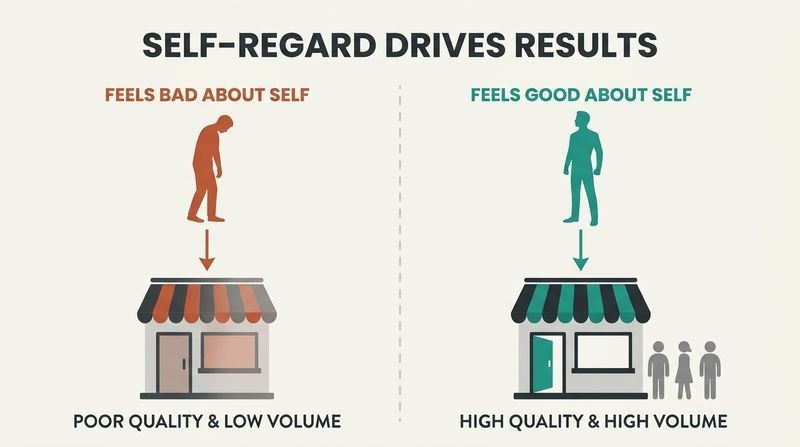
Self-regard is a productivity engine. The Manager keeps a screen reminder that people who feel good about themselves produce good results, and he tests it on his visitor: when do you work best, when you feel good about yourself or bad? The answer is obvious, and it scales to everyone. Helping people feel capable is not soft sentiment; it is the lever that moves output.
Quality and quantity both count. He points to two restaurants on the same street, one with a line out the door and one nearly empty. Same location, different outcome, because the busy one delivers a better product and service through better-treated people. Productivity, he insists, is volume and quality together, and both flow from how people feel about themselves at work.
The claim aligns with self-determination theory (Deci and Ryan), which shows competence, autonomy, and relatedness drive intrinsic motivation and performance. Decades of engagement research, including Gallup's finding that engaged teams outperform on profitability and retention, support the directional point. A caution: the causal arrow can run both ways. Sometimes people feel good because they just produced great results, not before. Mood and performance form a feedback loop, not a one-way street. The practical wisdom holds regardless: a manager who systematically erodes confidence is sabotaging the very output being demanded, while one who builds it compounds capability over time.
Write each key goal on one page you can reread in a minute
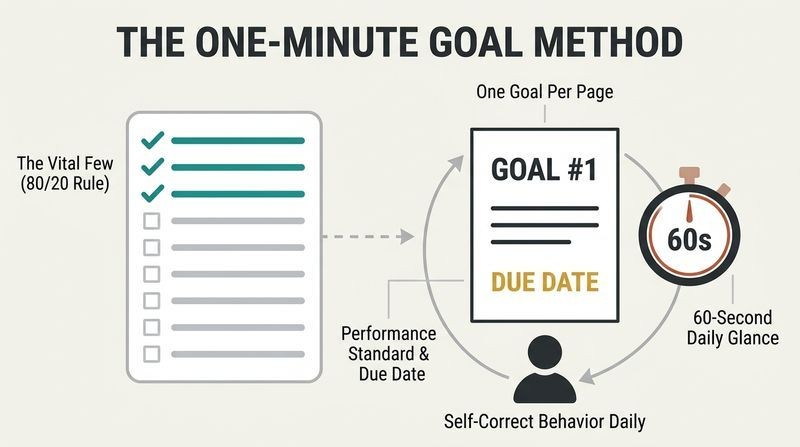
One Minute Goals are the foundation. The first secret fixes a chronic dysfunction: ask employees and their bosses what the job is, and you often get two different answers, then people get blamed for missing targets they never knew they owned. The fix is collaborative and concrete. Manager and employee agree on the handful of goals that matter, write each on a single page including the performance standard and due date, short enough to reread in about a minute.
Focus on the vital few. Applying the 80/20 rule, roughly 80% of meaningful results come from 20% of goals, so people set only three to five. They are urged to glance at goals daily, compare them to actual behavior, and self-correct without waiting for a boss.
The one-page discipline anticipates later movements like OKRs (Objectives and Key Results) popularized at Intel and Google, which similarly prize a small number of explicit, reviewable targets. The cognitive logic is sound: working memory is limited, and a goal you cannot recall cannot guide behavior. Behavioral research on goal-setting (Locke and Latham) confirms specific, challenging, written goals outperform vague "do your best" intentions. The subtle innovation here is frequency. Annual goals filed and forgotten are inert; goals reread daily become a live navigational instrument. One limit: brevity can hide complexity, and not every meaningful objective fits cleanly on a page or reduces to a deadline.
Catch people doing something right, then praise it within the hour
Praise immediately, specifically, sincerely. The second secret inverts ordinary management, which spends most of its energy catching people doing things wrong. Instead, the Manager watches closely early on to catch people doing something right, then delivers a One Minute Praising: he names exactly what was done well, says how good it makes him feel, pauses so the person can absorb it, and encourages more of the same.
Speed and specificity make it real. Paul explains why it lands: he does not wait for an annual review to learn he is valued, the precise detail proves the praise is sincere rather than generic flattery, and the Manager is consistent, praising good work even on days his own are going badly. Over time people start catching and praising themselves.
The praising protocol is essentially positive reinforcement delivered with deliberate timing, and behavioral science backs the design. Reinforcement loses potency as the delay between behavior and feedback grows, which is precisely why annual reviews fail to shape daily conduct. The specificity requirement also matters: research on praise (Carol Dweck) shows that praising effort and concrete actions builds resilience, whereas vague praise of innate traits can backfire. One risk the book underplays is praise inflation. If every act earns enthusiastic recognition, the signal degrades. The Manager's safeguard, that praise must be merited and sincere, is the load-bearing condition that keeps the technique from becoming hollow ritual.
When someone errs, attack the mistake first, then defend the person
The One Minute Re-Direct has two halves. The third secret replaces the old, top-down "Reprimand" for a collaborative age. First, confirm the goal was clear; if it was not, the manager owns that. Then comes a two-part response: the first half-minute focuses squarely on the mistake, stated specifically, followed by an honest expression of how the manager feels and a brief silence so concern can sink in.
Then rebuild the person. The second half-minute pivots to the human being: you are better than this error, I have confidence and trust in you, and when it is over, it is over. A college basketball coach benches his struggling star, tells him bluntly he is loafing, then says he is better than that, and the player returns transformed. Behavior is bad; the person remains good.
The sequencing is the genius and the controversy. The book insists tough must precede nice, illustrated by the parable of the emperor who lost his throne by switching from rewarding to punishing. This runs against the popular "feedback sandwich" that buries criticism between compliments, and the book is right to reject it: sandwiching often dilutes the message and trains people to dread praise as a warning sign. Modern frameworks like Kim Scott's Radical Candor echo the formula of caring personally while challenging directly. The clean "when it is over, it is over" rule is psychologically shrewd, preventing the grudge-holding and gunnysacking that poison ongoing working relationships.
Feedback on results is the number one thing that motivates people
The bowling metaphor. Asked why goals work, the Manager describes a problem employee who is listless at the office but ecstatic at a bowling alley. The difference is he can see the pins fall. Now imagine bowling with a sheet draped over the pins: you roll, hear a crash, but never learn your score. That is most jobs. Worse, some managers stand behind the sheet and announce "you missed eight" instead of "you got two."
Lift the sheet. People crave knowing how they are doing, which is why the Manager calls feedback the breakfast of champions. Many managers withhold clarity until the annual review, where employees finally learn everything they did wrong, a practice that breeds resentment and resignation rather than improvement.
The insight that feedback itself is motivating, not merely informational, is well supported. Csikszentmihalyi's research on flow identifies immediate feedback as a precondition for the absorbed, energized state the bowler displays. Video games engineer compulsive engagement precisely by making scores visible and instantaneous, a point the bowling analogy intuitively grasps decades early. The deeper organizational critique still bites: many performance systems optimize for documentation and legal defensibility over actual behavior change. The book's diagnosis, that managers hide the score to look discriminating at review time, exposes a perverse incentive where the appraisal ritual actively undermines the daily coaching that would make people better.
Praise approximate progress, the way you cheer a baby's first wobble
Reward the right direction, not just the destination. Why do Praisings work? Because that is how humans actually learn. Nobody teaches a child to walk by demanding a flawless stride and punishing every fall. You celebrate the first wobbly stand, then a single step. Teaching speech, you cheer "waller" long before the child can say "water" properly, tightening the standard only gradually.
Avoid leave-alone-zap. Most managers do the opposite, waiting until performance is exactly right before praising, so beginners rarely reach excellence. The Manager names the common pattern "leave-alone-zap": welcome new hires, abandon them, then jolt them when they fail. A friend's plan to house-train a dog by shoving its nose in the mess and tossing it out the window produces only a terrified animal that flees, never learning what to do.
This is shaping, the behavioral technique of reinforcing successive approximations toward a target behavior, rendered in homely examples. It is foundational to skill acquisition, animal training, and modern instructional design, where scaffolding gradually raises difficulty as competence grows. The leave-alone-zap label captures a real failure mode in onboarding: organizations invest heavily in recruiting, then strand newcomers without feedback during the exact window when reinforcement matters most. Educational research on the zone of proximal development (Vygotsky) makes the same point from another angle. The dog anecdote also delivers a sharp truth about punishment: it suppresses behavior near the punisher without teaching the desired alternative, producing avoidance rather than learning.
Separate a person's worth from their behavior when you correct them
You are not your mistake. The Manager's deepest principle, displayed on his screen, is that we are not merely our behavior; we are the person managing that behavior. When self-worth comes under attack, people get defensive, distort facts, and stop learning entirely. So a Re-Direct targets the action, never the human, and always closes by reaffirming the person.
Build up, never tear down. The goal is to eliminate the bad behavior while keeping the good person intact. If you walk away having attacked someone's character, they leave thinking about how unfairly they were treated rather than about their error, and the manager becomes the villain. Done right, the person owns the mistake and wants to get back on track, because respect and caring sit underneath the correction.
This anticipates a well-documented psychological finding: criticism perceived as a threat to identity triggers defensive processing, where people marshal counterarguments instead of absorbing the lesson. Dweck's work on fixed versus growth mindsets sharpens it. When errors are framed as verdicts on ability, learners disengage; when framed as fixable behaviors, they persist. The distinction also has moral weight, echoing the parenting and therapeutic principle of condemning the act while affirming the actor. One honest tension: persistent patterns of behavior do eventually reveal something about a person, and the book concedes this when it distinguishes a "can't do" problem, which coaching solves, from a "won't do" attitude, which may require parting ways.
Teach people to solve their own problems instead of solving them for you
Refuse to make their decisions. The Manager pointedly declines to tell the young man which employee to interview first, a small, deliberate "Re-Direct" in self-reliance. When Teresa calls panicking about a problem, he does not hand her a solution. He walks her through questions: What is actually happening? What do you want to happen? A problem, he explains, only exists as a gap between the two; without that gap you are merely complaining. He then makes her test each option against her desired outcome until she solves it herself.
Develop, do not rescue. Teresa realizes he has taught her a method she can run alone forever, which is why he later barely needs to supervise her. His division has high turnover, but the good kind: people leave because they are ready to run their own operations.
This is the management equivalent of teaching someone to fish, formalized. The problem definition, that a problem is a gap between actual and desired states, is genuinely useful and mirrors how engineers and consultants frame issues. The approach also solves the manager's perennial trap that William Oncken called the "monkey on the back," where solving subordinates' problems transfers their work upward and overloads the boss. The reframe that healthy turnover signals development success is counterintuitive and bold; most metrics treat all attrition as failure. The catch is that Socratic questioning takes patience and time up front, an investment harried managers resist, even though it pays back compounding hours later.
Announce your methods openly; transparency is what separates coaching from manipulation
Tell people what you are doing and why. The young man asks the uncomfortable question: are Praisings and Re-Directs just clever ways to manipulate people? The Manager's answer is that manipulation means deceptively controlling others for your own gain, and the safeguard against it is radical openness. He tells every new hire upfront exactly how he will manage, that he will give clear feedback both positive and corrective, and that it may feel uncomfortable at first.
Admit your own imperfection. The honesty extends to his flaws. He sometimes forgets the affirming second half of a Re-Direct, and employees feel free to call him on it, even joking that he owes them the reassurance. By confessing he might not always get it right and inviting correction, he proves he is on his people's side, which makes the whole system trustworthy rather than coercive.
The transparency test is a sound ethical heuristic, close to Kant's publicity principle: an action is suspect if it depends on the affected party not knowing your true intent. A technique that still works after you explain it fully is coaching; one that collapses under disclosure is manipulation. This matters because the behavioral tools here, reinforcement and correction, are ethically neutral instruments that propaganda and abusive bosses also use. The differentiator is consent and honesty, not the mechanics. The Manager's modeled fallibility adds something researchers call psychological safety (Amy Edmondson): when leaders admit error and invite challenge, teams surface problems earlier and learn faster, turning vulnerability into a performance advantage.
Analysis
The New One Minute Manager is a parable, and its form is inseparable from its function. By dramatizing principles through a young seeker, named characters, and a wise mentor, Blanchard and Johnson make behavioral science memorable and transmissible, which is why the original sold tens of millions of copies. The 2015 revision is itself a case study in the book's own thesis about adapting to change: the old authoritarian "Reprimand" becomes the collaborative "Re-Direct," goals are set side by side rather than imposed, and remote work and knowledge labor appear. The intellectual core is unfashionably simple, applied behaviorism dressed in business clothes: antecedents (goals) cue behavior, and consequences (praisings and re-directs) shape its future frequency. The screen aphorism "goals begin behaviors, consequences influence future behaviors" is pure operant conditioning. What elevates the book above a Skinnerian manual is its insistence on dignity, captured in the distinction between behavior and the person managing it, which inoculates the techniques against becoming cold manipulation. The strongest contribution is the integration: goals, praise, and correction are not three tips but one coherent loop, each meaningless without the others. Praise without clear goals is arbitrary; goals without feedback are invisible pins behind a sheet; correction without affirmation breeds defensiveness. The book's chief vulnerability is the "one minute" conceit, which the authors themselves wink at as a simplification; genuine development, trust-building, and difficult conversations rarely fit a minute, and the brevity branding can imply management is easier than it is. The 80/20 framing and the bowling, child-learning, and emperor parables remain pedagogically excellent. Read today, alongside Radical Candor, Drive, and Multipliers, it reads less as dated 1980s advice than as the durable, almost folk-wisdom substrate those later books elaborate. Its enduring power is that it tells managers not what to believe but exactly what to do tomorrow morning.
Review Summary
The New One Minute Manager receives mixed reviews, with an average rating of 3.85/5. Supporters praise its concise, practical advice on goal-setting, praising, and redirecting employees. Critics argue it's oversimplified and could be condensed further. Many appreciate the book's accessibility and potential for immediate implementation, while others find the parable format tedious. Some readers note the updated version feels more humble and modern. Overall, the book is seen as a quick read with valuable management insights, despite its brevity and simplistic approach.
People Also Read









Glossary
One Minute Goals
Brief written goals reviewed quicklyThe first secret. Manager and employee collaboratively agree on the three to five goals that drive most results, write each on a single page with its performance standard and due date, and reread them in about a minute. People check daily whether their behavior matches their goals and self-correct, eliminating the gap between what a boss expects and what an employee thinks the job is.
One Minute Praising
Immediate, specific positive feedbackThe second secret. As soon as you catch someone doing something right, you tell them precisely what they did well, say how good it makes you feel, pause so they can absorb it, then encourage more and express confidence in them. Delivered within the hour rather than saved for annual reviews, it builds the self-confidence that fuels performance.
One Minute Re-Direct
Two-part correction of mistakesThe third secret, replacing the older Reprimand. After confirming the goal was clear, you address the error in two halves: first state the specific mistake and how you feel about its impact, then pause; second, reaffirm that the person is better than the error and that you trust them. Tough on behavior, then supportive of the person, and once finished, the matter is closed.
Catch them doing something right
Notice and reinforce good behaviorThe guiding habit behind praising. Rather than scanning for errors, managers deliberately watch, especially with new or learning employees, for behavior worth recognizing, including work that is only approximately right at first, gradually raising the standard the way a parent cheers a toddler's first steps before expecting a confident stride.
Leave-alone-zap
Neglect then punish management styleBlanchard and Johnson's label for the common dysfunction of welcoming new hires, abandoning them without feedback, and then jolting them with criticism when they inevitably fail. It teaches people to do as little as possible and explains why so many employees disengage from their work.
Gunnysacking
Hoarding criticism until it explodesThe practice of storing up observations of poor performance until frustration overflows, then dumping every accumulated complaint at once, often at an annual review. It is unfair and ineffective because people dispute the facts or become defensive, which is why the book argues feedback should be continuous and delivered in small, timely doses.
Bowling behind the sheet
Working without seeing resultsA metaphor for jobs that hide feedback. Like bowling with a sheet draped over the pins, employees act but never learn their score, killing motivation. The book argues feedback on results is the number one motivator and urges managers to "lift the sheet" so people can see how they are doing, rather than waiting for a review.
FAQ
What's "The New One Minute Manager" about?
- Overview: "The New One Minute Manager" by Kenneth H. Blanchard is a modern adaptation of the classic management book, focusing on effective leadership in today's fast-paced world.
- Core Concept: It introduces a more collaborative approach to management, emphasizing the importance of engaging and motivating people to achieve both personal and organizational success.
- Three Secrets: The book revolves around three key management techniques: One Minute Goals, One Minute Praisings, and One Minute Re-Directs.
- Purpose: It aims to help managers lead more effectively by fostering a work environment where people feel valued and are encouraged to contribute their best.
Why should I read "The New One Minute Manager"?
- Adaptation to Change: The book provides insights into managing in a rapidly changing world, making it relevant for today's leaders.
- Practical Techniques: It offers simple, actionable strategies that can be implemented immediately to improve management effectiveness.
- Engagement Focus: The book emphasizes the importance of employee engagement and satisfaction, which are crucial for organizational success.
- Proven Success: The principles have been used by millions worldwide, demonstrating their effectiveness in various settings.
What are the key takeaways of "The New One Minute Manager"?
- One Minute Goals: Set clear, concise goals with your team to ensure everyone knows what is expected and what success looks like.
- One Minute Praisings: Catch people doing something right and provide immediate, specific praise to reinforce positive behavior.
- One Minute Re-Directs: Address mistakes quickly and constructively, focusing on the behavior, not the person, to encourage learning and improvement.
- People and Results: Effective management requires balancing a focus on both people and results, as they are interdependent.
What is the "One Minute Goals" method in "The New One Minute Manager"?
- Goal Clarity: Collaboratively set clear, concise goals with your team, ensuring everyone understands their responsibilities and what good performance looks like.
- Written Goals: Have team members write down their goals on a single page, including due dates, to keep them focused and accountable.
- Regular Review: Encourage daily review of goals to ensure alignment with current activities and make necessary adjustments.
- Self-Management: Empower team members to manage themselves by regularly checking their progress against their goals.
How do "One Minute Praisings" work in "The New One Minute Manager"?
- Immediate Feedback: Provide praise as soon as possible after observing positive behavior to reinforce it effectively.
- Specific Praise: Clearly articulate what the person did right and how it contributes to the team's success.
- Emotional Connection: Allow a moment for the person to feel good about their achievement, enhancing motivation and confidence.
- Encouragement: Encourage continued good performance and express confidence in the person's abilities.
What is the "One Minute Re-Directs" technique in "The New One Minute Manager"?
- Timely Correction: Address mistakes as soon as they are noticed to prevent them from becoming ingrained habits.
- Fact-Based Discussion: Confirm the facts and review the mistake with the person, focusing on the specific behavior that needs correction.
- Emotional Impact: Express how the mistake affects results and allow a moment for the person to reflect on the impact.
- Positive Reinforcement: Reaffirm the person's value, express confidence in their abilities, and support their success moving forward.
How does "The New One Minute Manager" explain the effectiveness of its methods?
- Feedback Importance: The book emphasizes that feedback is the number one motivator for people, helping them understand how they are doing.
- Behavioral Focus: By separating behavior from personal worth, the methods encourage improvement without damaging self-esteem.
- Simple and Quick: The techniques are designed to be quick and easy to implement, making them practical for busy managers.
- Proven Results: The methods have been tested and proven effective in various organizations, leading to better performance and satisfaction.
What are the best quotes from "The New One Minute Manager" and what do they mean?
- "The Best Minute I Spend Is The One I Invest In People." This quote highlights the importance of investing time in developing and supporting team members for long-term success.
- "Feedback Is the Breakfast of Champions." It underscores the critical role of feedback in motivating and guiding people to achieve their best.
- "Help People Reach Their Full Potential. Catch Them Doing Something Right." This emphasizes the power of positive reinforcement in unlocking people's potential.
- "We Are Not Just Our Behavior. We Are The Person Managing Our Behavior." It reminds managers to focus on behavior, not personal worth, when providing feedback.
How does "The New One Minute Manager" address changes in the modern workplace?
- Collaborative Leadership: The book shifts from top-down management to a more collaborative, side-by-side approach, reflecting modern workplace dynamics.
- Employee Engagement: It recognizes the growing importance of employee engagement and fulfillment in achieving organizational success.
- Adaptability: The methods are designed to be flexible and adaptable, allowing managers to respond effectively to rapid changes in technology and globalization.
- Talent Retention: The book emphasizes the need to attract and retain talent by creating a supportive and motivating work environment.
What is the role of the manager in "The New One Minute Manager"?
- Facilitator: The manager acts as a facilitator, helping team members set goals and providing the support they need to achieve them.
- Coach: By giving timely feedback and encouragement, the manager coaches team members to improve their performance and develop their skills.
- Partner: The manager works alongside team members, fostering a sense of partnership and shared responsibility for success.
- Leader: The manager leads by example, demonstrating the behaviors and attitudes that contribute to a positive and productive work environment.
How can "The New One Minute Manager" be applied outside of work?
- Family and Friends: The principles can be used to improve relationships with family and friends by setting clear expectations and providing positive feedback.
- Personal Development: Individuals can apply the methods to their own personal goals, using self-praising and self-re-directing to stay on track.
- Community Involvement: The techniques can be used in volunteer and community settings to motivate and engage others in achieving common goals.
- Everyday Interactions: The focus on clear communication and positive reinforcement can enhance everyday interactions and build stronger connections with others.
What is the significance of the "Symbol" in "The New One Minute Manager"?
- Reminder of Importance: The symbol serves as a reminder to managers to take a moment each day to recognize the value of the people they lead.
- Focus on People: It emphasizes that people are the most important resource in any organization and should be treated with respect and appreciation.
- Encouragement to Reflect: The symbol encourages managers to reflect on their interactions with team members and ensure they are fostering a positive environment.
- Visual Cue: As a visual cue, the symbol helps keep the principles of One Minute Management top of mind, reinforcing their application in daily practice.
About the Author
Other books by Kenneth H. Blanchard





Download PDF
Download EPUB
.epub digital book format is ideal for reading ebooks on phones, tablets, and e-readers.








































