
Key Takeaways
1. Relativism patronizes rather than respects opposing viewpoints
Your attitude, Zac, is to patronize me by telling me how much you respect my point of view while actually not taking it seriously enough to bother arguing against it.
The illusion of tolerance. When Zac attempts to mediate the clash between Sarah's scientific rationalism and Bob's belief in witchcraft, he claims both perspectives are equally valid within their own frameworks. However, this "separate but equal" approach actually insults both parties. By refusing to engage with the substance of their claims, the relativist dismisses them as mere cultural artifacts rather than serious attempts to describe reality.
The preference for direct conflict. Bob and Sarah find common ground in their mutual dislike of Zac's patronizing neutrality. They prefer direct, honest disagreement because it treats their beliefs as serious contenders for the truth.
- Sarah respects Bob enough to try to correct his superstition.
- Bob respects Sarah enough to challenge her scientific dogmatism.
- Zac sidelines both by placing them in isolated, non-competing boxes.
The self-defeating retreat. Ultimately, relativism acts as an intellectual shield to protect the relativist from ever being proven wrong. Whenever Zac is challenged, he retreats to saying, "That's just my point of view," initiating an infinite regress that strips his own statements of any real substance or communicative value.
2. Truth is simply correspondence to reality, not a claim of infallibility
To say of what is that it is not, or of what is not that it is, is false, while to say of what is that it is, or of what is not that it is not, is true.
Demystifying the concept. Roxana, the logician, introduces Aristotle's classic definition of truth to rescue the conversation from Zac's mystification. Truth is not a mysterious, oppressive force used by the powerful to dominate others; it is merely a linguistic relationship of correspondence. To say "Samarkand is in Uzbekistan" is true if and only if Samarkand is indeed in Uzbekistan.
Linguistic utility. The words "true" and "false" are highly efficient tools that allow us to express agreement or disagreement without endless repetition. They do not add a heavy metaphysical burden to our assertions.
- Saying "It is true that the wall collapsed" is logically equivalent to simply asserting "The wall collapsed."
- The concept of truth allows us to generalize, such as saying "Everything she said was true."
Objective reality. This definition anchors our thoughts to an external world that exists independently of our beliefs. Whether a statement is true depends entirely on how the world is, not on who utters it, how much power they hold, or which cultural framework they belong to.
3. Truth and certainty are fundamentally distinct concepts
Therefore something is true but not certain.
The confusion exposed. Zac argues that we should abandon the words "true" and "false" because calling something true implies absolute certainty, which human beings can rarely achieve. Roxana dismantles this by demonstrating that truth does not require human knowledge or certainty. She uses the example of the total number of coins on the train: it must be either odd or even, meaning one of those options is objectively true, yet it is completely uncertain to everyone on board.
Practical examples. This distinction is easily observed in everyday life and scientific inquiry. We routinely accept that things can be true without us being absolutely certain of them.
- We do not know for certain if there is life on other planets, yet the statement "There is life on other planets" is either true or false right now.
- A historical event occurred in a specific way, even if all records of it have been lost to time.
Liberating inquiry. By separating truth from certainty, we free ourselves from the trap of radical skepticism. We can search for objective truth while remaining fully aware that our current beliefs are fallible and subject to revision.
4. Fallibilism enables genuine knowledge without demanding absolute proof
It’s the very importance of the distinction between truth and falsity that should make us humble, and tolerant of others.
The fallibilist compromise. Sarah champions fallibilism as the true engine of scientific progress and intellectual humility. Unlike the relativist, who denies objective truth, the fallibilist passionately believes in objective truth but acknowledges that human beings are deeply prone to error. This perspective allows us to claim knowledge while remaining open to the possibility that we might be mistaken.
Reasonable standards. To make human knowledge possible, we must reject impossible standards of absolute, doubt-proof certainty. We acquire genuine knowledge by using our senses and reasoning properly under normal conditions.
- We know the sun is shining because we can see it, even if we cannot mathematically prove we are not hallucinating.
- We know basic mathematical truths like 5 + 7 = 12 because we can calculate them reliably.
Humility and progress. True tolerance does not come from pretending all opinions are equally valid, but from recognizing our own limitations. Because truth is "bigger than all of us," we must keep our theories open to challenge, testing, and refinement.
5. Avoiding the language of truth does not eliminate value judgments
The words ‘true’ and ‘false’ merely enable the underlying preference for telling it like it is to be expressed in fewer words, as a preference for truth.
The futility of avoidance. Zac warns that using "true" and "false" creates hierarchical value judgments, implying that one person's belief is superior to another's. Roxana points out that banning these words does not solve the problem. The moment Bob asserts that witchcraft works and Sarah denies it, they are already locked in a value conflict because both are trying to "tell it like it is."
The implicit preference. Human communication inherently relies on the assumption that representing reality accurately is better than representing it inaccurately. This preference exists regardless of the vocabulary we choose to employ.
- Asking for directions assumes we prefer the path that actually leads to our destination.
- Describing a medical treatment assumes we want to know if it actually cures the disease.
Linguistic shortcuts. Banning the words "true" and "false" only makes our language more cumbersome without changing the underlying reality of our disagreements. We cannot escape the responsibility of evaluating the accuracy of our assertions.
6. Scientific consensus is built on systematic verification, not naked power
The scientific community isn’t closed. Anyone can join, if they prove themselves competent by getting a scientific education and passing the exams.
The power critique. Zac attempts to deconstruct science by claiming that "knowledge is power" and that scientific consensus is merely an authoritarian tool used by a self-perpetuating elite to silence dissidents. Sarah vigorously defends the scientific community, arguing that its authority is earned through rigorous, transparent, and systematic methods of verification rather than brute force.
Self-correcting mechanisms. Unlike dogmatic systems, science is designed to expose and correct its own errors over time through institutionalized skepticism.
- Peer review ensures that experiments are checked by competent, independent researchers.
- Replication of results prevents individual fraud or bias from becoming permanent dogma.
- Openness to challenge allows revolutionary new theories to overthrow established paradigms when the evidence demands it.
Democratic accessibility. The scientific community is fundamentally meritocratic and open to anyone willing to undergo the training and meet the standards of evidence. It is the shared commitment to objective standards, rather than political power, that coordinates scientific progress.
7. Moral relativism paralyzes our capacity for ethical action
If I hadn’t thought I was just right, and the mother just wrong, I wouldn’t have felt entitled to go and stop her.
The ethical dilemma. When Sarah witnesses a mother repeatedly slapping her crying child, she is moved to intervene. However, her newly adopted stance of moral relativism creates a paralyzing contradiction. If moral values are merely subjective preferences, then the mother's belief in physical discipline is just as "right" relative to her framework as Sarah's belief in child protection is to hers.
The necessity of conviction. To justify intervening in the lives of others, especially against their will, we must believe that our moral judgments are objectively grounded. Relativism strips us of the intellectual authority required to stand up against injustice.
- We cannot condemn historical atrocities like slavery if we view them as merely "right for their time."
- We cannot protect the vulnerable if we treat abuse as a valid cultural preference.
The retreat to force. Without objective moral truth, ethical disputes degenerate into mere power struggles. If Sarah cannot appeal to a shared, objective standard of right and wrong, her only tool to stop the mother is brute, non-rational force.
8. Human decision-making integrates moral values and practical facts into a single system
Since our moral values are a crucial component of our whole system for making decisions, if I’m sceptical about our moral values, I’d better be sceptical about our decision-making as a whole.
The integrated mind. Sarah initially tries to separate her mind into two compartments: a scientific one for factual descriptions of reality and a subjective one for moral values. Roxana and Bob show that this division is impossible in practice. When we decide how to act, we must integrate our factual beliefs and moral values into a single, cohesive decision-making system.
The evolutionary test. Our survival as a species proves that our decision-making system is not completely disconnected from reality. If our moral and practical decisions were consistently wrong, we would have perished long ago.
- A moral code that forbade eating or wearing clothes in winter would quickly lead to extinction.
- Our ability to navigate complex social environments relies on a highly functional mix of moral and practical reasoning.
Hindsight as verification. Just as we use scientific experiments to test our physical theories, we use the consequences of our actions to test our decisions in retrospect. This feedback loop allows us to gradually correct both our practical mistakes and our moral errors, driving genuine human progress.
Review Summary
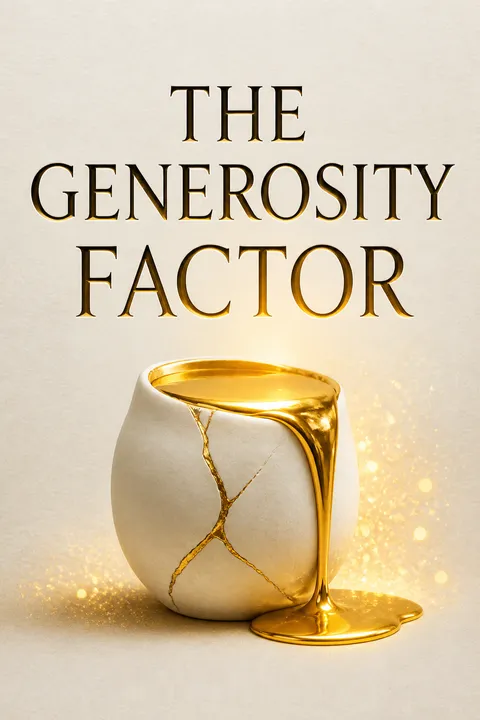
The Generosity Factor receives mostly positive reviews for its inspiring message about giving and generosity. Readers appreciate the parable-style storytelling and easy-to-understand principles. Many find it thought-provoking and impactful, praising its emphasis on using time, talent, and resources to help others. Some criticize the book for being overly religious or simplistic. The revelation that it's based on Chick-fil-A founder S. Truett Cathy's life adds interest for many readers. Overall, it's seen as a quick, meaningful read that challenges readers to be more generous.
People Also Read

About the Author
Other books by Kenneth H. Blanchard

Download PDF
Download EPUB
.epub digital book format is ideal for reading ebooks on phones, tablets, and e-readers.








































