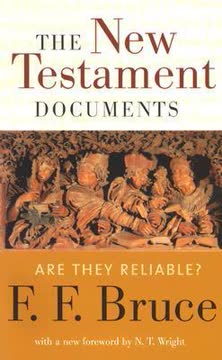
Key Takeaways
1. The Historical Foundation of Christianity is Paramount
For the Christian gospel is not primarily a code of ethics or a metaphysical system; it is first and foremost good news, and as such it was proclaimed by its earliest preachers.
Core Christian claim. Christianity's essence is not merely a set of ethical teachings or a philosophical system, but a historical revelation: God entering human history through the incarnation, crucifixion, and resurrection of Jesus Christ. This "good news" is intimately bound to specific events that occurred in Palestine during the Roman Empire, making the historical reliability of its foundational documents a question of first-rate importance.
Creedal emphasis. The Church's earliest creeds underscore this historical rootedness, fixing God's supreme revelation at a particular point in time, explicitly stating that Jesus Christ "suffered under Pontius Pilate." This "once-for-allness" distinguishes Christianity from other religious or philosophical systems not tied to specific historical moments, thereby demanding scrutiny of the writings that purport to record this revelation.
Profound influence. Even secular historians, like Lecky, acknowledged Jesus' character as the "highest pattern of virtue" and a powerful force for human regeneration, an influence derived solely from the New Testament records. It would be paradoxical if documents yielding such profound historical results were devoid of historical truth, providing a compelling additional reason to seriously investigate their trustworthiness.
2. New Testament Documents Boast Unparalleled Early Attestation
The evidence for our New Testament writings is ever so much greater than the evidence for many writings of classical authors, the authenticity of which noone dreams of questioning.
Abundant manuscripts. The New Testament possesses an extraordinary wealth of manuscript evidence, far surpassing that of most classical authors. While influential schools of thought in the 19th century confidently asserted late dates for key New Testament books, subsequent historical and archaeological discoveries have overwhelmingly confirmed a first-century date for the majority of these writings.
Superior evidence. Consider the stark contrast with other ancient historical works:
- Caesar's Gallic War: Only nine or ten good manuscripts, the oldest dating 900 years after Caesar.
- Livy's Roman History: Thirty-five surviving books from no more than twenty manuscripts, with only one fragment as old as the fourth century.
- Tacitus' Histories and Annals: Extant portions depend entirely on two manuscripts from the ninth and eleventh centuries.
- Thucydides and Herodotus: Known from eight manuscripts, the earliest around AD 900.
- New Testament: Approximately 5,000 Greek manuscripts, with two excellent fourth-century codices (Vaticanus and Sinaiticus) and significant papyrus fragments dating 100 to 200 years earlier.
Early papyri. Discoveries like the Chester Beatty Biblical Papyri (early 3rd century, containing most NT writings) and the John Rylands Papyrus (c. AD 130, a fragment of John's Gospel) demonstrate that the New Testament books were circulating widely within decades of their composition. This remarkably short interval between original writing and earliest extant evidence effectively removes any foundation for doubting the substantial integrity of the New Testament text.
3. The Canon's Formation Reflects Recognized Authority, Not Imposition
The New Testament books did not become authoritative for the Church because they were formally included in a canonical list; on the contrary, the Church included them in her canon because she already regarded them as divinely inspired, recognising their innate worth and generally apostolic authority, direct or indirect.
Organic recognition. The New Testament canon was not arbitrarily imposed by ecclesiastical councils but emerged from the Church's organic recognition of books already considered divinely inspired and possessing inherent apostolic authority. This process, believed to be guided by the Holy Spirit, affirmed texts that resonated with the truth of God's revelation and the teachings of Christ.
Early collections. Evidence suggests that collections of Christian writings began circulating early in the second century. The four Gospels were quickly united as "The Gospel" (singular), narrated in four distinct records. Similarly, Paul's letters were gathered into a collection known as "Apostolos." Early lists, such as Marcion's (c. AD 140) and the Muratorian Fragment (late 2nd century), confirm a core set of recognized books, even as some shorter epistles or Revelation faced regional debate.
Practical necessity. The need for a clearly defined canon arose from several practical challenges:
- Establishing and defending Christian doctrine against heresies (e.g., Marcionism).
- Determining which books were suitable for public reading in church services.
- Identifying which sacred texts could not be surrendered to imperial authorities during times of persecution without committing sacrilege.
The ultimate selection of the twenty-seven books, codified by councils in the late 4th century, reflects a consensus on their innate spiritual and apostolic authority, rather than an imposition of new standards.
4. The Gospels are Rooted in Eyewitness Testimony and Early Sources
We are, in fact, practically all the way through in touch with the evidence of eyewitnesses.
Synoptic relationships. The first three Gospels—Matthew, Mark, and Luke—are termed "Synoptic" due to their significant overlap in material, order, and wording. This phenomenon has led to extensive "Source Criticism," with the widely accepted "Markan hypothesis" proposing that Mark's Gospel was the earliest and served as a primary source for both Matthew and Luke. This is supported by Mark's common order and often fuller accounts of shared narratives.
Oral tradition and "Q". Beyond Mark, Matthew and Luke share a substantial body of non-Markan material, primarily consisting of Jesus' sayings. This common material is often attributed to a hypothetical document known as "Q" (from German Quelle, meaning "source"). Papias, an early second-century bishop, mentioned that "Matthew compiled the Logia [oracles/sayings] in the 'Hebrew speech' [Aramaic]," aligning with internal evidence suggesting an Aramaic substratum for much of the "Q" material.
Eyewitness and accuracy. The early Church's preaching, or "Kerygma," was a largely stereotyped, accurate proclamation of Jesus' deeds and words, initially in Aramaic and then in Greek. This oral tradition, rooted in eyewitness testimony, underlies the Synoptic Gospels. The presence of numerous disciples and even hostile witnesses during the early years ensured that any significant inaccuracies would be swiftly exposed. Luke, in particular, emphasizes his diligent research and orderly account, drawing from "those who from the beginning were eyewitnesses and ministers of the Word," thereby bolstering the trustworthiness of the Gospel narratives.
5. Gospel Miracles, Especially the Resurrection, are Central to Christ's Identity
But the one interpretation which best accounts for all the data, as well as for the abiding sequel, is that Jesus’ bodily resurrection from the dead was a real and objective event.
Miracles in context. The miracle stories in the Gospels are not isolated wonders but "signs" that reveal Christ's divine identity and the inbreaking of God's power into human history. They are "in character" with the supernatural Jesus consistently portrayed from the earliest strata of the Gospel tradition, and thus cease to be an insuperable stumbling-block if one accepts the Gospel's depiction of Him.
The Resurrection's centrality. The resurrection of Jesus is the supreme miracle, the cornerstone of Christian faith and the ultimate demonstration of His Messiahship and divine power. Early attempts to rationalize or explain away the resurrection (e.g., disciples stole the body, wrong tomb, hallucination) fail to account for:
- The empty tomb.
- Numerous post-resurrection appearances to diverse individuals and groups (e.g., Peter, the Twelve, over 500 brethren at once, James).
- The inability of the Jewish authorities, despite their power and motivation, to produce Jesus' body or definitively disprove the disciples' claims.
- The immediate and profound impact on the Jerusalem populace and the subsequent explosive growth of Christianity.
Significance of signs. Beyond their historical facticity, the miracles are "object lessons" or "acted parables" of the Kingdom of God. Healing miracles signify God's power over sin and suffering, while nature miracles (like turning water into wine or feeding the multitudes) betoken the abundance and joy of the messianic age. Understanding their profound evangelical significance, rather than merely defending their possibility, allows readers to grasp the deeper truth they convey about Christ and God's activity in history.
6. Paul's Early Letters Provide Independent Historical Corroboration
It is reasonable to believe that the evidence which convinced such a man of the out-and-out wrongness of his former course, and led him so decisively to abandon previously cherished beliefs for a movement which he had so vigorously opposed, must have been of a singularly impressive quality.
Earliest NT writings. The letters of the Apostle Paul, written between AD 48 and 60, represent the earliest extant New Testament documents, predating the Gospels in their final written form. Paul's dramatic conversion from a zealous persecutor of Christians to their chief herald underscores the singularly impressive quality of the evidence that compelled him to abandon his deeply cherished beliefs.
Historical outline. Although Paul's letters were addressed to Christian communities already familiar with the gospel story, they contain sufficient material to construct a clear outline of the early apostolic preaching about Jesus. Paul affirms:
- Jesus' divine pre-existence and real humanity, as a descendant of Abraham and David.
- His life under Jewish law.
- His betrayal and institution of the Last Supper.
- His crucifixion under Roman penalty, with responsibility laid at the door of Jewish leaders.
- His burial, resurrection on the third day, and subsequent appearances to numerous eyewitnesses, including over five hundred at once.
Agreement with Gospels. Paul's understanding of Christ's character—His meekness, gentleness, and self-denial—is in perfect agreement with the portrayal in the Gospels. He quotes Jesus' sayings on marriage, divorce, and the institution of the Lord's Supper, and his ethical instructions in Romans echo the Sermon on the Mount, demonstrating his deep familiarity with the teachings of his Master. Paul himself emphasized that the gospel he preached was identical to that preached by the other apostles, a striking claim given his independence from them.
7. Luke's Historical Accuracy is Consistently Vindicated by External Evidence
A man whose accuracy can be demonstrated in matters where we are able to test it is likely to be accurate even where the means for testing him are not available.
Historian's diligence. Luke, a physician and companion of Paul, explicitly states his meticulous research and orderly account in the prologue to his Gospel, addressed to "most excellent Theophilus." His two-part work (Gospel and Acts) provides a continuous history of Christian origins, from John the Baptist to Paul's Roman imprisonment, setting these events within the broader context of Roman imperial history.
Precise details. Luke's accuracy is remarkable, particularly in his precise use of proper titles for various officials across the Roman Empire, a challenging feat given the changing administrative structures of the time. Examples include:
- Sergius Paullus as proconsul of Cyprus.
- Gallio as proconsul of Achaia (a date confirmed by the Delphi inscription).
- "Politarchs" as chief magistrates in Thessalonica (corroborated by inscriptions).
- "First man of the island" as the official title for Malta's governor.
- Ephesus being called "Temple-Warden of Artemis" (supported by a Greek inscription).
- His careful distinction between Herod Antipas as "tetrarch" and other Herods as "king."
Archaeological confirmation. Sir William Ramsay, an archaeologist who initially doubted Luke's historical credit, was compelled by his research in Asia Minor to reverse his views, concluding that Luke was a "historian of the first rank." Luke's "we sections" in Acts, particularly the detailed account of Paul's voyage and shipwreck, are lauded for their remarkable accuracy in nautical and geographical details, further cementing his reputation for habitual and meticulous historical reporting.
8. Archaeological Finds Continually Illuminate and Confirm NT Details
Research in the field which forms the historical and geographical background to Luke’s narrative has not stood still since Ramsay’s heyday, but our respect for Luke’s reliability continues to grow as our knowledge of this field increases.
Tangible evidence. Archaeological discoveries, though perhaps less spectacular than those for the Old Testament, provide crucial and ongoing corroboration for numerous details within the New Testament narrative. These finds, ranging from inscriptions to excavated sites, offer tangible links to the historical and cultural world of early Christianity.
Specific examples:
- Temple barrier inscription: Found in Jerusalem, this Greek inscription warned Gentiles of death for entering the inner courts of the Temple, illuminating Paul's metaphor of the "middle wall of partition" in Ephesians.
- Pool of Bethesda: Excavations near St. Anne's Church in Jerusalem revealed the remains of a pool with five shallow porticoes, precisely matching John v. 2.
- Erastus inscription: A pavement found in Corinth in 1929, inscribed "Erastus, curator of public buildings, laid this pavement at his own expense," likely refers to the "City Treasurer" mentioned by Paul in Romans xvi. 23.
- Zeus and Hermes worship: Inscriptions near Lystra confirm the local worship of Zeus and Hermes, explaining the populace's reaction to Paul and Barnabas after healing a lame man (Acts xiv. 12).
Linguistic insights. Papyrus discoveries in Egypt revealed that the Greek of the New Testament was not a unique "language of the Holy Ghost" but the common vernacular (Koine Greek) of the day, making the message accessible to ordinary people. Furthermore, the Qumran texts (Dead Sea Scrolls) have shown striking affinities in thought and language with the Gospel of John, highlighting its fundamentally Hebraic character and enriching our understanding of the gospel's historical setting.
9. Early Jewish Writings Corroborate Key Historical Figures and Events
But, such as they are, these references do at least show that there was not the slightest doubt of the historical character of Jesus.
Rabbinical references. Despite their often hostile tone, early rabbinical writings (Mishnah and Talmuds), compiled after AD 70, provide independent confirmation of Jesus' historical existence. These texts portray Jesus of Nazareth as a transgressor who practiced magic, scorned the wise, led people astray, and was hanged on Passover Eve for heresy. They also mention His disciples healing in His name, demonstrating that His historical reality was not doubted, even by His opponents.
Josephus's testimony. The Jewish historian Flavius Josephus (AD 37-c. 100), a contemporary of the apostles, offers invaluable external corroboration. He mentions:
- John the Baptist: His execution by Herod Antipas, though Josephus attributes it to political fear rather than John's denunciation of Herod's marriage, confirming his historical role.
- James, brother of Jesus: His stoning by the high priest Ananus after the death of Procurator Festus (AD 61), referring to him as "the brother of Jesus the so-called Christ."
- Jesus Himself: The "Testimonium Flavianum" in Antiquities xviii. 3. 3, even with potential Christian interpolations, strongly suggests Josephus acknowledged Jesus as a wise man, a wonder-worker, the "so-called Christ," crucified under Pilate at the instigation of Jewish rulers, and the founder of the "tribe of Christians," with a belief in His resurrection.
Independent accounts. Josephus's accounts of John the Baptist and James are manifestly independent of the New Testament, strengthening their historical weight. His detailed historical works, despite his controversial role in Jewish history, provide a rich and often corroborating background for understanding the New Testament era.
10. Non-Christian Gentile Sources Acknowledge Jesus and Early Christianity
The reason for the paucity of references to Christianity in first century classical literature is not far to seek. From the standpoint of imperial Rome, Christianity in the first hundred years of its existence was an obscure, disreputable, vulgar oriental superstition...
Limited early references. Direct non-Christian Gentile references to Jesus or early Christianity in the first century are scarce. This is primarily because imperial Rome initially viewed Christianity as an obscure, disreputable, and vulgar oriental superstition, unworthy of serious attention from prominent writers. Any official records, such as police reports, that might have contained references have largely disappeared.
Indirect confirmations. Despite the scarcity, some early non-Christian sources offer indirect confirmations:
- Thallus (c. AD 52): A Samaritan historian, mentioned by the Christian chronographer Julius Africanus (c. AD 221), attempted to explain the darkness at Christ's crucifixion as a solar eclipse. This implies that the Gospel passion narrative was known in non-Christian circles in Rome by the mid-first century, and its details were being debated.
- Mara Bar-Serapion (post-AD 73): A Syrian philosopher, writing from prison to his son, compared the persecution of "their wise King" (Jesus) by the Jews to the fates of Socrates and Pythagoras, noting the subsequent abolition of the Jewish kingdom. This places Christ among revered sages and acknowledges His execution and the impact on the Jewish nation.
Roman archives and later forgeries. Early Christian apologists like Justin Martyr (c. AD 150) and Tertullian (c. AD 197) referred to Pilate's reports or imperial census records, believing they would corroborate Gospel accounts, though they likely had no direct access to them. Later, both pagan (Maximin II) and Christian forgeries of "Acts of Pilate" emerged, demonstrating the recognized historical impact of Jesus, even if the documents themselves were spurious. These references, though limited, confirm that Jesus and the early Christian movement were acknowledged in the broader Roman world.
Review Summary
People Also Read