Key Takeaways
1. Early Christianity was a highly diverse movement, not a unified monolith.
If we turn the clock back 1,850 years to the middle of the second century, we find people calling themselves Christian who subscribe to beliefs that no modern eye has seen or ear heard, Christians who believe that there are 2 different gods, or 32, or 365, Christians who claim that the Old Testament is an evil book inspired by an evil deity...
Radical early diversity. The earliest stages of the Christian movement were characterized by an astonishing array of theological beliefs and practices. Different groups, all claiming to follow Jesus, held views that would shock modern believers, such as asserting the existence of multiple gods or claiming the material world was created by an evil deity.
Competing Christian groups. These early factions possessed their own sacred texts and apostolic authorities to validate their claims:
- Jewish-Christian Adoptionists, who believed Jesus was a righteous human adopted by God but not divine.
- Marcionites, who believed the God of Jesus was entirely separate from the wrathful God of the Old Testament.
- Gnostics, who sought secret knowledge (gnosis) to liberate the divine spark trapped within the material world.
Emergence of orthodoxy. The group that eventually won these debates, the "proto-orthodox," established the boundaries of what became mainstream Christianity. They consolidated their power by creating a unified church hierarchy, a standardized creed, and a closed canon of Scripture to exclude their rivals.
2. The New Testament Gospels are ancient biographies, not modern objective histories.
I am writing not histories but lives, and a man’s most conspicuous achievements do not always reveal best his strength or his weakness.
Ancient biographical genre. The canonical Gospels are best understood as Greco-Roman biographies rather than modern, objective historical accounts. Unlike modern biographies, which focus on psychological development and exhaustive factual data, ancient biographies sought to reveal the subject's unchanging character through key anecdotes, speeches, and deeds.
Theological character portraits. The Gospel writers inherited oral traditions that had been passed down by word of mouth for decades, during which stories were naturally modified to address the needs of early Christian communities. Consequently, each Gospel presents a distinct theological portrait of Jesus:
- Mark portrays Jesus as the misunderstood, suffering Son of God.
- Matthew depicts him as the new Moses, the ultimate interpreter of the Jewish Law.
- Luke presents him as the blameless, rejected prophet and Savior of the entire world.
- John reveals him as the divine Word of God who descended from heaven.
Implications for history. Because these texts were written to inspire faith rather than to record disinterested facts, historians cannot simply take them at face value. We must analyze them critically to separate the historical core from the theological interpretations of the early church.
3. The Synoptic Problem is solved by the Four-Source Hypothesis, proving literary dependence.
The fact that they [Matthew and Luke] rarely do differ from Mark while agreeing with one another indicates that Mark must have been their source.
The Synoptic Problem. Matthew, Mark, and Luke share so many stories and verbal agreements that they must be literarily related. The puzzle of explaining their extensive similarities and differences is known as the Synoptic Problem, which is most elegantly solved by the Four-Source Hypothesis.
The four sources. This hypothesis establishes that Mark was the earliest Gospel written and was used as a primary source by both Matthew and Luke. In addition, scholars posit three other sources:
- Q (Quelle), a lost written collection of Jesus' sayings used by both Matthew and Luke.
- M, the source containing traditions unique to Matthew.
- L, the source containing traditions unique to Luke.
Methodological significance. Establishing Markan priority allows historians to use redaction criticism to see exactly how Matthew and Luke edited their sources. By analyzing what these authors added, omitted, or altered, we can directly uncover their unique theological agendas and community concerns.
4. Jesus was a first-century Jewish apocalyptic prophet who predicted an imminent cosmic judgment.
Truly I tell you, there are some standing here who will not taste death until they see that the kingdom of God has come with power.
Apocalyptic historical context. When evaluated using rigorous historical criteria, the historical Jesus is best understood as a Jewish apocalypticist. He lived in a highly charged Palestinian environment where many Jews expected God to intervene catastrophically to overthrow the forces of evil and establish his righteous kingdom on earth.
Core apocalyptic message. Jesus' teachings and actions were consistently oriented around this imminent cosmic transition:
- He associated with John the Baptist, an established apocalyptic prophet of judgment.
- He chose twelve disciples to represent the restoration of the twelve tribes of Israel in the coming age.
- He predicted the imminent destruction of the Jerusalem Temple as a corrupt institution that would be replaced in the new kingdom.
Ethical demands of the end. Jesus' ethical teachings, such as the command to love one's neighbor and to renounce wealth, were not designed for a long-term society. Instead, they were radical, interim demands meant to prepare people for the sudden arrival of the Son of Man and the final judgment.
5. Paul transformed Christianity from a local Jewish sect into a worldwide Gentile movement.
For I am not ashamed of the gospel; it is the power of God for salvation to everyone who has faith, to the Jew first and also to the Greek.
Apostle to the Gentiles. Paul was a highly educated Pharisee who initially persecuted the early Christian movement before experiencing a dramatic conversion through a vision of the resurrected Jesus. This experience convinced him that God had commissioned him to take the gospel of salvation to the non-Jewish world.
The law-free gospel. Paul argued that because Christ's death and resurrection had conquered the cosmic powers of sin and death, salvation was available to all people through faith alone. This radical claim led to intense conflicts with other early Christian leaders:
- He insisted that Gentile converts did not need to be circumcised or keep kosher food laws.
- He argued that if keeping the Law could make a person right with God, then Christ died for nothing.
- He maintained that the true descendants of Abraham are those who share his faith, not his physical lineage.
Occasional letters. Paul's surviving letters are not systematic theological treatises but occasional documents written to address specific crises in the churches he founded. They reveal a pastor grappling with the practical and theological implications of living in the tension between the "already" of Christ's victory and the "not yet" of his return.
6. The Johannine literature reveals a community's evolution from a Jewish synagogue to Gnostic-leaning dualism.
His parents said this because they were afraid of the Jews; for the Jews had already agreed that anyone who confessed Jesus to be the Messiah would be put out of the synagogue.
Socio-historical evolution. The Gospel and Epistles of John preserve the history of a distinct Christian community that underwent a radical social and theological transformation. By analyzing the layers of tradition within these texts, historians can trace the community's journey through several distinct stages of development.
Stages of development. The community's history can be reconstructed as follows:
- Stage One: The group originated as a sect of Jews who believed Jesus was the messiah but continued to worship in the local synagogue.
- Stage Two: Tensions escalated until the Jewish Christians were formally expelled from the synagogue, causing a profound sense of social alienation.
- Stage Three: This exclusion fostered a sharp "us versus them" dualism, where the community came to view "the Jews" as children of the Devil and Jesus as a divine being sent from heaven.
The Johannine schism. After the Gospel was written, the community fractured even further, as evidenced by the Johannine Epistles. A secessionist group took the Gospel's high Christology to a docetic extreme, claiming that Jesus was so divine that he only appeared to have a physical body, a view that the author of 1 John vehemently opposed.
7. Early Christian self-definition led to a tragic rise in theological anti-Judaism.
The one who hung the earth in space, is himself hanged; the one who fixed the heavens in place, is himself impaled; the one who firmly fixed all things, is himself firmly fixed to the tree. The Lord is insulted, God has been murdered, the king of Israel has been destroyed, by the hand of Israel.
The struggle for identity. As the early church became increasingly Gentile, it faced a crisis of legitimacy. To defend themselves against pagan charges of being a dangerous, novel superstition, Christians had to claim the ancient heritage of the Jewish Scriptures as their own.
Theological displacement of Judaism. This process of self-definition resulted in a series of polemical writings that sought to prove Christianity's superiority over Judaism:
- The Epistle to the Hebrews argued that the old covenant was an imperfect shadow that had been made obsolete by the reality of Christ.
- The Epistle of Barnabas claimed that the Jews had never stood in a covenant with God because they broke it immediately at Mount Sinai.
- Later writers like Melito of Sardis accused the Jewish people of the ultimate crime of deicide, the murder of God.
Tragic historical consequences. What began as the defensive rhetoric of a marginalized, powerless minority took on a terrifying dimension when Christianity became the official religion of the Roman Empire. Armed with imperial power, later Christians used these theological arguments to justify the state-sanctioned persecution and oppression of the Jewish people.
8. Roman persecution of Christians was local, sporadic, and based on social and political suspicion.
They think the Christians the cause of every public disaster, of every affliction with which the people are visited. If the Tiber rises as high as the city walls, if the Nile does not send its waters up over the fields, if the heavens give no rain, if there is an earthquake, if there is famine or pestilence, straightway the cry is, “Away with the Christians to the lion!”
Nature of Roman persecution. Contrary to popular myth, early Christians did not face a constant, empire-wide effort by Roman authorities to destroy their religion. For the first two centuries, persecution was local, sporadic, and typically initiated at the grassroots level by pagan neighbors who viewed Christians with deep suspicion.
Grounds for hostility. The Roman public and provincial governors opposed Christians for several distinct reasons:
- Their refusal to worship the state gods was seen as an act of political treason that could anger the deities and bring disaster upon the empire.
- Their closed, secretive meetings led to wild rumors of flagrant immorality, including incest and cannibalism.
- Their exclusive commitment to their new "family of faith" disrupted traditional domestic and social structures.
The Christian response. Christians responded to this hostile environment in various ways. Some, like Ignatius of Antioch and Polycarp of Smyrna, embraced martyrdom as the ultimate imitation of Christ, while others, the apologists, wrote sophisticated defenses to prove that Christians were moral, law-abiding citizens who posed no threat to the empire.
9. The original New Testament text must be reconstructed from thousands of variant manuscripts.
There are more differences among our manuscripts than there are words in the New Testament.
The manuscript tradition. We do not possess the original copies of any of the books of the New Testament. Instead, we have nearly 5,400 Greek manuscripts produced by hand over the course of many centuries, none of which is perfectly identical to any other.
Types of scribal changes. Scribes who copied these texts introduced hundreds of thousands of variations, which can be categorized into two main types:
- Accidental changes, such as misspellings, skipping lines, or misreading words in a text that lacked punctuation and word spaces.
- Intentional changes, such as harmonizing different Gospel accounts, correcting perceived grammatical or historical errors, and modifying passages to support orthodox theological positions.
The task of textual criticism. Textual critics have developed rigorous scientific criteria to analyze these manuscripts and reconstruct the earliest possible form of the text. By evaluating the age, quality, and geographical distribution of the witnesses, as well as the likelihood of scribal alteration, scholars can determine with a high degree of probability what the original authors actually wrote.
Review Summary
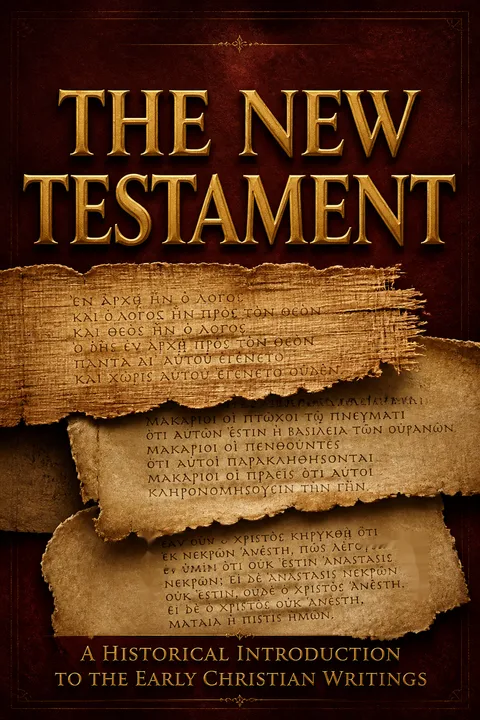
Readers widely praise The New Testament as an exceptional academic introduction to early Christianity, lauding Ehrman's clarity, accessibility, and historical rigor. Many appreciate his ability to contextualize NT writings within their socio-cultural and literary landscapes without straying into theological debate. The book is frequently recommended as a college textbook. Some critics note occasional argumentative weaknesses, perceived bias toward atheism, or inconsistencies in applying historical standards. Overall, it is considered invaluable for anyone—believer or skeptic—seeking a scholarly, historically grounded understanding of the New Testament and early Christian movements.
About the Author
Other books by Bart D. Ehrman
Download PDF
Download EPUB
.epub digital book format is ideal for reading ebooks on phones, tablets, and e-readers.








































