Plot Summary
Violets on the Maple
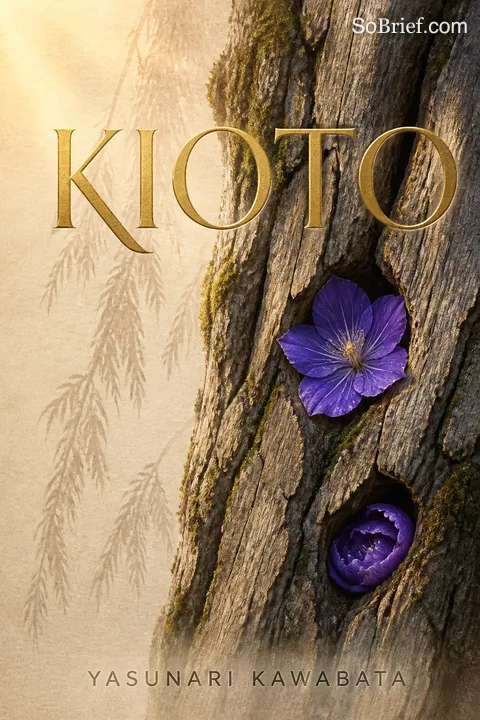
In the heart of Kyoto, Chieko sits in her family's small garden, captivated by two violets blooming on the trunk of an ancient maple. She wonders if the violets, separated by a foot, know each other—an innocent musing that echoes her own sense of isolation. The garden's Christian lantern, weathered and half-forgotten, stands as a silent witness to her contemplations. Chieko's life, like the violets and the bell crickets she keeps in jars, feels both sheltered and confined. She senses a kinship with these small, unnoticed lives, pondering her own place in the world. The gentle spring day, the butterflies, and the subtle loneliness of the violets set the tone for Chieko's journey—a search for belonging, identity, and connection in a city where tradition and change intertwine.
Secrets Behind Lattice Doors
Chieko's father, Takichiro, retreats to a convent temple, seeking inspiration for his kimono designs and solace from the pressures of modern business. The Sada family's shop, with its old lattice doors and storied past, is both a sanctuary and a prison. Chieko's relationship with her parents is loving but shadowed by unspoken truths. Her mother, Shige, hints at the possibility of Chieko leaving the family business, while Takichiro's artistic frustrations mirror the family's struggle to adapt to changing times. The home's rituals—changing the flowers, tending the hearth—are acts of devotion to a fading way of life. The lattice door becomes a symbol of both protection and separation, guarding secrets that will soon surface.
Cherry Blossoms and Confessions
Amid the splendor of Kyoto's cherry blossoms, Chieko is invited by Shin'ichi, a gentle university student, to view the flowers. Their stroll through Heian Shrine's gardens is filled with subtle tension and unspoken affection. Under the falling petals, Chieko confides in Shin'ichi that she was an abandoned child, left at her family's shop as a baby. Shin'ichi, moved and unsettled, tries to comfort her, suggesting that all people are, in a sense, abandoned by God. Chieko's confession is not a plea for sympathy but a statement of fact—her identity is shaped by absence as much as by love. The beauty of the blossoms is tinged with melancholy, reflecting the fragility of happiness and the weight of secrets.
Patterns of Family and Cloth
Takichiro's passion for kimono design is both a source of pride and a burden. He seeks inspiration in ancient patterns and the natural world, but the demands of business and the changing tastes of postwar Japan leave him restless. Chieko, devoted to her father, wears his understated designs, even as others favor more fashionable styles. The family's collection of old fabrics and costumes is a tangible link to the past, yet it also underscores their isolation from the present. Conversations between Chieko and her parents reveal a deep mutual care, but also a sense of resignation. The act of creating and wearing cloth becomes a metaphor for the weaving of family ties—delicate, intricate, and sometimes frayed.
The Twin in the Cedars
On a visit to the Kitayama cedar village, Chieko's friend Masako notices a mountain girl who bears an uncanny resemblance to Chieko. The girl, Naeko, is strong, hardworking, and dressed in the practical clothes of a laborer. Masako is struck by the similarity, but Chieko dismisses it as coincidence—though the encounter leaves her unsettled. The village, with its orderly rows of polished cedar logs and women laboring alongside men, stands in contrast to Chieko's sheltered life. The possibility of a twin, separated by fate and circumstance, begins to haunt Chieko, raising questions about identity, belonging, and the arbitrary nature of destiny.
Festival Shadows and Revelations
During the vibrant Gion Festival, Chieko and Naeko's paths cross again, this time in the sacred space of Otabisho. Naeko, believing Chieko to be her long-lost twin, approaches her with tears and joy. The revelation is overwhelming for Chieko, who learns that Naeko's parents—her own biological parents—are dead, and that Naeko has grown up in hardship. The festival's music and crowds fade into the background as the sisters confront the reality of their separation and the different lives they have led. The encounter is bittersweet: Naeko is filled with happiness at finding her sister, while Chieko is left with confusion, sorrow, and a sense of irrevocable change.
Fathers, Daughters, and Designs
Takichiro, moved by his daughter's gift of art books and her steadfast support, attempts to create a bold new obi design inspired by Western abstraction. He seeks out the skilled weaver Hideo to bring his vision to life, but is met with unexpected resistance. Hideo, sensitive and exacting, finds the design discordant and refuses to weave it as is. Takichiro, wounded, discards the design, only to have Hideo secretly recreate it from memory. The episode reveals the complexities of artistic creation, generational pride, and the longing for approval. Meanwhile, Chieko's relationship with her parents deepens, as they grapple with the prospect of her future and the meaning of family.
The Weaver's Dilemma
Hideo, the young weaver, becomes entangled in the lives of both Chieko and Naeko. Mistaking Naeko for Chieko during the festival, he promises to weave her an obi—a gesture that becomes fraught with meaning when the truth of their twinship emerges. Chieko, recognizing the confusion, asks Hideo to make the obi for Naeko instead. The act of weaving becomes a symbol of connection and separation, as Hideo pours his heart into a gift for a woman he barely knows, yet who embodies the qualities he admires in Chieko. The boundaries between self and other, love and duty, blur in the intricate patterns of cloth and fate.
Sisterhood in the Pines
Chieko visits Naeko in the cedar mountains, where the sisters share a moment of profound closeness during a sudden thunderstorm. Naeko shelters Chieko with her body, their physical and emotional bond transcending words. They speak of their different lives, the choices they face, and the meaning of happiness. Naeko's humility and strength contrast with Chieko's gentleness and longing. The cedar groves, cultivated yet wild, mirror the sisters' intertwined destinies. Their reunion is both a healing and a reminder of the distances—social, emotional, and existential—that remain between them.
Autumn's Passing Colors
As autumn descends on Kyoto, the city's traditions—festivals, dances, and rituals—continue, but with a sense of impermanence. The dismantling of the old streetcar, the fading of ancient customs, and the struggles of the weaving industry all signal a world in transition. Chieko and Naeko, each in their own way, confront the limits of their circumstances. Hideo delivers the obi to Naeko, who treasures it as a symbol of sisterhood and possibility, even as she doubts her place in Chieko's world. The colors of autumn—vivid yet fleeting—reflect the beauty and sorrow of lives shaped by forces beyond their control.
Choices in the Winter Rain
Winter brings a hush to the city and the mountains. Chieko and Naeko meet again, this time to discuss Hideo's proposal of marriage to Naeko. Naeko, torn between gratitude, loyalty, and her own sense of unworthiness, hesitates to accept. She fears being an "illusion" or substitute for Chieko in Hideo's heart, and worries about the complications her presence might bring to Chieko's family. Chieko, supported by her parents' unconditional love, urges Naeko to visit their home, offering her a place of belonging. The sisters' conversation is tender, fraught with emotion, and unresolved—mirroring the uncertainties of adulthood and the enduring ache of separation.
Illusions, Goodbyes, and Home
In the final days of winter, Naeko visits Chieko's home, welcomed by the Sada family with warmth and tears. The sisters, identical in appearance yet shaped by different fates, share a night together, reflecting on the mysteries of identity, love, and destiny. Naeko, feeling she cannot remain in Chieko's world, departs before dawn, leaving Chieko with a sense of loss but also gratitude. The falling snow, the silent city, and the enduring presence of the violets on the maple evoke a sense of closure and renewal. Chieko, surrounded by the love of her adoptive parents and the memory of her sister, finds a measure of peace—her home, imperfect and impermanent, is where her heart belongs.
Analysis
"The Old Capital" is a meditation on identity, belonging, and the passage of time, set against the backdrop of a Kyoto caught between tradition and modernity. Kawabata's narrative is both elegiac and hopeful, exploring the ways in which individuals are shaped by forces beyond their control—family, history, and the relentless march of change. The twin sisters, Chieko and Naeko, embody the novel's central paradox: that sameness and difference, connection and separation, are inextricably linked. Their reunion is both a healing and a reminder of the limits of reconciliation; happiness is fleeting, and loneliness endures. The novel's rich symbolism—flowers, seasons, rituals—serves to anchor the characters in a world that is both beautiful and impermanent. Ultimately, "The Old Capital" invites readers to reflect on the meaning of home, the nature of love, and the quiet heroism required to accept life's uncertainties. In a modern context, the novel resonates as a poignant exploration of cultural loss, personal resilience, and the enduring human need for connection.
Review Summary
The Old Capital is a lyrical novel set in post-war Kyoto, exploring themes of tradition, modernity, and identity through the story of Chieko, an adopted daughter who discovers she has a twin sister. Readers praise Kawabata's exquisite prose, vivid descriptions of nature and festivals, and subtle exploration of human emotions. The novel is celebrated for its portrayal of Japanese culture and aesthetics, though some find the pacing slow. Many consider it a masterpiece that captures the essence of Kyoto and the changing face of Japan.
People Also Read







Characters
Chieko
Chieko is the adopted daughter of the Sada family, raised in the heart of Kyoto's traditional merchant class. Sensitive and introspective, she is attuned to the subtleties of nature and the emotional undercurrents of those around her. Her discovery of her origins as an abandoned child—and later, her twinship with Naeko—propels her on a journey of self-understanding. Chieko's relationships with her parents are marked by deep affection and mutual care, yet she is haunted by questions of identity and belonging. Her development is characterized by a growing acceptance of ambiguity, a willingness to embrace both joy and sorrow, and a quiet strength that allows her to navigate the complexities of love, family, and tradition.
Naeko
Naeko, Chieko's twin, is raised in the Kitayama cedar village, living a life of hard labor and modest means. She is strong, practical, and deeply loyal, yet carries a profound sense of loneliness and longing. The discovery of her sister fills her with joy, but also with a sense of unbridgeable distance. Naeko's humility masks a keen intelligence and emotional depth; she is acutely aware of the social and psychological barriers that separate her from Chieko. Her refusal to become an "illusion" or substitute in Hideo's affections reveals a fierce sense of self-worth. Naeko's journey is one of acceptance—of her circumstances, her limitations, and the bittersweet beauty of fleeting connections.
Takichiro
Takichiro is Chieko's adoptive father, a kimono wholesaler and designer struggling to reconcile tradition with modernity. He is both loving and demanding, seeking solace in art and nature while grappling with the decline of his business and the changing world around him. His relationship with Chieko is marked by tenderness and regret; he wishes to provide for her but is often frustrated by his own limitations. Takichiro's artistic ambitions are both a source of inspiration and a burden, reflecting his desire to leave a meaningful legacy. His eventual acceptance of Naeko and willingness to embrace change signal a maturation of character and a deepening of paternal love.
Shige
Shige, Chieko's adoptive mother, is the emotional anchor of the Sada family. She is practical, compassionate, and deeply devoted to her daughter's well-being. Shige's acceptance of Chieko's origins and her openness to Naeko's presence reveal a generosity of spirit and a capacity for forgiveness. She is attuned to the rhythms of domestic life, maintaining the rituals and traditions that give the family a sense of continuity. Shige's quiet strength and adaptability enable her to weather the uncertainties of the family's fortunes and to support Chieko through moments of crisis and transformation.
Hideo
Hideo is a young obi weaver from Nishijin, known for his skill and integrity. He is introspective and exacting, holding himself and others to high standards. Hideo's interactions with Chieko and Naeko are marked by a mixture of admiration, confusion, and longing. His initial resistance to Takichiro's design, and his subsequent decision to weave it from memory, reflect his commitment to authenticity and his struggle to balance tradition with innovation. Hideo's feelings for Chieko become entangled with his relationship to Naeko, leading him to question the nature of love, identity, and artistic creation.
Shin'ichi
Shin'ichi is Chieko's childhood companion and a university student with a kind, unassuming nature. He harbors a quiet affection for Chieko, offering her support and understanding without expectation. Shin'ichi's sensitivity and humility make him a stabilizing presence in Chieko's life, though he is often overshadowed by his more assertive brother, Ryusuke. His role in the story is that of confidant and emotional anchor, embodying the virtues of patience, empathy, and steadfastness.
Ryusuke
Ryusuke, Shin'ichi's older brother, is a graduate student and the heir to a prosperous wholesale business. He is confident, direct, and sometimes overbearing, unafraid to challenge authority or confront uncomfortable truths. Ryusuke's interest in Chieko is both romantic and practical; he sees in her a partner who could share his ambitions and values. His willingness to intervene in the Sada family's affairs, and his offer to become an adopted son-in-law, reflect both his sense of responsibility and his desire for connection. Ryusuke's psychological complexity lies in his struggle to balance personal desire with familial duty.
Masako
Masako is Chieko's close friend, known for her frankness and adventurous spirit. She serves as a catalyst for key events, encouraging Chieko to explore the world beyond her family's shop and to confront uncomfortable truths. Masako's observations—particularly her recognition of Naeko's resemblance to Chieko—help propel the narrative toward its central revelation. Her role is that of confidante and provocateur, challenging Chieko to question her assumptions and embrace change.
Otomo Sosuke
Sosuke is Hideo's father and a respected obi weaver in Nishijin. He embodies the values of craftsmanship, perseverance, and humility. Sosuke's relationship with Takichiro is marked by mutual respect and a shared sense of loss in the face of modernity's encroachments. He is supportive of his sons, particularly Hideo, and serves as a bridge between generations. Sosuke's character reflects the dignity and resilience of Kyoto's artisan class.
Naeko's Adoptive Family (Murase)
The Murase family, who raise Naeko after her parents' deaths, provide her with stability and a sense of belonging. They are hardworking landholders in the cedar village, embodying the values of rural community and mutual aid. Their acceptance of Naeko, and their willingness to let her pursue her own path, contrast with the more rigid expectations of the Sada family. The Murases' understated presence in the narrative highlights the importance of chosen family and the quiet heroism of everyday life.
Plot Devices
Duality and Doubling
The central device of "The Old Capital" is the motif of duality—most powerfully embodied in the twin sisters, Chieko and Naeko. Their physical resemblance and divergent upbringings serve as a meditation on fate, nature versus nurture, and the arbitrary boundaries that define selfhood. The violets on the maple, the two hollows in the tree, and the mirrored patterns in kimono designs all reinforce this theme. The narrative structure, alternating between city and mountain, tradition and modernity, further underscores the tension between sameness and difference.
Symbolism of Nature
Kawabata uses the changing seasons, the blossoming and fading of flowers, and the cultivation of cedar trees as metaphors for the characters' emotional journeys. The violets, cherry blossoms, autumn leaves, and winter snow all serve as externalizations of longing, loss, and renewal. The natural world is both a source of beauty and a reminder of impermanence, mirroring the characters' struggles to find meaning in a transient world.
Ritual and Tradition
The festivals, tea ceremonies, and family rituals that punctuate the narrative provide structure and continuity in a rapidly changing society. These traditions are both comforting and constraining, offering a sense of belonging while also highlighting the characters' alienation. The tension between innovation and preservation is embodied in the struggles of the Sada family and the weaving community, as they seek to adapt without losing their identity.
Mistaken Identity and Misrecognition
The repeated instances of mistaken identity—Hideo's confusion between Chieko and Naeko, the festival encounters, and the sisters' own uncertainties—function as catalysts for self-discovery. These moments of misrecognition force the characters to confront the limits of perception and the complexity of desire. The device also serves to blur the boundaries between self and other, challenging the notion of fixed identity.
Foreshadowing and Circular Structure
The novel's opening images—the violets, the Christian lantern, the bell crickets—foreshadow the themes of separation, longing, and the search for connection. The narrative's circular structure, returning to motifs and settings introduced at the beginning, creates a sense of inevitability and closure. The story's emotional arc mirrors the cycle of the seasons, moving from the hope of spring to the introspection of winter.
Download PDF
Download EPUB
.epub digital book format is ideal for reading ebooks on phones, tablets, and e-readers.








































