Key Takeaways
1. Wallace's Ambition Forged in Poverty and Early Political Shifts
On the first day at the state capitol he stood on the bronze star where Jefferson Davis had taken the oath of office in 1861, and looked out across the city. “I knew I would return to that spot. I knew I would be governor.”
Humble beginnings. George Wallace grew up in Clio, Alabama, a small, impoverished rural community in the Black Belt, where his family struggled financially despite his doctor grandfather's local prominence. His mother, Mozelle, instilled a desire for refinement, while his father, George Sr., a struggling farmer, encouraged his aggressive nature. This upbringing in a region marked by economic hardship and rigid racial hierarchy deeply shaped his worldview and fueled his relentless ambition.
Early political opportunism. Wallace's political career began as a legislative page at 15, where he first envisioned becoming governor. He cultivated political contacts and, despite a brief, undistinguished law practice after serving in WWII, quickly won a seat in the state legislature in 1946. His early legislative record was marked by a blend of progressive social spending and a cautious approach to racial issues, aligning with populist Governor Jim Folsom while maintaining ties with conservatives.
Shifting racial stance. Initially, Wallace presented himself as a "humane segregationist," even serving on the board of all-black Tuskegee University. However, his political compass shifted dramatically after his 1958 gubernatorial defeat, when he concluded that his perceived "softness on the race question" was his undoing. This pivotal loss led to his infamous vow: "no other son-of-a-bitch will ever out-nigger me again," setting the stage for his uncompromising segregationist rhetoric.
2. The "Stand in the Schoolhouse Door" as a Calculated Act of Defiance
“Today I have stood, where once Jefferson Davis stood, and took an oath to my people. It is very appropriate then that from this Cradle of the Confederacy, this very Heart of the Great Anglo-Saxon Southland . . . we sound the drum for freedom. . . . In the name of the greatest people that have ever trod this earth, I draw the line in the dust and toss the gauntlet before the feet of tyranny . . . and I say . . . segregation now . . . segregation tomorrow . . . segregation forever.”
Iconic inaugural address. On January 14, 1963, George Wallace delivered an inaugural address that cemented his image as the defiant leader of white Southern resistance. Penned by his speechwriter Asa Carter, the speech's fiery rhetoric, particularly the "segregation forever" line, resonated deeply with white Alabamians and launched him onto the national stage. This moment was a carefully orchestrated political spectacle, designed to elevate Wallace as the champion of states' rights against federal overreach.
Confrontation with the Kennedys. The "stand in the schoolhouse door" at the University of Alabama in June 1963 was another meticulously planned confrontation. Despite private assurances to federal officials that he would avoid violence, Wallace publicly vowed to physically block the enrollment of black students Vivian Malone and James Hood. This theatrical defiance forced President John F. Kennedy to federalize the Alabama National Guard, creating a powerful visual of federal power confronting state resistance.
Political gains from "defeat." Although Wallace was ultimately forced to step aside, allowing the students to enroll, he framed the event as a victory. He argued that he had forced the federal government to use military force, thereby exposing its "tyranny" and rallying white Southerners to his cause. This perceived triumph, despite the actual integration, significantly boosted his popularity and solidified his image as an unyielding defender of Southern traditions.
3. Birmingham Bombing: Wallace's Reckless Incitement and Tragic Consequences
“The Supreme Court, the Kennedy administration and the civil rights agitators are more to blame for this dastardly crime than anyone else,” he told television viewers.
Inciting racial tensions. In the spring of 1963, as civil rights demonstrations intensified in Birmingham, Wallace actively encouraged hard-line responses from figures like Public Safety Commissioner Bull Connor. He publicly denounced civil rights leaders as "white renegades" and "mobsters," and deployed state troopers to the city, exacerbating an already volatile situation. His rhetoric consistently blamed "outside agitators" and federal interference for any unrest, deflecting responsibility from local segregationist actions.
Tragedy at 16th Street Baptist Church. On September 15, 1963, a bomb exploded at the 16th Street Baptist Church, killing four young black girls. This horrific act, occurring shortly after Wallace had ordered state officials to close integrated schools, was a direct consequence of the climate of racial hatred he fostered. Despite overwhelming evidence pointing to white terrorists, Wallace publicly suggested that the bombing might have been carried out by "Negroes or maybe Communists" to gain publicity.
Shielding perpetrators. The state's investigation into the bombing was a charade, with Wallace's state police chief, Al Lingo, arresting Klansmen on minor charges and then releasing them. This deliberate obstruction, coupled with Wallace's continued rhetoric blaming civil rights activists, allowed the actual murderers to evade justice for years. The incident became a stark symbol of the moral bankruptcy of segregation and Wallace's willingness to sacrifice innocent lives for political gain.
4. The 1964 Presidential Primaries: A "Tremor" of White Backlash
“I don’t need a foreign policy,” he told Ingram with an impish grin. “All they wanted to know about was niggers,” he said, “and I’m the expert.”
Testing national waters. Following his "schoolhouse door" stand, Wallace embarked on a national speaking tour, initially targeting prestigious Northern universities. He skillfully adapted his message, downplaying overt racism in favor of "constitutional" arguments about states' rights and federal overreach. His ability to charm and disarm hostile audiences, often with self-deprecating humor, surprised many and garnered significant media attention.
Surprising primary success. In 1964, Wallace entered Democratic presidential primaries in Wisconsin, Indiana, and Maryland, states with small black populations. Despite being dismissed by national media and mainstream politicians, he achieved unexpectedly strong showings:
- Wisconsin: Captured over a third of the Democratic vote (266,000 votes).
- Indiana: Secured 30% of the vote.
- Maryland: Won 43% of the vote, carrying 16 of 23 counties.
These results, particularly in white working-class and suburban areas, revealed a significant "white backlash" against federal civil rights policies and social change.
A national phenomenon. Wallace's primary performance demonstrated that his appeal extended far beyond the Deep South. He tapped into a broader national discontent among white voters who felt ignored by the political establishment and threatened by rapid social changes. This "tremor" of support, though not enough to win the nomination, signaled a powerful undercurrent in American politics that would reshape future elections.
5. Lurleen Wallace's Surrogate Candidacy: A Strategy to Maintain Power
“Get your running shoes on. The succession bill has failed.”
Circumventing term limits. Alabama law prohibited governors from serving consecutive terms, a restriction Wallace desperately sought to overturn to maintain his political base for a future presidential run. When his efforts to pass a constitutional amendment failed in the state legislature in 1965, he devised a audacious plan: to run his wife, Lurleen, as a surrogate candidate. This move, while seemingly bizarre, was a calculated maneuver to retain control of the governor's office.
Lurleen's reluctant role. Lurleen Wallace, a shy former dime-store clerk with no political ambitions, initially resisted the idea. However, driven by loyalty to her husband and a desire to avoid returning to the financial struggles and neglect she experienced during his 1958 defeat, she reluctantly agreed. Her battle with cancer, which she kept largely private, added a tragic dimension to her candidacy, though her husband's campaign often downplayed the severity of her illness.
Overwhelming victory. In the 1966 Democratic primary, Lurleen Wallace achieved a landslide victory, securing nearly half a million votes—more than 50% of the total—against nine male opponents. This triumph was fueled by a massive turnout of white voters, many of whom saw her as a proxy for her husband's defiance against federal integration efforts. Her victory solidified George Wallace's control over Alabama and provided a powerful platform for his next presidential bid.
6. The 1968 Campaign: Tapping into the "Politics of Alienation" Nationally
“They vomit laughter. Trying to eject the vacuum inside them.”
Broadening the message. After his wife's inauguration, George Wallace launched his 1968 presidential campaign as a third-party candidate under the "American Independent Party." He expanded his message beyond explicit segregation, focusing on a broader "politics of alienation" that resonated with millions of white working-class and middle-class Americans. His rallies, often described as "political Janis Joplin concerts," were emotional catharses for audiences who felt ignored and threatened by social change.
Key themes of alienation:
- Law and Order: Denouncing urban riots, street crime, and "thugs" who "burned down half a city."
- Anti-Establishment: Attacking "pseudo-intellectual elites," "briefcase-carrying bureaucrats," and "out-of-touch politicians" in Washington.
- Cultural Conservatism: Criticizing "long-haired hippies," anti-war protesters, and the perceived breakdown of traditional values (God, family, country).
- Economic Grievances: Voicing frustration over high taxes, foreign aid, and welfare programs that supposedly benefited the "undeserving poor."
Grassroots fundraising success. Despite lacking a traditional party structure, Wallace's campaign raised over $9 million, primarily through small contributions and direct-mail solicitations. This grassroots funding, coupled with his ability to draw massive, enthusiastic crowds, demonstrated a deep well of discontent across the nation. His campaign's success in getting on the ballot in all fifty states was an extraordinary organizational feat, often dismissed by a skeptical national media.
7. Nixon's "Southern Strategy" and the Threat of George Wallace
“Your point is that we had to move to the right in order to cut Wallace off at the pass?” asked Nixon. “Absolutely,” replied Parmet.
Nixon's calculated approach. Richard Nixon, aiming for the presidency in 1968, recognized the potent appeal of Wallace's message but sought to co-opt it without appearing overtly racist. His "Southern Strategy" aimed to win over disgruntled white Southern Democrats and conservative Northern blue-collar workers by subtly addressing their concerns about "law and order," busing, and federal overreach, while distancing himself from Goldwater's explicit segregationist stance.
Wallace as a spoiler. Nixon viewed Wallace as a significant threat, not necessarily to win, but to deny him an electoral majority, potentially throwing the election into the Democratic-controlled House of Representatives. This fear drove Nixon's cautious approach, as he sought to appeal to Wallace voters without alienating moderate Republicans. His choice of Spiro Agnew as running mate, known for his tough stance on urban riots, was a key part of this strategy.
Co-opting Wallace's issues. Nixon's campaign carefully adopted Wallace's rhetoric on "law and order," criticizing anti-war protests and urban unrest. He also began to express opposition to "forced busing" and to advocate for "freedom of choice" in school desegregation, positions that resonated with Wallace's base. This strategic shift aimed to draw Wallace's supporters into the Republican fold, ultimately weakening the third-party challenge.
8. The 1970 Gubernatorial Race: A Return to Unabashed Race-Baiting
“We’ll just throw the niggers around his neck.”
Reclaiming the governorship. After his 1968 presidential run, Wallace needed to regain the Alabama governorship to maintain his political platform for 1972. Despite a promise not to run against his successor, Albert Brewer, Wallace launched a ruthless campaign. He faced a formidable opponent in Brewer, who was widely regarded as a competent and honest governor, and who had garnered support from a coalition of black voters and white moderates.
Nixon's covert intervention. President Nixon, desperate to neutralize Wallace as a third-party threat in 1972, secretly channeled $400,000 into Brewer's campaign. This covert operation, involving cash transfers and elaborate cover stories, aimed to defeat Wallace and remove him from the national political stage. However, the heavy-handed tactics, including leaks to the press about IRS investigations into Wallace's brother, Gerald, ultimately backfired, fueling Wallace's narrative of political persecution.
Unleashing racial demagoguery. Faced with a strong opponent and White House interference, Wallace abandoned his more nuanced national rhetoric and returned to raw race-baiting. His campaign unleashed a barrage of "unauthorized" leaflets and radio ads linking Brewer to "black militants" and warning that a Brewer victory would lead to black control of the state. This strategy, epitomized by the infamous "This Could Be Alabama Four Years From Now!" leaflet, proved devastatingly effective, securing Wallace a narrow victory.
9. The 1972 Assassination Attempt: A Turning Point and Political Maneuvering
“I’m shot,” he said to her in a flat breathless voice. “I’ve been shot.”
Bremer's motivations. On May 15, 1972, Arthur Bremer, a disturbed young man with a history of mental instability and a desperate craving for fame, shot George Wallace at a campaign rally in Laurel, Maryland. Bremer's diary revealed a plan to assassinate either Nixon or Wallace, driven by a desire for recognition rather than political ideology. The shooting left Wallace paralyzed from the waist down and in constant pain, fundamentally altering his life and political career.
Nixon's immediate response. President Nixon, upon hearing of the shooting, immediately ordered enhanced security for other candidates and initiated a covert operation to control the narrative. White House aide Charles Colson attempted to plant disinformation linking Bremer to George McGovern's campaign, and Nixon expressed concern that any evidence linking Bremer to Republicans could cost him the election. The White House also sought to suppress information about Bremer's diary, which revealed his stalking of Nixon.
Political fallout and Wallace's resilience. The assassination attempt, while tragic, paradoxically boosted Wallace's national sympathy and solidified his image as a courageous fighter. Despite his severe injuries, he continued his campaign from his hospital bed, winning primaries in Michigan and Maryland. His near-death experience, coupled with his wife Cornelia's determination, ensured his political survival, though his physical limitations would forever change his campaigning style.
10. Wallace's Enduring Legacy: A Prophet of Modern Conservatism
“I had to do things—say things to get elected in Alabama, that made it impossible for me to ever be President.”
A complex "redemption." In his later years, Wallace, confined to a wheelchair and suffering from chronic pain, embarked on a path of public apology and reconciliation with black Alabamians. He sought forgiveness for his past segregationist stance, appointed African Americans to state positions, and won his final gubernatorial election in 1982 with significant black support. While some saw this as genuine redemption, critics noted his continued racial insensitivity in private and the political expediency of his shift.
Anticipating conservative themes. Wallace, despite his ultimate political defeats on the national stage, proved to be a prophetic figure in American politics. He identified and exploited a deep well of discontent among white working-class and middle-class Americans, anticipating many of the themes that would later define modern conservatism:
- Anti-establishment sentiment: Distrust of federal government, "intellectual snobs," and "briefcase-carrying bureaucrats."
- Law and order: Emphasis on crime, social disorder, and a tough stance against "welfare loafers" and "hippies."
- Cultural grievances: Opposition to busing, perceived moral decline, and defense of traditional values.
- Tax revolt: Frustration with high taxes and government spending.
The "most influential loser." Wallace's impact was not in winning the presidency, but in reshaping the political landscape. He forced both major parties, particularly the Republicans, to adopt more conservative stances on social and racial issues, paving the way for the "Southern Strategy" and the rise of figures like Ronald Reagan. His ability to articulate the frustrations of the "silent majority" made him, in the words of the book, "the most influential loser in twentieth-century American politics."
Review Summary
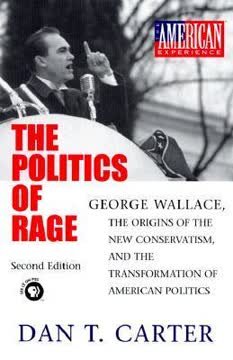
Reviewers broadly praise The Politics of Rage as a masterful, exhaustively researched biography that transcends its subject to illuminate the origins of modern conservative politics. Most highlight Carter's unflinching portrayal of Wallace as a power-hungry demagogue whose racist demagoguery shaped American politics for decades. Many reviewers draw striking parallels to Donald Trump, noting the book's eerie prescience. Wallace's corruption, manipulation, and cynical exploitation of white resentment are recurring themes. Some find the book dense but rewarding; nearly all consider it essential reading.
People Also Read




 Immersive