

Plot Summary
Prologue
The book opens with a defiant dedication: to those who lost their voice, to those people still whisper about, to those who fight every day to forget. A short roster of men's names follows, listed like a ledger of debts still owed. Einstein's tidy maxim, that the weak revenge, the strong forgive, and the intelligent ignore, is flatly rejected.
The narrator embraces a colder creed instead: revenge tastes best served slowly, because patience makes the guilty forget anyone is coming for them, and that forgetting makes their eventual screams sound all the sweeter when the reckoning finally arrives.
The framing announces voice and genre at once: this is trauma reframed as mission, grief recast as method. By name-dropping a list of men and dismissing Einstein's counsel of forgiveness, the text refuses the cultural script that asks survivors to heal quietly and move on. The aestheticization of vengeance, screams rendered as music, signals an unreliable yet seductive narrator who has converted pain into purpose. It also establishes dramatic contract with the reader: we are invited to root for a killer. The cold patience celebrated here becomes literal plot architecture, one victim a month, foreshadowing both the discipline and the dissociation that define the protagonist.
Two Profilers, One Coffee
On an overcast cafe patio, a young woman coolly dismisses an arrogant man named Craig4 who tries to charm her. His quieter companion watches instead, pays her bill, and walks off calling her his entertainment. Curious, she returns the cash, and the two trade readings like duelists. He names her detachment, her loneliness, the old loss buried under her bohemian calm; she clocks him as FBI from his blacked-out SUV and modest suit.
Unnerved that a stranger pried open feelings she has armored for years, she takes the card he slips her: Logan Bennett.2 An alarm on her phone snaps her back into discipline. She tells herself she must stay cold, because anything softer could fracture a plan she has guarded too long.
The meet-cute is staged as a contest of surveillance, which is exactly what intimacy will mean for these two. Abby weaponizes the profiler trope: being seen, the romantic ideal, becomes an existential threat to a woman whose survival depends on being unreadable. Logan's accuracy is both seduction and danger, and Lana's panic registers attraction and exposure as the same sensation. The closing pivot to her phone alarm performs the book's central split: the woman capable of warmth and the operative who cannot afford it occupy one body. The reader is positioned to feel the pull of connection before learning what that connection actually endangers.
The Girl With the Knife
After leaving the cafe, the same woman drives to an isolated house, dresses in oversized men's boots and rock-weighted backpacks to fake a heavy intruder's tread, and slips inside. When a man she calls Ben11 steps from the shower, she slices his Achilles tendon and chokes him to the brink of death without finishing him.
She tells him she was a sixteen-year-old girl the last time he saw her, that he took three turns, and that she will take three pounds of flesh across three days. He recognizes her as someone the world believes died a decade ago. There is no mercy in her, only a high she gets from his terror. The charming patio flirt1 is revealed as a methodical, vengeful torturer.
The hard cut from banter to butchery is the novel's defining shock and its thesis. By withholding Lana's nature through chapter one and detonating it here, the narrative implicates the reader's earlier affection. The ritual specifics, staged footprints, ground-level strangling, pounds of flesh, fuse Old Testament retribution with forensic intelligence, framing her not as feral but as a project manager of pain. Crucially, terror gets her high while nudity sickens her, a psychological tell that her sadism is reactive, born of violation rather than appetite. The mathematics of three turns, three days, three pounds renders trauma into a balanced equation she is determined to settle.
Chasing the Wrong Monster
At Quantico, Logan2 and his colleagues pore over five linked killings: men from one tiny, devoutly religious town, each castrated, each crime scene marked with a wall painted in the victim's blood.
The team constructs a profile of a large, physically fit gay male sexual sadist driven by rejection, estimating his weight from the staged footprints. Agents sent to the stonewalling town of Delaney Grove learn nothing. Logan2 senses the profile is subtly wrong but cannot locate the flaw.
Meanwhile Lana1 finally calls him, claiming she observed a proper waiting period, and their banter turns warm and easy. The irony tightens: the analyst assembling the manhunt is falling for the very killer he hunts, and his reasoning points confidently in every direction but hers.
Here the book turns procedural to mine its richest vein of dramatic irony. The FBI's elaborate, internally coherent profile is a monument to how expertise, fed staged evidence, manufactures certainty about the wrong suspect. Lana has effectively authored the profile by curating what the scene says, an act of narrative control that mirrors the author's own. The gendered assumptions, that torture and castration must signal a male sadist, expose how investigative frameworks encode bias that a clever woman can exploit. Logan's nagging unease is the reader's privileged knowledge leaking into him, a slow-burn suspense engine: we wait not for whether he is wrong but for when he discovers it.
Texts Between Hunters
Their first real meeting is a rushed coffee that Logan2 must abandon for work, leaving Lana1 waving like a fool. What follows is weeks of relentless texting and calls: gallows humor, flirtation, his stories of early cases, her invented tales of appraising sex dolls and dildos for her online trade business.
Lana,1 who has felt dead since her teens, catches herself grinning in a way she barely recognizes, while Logan,2 a workaholic warned by colleagues that agents never keep relationships, keeps hunting for a flaw in her and finding none.
Both reflexively dodge personal questions. Neither grasps the gulf between them: he cages killers, she becomes one every month. The tenderness is genuine, and that authenticity is precisely what makes it perilous.
The courtship unfolds through screens, a fitting medium for two people fluent in curating themselves. Text strips away the micro-expressions both weaponize, letting Lana pass as ordinary and letting Logan relax his vigilance. Abby uses humor as intimacy's vehicle and its smokescreen; Lana's jokes about appraised sex toys are deflections that double as real charm. The chapter dramatizes a survivor rediscovering the capacity for play, a developmental milestone she had assumed murdered alongside her old self. Logan's compulsion to find her flaw is the analyst's love language, but it also seeds the suspicion that will later matter. Their mutual deflection is not coldness; it is two wounded people negotiating exposure.
A Dead Girl's Three Names
Watching her married target Tyler7 through hidden cameras, Lana1 finally lays out her lost decade. At sixteen in Delaney Grove, she and her brother were savaged by a pack of local boys the night their father was publicly disgraced; the town buried her as dead.
Her best friend Jake,3 son of her father's lawyer, helped her disappear into the identity of Kennedy Carlyle,1 a wealthy orphan killed the same night in a car crash, then later into Lana Myers.1 She spent years weeping, then training in martial arts and earning black belts, then plotting.
Now she executes one tormentor a month, castrating each to strip away the power they once held over her. Jake3 notes she seems oddly cheerful lately; she blames adrenaline, hiding that the change is Logan.2
The origin story recasts every prior scene, converting a serial killer into a grief survivor with a ledger. The triple identity, Victoria to Kennedy to Lana, literalizes how trauma shatters and reassembles the self; each name is a survival strategy, each erasure a small death she chose over the one inflicted on her. Castration as signature is not random cruelty but symbolic reversal, returning to her attackers the helplessness they imposed. Jake's observation about her new lightness is the book's quiet tragedy in miniature: love is healing the very numbness that makes her mission bearable. Recovery and revenge, the narrative suggests, may be incompatible projects competing for the same heart.
The Agent at Her Door
Logan2 abuses his access to locate Lana's1 address and arrives unannounced. She opens the door pantsless, and the reunion ignites at once. As he carries her toward the bedroom, she silently races through her hazard list: the upstairs murder room, the living-room monitors streaming Tyler's7 life, the row of cleaned knives. Logan2 notices old scars mapping her body, and she deflects with a car-accident lie.
They sleep together, and for the first time since the assault she feels safe being held down beneath someone. Afterward, glowing and unsettled, she resolves to move her weapons into the hidden room Jake3 built, lock it, and kill the surveillance feed before his curiosity ever finds it. Desire and concealment now share the same square footage.
Physical intimacy here is a triumph and a security breach in the same breath. That Lana can be pinned without panic marks profound healing, her body relearning trust, yet the scene runs on suspense about a closet of evidence feet away. Abby fuses the romance and thriller registers so the reader's arousal and dread are inseparable, mirroring Lana's own divided experience. The scars become a synecdoche for her whole concealed history: visible, asked about, lied away. Logan's boundary-crossing arrival, romantic in genre convention, is quietly ominous, demonstrating that the man who can find her unannounced is also the man professionally equipped to uncover everything.
Symmetry and a Restaurant Booth
Studying a separate serial case, Logan2 abruptly realizes the unsub the media calls the Boogeyman9 selects women for flawless facial symmetry, casting their faces into bronze da Vinci-style sculptures and robbing them to buy the metal. The insight rockets him to New York.
There, by grim coincidence, Lana1 and Jake3 are already shadowing Tyler7 in disguise, Jake3 posing as blind. Wigged and wired with an earpiece, Lana1 overhears Tyler7 and Lawrence8 nervously debating who is picking off their old crew, clearing the remorseful Dev12 and the supposedly wheelchair-bound Jacob,3 who is Jake himself.
Lawrence8 gropes the disguised Lana1 and presses his card on her. Then she glimpses Logan2 on the same sidewalk, celebrating his arrest, and is forced to let his call ring out, unanswered.
Two hunts braid here, sharpening the book's mirror motif: Logan solves a killer obsessed with perfect symmetry while failing to see the symmetrical killer in his own bed. The da Vinci unsub, sculpting beauty from murder, is a grotesque double of Lana, who sculpts justice from the same medium. The restaurant surveillance reverses chapter one's dynamic, now Lana is the unseen reader of others, harvesting the men's casual cruelty and confirming their refusal of remorse. Their joking dismissal of every suspect, including the wheelchair ruse, rewards her meticulous misdirection. The near-collision with Logan tightens the thriller's noose, geography itself conspiring to push her two lives toward collision.
Two Men in the Cellar
At Logan's2 house Lana1 studies his Boogeyman9 file and deduces the killer is a cash-paid custodial worker, pointing to the surgically correct cleaners used on each kill room. The tip breaks the case open. While Logan2 flies off chasing it, Lana1 and Jake3 abduct Tyler7 and Lawrence8 into the cellar of Tyler's7 empty old house.
Strung up in chains, the two men finally recognize the ghost they believed dead for a decade. Interwoven flashbacks expose the full atrocity: the boys raped Victoria1 and tortured her gay brother Marcus10 to death, then threatened Dev's12 sister into lifelong silence. Jake,3 who once vomited at the violence, stays to help this time. Over slow days she takes them apart, painting the cellar walls in two shades of red.
The chapter delivers the catharsis the prologue promised and the cost the narrative has been hiding. Lana arming Logan with a profile is the relationship's defining paradox: she genuinely wants him to stop a monster while she perfects her own monstrosity, and her custodial insight comes from a survivor's compulsive expertise in cleaning, hinting at her own scrubbed history. The cellar revelation about Marcus reframes her crusade as grief for a beloved brother, not only personal violation, widening the wound. Jake's choice to participate, conquering his nausea, marks loyalty curdling into complicity. The men's recognition completes the prologue's logic: the forgotten executioner arrives, and the screams finally sound, to her, like music.
The Name Carved in Flesh
The escaped custodial killer, identified as Gerald Plemmons,9 escalates spectacularly, hanging a judge's wife from a window with the Boogeyman9 moniker and Logan Bennett's2 own name carved into her chest. Jake3 warns that the sadist9 will strike at Logan2 through a proxy, most likely his girlfriend.1
Lana,1 who once nearly exposed herself by dripping victims' blood into her hair before talking her way past Logan's2 suspicion, vows to become the monster's9 nightmare and shield the man she loves. Before she can move, a redheaded FBI colleague named Hadley5 appears on her doorstep with a file and one blunt demand: explain why she stole the identity of a dead girl. The shell Lana1 spent ten years building splits open on a cliffhanger.
The finale converts the parallel-killer subplot into a direct threat, fusing the romance and thriller arcs: protecting Logan now requires Lana to fight on his behalf rather than merely hide from him. Plemmons carving Logan's name externalizes the danger that proximity to Lana represents, the gravitational pull of violence toward everyone she loves. Hadley's arrival is the long-deferred payoff of Logan's compulsive scrutiny, now wielded by a subordinate with fewer scruples and a criminal past of her own. By ending mid-exposure, Abby weaponizes the book's central tension, intimacy as discovery, leaving the reader suspended between rooting for concealment and dreading it, the survivor's secret prized open at last.
Analysis
The Risk is a dark romance built on a single audacious provocation: can a reader love a torturer? Abby answers by splitting the narration between predator and pursuer, letting affection accumulate in chapter one before detonating Lana's1 true nature, so that complicity is retroactive and inescapable. The novel's intelligence lies in its mirror structure. Lana1 and Logan2 are the same instrument, profilers who decode strangers, pointed in opposite moral directions; their romance is therefore an act of mutual surveillance where being known is both the deepest intimacy and the lethal threat. Every tender beat doubles as a near-discovery, fusing the dopamine of romance with the dread of the thriller until the reader cannot separate arousal from alarm. Thematically, the book interrogates the cultural demand that survivors heal politely. Lana's1 monthly executions are framed not as madness but as accounting, a refusal of the forgiveness Einstein recommends in the rejected epigraph. Yet Abby complicates her own revenge fantasy: love begins eroding the numbness that makes the mission bearable, and Jake's3 worry that Lana1 grows too cheerful exposes the tragic incompatibility of recovery and vengeance. The triple identity literalizes how trauma fragments selfhood, each name a survival strategy purchased at the cost of erasure. Castration as signature reverses the helplessness once inflicted on her, a symbolic restoration of stolen power. The parallel Boogeyman plot supplies an external monster against whom Lana's1 discrimination, sparing the remorseful Dev,12 looks almost ethical, blurring the line the FBI is paid to enforce. Ending mid-exposure, the novel weaponizes its core tension, leaving the reader suspended between hoping the survivor's secret holds and dreading what its revelation will cost. It is pulp with a serious question underneath: whether justice and law were ever the same thing.
Review Summary
The Risk is the thrilling first book in the Mindf*ck series, featuring Lana Myers, a vigilante serial killer, and Logan Bennett, an FBI profiler. Readers praise the unique plot, intense suspense, and chemistry between the main characters. Many found the dark themes and revenge storyline compelling, though some warn about graphic content. The book's short chapters and cliffhanger ending left most readers eager to continue the series. While a few found it overhyped, the majority gave it high ratings for its addictive storytelling and complex characters.
People Also Read









Characters
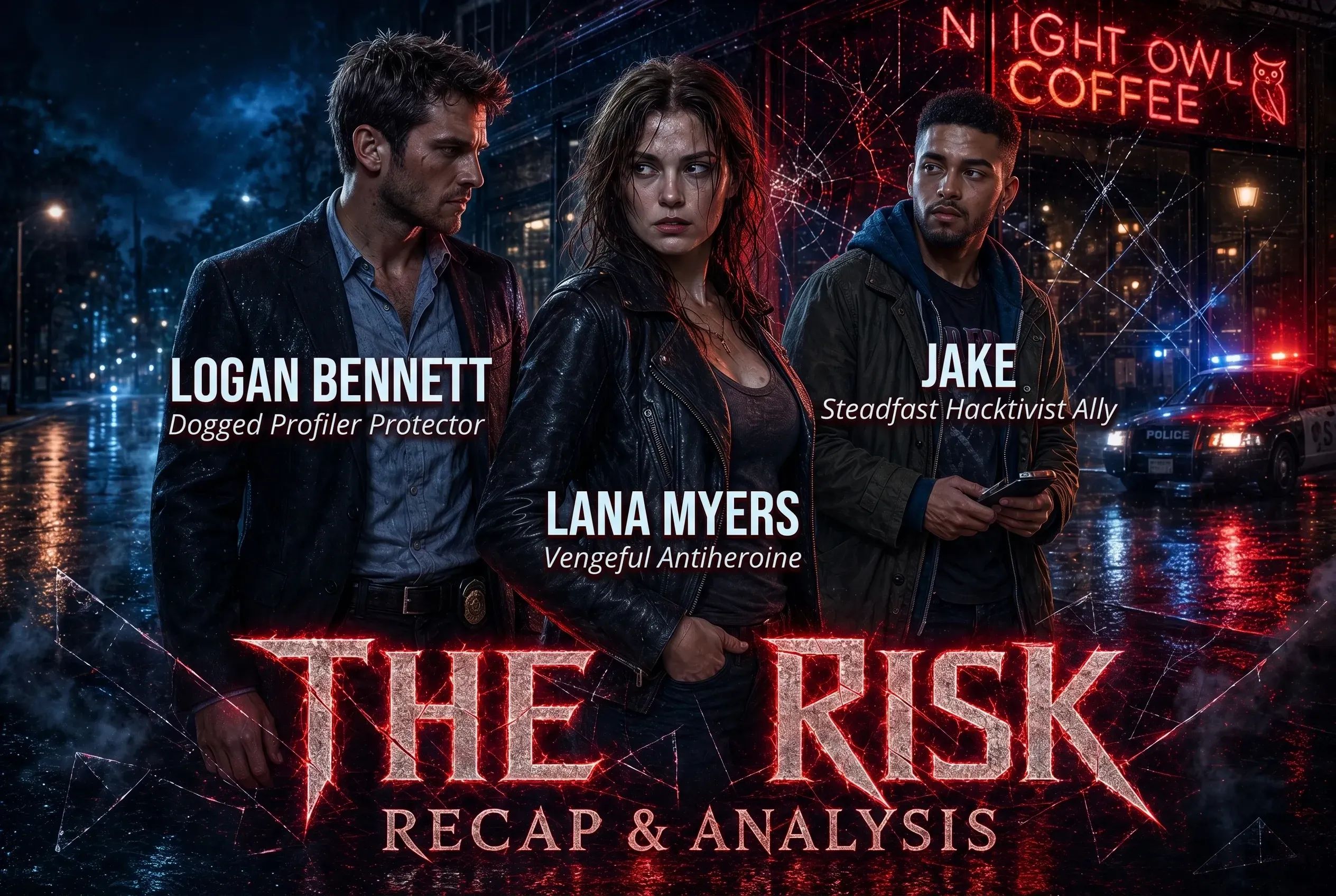
Lana Myers
Vigilante with three namesBorn Victoria Evans, reborn as Kennedy Carlyle and then Lana Myers, she is a survivor turned methodical executioner. Brutalized at sixteen alongside her brother10, she rebuilt herself across a decade of grief, martial-arts training, and meticulous planning into a hunter who kills one of her abusers each month. She reads people with cold precision, masks every micro-expression, and trusts almost no one. Beneath the armor lives a witty, dramatic girl she assumed was murdered with her old name. Her psychology is a study in dissociation harnessed as discipline: terror in others gives her a high, while genuine tenderness terrifies her more than violence. Logan2 reawakens a buried hunger to feel human, forcing her to wonder whether revenge and the capacity for love can coexist in one body.
Logan Bennett
FBI profiler who reads everyoneA gifted, intuitive FBI behavioral analyst recruited young, Logan crawls into killers' psyches to catch them and trusts his gut over consensus. Raised by a beloved stepfather after his mother chased wealth, he is a workaholic resigned to solitude, his colleagues warning that agents never sustain love. His defining trait is compulsive profiling he cannot switch off, which has wrecked past relationships and now both seduces and endangers Lana1. Drawn to her wounded mystery, he develops a hero complex around her, simultaneously falling hard and nagged by suspicion that she is too flawless to be true. Decent, funny, and dogged, he embodies dramatic irony incarnate: the more skilled he is at his job, the closer he drifts toward exposing the woman he adores.
Jake
Loyal hacker and partnerLana's1 oldest friend and the son of her father's lawyer, Jake faked her death, manages identities, runs the tech behind her cover business, and maintains a public ruse of being wheelchair-bound. Bisexual, fiercely protective, and prone to worry, he is the brains and conscience to her blade. He shares her martial training and her grief for her brother10, but the gore sickens him, leaving complicity warring with nausea.
Craig
Arrogant FBI PR faceThe flashy, expensively dressed colleague who first hits on Lana1 and is rejected, Craig serves the team as its media-savvy public relations man rather than a profiler. Vain and convinced of his own charm, he resents that Lana1 chose Logan2 over him. He provides comic friction, voicing the team's weaker theories and needling Logan2 about his new relationship.
Hadley
FBI tech with a recordA forensics and computer specialist recruited out of legal trouble rather than virtue, Hadley runs Lana's1 background checks for Logan2 and admits to peeking past legal limits. Brash, nosy, and morally flexible, she banters with the team and harbors a curiosity that proves consequential. Her loyalties and methods make her unpredictable, and her initiative carries the story toward its sharpest turn.
Elise
Sharp profiler colleagueA seasoned FBI profiler on Logan's2 team, Elise supplies clinical insight into sadism and victimology and reminds Logan2 that agents rarely sustain relationships. Pragmatic and observant, she nudges him to rest and stays current on the cases he cannot let go.
Tyler
Married target under watchA man from Lana's1 hometown linked to the night that shattered her, now married and conducting an affair. She surveils his scheduled, predictable life through hidden cameras, exploiting his routines and his keyless locks as she patiently prepares to collect on his old debt.
Lawrence
Predatory hometown figureAnother man tied to Lana's1 past, smug and lecherous, who gropes and propositions her disguised self in New York. Sharper and more suspicious than Tyler7, he pushes the others toward burner phones and security systems, sensing someone is hunting their old circle.
Gerald Plemmons
Symmetry-obsessed rival killerThe serial rapist and murderer the media dubs the Boogeyman, a forgettable cash-paid custodial worker who selects women for perfect facial symmetry and casts their faces into bronze da Vinci-style sculptures, robbing victims to fund the metal. Once Logan2 exposes him, he craves the spotlight, escalating into theatrical, vengeful violence aimed squarely at the agent who hunts him.
Marcus
Lana's murdered brotherLana's1 gay older brother, remembered as kind, honest, and luminous. He was assaulted and tortured to death the same night Lana1 was attacked, and his loss is the deepest engine of her crusade, shared in grief with Jake3, who also loved him.
Ben Harris
First on-page victimOne of the men who assaulted Lana1 a decade earlier, the first killing shown in full. Successful and submissive in his work life, he fails to recognize her until she invokes the night, then dies slowly over three days as her opening demonstration.
Dev
The remorseful spared oneA member of the attacking group who later broke down, wept, and called the assault sickening, then sought penance through religious mission work. Coerced into being present, he showed the only conscience among them, which spares him the worst of Lana's1 reckoning.
Kyle
The one saved for lastOne of Lana's1 tormentors whom she deliberately reserves for the end of her list, wanting him terrified and weeping by the time she reaches him. His delayed fate anchors the long game driving her monthly pattern.
Plot Devices
Mutual Profiling
Engine of irony and intimacyBoth lovers read people for a living, Logan2 as an FBI analyst and Lana1 as a survivor who learned to decode threats. Their attraction is built on being seen, the very thing Lana1 cannot survive. Abby uses the device to generate continuous suspense: every tender conversation is also an interrogation, every accurate read a near-miss. The hunter dates the agent assigned to catch a killer who is her, so the reader watches Logan's2 skill inch him toward a truth that would destroy them both. Profiling also structures the procedural subplots, letting Lana1 feed false signals into investigations while Logan2 brilliantly solves the cases that are not hers.
Forensic Misdirection
Hides killer's identityLana1 engineers her crime scenes to manufacture a false profile. She wears oversized men's boots with a custom toe-piece to stamp a heavy man's heel-to-toe prints, strangles victims while they are on the ground to disguise her height, and castrates each man so investigators assume a large male sadist. The blood-painted walls and consistent castration become a deliberate signature steering the FBI away from a five-foot-four woman presumed long dead. The device pays off in the team's confidently wrong profile and dramatizes how evidence, curated by an intelligent perpetrator, becomes a story told to the very people meant to read it objectively.
The Triple Identity
Conceals and reframes protagonistThe protagonist1 exists as three people: Victoria Evans, the brutalized teenager the town buried; Kennedy Carlyle, a wealthy orphan killed in a crash whose paperwork Jake3 repurposed; and Lana Myers, the cool persona she lives in now. The faked death funds and shields her vendetta, letting her hunt men who believe she is a ghost. The device delivers the novel's central recontextualization, transforming a serial killer into a grief-stricken survivor, and supplies the cliffhanger when an investigator5 demands to know why she stole a dead girl's identity, turning her own concealment into the weapon aimed back at her.
The Parallel Boogeyman Case
Mirror and external threatRunning alongside Lana's1 vendetta is Logan's2 hunt for a serial rapist9 who kills women for perfect facial symmetry and casts their faces in bronze. This unsub functions as Lana's1 dark mirror, an artist of murder against whom her own crusade is implicitly measured, and as the engine that escalates the plot when Logan's2 brilliance brings the killer notoriety he learns to crave. Lana1 even helps profile him, deepening the irony of a killer aiding the law. By the finale the case stops being parallel and becomes personal, threatening Logan2 directly and forcing Lana1 to choose between hiding and protecting the man she loves.
Einstein Epigraphs
Ironic thematic framingEach chapter opens with an Einstein quotation, a habit inherited from Lana's1 father, who used the physicist to make sense of a collapsing world. The epigraphs counterpoint the violence with detachment and intellect, framing torture as cold rationality and romance as relativity. They lend the narrator a philosophical veneer that both elevates and unsettles, suggesting a mind that intellectualizes atrocity to survive it. The recurring device ties Lana's1 present brutality to her lost family and her grieving father, threading tenderness and theory through scenes of revenge, and reinforcing the book's argument that reason and monstrosity are not opposites but neighbors.
FAQ
Synopsis & Basic Details
What is The Risk about?
- Vigilante's Dual Life: The Risk introduces Lana Myers, a woman living a meticulously crafted double life: a sharp, independent online business owner by day, and a ruthless, methodical vigilante by night, systematically hunting down and torturing men responsible for a horrific past trauma. Her mission is fueled by a deep-seated need for revenge for herself and her deceased brother.
- Unlikely FBI Connection: Her carefully constructed world is complicated by a chance encounter with Logan Bennett, a brilliant FBI profiler investigating a series of gruesome murders that, unbeknownst to him, are Lana's handiwork. Their immediate, intense connection sparks a dangerous romance built on mutual attraction and profound deception.
- Collision of Justice & Vengeance: The narrative explores the escalating cat-and-mouse game between Lana and Logan, as his investigation unknowingly closes in on her, while Lana grapples with her burgeoning feelings for him and the relentless demands of her vengeful mission. The story sets the stage for an inevitable collision between personal retribution and the pursuit of justice.
Why should I read The Risk?
- Intense Psychological Thriller: Dive into a dark, compelling narrative that masterfully blends psychological suspense with a forbidden romance, keeping readers on edge as the lines between hero and villain blur. The novel offers a unique exploration of trauma, revenge, and the complex morality of vigilantism.
- Complex Character Dynamics: Experience the captivating push-and-pull between Lana and Logan, two highly intelligent individuals who are experts at reading others but struggle with their own emotional vulnerabilities. Their relationship is a ticking time bomb, adding layers of tension and emotional depth to the high-stakes plot.
- Unflinching Exploration of Trauma: The book provides a raw and unflinching look at the long-term effects of severe trauma, showcasing how it can shape identity and drive extreme actions. Lana's journey is a powerful, albeit dark, testament to survival and the desperate search for closure.
What is the background of The Risk?
- Small-Town Secrets: The story is deeply rooted in the dark secrets of Delaney Grove, a small, religious town where Lana's traumatic past unfolded. This insular community's complicity and denial of the original crime serve as a powerful backdrop, highlighting how societal silence can enable horrific acts and fuel a survivor's quest for retribution.
- FBI's Profiling World: The narrative immerses readers in the intricate world of FBI profiling, with Logan Bennett's team meticulously analyzing crime scenes and victimology. The contrast between the FBI's systematic pursuit of justice and Lana's personal, brutal vengeance creates a compelling tension, showcasing different approaches to dealing with evil.
- Author's Dedication & Theme: S.T. Abby dedicates the book "for the ones who lost their voice" and "who fight every single day to forget," immediately signaling the central themes of trauma, survival, and reclaiming agency. The opening quotes from Einstein, particularly "Revenge is a dish best served cold," explicitly set the tone for Lana's calculated and unyielding mission.
What are the most memorable quotes in The Risk?
- "Revenge is a dish best served cold… It means they forget you're coming for them, and their screams sound so much prettier when the time finally comes." (Author's Note): This chilling quote from the author's note perfectly encapsulates Lana's cold, calculated approach to vengeance, highlighting the sadistic pleasure she derives from her victims' terror and the meticulous planning behind her actions. It sets the dark, unapologetic tone for the entire series.
- "I'm a 5'4 package of vengeance that no one sees coming." (Chapter 7): This quote from Lana's internal monologue reveals her self-perception as a formidable, underestimated force. It underscores her physical transformation and mental fortitude, emphasizing how she weaponized her trauma to become an avenger, defying expectations based on her appearance.
- "You're so good… I'm afraid I'm going ruin all the best parts about you." (Chapter 15): Lana's poignant admission to Logan reveals her deep internal conflict and the profound impact he has on her. It highlights her self-awareness of the monster she has become and her fear that her darkness will inevitably corrupt the goodness she sees in him, adding a tragic layer to their relationship.
What writing style, narrative choices, and literary techniques does S.T. Abby use?
- Dual Perspective & Internal Monologue: Abby employs a dual first-person perspective, alternating between Lana and Logan, providing intimate access to their thoughts and motivations. Lana's internal monologue is particularly raw and unfiltered, revealing her dark humor, self-awareness of her "psychotic" tendencies, and the constant battle between her vengeful self and her yearning for normalcy.
- Fast Pacing & Cliffhangers: The narrative maintains a relentless, high-octane pace, driven by short chapters, rapid scene transitions, and frequent internal and external conflicts. Abby masterfully uses mini-cliffhangers at the end of many chapters and scenes, compelling the reader to continue, mirroring the constant tension and danger in Lana's life.
- Subtle Symbolism & Intertextual Allusion: Beyond explicit motifs, Abby weaves in subtle symbolism, such as the recurring Einstein quotes that frame each chapter, offering philosophical commentary on intelligence, reality, and human nature, often ironically contrasting with the brutal events. The use of children's songs during torture scenes (e.g., "Hush Little Baby," "Ring Around the Rosy") creates a disturbing juxtaposition, symbolizing the perversion of innocence and the deep-seated childhood trauma driving Lana's actions.
Hidden Details & Subtle Connections
What are some minor details that add significant meaning?
- Lana's "D-Day Screening": In Chapter 1, Lana is discreetly watching "D-day screening" on her phone. This seemingly throwaway detail subtly foreshadows her meticulous planning and military-like precision in executing her revenge, likening her operations to a strategic, decisive invasion. It hints at the scale and seriousness of her mission from the very beginning.
- Logan's Suit Observation: Lana's initial observation of Logan's "less flashy" suit compared to Craig's expensive one, combined with her deduction about the "dark SUV" and "blacked out windows," immediately leads her to profile him as FBI. This detail not only showcases her exceptional profiling skills but also highlights the subtle class differences and professional roles within the FBI team, which Logan later confirms.
- Gargoyles at Lana's Driveway: The description of Lana's driveway having "gargoyles at the end just to make it a little creepier" in Chapter 8 is a subtle symbolic detail. Gargoyles, often grotesque protectors, reflect Lana's own monstrous yet protective nature, guarding her secluded, dark world from outsiders and hinting at the hidden horrors within her home.
What are some subtle foreshadowing and callbacks?
- Lana's "Right List" Joke: When Lana texts Logan, "I only retain the names of people I like or want to kill," and then adds, "Hope I'm on the right list," Logan's response, "You are. Currently, you're at the top of the right list," is a darkly ironic foreshadowing. It hints at the dangerous proximity of their worlds and the potential for Logan to become either a victim or a target if he ever discovers her true nature.
- Logan's Mirroring Victims: Logan's internal observation in Chapter 2 that "All the victims are a reflection of myself. Single. Alone. Physically fit. Living in a secluded area. Workaholics," subtly foreshadows his eventual targeting by the Boogeyman. This self-awareness of his vulnerability, despite his FBI status, highlights the pervasive danger of the criminal world he inhabits.
- "You should have killed me deader": Lana's chilling line to Lawrence in Chapter 14, "You're dead… You're supposed to be dead. You should have killed me deader," is a direct callback to her presumed death as Victoria Evans. This statement not only reveals her true identity to her victim but also underscores the profound impact of their past actions, emphasizing that their failure to ensure her death led directly to their current torment.
What are some unexpected character connections?
- Jake's Physical Disguise: The revelation that Jake, Lana's tech-savvy partner, uses a "goatee, dark glasses, and a stick" to appear blind and "in a wheelchair these days" (Chapter 10) is an unexpected detail. This elaborate disguise, unknown to Logan's team, highlights the depth of their planning and commitment to remaining undetected, showcasing Jake's active role in their deception beyond just technical support.
- Dev's Unforeseen Remorse: The discussion between Tyler and Lawrence in Chapter 10 about Dev, the only one who showed remorse for the original assault, and his subsequent "church mission," is a surprising twist. This detail reveals a nuanced aspect of the perpetrators, suggesting not all were equally remorseless, and ultimately leads Lana to spare Dev from the full extent of her planned revenge, altering her kill list.
- Hadley's Personal Curiosity: Hadley's "peeking" into Lana's financials and her disappointment that Lana doesn't live in a "mansion with swans" (Chapter 11) reveals a personal, almost gossipy, side to her character. This unexpected curiosity, driven by Logan's obvious infatuation, subtly foreshadows her later, more serious investigation into Lana's identity, showing how personal interest can intersect with professional duty.
Who are the most significant supporting characters?
- Jake, The Mastermind's Anchor: Jake is indispensable as Lana's tech genius and emotional anchor, providing not only the means for her revenge (identity changes, surveillance, forensic countermeasures) but also a crucial moral and emotional support system. His shared trauma with Lana and his willingness to participate in the brutal acts, despite his own revulsion, underscores the depth of their bond and the pervasive impact of their past.
- Hadley, The Unwitting Catalyst: Hadley, Logan's sharp and rule-bending colleague, becomes a pivotal character by inadvertently uncovering Lana's stolen identity. Her tenacity and technical prowess, initially used for casual curiosity, ultimately drive the plot towards its climactic confrontation, making her the direct threat to Lana's carefully constructed world.
- The Boogeyman, The Dark Mirror: Gerald Plemmons, the "Boogeyman," serves as a significant foil and dark mirror to Lana. His escalating violence, exhibitionism, and eventual targeting of Logan force Lana to confront the morality of her own actions and the nature of true monstrosity. He introduces a new, external threat that pushes Lana's boundaries and forces her to act not just for revenge, but for protection.
Psychological, Emotional, & Relational Analysis
What are some unspoken motivations of the characters?
- Lana's Yearning for Normalcy: Beneath her cold, vengeful exterior, Lana harbors a deep, unspoken desire for a normal life and genuine connection, which Logan unexpectedly awakens. Her willingness to engage in flirtation and her internal joy at his attention ("I never realized the power of hope until he suddenly appeared") reveal a profound longing for the humanity she thought was lost, even as it conflicts with her mission.
- Logan's Hero Complex & Attraction to Darkness: Logan's immediate and intense attraction to Lana, whom he profiles as "haunted" and "detached," suggests an unspoken motivation rooted in a hero complex or a subconscious draw to individuals who embody the darkness he fights. His desire to "save" or understand her, despite her guarded nature, hints at a deeper psychological need to bring light to shadowed lives.
- Jake's Vicarious Vengeance: Jake's active participation in Lana's revenge, despite his physical revulsion to the gore ("Jake spent forever puking in a bucket"), is driven by an unspoken need for vicarious vengeance for his own trauma and the loss of Marcus. His role as the "brains" allows him to inflict pain without directly engaging in the most brutal acts, serving as a coping mechanism and a form of penance for his inability to prevent the original tragedy.
What psychological complexities do the characters exhibit?
- Lana's Controlled Psychosis: Lana exhibits a complex psychological state where her trauma has transformed into a highly controlled, almost ritualistic psychosis. She is self-aware of her "psychotic" tendencies ("I realize that's probably psychotic, but I wasn't born this way. They turned me into this."), yet she rationalizes her actions as justice. Her ability to compartmentalize her brutal acts from her burgeoning emotions for Logan showcases a profound, albeit disturbing, mental resilience.
- Logan's Intuition vs. Emotional Blindness: Logan, a brilliant profiler, demonstrates a fascinating psychological complexity where his professional intuition is remarkably sharp in criminal cases, yet he is emotionally blind to the truth about Lana. His desire for connection and his "honeymoon phase" infatuation override his profiling instincts, highlighting how personal biases and emotional needs can compromise even the most astute minds.
- The Cycle of Trauma & Transformation: The novel deeply explores the psychological impact of trauma, showing how it can transform victims into perpetrators. Lana's journey from a "horrified, terrified, sobbing little girl" to a "5'4 package of vengeance" illustrates a profound psychological shift, where her pain is transmuted into power and her identity is forged anew through the very acts she condemns in others.
What are the major emotional turning points?
- Lana's First Uncontrolled Smile: The moment Logan makes Lana genuinely smile and laugh, causing her "stomach to flutter" and making her feel "the most human I've felt in so long" (Chapter 3), marks a significant emotional turning point. It signifies the unexpected thawing of her carefully constructed emotional fortress and the reawakening of feelings she believed were long dead, introducing hope and vulnerability into her life.
- The Unexpected Kiss & Lack of Panic: Lana's surprise when Logan shows up unannounced and kisses her fiercely, and her subsequent realization that she doesn't experience the "inevitable panic attack of being pinned down" (Chapter 8), is a pivotal emotional breakthrough. This moment signifies a profound healing or shift in her trauma response, allowing her to experience intimacy without the debilitating fear that previously plagued her.
- Logan's Targeting by The Boogeyman: The revelation that the Boogeyman has carved "Logan Bennett" into a victim's chest (Chapter 16) is a major emotional turning point for Lana. This direct threat to the man she loves shatters her compartmentalization, forcing her to shift from a purely vengeful mindset to one of protection, highlighting the depth of her feelings and the new stakes in her dangerous life.
How do relationship dynamics evolve?
- Lana & Logan: From Wits to Intimacy: Their relationship evolves from an initial battle of wits and profiling in Chapter 1 to a deep, passionate intimacy by Chapter 8. What begins as intellectual sparring and guarded flirtation ("You're profiling me, for one") quickly escalates to profound physical and emotional connection, despite the massive secrets Lana keeps, showcasing the power of unexpected attraction.
- Lana & Jake: From Brains to Brutality: The dynamic between Lana and Jake shifts from him being primarily the "brains" and logistical support (Chapter 5) to him actively participating in the physical torture and killing of their victims (Chapter 14). This evolution reflects Jake's own processing of trauma and his deepening commitment to their shared revenge, transforming their partnership into a more direct and brutal collaboration.
- Lana & Her Victims: From Prey to Predator: The relationship dynamic between Lana and her victims undergoes a complete reversal. Once the helpless "prey" in her past trauma, Lana meticulously plans and executes her revenge, becoming the dominant "predator" who strips her victims of their dignity and power, forcing them to experience the terror she once endured ("I get off on the terror. I want him to cry for much, much longer.").
Interpretation & Debate
Which parts of the story remain ambiguous or open-ended?
- The Full Extent of Jake's Trauma: While it's clear Jake was deeply affected by the events in Delaney Grove and Marcus's death, the specific details of his personal trauma and how he coped (beyond his tech work and revulsion to violence) remain somewhat ambiguous. This leaves room for future exploration of his character and motivations.
- The Future of Lana and Logan's Relationship: The novel ends with Hadley confronting Lana about her stolen identity, leaving the future of Lana and Logan's relationship entirely open-ended. It's debatable whether Logan will be able to reconcile his love for Lana with her identity as a serial killer, or if their bond is irrevocably doomed by her secrets and actions.
- The Boogeyman's Ultimate Fate: While the Boogeyman is identified and his targeting of Logan is established, his ultimate capture or demise is not resolved by the end of the book. This leaves readers to wonder about the immediate danger to Logan and Lana, and whether Lana will directly confront this new, more dangerous monster.
What are some debatable, controversial scenes or moments in The Risk?
- The Morality of Lana's Torture: The most controversial aspect is Lana's brutal and prolonged torture of her victims, particularly the graphic descriptions of "three pounds of flesh" and the dismemberment. This raises a significant debate about whether her actions, even in pursuit of justice for past trauma, cross a line into pure sadism, making her as monstrous as those she hunts.
- Logan's Sharing of Classified Information: Logan's repeated sharing of classified FBI case details with Lana, a civilian and his romantic interest, is highly debatable. While presented as a sign of his trust and her "genius," it's a clear breach of professional ethics and security protocols, prompting questions about his judgment and the potential consequences for his career.
- The Justification of Revenge vs. Justice: The novel constantly debates whether Lana's revenge is a justifiable form of justice, given the failures of the legal system to protect her and punish her abusers. Readers are forced to confront whether her personal retribution, however brutal, is a necessary evil when traditional justice is absent, or if it simply perpetuates a cycle of violence.
The Risk Ending Explained: How It Ends & What It Means
- Hadley's Confrontation & Identity Exposure: The book concludes with Hadley Grace, Logan's colleague, confronting Lana at her home, revealing that she knows Lana stole a dead girl's identity. This cliffhanger signifies the immediate collapse of Lana's carefully constructed dual life and the imminent exposure of her true identity as Victoria Evans, presumed dead.
- Convergence of Worlds & Inevitable Reckoning: The ending means that Lana's two separate worlds—her life as a vigilante avenger and her burgeoning relationship with Logan—are about to violently collide. The FBI, represented by Hadley, is now directly on her trail, setting the stage for an unavoidable confrontation that will force
Mindf*ck Series



About the Author
Other books by S.T. Abby

Download PDF
Download EPUB
.epub digital book format is ideal for reading ebooks on phones, tablets, and e-readers.








































