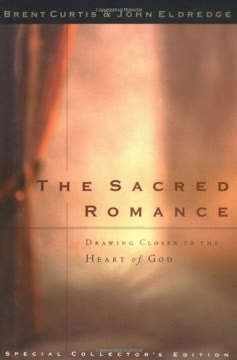
Key Takeaways
1. The Heart's Deep Thirst: We've lost touch with our longing for a Sacred Romance.
Thirsty hearts are those whose longings have been wakened by the touch of God within them.
Something missing. Many of us, years into our spiritual journey, feel a persistent voice suggesting "There is something missing in all of this." This voice, often dismissed as imagination or disloyal to our religious practices, speaks of a deep, wild passion—a thirst for a love affair, an adventure, something more. We try to silence it with busyness, service, or distractions, but it persists.
Losing heart. To lose touch with this inner voice, this "life of the heart," is to lose everything. Our modern world, with its emphasis on efficiency and performance, teaches us to ignore our deepest yearnings. We learn to offer only approved parts of ourselves, creating a "shimmering self" buried beneath carefully crafted performances. This leads to a double life where our outer actions are divorced from our inner desires.
God's call. This inconsolable longing for intimacy, beauty, and adventure is the most powerful part of our personality, fueling our search for meaning. It is, in fact, the voice of God calling us. When we move our spiritual life into external activity, our faith becomes a series of problems or principles, and we drift internally, weary and bored, losing the "Romance" that first drew us to Christ.
2. Life's Dual Revelations: The Enchantment of Romance and the Piercing of Arrows.
There are only two things that pierce the human heart, wrote Simone Weil. One is beauty. The other is affliction.
The Great Romance. From childhood, we experience a profound "Romancing"—an enchantment that fills us with anticipation, hinting at a grand story of love, adventure, and mystery. This wooing comes through nature, music, art, and moments of deep connection, assuring us of a benevolent world and a heroic purpose. It's a longing for transcendence, to be part of something larger and good, a relationship of heroic proportions.
The Message of the Arrows. Simultaneously, life delivers "Arrows"—pain, loss, betrayal, and suffering that strike deep. These afflictions, whether subtle or devastating, whisper a counter-message: "You are alone. There is no Romance, no one strong and kind." This foreboding tempts us to kill our heart, to become self-reliant, or to numb ourselves with addictions, believing that if we don't want so much, we won't be so vulnerable.
The heart's dilemma. These two messages—the enchanting Romance and the piercing Arrows—are radically different and seem mutually exclusive, splitting our hearts. We are left to wonder which is the truer message and how to reconcile them. Our deepest convictions are formed by how we respond to these dual revelations, shaping our "personality" and even our spiritual life.
3. The Quest for a Larger Story: Our small narratives fail to reconcile life's paradoxes.
We all feel the riddle of the earth without anyone to point it out. The mystery of life is the plainest part of it.
Lost in fragments. We constantly try to make sense of life's wonderful and awful experiences, seeking coherence. However, without a larger, overarching narrative, we interpret life through isolated fragments, feelings, and images. This leads us to create our own "smaller stories" to survive or find meaning, such as:
- The victim: "Why does everything go wrong for me?"
- The survivor: "The world is dangerous, I must protect myself."
- Romantic love: "That special someone will complete me."
- Sports/Business: "Life is a big game, I must win."
- Religious legalism: "If I obey, God will protect me."
The failure of small stories. These self-scripted dramas inevitably fail because human consciousness is too mysterious to script our own lives. They leave out significant parts of our souls, denying either the tragedy or the Romance of life, ultimately leading to a "sickness of heart" and a sense of meaninglessness. Our culture, having lost its grand narrative, demands immediate gratification, trapping us in a small, eternal present.
The Gospel as a fairy tale. The Scriptures present the gospel not as a list of propositions, but as a "Sacred Romance"—a cosmic drama, a true fairy tale. This story is weighty enough to encompass both beauty and affliction, offering genuine heroes, high stakes, and the ultimate triumph of good. It's a narrative that invites us to participate, giving redemptive meaning to all our experiences.
4. God: The Wild, Good, and Relentlessly Pursuing Hero of the Story.
"Safe?" said Mr. Beaver; "don't you hear what Mrs. Beaver tells you? Who said anything about safe? 'Course he isn't safe. But he's good. He's the King, I tell you."
The question of God's heart. When faced with the Arrows of life, we often question God's care, asking, "Do you care for me, God?" We rationalize his seeming indifference, but deep down, we fear he is aloof or even malicious. This apprehension drives us to write our own scripts, believing God is either indifferent or too wild to trust.
God as the Hero. The Scriptures reveal God not merely as the Author, but as the central character—the Hero—of the larger story. His motive is love, rooted in the perfect intimacy of the Trinity. He created us out of an overflowing generosity, inviting us to share in this heroic intimacy, even though he knew the enormous risk of betrayal.
His unyielding pursuit. Despite Satan's rebellion and humanity's betrayal, God announces his intention never to abandon us. He pursues us relentlessly, using both beauty and affliction to recapture our hearts. His "wildness" in allowing suffering is not indifference, but a fierce determination to redeem us from our self-redemptive stories and draw us into deeper communion with him, proving his goodness through grace, not just power.
5. Our True Identity: The Beloved, worth fighting for.
I am my beloved's and his desire is for me.
The longing to be chosen. We come into the world longing to be special, to be pursued for who we truly are, not for what we can do. Yet, early experiences often teach us we are not enough, leading to a deep-seated fear of being discovered as flawed or unlovable. We adopt "false selves" to gain acceptance, burying our "shimmering self."
Identity bestowed. Our identity is not self-generated; it is bestowed through relationships, particularly our impact on others. The gospel declares that we are "The Beloved," so significant that our turning away created a cosmic crisis. God launched the greatest campaign in history—the Incarnation—to win us back, acting as a jealous lover.
Glorious ruins. We are not "pond scum," but "glorious ruins"—ravaged by the Fall, yet still awe-inspiring. Our inability to see our own glory is a spiritual amnesia. God's desire is for our heart, our truest self, not just our obedience or service. He calls us "Sought After," "Fought Over," "Captured and Rescued," revealing that there is something profoundly desirable within us.
6. The Adversary's Deception: To kill our heart and separate us from God's love.
Your enemy the devil prowls around like a roaring lion looking for someone to devour.
Satan's revenge. Our adversary, Lucifer, once a perfect angel, rebelled against God out of pride and jealousy. Defeated in heaven, his singular purpose became to wound God by destroying or seducing God's new beloved—humanity. He seeks to steal our love for God, ravish us, and mock us, proving God's kingdom is based on power, not love.
The disguised roar. Satan's primary tactic is not overt temptation, but deception. He acts as a "Storyteller," reinterpreting our life's Arrows to convince us that God is our enemy and our heart's desires are illegitimate. He whispers accusations, using familiar voices from our past, to make us believe we are worthless, alone, and that the Sacred Romance is a lie.
Cinderella's plight. Like Cinderella, convinced by her stepsisters that she is a contemptible maid, we are persuaded to live as "cellar maids" rather than princesses. Satan camouflages the simplicity of this spiritual warfare with a thousand other distractions, aiming to disconnect us from our heart and God's love, leading us into smaller, safer stories of control and indulgence.
7. The Allure of Less-Wild Lovers: Our compromise for control and fleeting gratification.
It is the nature of desire not to be satisfied, and most human beings live only for the gratification of it.
Abandoning the Romance. Faced with life's Arrows and the adversary's whispers, we often give up on the Sacred Romance, choosing "less-wild lovers" that promise control or immediate gratification. These compromises lead to resignation, where good is merely "nice" and evil is "normal."
Two paths of compromise:
- Anesthesia: We anesthetize our hearts through competence, order, and busyness (e.g., perfect housekeeping, formulaic religion). This avoids the wildness of desire and the pain of vulnerability, making us emotionally unavailable.
- Indulgence: We seek immediate transcendence through addictions (e.g., affairs, drugs, pornography, obsession with giftedness). These offer momentary satisfaction but chain us, leaving us empty and perpetually thirsty.
God's anguish. God experiences our turning to these less-wild lovers as spiritual adultery, pleading for our return. Our addictions, which we call "affairs," are our heart's attempt to find the communion it was made for in non-transcendent sources. This overpowers our will, making us captive and unable to love freely.
8. The Journey of the Heart: Detachment, seeing, and facing life's trials with new eyes.
The Sacred Romance involves for every soul a journey of heroic proportions.
Pilgrimage of the heart. Entering the Sacred Romance begins with a decision to become a "pilgrim of the heart," turning away from attachments to false selves and less-wild lovers, and turning toward desire for God. This requires "detachment"—freedom of desire, not from desire—to pursue committed relationship with God.
Eyes to see. The journey demands "eyes to see" the true drama unfolding in our lives. Like Elisha's servant, we often miss the spiritual battle and God's redemptive work. Everyday "nits" (mundane struggles) and dramatic "dragons" (crises) are not random; they are part of the plot God uses to reveal our heart's attachments and speak healing to our deepest wounds.
The sentences we live by. Trials uncover the "sentences" we've lived by (e.g., "I'll never have the love I want," "I'm on my own"). These reveal where our heart is anchored, other than in God's love. As we face these, we have a choice: retreat into cynicism, become demanding, or let the ache lead us deeper into our heart and higher toward heaven, casting our vote for God's goodness.
9. Abiding in Christ: Finding true rest and substance in communion, not just activity.
I am the vine; you are the branches. If a man remains in me and I in him, he will bear much fruit; apart from me you can do nothing.
Ontological lightness. We often approach the spiritual life through "doing" (e.g., Bible study, service), but this leaves us with "ontological lightness"—an identity tied to activity, not substantive being. When we stop "doing," we feel restless, empty, and unanchored, unable to truly rest in God. Our prayers become busy petitions, not deep communion.
Making a home in Christ. Jesus invites us to "abide" in him, to make our home in him, rather than in false comforters like cynicism, rebellion, or self-sufficiency. This means rejecting the "less-wild lovers" that fill our heart's emptiness and instead, holding our heart as an "empty cup," trusting God to fill it. This is the essence of repentance and true rest.
The desert tradition. To learn to abide, we must enter our "desert"—a place of solitude, silence, and separation from worldly provisions. Here, we confront our emptiness and the compulsion to return to activity. By allowing our heart to speak its weariness and need, and by clinging to Christ's faithfulness, we become "ontologically substantive," anchored in his love, and transformed into his likeness.
10. Hope for Heaven: The ultimate consummation of our Sacred Romance.
If I find in myself desires which nothing in this world can satisfy, the only logical explanation is that I was made for another world.
The fuel of hope. Our hearts cannot live without hope. Without a vivid vision of heaven—the consummation of our Love Story—our journey becomes an endless struggle, leading to desperation and despair. We place on this world a burden it was never intended to bear, seeking ultimate happiness in fleeting experiences.
Beyond imagination. Heaven is not a dull, static place, but the ultimate fulfillment of our deepest longings for intimacy, beauty, and adventure. Paul assures us, "No eye has seen, no ear has heard, no mind has conceived what God has prepared for those who love him." Our imagination cannot outdream God.
The glorious arrival. Heaven promises:
- Intimacy: A reserved place at the wedding feast of the Lamb, a new name known only to our Lover, and perfect communion, free from shame.
- Beauty: A world of breathtaking splendor, where every faculty is an "inlet of delight," and we are united with the beauty we see.
- Adventure: Co-reigning with Christ, exploring new heavens and earth, and fulfilling our total design, using our unique gifts to increase God's glory and know each other fully.
This "exhilarating finish in and with God" fuels our desire and gives meaning to our present struggles, assuring us that our dreams will come true, and "real life begins" when we arrive home.
Review Summary
The Sacred Romance receives generally positive reviews, averaging 3.99 out of 5. Many readers describe it as life-changing, praising its fresh perspective on God's pursuing love and its ability to awaken dormant desires for intimacy, beauty, and adventure. Several found it emotionally challenging but ultimately healing. Critics note it can be overly verbose, repetitious, and heavy on metaphor, with some finding it lacking in scriptural grounding. The book resonates most with readers seeking a relational faith experience beyond rules and religious routine.
People Also Read
 Immersive
 Immersive