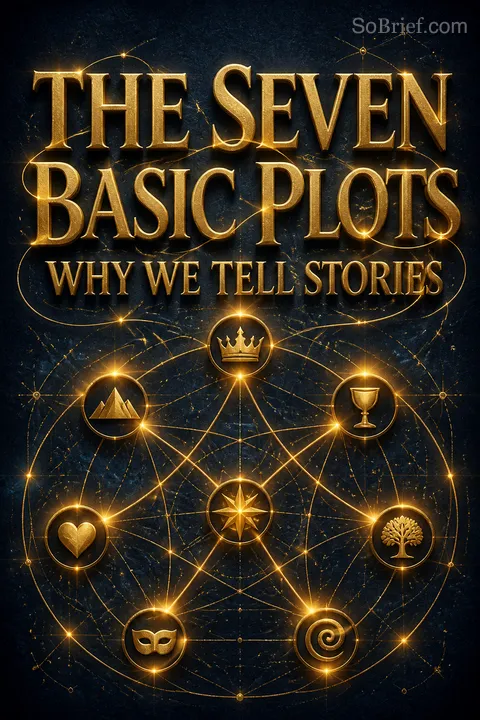
Key Takeaways
1. Storytelling is governed by a universal, unconscious grammar of archetypes
We are in fact uncovering nothing less than a kind of hidden, universal language: a nucleus of situations and figures which are the very stuff from which stories are made.
The hidden blueprint. Beneath the infinite variety of human narratives lies a remarkably consistent, genetically programmed structure of the mind. Whether listening to an ancient myth or watching a modern Hollywood blockbuster, our brains instinctively recognize and respond to the same fundamental patterns. This universal grammar of storytelling transcends time, culture, and geography, proving that the human imagination is bound by a shared, instinctual map.
The collective unconscious. This shared narrative grammar is rooted in what Carl Jung termed archetypes—ancient, instinctual riverbeds of the human psyche. These patterns do not merely entertain us; they serve a profound evolutionary purpose by helping us navigate the psychological challenges of existence. By projecting our inner conflicts onto the characters of a story, we are able to make sense of our own lives and the world around us.
Key archetypal elements:
- The Hero/Heroine: The central figure representing our own potential for growth.
- The Dark Power: The personification of the destructive, limiting ego.
- The Wise Old Man/Anima: Guides that lead us toward psychological integration.
- The Sacred Union: The ultimate symbolic resolution of inner and outer conflict.
2. Overcoming the Monster represents the triumph of selfless courage over devouring egotism
The monster in storytelling thus represents everything in human nature which is somehow twisted and less than perfect.
The monstrous ego. The monster—whether a dragon, a giant, or a modern sci-fi alien—is never a whole, perfect human being. It is a highly magnified, grotesque personification of pure, unbridled egotism: heartless, self-seeking, and ultimately blind to the wider reality. This creature represents everything in human nature that is twisted, destructive, and out of harmony with the collective good.
The selfless champion. To defeat this existential threat, the hero must stand as the monster's absolute opposite. He must act not for personal gain, but selflessly on behalf of the community, representing the forces of life and light against the shadow of death. Through this struggle, the hero is forced to mature, developing the strength and wisdom needed to restore order to the world.
The path to victory:
- The Call: Becoming aware of the monster's shadow over the land.
- The Ordeal: Facing the terrifying, seemingly invincible power of the beast.
- The Blind Spot: Exploiting the monster's fatal lack of holistic awareness.
- The Release: Slaying the beast, freeing the captive, and redeeming the kingdom.
3. Rags to Riches is the ultimate blueprint for human maturation and self-realization
What has happened to them is that they have at last revealed or developed what was potentially in them all the time.
The journey of growth. More than any other plot, Rags to Riches traces the development of a young, unformed protagonist from vulnerable childhood to independent maturity. The physical transition from poverty to wealth is merely an outward symbol of an inward psychological transformation. It is the story of how we must all grow up, shedding our dependence on others to discover our true, hidden potential.
The central crisis. The hero's upward climb is never a simple, unbroken line; it is interrupted by a devastating crisis where all seems lost. This crucial stage forces the protagonist to shed their youthful dependence and discover their own inner strength and self-reliance. Only by going through this dark night of the soul can they develop the maturity needed to claim their rightful place in the world.
Stages of maturation:
- Initial Wretchedness: Being overshadowed by cruel, egocentric parent-figures.
- First Success: Glimpsing the potential of a grander, more fulfilled life.
- The Fall: Losing everything and falling into total, isolating despair.
- The Final Test: Confronting the dark rivals using newly found inner autonomy.
4. The Quest is a dual journey of external trials and internal mastery of the goal
The second part, which begins when the hero is actually within sight of his goal, sees him having to face a final great ordeal...
The call to leave. The Quest begins with an urgent compulsion to escape an oppressive, decaying environment—the "City of Destruction." Guided by a vision of a far-off, life-renewing treasure, the hero and his companions set out across a hostile, alien wilderness. This journey represents the conscious decision to leave behind the comfortable but limiting confines of our early lives in search of a higher purpose.
The final obstacle. Arriving at the destination is only half the battle; the second half of the story requires the hero to secure the prize against a new onslaught of dark forces. This final ordeal tests whether the hero has developed the maturity and self-control needed to hold the treasure. It is not enough to find the goal; one must prove worthy of keeping it.
The questing framework:
- The Companions: Allies representing different, complementary aspects of the psyche.
- The Ordeals: Facing monsters, temptations, and deadly opposing forces.
- The Underworld: Transcending death to receive guidance from spirits of the past.
- The Renewal: Securing the prize, marrying the princess, and restoring the kingdom.
5. Voyage and Return models the shocking but necessary confrontation with the unconscious
The 'other world' is never wholly real to them - even though the experience of being there may eventually seem to threaten their very survival.
Plunging into the unknown. Unlike the purposeful Quest, the Voyage and Return begins with a naive, bored, or reckless hero unexpectedly falling out of their normal world into a bizarre, dream-like other realm. This represents the sudden, shocking confrontation of the limited ego with the vast, untamed unconscious. It is an experience that strips away all our familiar assumptions of identity, forcing us to confront the unknown.
The threat of entrapment. The initial fascination of this wonderland gradually sours into frustration and nightmare as the hero realizes they are trapped. The alien world threatens to dissolve their very identity, forcing a desperate, thrilling escape back to the safety of home. This journey is a model for those times in our lives when we are overwhelmed by forces we cannot control, and must fight to regain our balance.
The psychological outcome:
- The Unchanged Return: Treating the adventure as "just a dream" and learning nothing.
- The Lost Anima: Escaping the other world but leaving the beloved behind, ending up lonely.
- The Rebirth: Being fundamentally transformed by the journey, achieving true self-knowledge.
6. Comedy resolves social division by replacing ignorance with holistic recognition
The 'change from ignorance to knowledge' thus becomes in each case a transition from division to wholeness, from darkness to light...
The shadow of confusion. Comedy is not merely a funny story; it is a highly structured drama about a community thrown into a twilight of misunderstanding, deceit, and division. This social sickness is almost always caused by a dominant, egocentric figure whose blind obsession blocks the flow of life. The characters are cut off from each other, unable to see themselves or others clearly.
The power of recognition. The resolution of a Comedy hinges on a dramatic reversal where things previously hidden are brought into the light. This "unknotting" allows the characters to throw off their disguises, recognize their true identities, and see the world straight and whole. It is the moment when the cold, divisive power of the ego is finally dissolved by the warmth of true connection.
The comic resolution:
- The Change of Heart: The dark, obsessed figure is softened and liberated.
- The Pairing Off: The lovers find their true, complementary "other halves."
- The Restoration: Families are reunited and the community is restored to harmony.
7. Tragedy warns of the fatal, self-destructive spiral of unchecked ego-inflation
It is the very essence of Tragedy that the hero or heroine should become, step by step, separated from other people.
The fatal temptation. Tragedy shows us a hero who, driven by some unfulfilled desire for power, sex, or status, succumbs to a forbidden temptation. For a brief "dream stage," they seem to get away with their crime, enjoying a heady, illusory sense of success. But because their course is built on a lie, they are set on a path that must eventually lead to their own destruction.
The narrowing spiral. Because their course is built on a lie, the hero's vision becomes increasingly restricted and distorted. To secure their position, they are driven to commit further dark acts, isolating themselves from others and turning their violence against the very symbols of light and life. They become trapped in a nightmare of their own making, unable to escape the consequences of their choices.
The tragic trajectory:
- Anticipation: The hero is tempted by a forbidden desire.
- Dream Stage: The hero commits the dark act and enjoys temporary success.
- Frustration: Things begin to go wrong, and the hero commits further crimes to cover up.
- Nightmare: The net closes in, and the hero is consumed by guilt and paranoia.
- Destruction: The hero is destroyed by the forces they unleashed, restoring cosmic balance.
8. Rebirth: The triumph of the light feminine
"The treasure which the hero fetches from the dark cavern is life: it is himself."
The living death. The Rebirth plot begins with a hero or heroine who has fallen under a dark spell cast by the dark part of themselves, or by some external dark figure. This has the effect of freezing them in a state of living death, characterized by coldness, immobility, and despair. They are trapped in a narrow prison of the ego, unable to feel for others or to see the world clearly.
The redeeming presence. The key to their liberation is the arrival of a light, redeeming figure—a child or a loving woman—who represents the selfless power of the unconscious. This presence melts the icy grip of the ego, awakening the hero's dormant capacity to feel and to love. It is a model for those times in our lives when we are saved from despair by the power of connection.
The process of regeneration:
- The Thawing: The heart is opened to selfless, connecting emotion.
- The New Vision: The eyes are opened to see the world objectively and whole.
- The Integration: The hero is restored to his true, mature self, united with the whole.
9. All stories ultimately mirror the psychological struggle between the Ego and the Self
"The treasure which the hero fetches from the dark cavern is life: it is himself."
The ultimate conflict. Beneath the variety of the seven basic plots lies a single, universal drama: the struggle of the human ego to reconcile itself with the deeper, organizing power of the Self. Stories are the means by which our unconscious tries to guide us toward this state of inner integration. They provide us with a map of the human psyche, showing us how to navigate the pitfalls of egotism.
The complete happy ending. The final union of the hero and heroine, and their succession to the kingdom, is the supreme symbol of this psychological wholeness. It represents the perfect balance of the masculine and feminine principles within the human psyche, bringing peace, order, and life renewed. It is the moment when we are at last at one with ourselves and the universe.
The lessons of the archetypes:
- The Ego: The source of division, unreality, and self-destructive blindness.
- The Self: The source of connection, objective truth, and eternal life.
- The Story: The map that guides us from the shadow of the ego into the light of the Self.
I confirm that I have written detailed takeaways for ALL 9 key takeaways in the format requested.
Review Summary
The Seven Basic Plots receives mixed reviews. Many praise its comprehensive analysis of storytelling patterns and find it insightful for writers and readers alike. Critics appreciate Booker's ambitious scope and thought-provoking ideas. However, some find the book overly long, repetitive, and biased. Readers are divided on Booker's Jungian approach and his critique of modern literature. Some view his conservative perspective as problematic, while others see value in his traditional interpretations. Despite its flaws, many consider it a significant work on narrative structure and human psychology.
Download PDF
Download EPUB
.epub digital book format is ideal for reading ebooks on phones, tablets, and e-readers.








































