Key Takeaways
1. The Constitution's Ambiguous Founding on Slavery
The framers of the Constitution, dealing with slavery as an incidental but troublesome circumstance, ended by extending it a kind of shamefaced recognition that included a measure of protection, but they contributed little to defining its national status.
Initial neutrality. At the nation's founding, the Continental Congress initially restricted the slave trade, reflecting some moral aversion and strategic resistance to British authority. However, the Declaration of Independence, while exalting liberty, omitted direct condemnation of slavery, a passage Jefferson attributed to Southern and Northern sensitivities. This early ambiguity set a precedent for avoiding direct confrontation with the institution.
Compromise and silence. The Articles of Confederation, and later the Constitution, addressed slavery indirectly through compromises like the three-fifths clause for representation and taxation. This clause, a pragmatic solution to sectional bargaining, did not define slaves as three-fifths human but rather as a fractional measure of wealth for apportionment. The Constitution's framers deliberately avoided using the words "slave" or "slavery," opting for euphemisms like "persons held to service or labour," reflecting a discomfort with the institution while granting it implicit recognition.
Limited federal power. The Constitution's fugitive slave clause, requiring the return of escaped "persons held to service or labour," was a concession to slaveholding states, but its initial wording did not explicitly mandate federal enforcement. This left the immediate responsibility for slave recovery largely to individual owners and state laws. The overall effect was a document that, while not explicitly proslavery, provided a framework within which slavery could persist and even expand, leaving its ultimate fate to future generations.
2. Federal Government's Gradual Embrace of Slavery
The policy of the federal government down through the years, despite several conspicuous exceptions, had been predominantly supportive of slavery.
Defaulting to proslavery. Despite the Constitution's initial ambiguity, the federal government gradually adopted policies that actively supported and protected slavery. This wasn't always due to deliberate proslavery intent but often resulted from "chronic indifference, a few unthinking decisions, and the tacit assumption of prescriptive rights." This incremental drift solidified slavery's position within the national framework.
Judicial and executive actions. Federal courts, particularly the Supreme Court, consistently upheld slaveholders' rights, culminating in the Dred Scott decision which declared slaves as property protected by the Fifth Amendment. Executive actions, from presidents like Jefferson and Jackson, also reinforced slavery, whether through land acquisitions that expanded slave territory or diplomatic efforts to recover runaways. This pattern established a functional proslavery character for the federal government.
Legislative reinforcement. Congress, though sometimes divided, passed laws that strengthened slavery's legal standing. The Fugitive Slave Act of 1793, and especially its harsher 1850 iteration, mandated federal and state cooperation in returning escaped slaves, effectively extending slave state law into free states. This legislative support, often driven by Southern unity and Northern acquiescence for the sake of Union, transformed the federal government into an active agent for the slaveholding interest.
3. Washington D.C.: A Symbol of Federal Slavery
For abolitionists, the presence of slavery in “the very household” of the Republic placed a stamp of infamy upon the entire country.
Capital's complicity. The selection of Washington D.C. as the national capital, situated between slaveholding Maryland and Virginia, inadvertently cemented federal involvement with slavery. When Congress assumed exclusive jurisdiction over the District in 1801, it adopted existing state laws, thereby "casually and silently" legitimizing slavery in the nation's symbolic center.
Abolitionist battleground. The presence of slave markets and the daily reality of slavery within sight of the Capitol became a potent symbol for abolitionists, who relentlessly petitioned Congress for its eradication. Events like the 1848 Pearl affair, where 76 slaves attempted escape from Washington, dramatically highlighted federal complicity and fueled public outrage, leading to mob violence and intense congressional debates.
Southern stronghold. Despite declining slave populations in the District, Southern political unity ensured that Washington D.C. remained a "southern province." Efforts to abolish slavery or even the slave trade in the capital were consistently blocked, often by invoking the "entering wedge" argument—that any federal action against slavery in D.C. would inevitably lead to its abolition nationwide. The Compromise of 1850 only mildly restricted the slave trade in the District, leaving slavery itself intact.
4. Slavery's Influence on American Foreign Policy
The United States at midcentury was still viewed throughout much of the world as a symbol of personal liberty and self-government. Yet it had also come to be conspicuous as one of the last strongholds of slavery in Western civilization.
Paradoxical image. The young American republic, a beacon of liberty, presented a contradictory image to the world due to its embrace of slavery. This paradox was starkly evident in its foreign relations, where the federal government consistently acted as a "slaveholders' agent," defending the institution against international criticism and efforts for its abolition.
Diplomatic defense of slave property. From the Revolutionary War's end, the U.S. government vigorously pursued claims against Britain for slaves carried away, explicitly recognizing them as "property" in treaties and diplomatic correspondence. Later, in incidents involving slave ships forced into British West Indian ports, American diplomats, regardless of their personal views or party affiliation, vehemently argued that slaves remained property under U.S. jurisdiction, even in foreign waters.
Expansion and anti-abolitionism. Slavery profoundly influenced American expansionism, particularly regarding Texas and Cuba. Southern leaders, fearing British abolitionist plots to undermine slavery in these regions, pushed for annexation, framing it as a defense of national security and economic interests. This "defensive imperialism" injected anti-abolitionism directly into foreign policy, with figures like John C. Calhoun asserting that abolition in Cuba would be a "calamity" for the U.S.
5. Flawed Enforcement of African Slave Trade Bans
The lopsidedness of the House vote in 1800 was surpassed in 1807 when members voted 113 to 5 for the historic prohibitory act.
Early legislative success. The federal government, starting in 1794, enacted increasingly stringent laws against the African slave trade, culminating in the 1807 act prohibiting importation and the 1820 act declaring slave trading as piracy punishable by death. These laws reflected a broad national consensus against the trade, driven by humanitarian concerns and a desire to limit the black population, especially after the Haitian Revolution.
Persistent evasion. Despite strong laws, enforcement was "apathetic and criminally lax," particularly concerning American participation in the international slave trade to Cuba and Brazil. American ships, often built in Baltimore, frequently sailed under false flags or transferred ownership to evade capture by British patrols. This "virtual complicity" of the U.S. government, often due to a lack of resources, political will, and legal loopholes, allowed the trade to flourish under the American flag.
Diplomatic friction. British efforts to suppress the trade, including demands for mutual search treaties, were consistently rebuffed by the U.S., which invoked "freedom of the seas" and national sovereignty. This stance, while popular domestically, frustrated international anti-slavery efforts and strained Anglo-American relations for decades. It wasn't until the Civil War, when the U.S. needed British support and reversed its maritime policy, that a mutual search treaty was finally signed in 1862, effectively ending American involvement in the transatlantic slave trade.
6. The Escalating Fugitive Slave Crisis
What turned a difficult problem into an explosive national issue was the developing pattern of outlawry on both sides.
Constitutional mandate, weak enforcement. The Constitution's fugitive slave clause (Article IV, Section 2) required the return of escaped slaves, but the initial 1793 federal law provided only minimal enforcement mechanisms, relying heavily on state and local officials. This led to a "pattern of outlawry" where slaveholders often resorted to private recaption, sometimes resulting in the kidnapping of free blacks, while abolitionists actively aided runaways.
Northern resistance. Northern states responded with "personal liberty laws" designed to protect free blacks and obstruct slave recovery. These laws, which sometimes prohibited state officials from participating in renditions or granted alleged fugitives jury trials, directly challenged federal authority and infuriated Southerners. The Supreme Court's 1842 Prigg v. Pennsylvania decision, while affirming the federal law, inadvertently encouraged state non-cooperation by declaring federal power over fugitives to be exclusive.
The 1850 Act and its consequences. The Fugitive Slave Act of 1850, a key component of the Compromise, drastically expanded federal power, creating a network of commissioners and mandating federal marshals' involvement. It denied alleged fugitives due process rights like jury trials and made it a federal crime to aid runaways. This "unrelieved abrasiveness" provoked widespread Northern resistance, including violent rescues and further personal liberty laws, becoming a potent symbol of federal overreach and a major catalyst for sectional alienation.
7. Territorial Expansion Ignites Sectional Conflict
Inexorably, the nation moved toward a new sectional crisis over slavery.
Early territorial policies. The Northwest Ordinance of 1787 prohibited slavery north of the Ohio River, establishing a precedent for federal restriction. However, the organization of Southern territories like Mississippi and Louisiana tacitly permitted slavery, effectively extending the Mason-Dixon line westward. This "national policy of having two policies" laid the groundwork for future conflicts over slavery's expansion.
Missouri Crisis and its legacy. The 1819-1821 Missouri Crisis, sparked by a proposal to ban slavery in Missouri upon statehood, revealed deep sectional divisions and constitutional debates over Congress's power to regulate slavery in new states. The Missouri Compromise (1820) temporarily resolved the issue by admitting Missouri as a slave state and Maine as a free state, while prohibiting slavery in the remaining Louisiana Purchase territory north of 36°30' latitude. This compromise, however, left a lasting "supersensitivity" among Southerners regarding federal power over slavery.
Kansas-Nebraska and Dred Scott. Stephen Douglas's 1854 Kansas-Nebraska Act, which repealed the Missouri Compromise line and introduced "popular sovereignty," reignited the territorial conflict, leading to violence in "Bleeding Kansas" and the formation of the Republican Party. The Supreme Court's 1857 Dred Scott decision further inflamed tensions by declaring that Congress could not ban slavery in any territory, effectively nationalizing slavery and invalidating the core Republican platform. This judicial intervention, intended to settle the issue, instead deepened the constitutional crisis.
8. Lincoln's Election: A Revolutionary Threat to the Slaveholding Republic
Our enemies are about to take possession of the Government. We must expect just that sort of leniency which is shown by the conqueror over a subjugated and craven people.
Southern fears of Republicanism. Lincoln's election in 1860, without a single Southern electoral vote, was perceived by many Southerners not as a democratic outcome but as an "act of war" and a "deliberate, cold-blooded insult." They viewed the Republican Party as a "hostile, revolutionary force" bent on the total destruction of their slaveholding system, despite Lincoln's assurances that he would not interfere with slavery where it already existed.
Erosion of federal protection. Southerners feared that a Republican administration would systematically dismantle the federal protections slavery had enjoyed for decades. This included repealing fugitive slave laws, prohibiting interstate slave trade, reorganizing the Supreme Court to reverse Dred Scott, and abolishing slavery in federal territories and the District of Columbia. The perceived threat was not just to property but to their entire social order, which they believed would be subjected to "servile insurrection, to murder, arson, and other crimes."
John Brown's catalytic raid. John Brown's 1859 raid on Harpers Ferry, though a failure, profoundly impacted the Southern psyche. It transformed abstract fears of abolitionism into a visceral conviction that Northern Republicans condoned violent slave rebellion. The widespread Northern mourning after Brown's execution further solidified Southern belief in the North's "undying hatred for the South," making secession seem "virtually inevitable" as a preemptive defense against perceived existential threats.
9. The Republican Revolution and Emancipation
This issue embraces more than the fate of these United States. It presents to the whole family of man the question whether a constitutional republic or democracy—a government of the people by the same people—can or cannot maintain its territorial integrity against its own domestic foes.
Lincoln's evolving vision. Upon taking office, Lincoln faced the immediate challenge of preserving the Union, initially deferring to the Crittenden-Johnson Resolutions which stated the war was not to liberate slaves. However, his deeper conviction, articulated in speeches like the Gettysburg Address, was that the nation's "experiment" in self-government was tied to the "rights of human nature" and the eventual elimination of slavery. He saw the war as a divinely ordained struggle to redeem the Union from its "great wrong."
Slaves as "prime movers." While Lincoln initially moved cautiously, often prioritizing border-state loyalty and even proposing compensated emancipation and colonization, the actions of enslaved people themselves forced his hand. Thousands of "contraband" slaves fleeing to Union lines created a de facto emancipation that generals like Benjamin Butler recognized. This grassroots movement pressured Lincoln to adopt a formal emancipation policy, culminating in the Preliminary Emancipation Proclamation after the Battle of Antietam.
Emancipation Proclamation and its impact. On January 1, 1863, Lincoln issued the Emancipation Proclamation, declaring all slaves in Confederate territory free and authorizing their recruitment into the Union army. This decree, a "death knell of the slaveholding republic," transformed the war into a fight for freedom and fundamentally reshaped the nation's identity. Though initially a war measure, it set the stage for the Thirteenth Amendment, which permanently abolished slavery nationwide, fulfilling Lincoln's vision of a "new birth of freedom."
10. Reconstruction's Unfinished Promise of Freedom
The slaveholding republic, he conceded, was gone. But “the spirit or power of slavery” lived on.
Post-war challenges. Following the Civil War and emancipation, the nation faced the immense task of reconstructing racial relationships. The Thirteenth Amendment abolished slavery, but the "spirit or power of slavery" persisted through deep-seated white racism and a strong preference for local control. Southern states enacted "Black Codes" to re-subjugate freedmen, prompting Congress to intervene with civil rights legislation.
Federal intervention and its limits. Congressional Reconstruction, driven by Republicans, aimed to secure black civil rights through the Freedmen's Bureau and the Civil Rights Act of 1866, followed by the Fourteenth and Fifteenth Amendments. These measures sought to establish federal power to protect individual liberties against state actions and ensure black suffrage. However, this federal intervention faced strong resistance from President Andrew Johnson and a white populace unwilling to fully embrace racial equality.
Constitutional counterrevolution. The Supreme Court, in decisions like the Civil Rights Cases (1883), severely limited the scope of the Reconstruction Amendments, effectively dismantling federal protections for black civil rights. The Court ruled that the Fourteenth Amendment did not apply to private acts of discrimination and that the Thirteenth Amendment only abolished formal slavery, not its lingering "badges and incidents." This "constitutional counterrevolution," combined with Northern apathy and Southern white supremacist violence, led to the widespread disfranchisement and segregation of African Americans, leaving the promise of "a new birth of freedom" largely unfulfilled for generations.
Review Summary
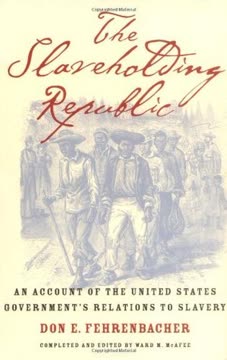
The Slaveholding Republic argues that the United States was fundamentally a pro-slavery nation from its founding until the Civil War. Reviewers praise Fehrenbacher's documentation of federal government protection of slavery through foreign policy, refusing to aid Britain in suppressing the slave trade, pursuing fugitive slaves, and expanding slavery westward. The book demonstrates how Southern-dominated Congress enabled slavery's survival despite the Constitution's neutral intent. Lincoln's attempts to reverse this federal subservience to slaveholding interests precipitated the Civil War. Readers find the work convincing and extraordinarily revealing about government complicity in slavery.