Key Takeaways
1. Giddens's Sociology is a Progressive Liberal Project
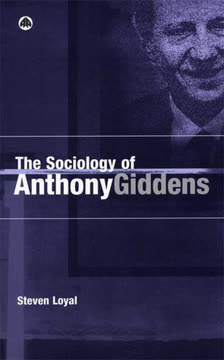
The central argument of this book is that Giddens’s sociology needs to be placed within the social, political and historical context within which it was constructed.
Political underpinnings. Anthony Giddens's extensive sociological work, from his early analyses of classical theorists to his later political engagements, is fundamentally shaped by a "progressive liberal world-view." This perspective, rooted in the Enlightenment, sought to combine the core tenets of liberalism—individual freedom, autonomy, and rationality—with aspects of socialism, particularly concerning social equality and critique of domination. This ambition to synthesize often antagonistic intellectual traditions forms the bedrock of his theoretical innovations and shifts.
Historical context. Giddens's intellectual journey unfolded against a backdrop of significant socio-political changes, notably the Cold War and the subsequent collapse of state socialism. This bipolar world, with its ideological tension between capitalism and state socialism, profoundly influenced his "libertarian socialism" stance. He aimed to critique both the inequalities of capitalism and the repressive bureaucracy of existing socialist states, seeking a "third way" that could transcend these limitations.
Theoretical expression. This political project translated into Ghens's sociological theories, particularly his structuration theory. His emphasis on the knowledgeable and capable individual, while acknowledging social constraints, reflects a liberal desire for self-determining agents. However, this commitment often led to theoretical inconsistencies and an "epistemological individualism" that struggled to fully integrate the social nature of human existence.
2. The Knowledgeable Agent and the "Double Hermeneutic"
Every social actor knows a great deal about the conditions of reproduction of the society of which he or she is a member.
Agent's knowledgeability. Giddens posits that social actors are highly knowledgeable, possessing both discursive (articulable) and practical (tacit, taken-for-granted) consciousness, alongside an unconscious realm of desires. This emphasis counters deterministic views that portray individuals as "cultural dupes." Practical consciousness, in particular, allows agents to "go on" in daily life, forming the "mutual knowledge" that underpins social interaction.
Bounded knowledge. Despite this knowledgeability, Giddens argues that an agent's understanding is always bounded. This limitation stems from:
- Spatial circumscription: Agents' knowledge is limited to their specific social environments.
- Unacknowledged conditions: Unconscious and practical knowledge are not immediately accessible.
- Unintended consequences: Actions often produce unforeseen outcomes.
Sociology's primary task is to illuminate these bounds, revealing the unacknowledged conditions and unintended consequences of action.
Sociology as critique. This leads to the "double hermeneutic," where sociological theories not only interpret the social world but also feed back into it, potentially altering social practices. This dynamic makes sociology inherently critical, obliging it to scrutinize lay beliefs and challenge forms of domination. However, Giddens's epistemological grounding for distinguishing "true" from "false" beliefs, crucial for this critique, remains largely unelaborated, oscillating between foundationalism and relativism.
3. Agency as Transformative Power and Ontological Security
An agent ceases to be such if he or she loses the capability to ‘make a difference’, that is, to exercise some sort of power.
The capable agent. Central to Giddens's theory is the concept of agency as a "transformative capacity"—the inherent ability of individuals to "always do otherwise" and intervene in the world. This capacity is intrinsically linked to power, as agents deploy causal powers to influence events and others. This voluntaristic stance aims to avoid deterministic accounts of human behavior, emphasizing human freedom and the potential for social change.
Ontological security and routine. To reconcile individual choice with the observed patterns and predictability of social life, Giddens introduces the concept of "ontological security." This largely unconscious psychological need, established in early childhood, drives individuals to maintain routines and conventions, thereby containing anxiety and fostering a sense of trust in the social world. Routine, therefore, acts as a crucial mechanism linking individual psychological needs to the reproduction of social practices.
Constraints on action. While emphasizing agency, Giddens also acknowledges various forms of constraint:
- Material constraints: Limits imposed by the physical body and environment.
- Sanctions: Punitive responses from others.
- Structural constraints: Pre-structured enablements that appear as opportunities, but only make sense in relation to an agent's motivations.
However, these constraints are always mediated by an agent's desires and reasons, ensuring that action is never purely determined but always involves an element of choice, even in seemingly "no-choice" situations.
4. Social Structure as Generative Rules and Resources
By the term ‘structure’ I do not refer, as is conventional in functionalism, to the descriptive analysis of the relations of interaction which ‘compose’ organisations or collectivities, but to systems of generative rules and resources.
Reconceptualizing structure. Giddens fundamentally redefines "structure" away from its conventional understanding as patterned social relationships (which he re-labels "social systems"). Instead, structure refers to "structuring properties"—generative rules and resources that exist "virtually" outside of time and space, yet are recursively implicated in the reproduction of social systems. This "duality of structure" means structure is both the medium and outcome of social practices.
Enabling and constraining. Unlike traditional views where structure is primarily a barrier, Giddens argues that structure is inherently both enabling and constraining. Just as language provides the rules (structure) that enable speech (action) while also limiting its forms, social structures provide the conditions of possibility for action. Every act of social production simultaneously draws upon and reproduces these underlying structures.
Rules and resources. Structure is composed of:
- Rules: Generalizable procedures, largely tacit, that guide social practices. Giddens emphasizes their "generative" nature, allowing actors to "go on" in novel circumstances.
- Resources: The "vehicles" through which power is exercised. These are divided into:
- Authoritative resources: Capabilities generating command over persons.
- Allocative resources: Capabilities generating command over objects or material phenomena.
These rules and resources are organized into three structural categories—signification, domination, and legitimation—which are mediated by interpretive schemes, facilities, and norms in interaction.
5. Time-Space as Constitutive of a "Discontinuist" History
All social interaction, like any other type of event, occurs across time and space. All social interaction intermingles presence and absence.
Time-space as integral. Giddens argues that time and space are not mere "environments" for social action but are constitutive features of social life, deeply embedded in its very fabric. Drawing on Heidegger's concept of "presencing," he emphasizes how social interaction intermingles presence and absence, linking the immediate moment to broader social systems. This perspective highlights the importance of contextuality and situatedness in understanding social interactions.
Time-space distanciation. A key concept is "time-space distanciation," which describes the "stretching" of social systems across vast spans of time and space. This process, facilitated by "disembedding mechanisms" like writing and electronic communication, leads to a separation between:
- Social integration: Face-to-face interaction in contexts of "co-presence."
- System integration: Reciprocity between actors or collectivities across extended time-space.
This distanciation is crucial for understanding the dynamics of power and the evolution of societal forms.
Discontinuist historical sociology. Giddens develops a "discontinuist" historical sociology that challenges Marxist evolutionism and functionalism. He proposes a tripartite typology of societies—tribal, class-divided, and class societies—differentiated primarily by their degree of time-space distanciation and "storage capacity" of authoritative and allocative resources. This approach emphasizes historical contingency and the multi-dimensional nature of social change, though it sometimes leans towards technological determinism.
6. Modernity as a "Runaway Juggernaut" of Risk and Reflexivity
Modernity is a risk culture. I do not mean by this that social life is inherently more risky than it used to be; for most people that is not the case. Rather, the concept of risk becomes fundamental to the way both lay actors and technical specialists organise the social world.
Radicalized modernity. Giddens argues that contemporary society is not "postmodern" but rather "late modernity"—a radicalized phase of modernity characterized by profound transformations. This era is defined by:
- Separation of time and space: Leading to precise "zoning" of social life.
- Disembedding mechanisms: Symbolic tokens (money) and expert systems (science) lift social relations from local contexts.
- Wholesale reflexivity: Constant revision of social practices in light of new information, subverting traditional certainties.
The "risk society." Modernity introduces a new "risk profile" dominated by "manufactured risk"—dangers created by human intervention, such as nuclear war or ecological calamity. This pervasive risk, often global in scope, forces individuals to place "trust" in abstract systems and distant events, leading to a sense of fatalism and repressed anxiety. Giddens famously likens modernity to a "runaway juggernaut" that we can partially steer but never fully control.
Reflexive self-identity. In this post-traditional world, individuals are compelled to construct their own "self-identity" as a "reflexive project." The erosion of tradition and the "pluralization of lifeworlds" mean individuals face a constant array of lifestyle choices, which, paradoxically, they are "forced to choose." This leads to a focus on "life politics" and the pursuit of "pure relationships" based on mutual disclosure and trust, as individuals seek meaning in a world stripped of traditional moral anchors.
7. The "Paradox of Socialism" and the Rise of the Third Way
The contrast between capitalist and state socialist society is the living manifestation of what I shall refer to as the ‘paradox of socialism’: a dilemma resulting from two constituent elements in socialist theory, a clash between the principle of the regulation of production according to human need, and the principle of the elimination or reduction of the exploitative domination of man over man.
Socialism's dilemma. Giddens identifies a "paradox of socialism" stemming from its dual aims: achieving equality through rational social planning and eliminating domination to foster human freedom. He argues that state socialism, exemplified by the Soviet Union, prioritized rational control at the expense of individual liberties, leading to bureaucracy and repression. This critique, drawing on Weber and Hayek, suggests that the pursuit of a rationally planned economy inevitably clashes with the protection of individual freedoms.
The end of the bipolar world. The collapse of state socialism after 1989 profoundly reshaped Giddens's political thought, leading him to conclude that traditional "left" and "right" ideologies were obsolete. He embraced the idea that "no one any longer has any alternatives to capitalism," shifting his focus from transcending capitalism to reforming and "radicalizing" social democracy within its framework.
The "Third Way." This new political project, the "Third Way," aims to transcend both old-style social democracy (seen as outdated Keynesianism) and neo-liberalism (seen as socially corrosive). It advocates a "radical centre" that embraces globalization, individual reflexivity, and market dynamics, while promoting values like:
- Freedom as autonomy and responsibility.
- "Generative equality" (redistribution of possibilities, not just wealth).
- Cosmopolitan pluralism and dialogic democracy.
- A "social investment state" focused on human capital and "positive welfare."
This approach seeks to foster an "autotelic self" capable of self-actualization in a post-scarcity, risk-laden world.
8. Giddens's Theory: A Philosophical Bias with Empirical Gaps
Social theory has the task of providing conceptions of the nature of human social activity which can be placed in the service of empirical work.
Ontological overemphasis. Despite Giddens's stated aim for social theory to illuminate empirical research, his work often remains at a high level of abstraction, prioritizing ontological discussions over concrete empirical analysis. His elaborate conceptual distinctions, such as "virtual existence" for structures or the precise stratification of consciousness, often lack clear empirical referents or testability, leading to metaphysical assumptions rather than verifiable sociological insights.
Weak empirical grounding. Giddens's reluctance to undertake original empirical work, and his tendency to apply his theory to pre-existing research, highlights a disconnect between his theoretical framework and its practical application. He often treats his concepts as "sensitizing devices" rather than robust explanatory tools, which undermines the grander claims of his structuration theory and historical sociology. His interpretations of empirical studies can appear strained, serving more to justify his theory's internal coherence than to genuinely advance empirical understanding.
Unresolved dualisms. Despite his efforts to overcome dualisms, Giddens's work often reintroduces them. His "duality of structure" still implies a prior separation of agency and structure, and his methodological distinctions (e.g., strategic vs. institutional analysis) reinforce this. Furthermore, his historical sociology often relies on value-laden binary oppositions:
- Traditional society: Homeostasis, routine, ontological security, non-reflexivity, nature, meaning.
- Class society (capitalism): Change, lack of ontological security, reflexivity, "created environment," meaninglessness.
These implicit biases, rooted in his liberal world-view, lead to a partial and sometimes contradictory analysis of social change and human experience.
9. An Alternative: Humans as Fundamentally Social Beings
Above all, we must avoid postulating ‘society’ again as an abstraction vis-a-vis the individual. The individual is the social being.
Beyond dualisms. The persistent agency/structure debate, and its philosophical antecedents (subject/object, individual/society), are not eternal truths but historical constructs that emerged with modern social relations and capitalist individualism. Giddens's "duality" attempts to bridge this gap but still presupposes a fundamental separation. A more fruitful approach requires dissolving these dualisms by starting from the premise that humans are fundamentally social beings, rather than abstract, isolated individuals.
Sociality as ontology. This alternative ontology posits that human beings are intrinsically social creatures, whose "individuality" is attained only within and through historically acquired social forms. There is no inherent distinction between the individual and society; rather, the "individual" is an abstraction from social relations, a microcosm of society itself. This perspective emphasizes:
- Mutual susceptibility: Individuals are deeply interdependent, shaped by mutual evaluations and the need for social recognition.
- Productive beings: Humans require cooperation to produce their means of subsistence, intertwining material production with the creation of social relations.
This approach rejects the sharp separation between the natural and social worlds, recognizing human productive activity as a fundamental condition of all social life.
Contextual and relational analysis. A more adequate sociology, drawing on thinkers like Marx, Durkheim, Elias, and Bourdieu, would focus on:
- Social struggle and conflicting interests: Placing these at the heart of sociological analysis, rather than abstract notions of choice or risk.
- Reflexive methodology: Examining the social and historical conditions that shape both academic concepts and social realities.
- Empirical grounding: Mediating universal theoretical insights with particular historical and contextual analyses, to understand how "real individuals, their activity and the material conditions of their life" are produced and reproduced within dynamic, interdependent social figurations.








































