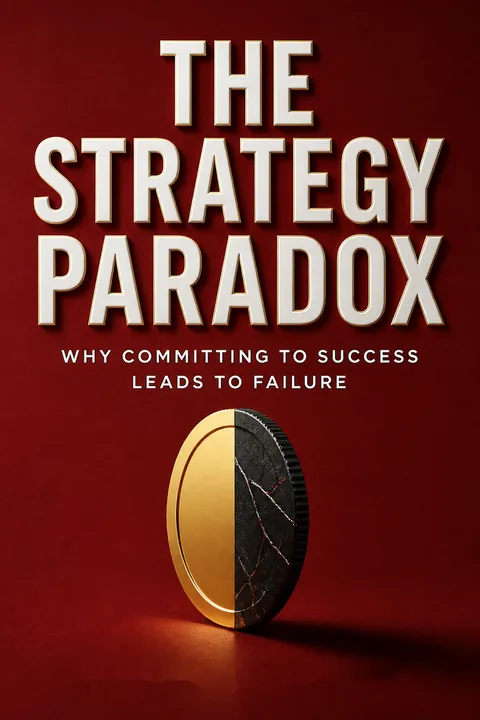

Key Takeaways
1. The Strategy Paradox: Success and Failure are Two Sides of the Same Coin
The result is the Strategy Paradox: strategies with the greatest possibility of success also have the greatest possibility of failure.
Unpredictable future. Most strategies are built on specific beliefs about the future, yet the future is deeply unpredictable. This fundamental tension creates the Strategy Paradox: the very actions required for breakthrough success also maximize the potential for total collapse. It's not that success is the opposite of failure; rather, mediocrity is the true opposite, as those who risk nothing achieve nothing.
Sony's dilemma. Consider Sony's Betamax VCR and MiniDisc player. Both were brilliantly conceived, cutting-edge products, flawlessly executed, and responsive to market needs. Yet, both failed because the underlying assumptions about market evolution proved wrong. Sony's commitments, necessary for dominance, became liabilities when key uncertainties broke against them, illustrating that even great strategies can fall victim to bad luck.
Research bias. This paradox is often overlooked in business research because studies typically focus on successful firms, comparing them to mediocre survivors rather than outright failures. This "survivor bias" obscures the critical importance of managing uncertainty, as it only highlights the characteristics of those who "guessed right" while ignoring the many who made similar bold bets and failed.
2. Extreme Strategies Drive Profit but Also Risk of Ruin
The same behaviors and characteristics that maximize a firm’s probability of notable success also maximize its probability of total failure.
Strategic purity. Research consistently shows that "pure" strategies, positioned at the extremes of either product differentiation or cost leadership, generally lead to higher profitability than "hybrid" strategies that try to do both. These pure strategies require significant, hard-to-copy commitments to unique assets or capabilities, making them difficult for competitors to imitate.
The middle ground. Firms "stuck in the middle" often struggle with inconsistent choices, higher costs due to complexity, and vulnerability to focused competitors. While they avoid the high-risk, high-reward nature of pure strategies, they also forgo the possibility of above-average returns, settling for mediocrity.
Risk-return trade-off. The higher profitability of pure strategies comes at a cost: a materially higher probability of bankruptcy. This is often missed due to survivor bias in studies that only examine surviving firms. The strategy paradox reveals that firms pursuing extreme strategies face a feast-or-famine existence, thriving when market conditions align with their commitments but risking ruin when they don't.
3. Adaptability and Forecasting Cannot Resolve the Paradox
Adaptability, then, is a viable but limited response to a changing environment.
Limits of adaptability. While organizational adaptability is often touted as the solution to uncertainty, it is effective only when the pace of organizational change matches that of the environment. This rarely happens, leading to two critical mismatches:
- Fast change: Sudden, exogenous shocks (e.g., telecom bubble burst) or new-market disruptions (e.g., disk drive evolution) occur too rapidly for organizations to adapt. Survivors are often those fortuitously configured, not those that adapted.
- Slow change: Gradual, incremental shifts (e.g., industrial decline, low-end disruption) are insidious. Organizations make small, effective adjustments, delaying radical transformation until it's too late, becoming "painted into a corner."
Forecasting's futility. Accurate forecasting for strategic planning is equally impossible.
- Track records are meaningless: With countless predictions, some will inevitably be right by chance ("monkeys at typewriters").
- Future is a probability distribution: The future is a shifting mass of probabilities, not a fixed point to be discovered. We cannot assess the accuracy of probability-based forecasts because we cannot observe "true" probabilities.
- Inherent randomness: Systems are unpredictable due to exogenous shocks, sensitivity to initial conditions (chaos theory), and human free will/irrationality.
No escape. Neither adaptability nor forecasting can fundamentally overcome the strategy paradox. These limitations are like the "speed of light" in strategy—inescapable constraints that force a trade-off between risk and return.
4. Requisite Uncertainty: Aligning Hierarchy with Time and Strategic Uncertainty
The responsibilities attached to each level of the hierarchy are determined by the balance between managing uncertainty and managing commitments.
Time defines hierarchy. The traditional organizational hierarchy, often criticized, finds its true purpose in managing strategic uncertainty. Building on Elliott Jaques's work, each hierarchical level is best defined by the longest time horizon over which its decisions play out. Strategic uncertainty increases dramatically with longer time horizons.
Differentiated roles. This insight leads to "Requisite Uncertainty," a model where:
- Board/Corporate Office (Longest Horizon): Focus on managing strategic uncertainty by mitigating risk and gaining exposure to opportunities. Their role is to create strategic options, not make specific commitments.
- Operating Division Leadership (Intermediate Horizon): Commit to a specific strategy but hedge against downside risks. They translate corporate options into concrete plans.
- Functional Management (Shortest Horizon): Focus almost entirely on delivering on existing commitments, learning how to execute as efficiently and effectively as possible.
Beyond complexity. This isn't about making decisions "harder" at higher levels, but fundamentally different. While operational and financial uncertainties exist at all levels, strategic uncertainty is primarily the domain of senior leadership, demanding a distinct approach to decision-making.
5. Corporate Leaders Must Create Strategic Options, Not Make Commitments
Applying the principles of Requisite Uncertainty implies that CEOs should not see their role in terms of making strategic choices—that is, commitments. Rather, they should focus on building “strategic options,” that is, creating the ability to pursue alternative strategies that could be useful, depending on how key uncertainties are resolved.
Vivendi's lesson. Jean-Marie Messier's near-bankruptcy of Vivendi Universal illustrates the peril of a CEO making bold, commitment-based strategic choices in the face of massive uncertainty. His vision of a converged media empire, though initially lauded, failed when its underlying assumptions proved wrong, leaving the company overleveraged and unable to adapt.
BCE's inadvertent success. In contrast, BCE Inc. under Jean Monty inadvertently eluded the paradox in some areas by taking partial equity stakes in wireless telephony and IT consulting. These weren't full commitments but "real options" – rights, not obligations, to invest further. This allowed BCE to explore opportunities and mitigate risk, exercising the wireless option when synergies emerged, and abandoning the IT consulting option when they didn't.
Microsoft's deliberate approach. Bill Gates at Microsoft exemplified deliberate options-based strategy. Instead of committing to a single future platform (DOS, OS/2, Windows, Mac, Unix), Microsoft pursued multiple initiatives in parallel, making small bets and committing fully only when uncertainties resolved. This allowed Microsoft to dominate the PC OS market and later navigate new challenges in gaming, mobile, and online services.
Strategic diversification. This approach, termed "strategic diversification," creates value by positioning a firm to pursue new strategic opportunities more effectively and at lower cost than outright acquisition. It's not about traditional synergies, but about managing uncertainty by creating a portfolio of options that investors cannot replicate.
6. Strategic Flexibility: A Four-Phase Framework for Managing Uncertainty
Strategic Flexibility is the corporate-level framework for managing strategic uncertainty through the creation of strategic options.
Transcending constraints. Operating divisions (OpCos) are inherently constrained by their resources, structure, and strategic focus. These constraints drive their efficiency and performance but limit their ability to manage strategic uncertainty. Strategic Flexibility is the corporate-level capacity to transcend these OpCo constraints, allowing the overall corporation to achieve higher returns at lower risk.
J&J's model. Johnson & Johnson's corporate venture capital arm, JJDC, transformed itself to embody Strategic Flexibility. Instead of merely funding OpCo-aligned projects, JJDC now focuses on creating real options on alternative strategies that fall outside OpCo constraints. For example, the conscious sedation project addressed a market opportunity too long-term, too small, and too far afield for any single OpCo.
The four phases. Strategic Flexibility provides a structured, repeatable process:
- Anticipate: Build scenarios to bound the range of plausible futures.
- Formulate: Develop optimal strategies for each scenario and identify core vs. contingent elements.
- Accumulate: Create a portfolio of real options on the contingent elements.
- Operate: Actively manage the options by preserving, exercising, or abandoning them as uncertainties resolve.
Beyond traditional VC. JJDC's shift from "making money" to "managing uncertainty" highlights this transformation. It's about creating a strategic insurance policy for the entire corporation, enabling OpCos to maintain their focus while the corporate office prepares for unpredictable shifts.
7. Anticipate with Scenarios: Explore Extreme Futures, Don't Predict a Single One
Scenarios are best thought of as specific and full-blooded descriptions of different futures.
Beyond prediction. Scenario building is not about forecasting a single future, but about taking seriously the inherent unpredictability of the long term. It's a tool to define the limits of what is plausible, preserving divergent views within the top management team rather than forcing consensus on an unknowable future.
Building scenarios (5 steps):
- Ask the Right Question: Focus on fundamental strategic issues (e.g., "Should we broaden our scope into merchant generation?"), not tactical decisions. Define a relevant time horizon (e.g., 10 years for Alliant Energy).
- Identify Dimensions of Uncertainty: Cluster key factors that make commitment difficult (e.g., economy, international trade, technology, market structure for J&J). Aim for 2-5 dimensions.
- Determine Limits of Uncertainty: For each dimension, identify credible but extreme boundary conditions, transcending conventional wisdom without becoming ludicrous.
- Determine Final Scenario Set: Use a "truth table" to identify all "corner solutions" (e.g., 2^5 = 32 scenarios for Alliant Energy). Eliminate internally inconsistent or implausible scenarios to reduce the set to a manageable number (e.g., 4-6).
- Determine Relative Probabilities: Have team members secretly vote on scenario probabilities. The goal is for the group to show profound uncertainty, even if individuals have strong beliefs, thus preserving diverse perspectives.
Alliant Energy's insight. Alliant Energy used scenarios to analyze entering the merchant generation market. This process revealed that, despite individual attractive opportunities, the overall strategic risk/return profile was unacceptable given the capital required. Their informed decision not to commit was a successful outcome of scenario planning.
8. Formulate Strategies: Decompose into Core Commitments and Contingent Options
Each optimal strategy can then be decomposed into its constituent elements—the technologies, capabilities, or other assets required to implement the strategy.
Optimal strategies for each scenario. Once scenarios are established, the next step is to formulate the optimal strategy for each. This involves applying traditional strategic analysis tools (e.g., industry structure, game theory, core competencies) to the specific conditions described by each scenario, without needing to agree on a single future.
Core vs. contingent elements. Each optimal strategy is then broken down into its constituent elements (resources, capabilities, assets).
- Core elements: Those valuable across all plausible scenarios. These warrant immediate commitment and investment.
- Contingent elements: Those valuable only under some scenarios. These are candidates for strategic options.
Hierarchical application:
- Board/Corporate Office: Focus on identifying core and contingent elements across the entire possibility space. Their goal is to build a portfolio of options that provides Strategic Flexibility for the operating divisions.
- Operating Divisions: Must choose and implement a specific strategy, often derived from the core elements and some exercised contingent options. They hedge downside risks through contingency planning, accepting their limited ability to change strategy.
- Functional Management: Focus on learning how to execute the chosen strategy as effectively as possible, operating within defined parameters and short time horizons.
SBC's hedging. SBC's Consumer division, facing cable competition, used scenarios to model optimal implementation of its existing strategy. This revealed that while they couldn't change their core strategy, they could make tactical decisions (pricing, service bundles) to steer competitive battles away from catastrophic outcomes, effectively hedging their strategic downside.
9. Accumulate Options: Invest in Contingent Elements, Not Just Growth
Investing in contingent elements in an optionlike manner, a corporation can cover a far greater range of assets far more cost-effectively.
Beyond robust strategies. While a "robust" strategy aims to be "good enough" under all scenarios, it often leads to mediocre performance. Strategic Flexibility, through accumulating real options, allows a company to aim for the "efficient frontier" – higher returns at lower risk by being prepared for multiple optimal futures.
Strategic options vs. growth options. A key distinction is between a simple growth option (e.g., investing more in an existing product line) and a strategic option on a contingent element of an alternative strategy. Strategic options enable a fundamental shift in an organization's position on the industry's production possibility frontier.
- Example: BCE's investment in BCE Mobile was a growth option for wireless, but also a strategic option on wireline/wireless integration – a new strategy unattainable by either business alone.
Mechanisms for creating options:
- Acquisitions: Buying a firm not for immediate synergy, but for its potential to enable a future strategy. Requires paying less than full commitment value.
- Joint Ventures (JVs): Partners pool resources to explore new markets or technologies. JVs can be "learning races" but offer lower commitment than acquisition.
- Partial Ownership: Acquiring a significant equity stake (e.g., 20-80%) to gain influence and a window into a target, without full control or commitment. This balances capital efficiency with the ability to exercise the option later.
FSI example. The U.S. financial services industry, facing convergence and deregulation, saw firms use these mechanisms to create options on new business models (e.g., cross-industry mergers, JVs with tech companies, partial stakes in diverse targets). This "strategic diversification" positions firms for future value creation that investors cannot replicate.
10. Operate Options: Preserve, Exercise, or Abandon with Purpose
It is the ability to abandon an option that makes it truly an option, and not merely a delayed commitment.
Preserving option value. Unlike financial options, strategic options require active management to maintain their value. This means:
- Minimizing carrying costs: Allowing the target company (the option) to operate independently, ideally breaking even, to avoid draining resources from the focal company.
- Maintaining integrability: Imposing strategic constraints on the target to ensure it remains alignable with potential future integration, without stifling its stand-alone viability. Example: BCE redirecting Emergis's growth to preserve its option value for Bell.
Exercising options. This transforms an option into a commitment, enabling an operating division to pursue a new strategy.
- Bottom-up (Patching): When change is within divisional constraints, resources can be reconfigured by divisional management (e.g., PrintCo's digital printing).
- Top-down (Heroic CEO): When change transcends divisional constraints, an activist corporate office or CEO is needed (e.g., Rupert Murdoch launching Fox Broadcasting).
- Splitting the Difference: Corporate and divisional collaboration, with corporate loosening constraints and divisional driving change (e.g., CIBC integrating corporate and investment banking).
Abandoning options. Crucial for true option value, yet often seen as failure due to the "sunk-cost effect." The corporate office, which creates options, must also be responsible for abandoning them when they fall "out of the money," even if the division itself is profitable. Example: BMO divesting its Bancomer stake when the NAFTA bank strategy's option value evaporated, despite a financial gain.
11. Embrace a Strategy of Humility: Build on Uncertainty, Not Despite It
Ultimately, making the right kinds of commitments in an unpredictable world demands that strategic planning be based on an acceptance of our limitations and a willingness not merely to admit, but to embrace, what we do not know.
Reinventing strategy. The Strategy Paradox demands a fundamental shift in how we approach strategy. Instead of planning based on what we think we know about the future, we must begin with a clear identification of what we don't know – the strategic uncertainties.
Deliberate and emergent. Requisite Uncertainty allows for both deliberate and emergent strategy formulation simultaneously:
- Senior Management (Emergent): Focuses on the long-term, managing strategic uncertainty by creating a portfolio of options.
- Divisional Management (Deliberate): Focuses on the intermediate term, making specific commitments and hedging risks within their chosen strategy.
- Functional Management (Most Deliberate): Focuses on the short-term, executing and learning how to deliver on existing commitments.
The strategy of humility. This approach requires humility – acknowledging that our ability to foresee or control the future is limited. It means accepting that even the most powerful strategic tools (industry analysis, core competence) should follow, not precede, an assessment of critical uncertainties. By embracing uncertainty, organizations can craft strategies that are more robust, adaptable, and ultimately more successful, transforming the pursuit of greatness from a gamble into a managed endeavor.
Review Summary
The Strategy Paradox receives generally positive reviews, averaging 3.89/5. Readers praise its unconventional, thought-provoking premise — that the same strategies driving success can also cause failure, with chance playing a significant role. Many highlight the "strategic options" framework as valuable, particularly for large organizations. Common criticisms include the book being overly academic, unnecessarily long, and less applicable to smaller businesses. Several reviewers note it challenges conventional business wisdom effectively, though some find the proposed solutions of strategic flexibility impractical or costly to implement.
People Also Read









Download PDF
Download EPUB
.epub digital book format is ideal for reading ebooks on phones, tablets, and e-readers.








































