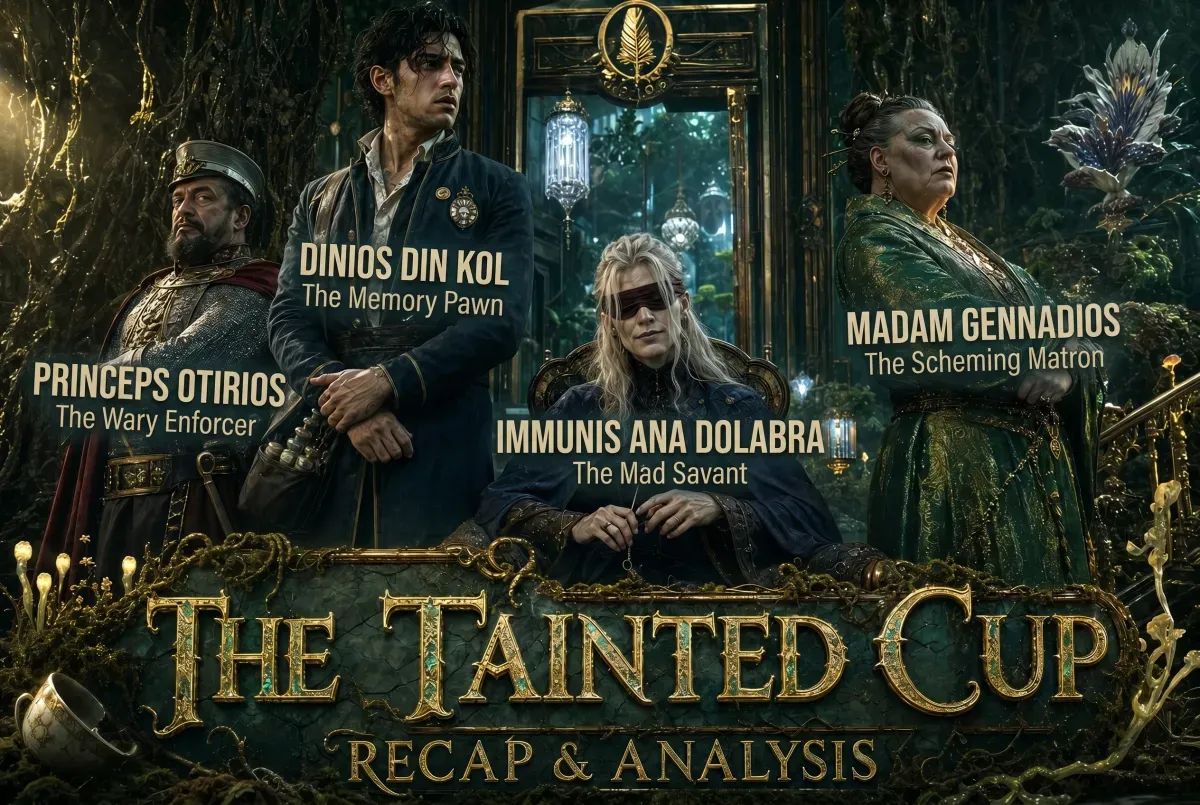



Plot Summary
The Man in the Tree
Din,1 a twenty-year-old engraver and assistant investigator, arrives at a fog-wrapped Haza estate in the backwater canton of Daretana to examine a corpse. Commander Blas of the Engineers has been killed by slender trees that erupted from inside his body, splitting his skull and devouring his limbs in under five minutes.
Din1 engraves every detail into his perfect memory: a perfumed oil pot, molded fernpaper in the bathing closet, a withered air-cooling mushroom, fresh blood beneath the kitchen stove.
He interviews the household staff and learns Blas was a lecherous friend of the wealthy Haza clan, staying alone in their mansion. Nauseated and badly out of his depth, Din1 quietly pockets Blas's diary and prepares to report, unsure whether this is wild contagion or careful murder.
The opening fuses biopunk horror with classic locked-room procedure, establishing a world where life itself is engineered and weaponized. Bennett anchors the reader through Din's self-conscious performance of authority, a young officer impersonating competence while fighting his own gag reflex. The grotesque image of vegetation bursting through a man encodes the book's central anxiety: that the Empire's miraculous alterations are one mistake away from devouring their makers. Din's covert theft of the diary signals his defining tension, an honest servant willing to break rules. The scene also seeds the Haza insignia and the dappleglass clues that will only pay off hundreds of pages later.
The Blindfolded Investigator
In the jungle, Din1 reports to his master, Immunis Ana Dolabra,2 a brilliant, blindfolded recluse who lives buried in books and traps random officers for interrogation to relieve her boredom.
As Din1 recites the scene from memory, Ana2 recognizes the murder weapon: dappleglass, an engineered grass that once consumed the entire canton of Oypat, growing inside anyone who inhales its spores. She concludes Blas was assassinated, poisoned in his bath with help from someone inside the house.
Meanwhile her homemade quake instrument begins chiming, warning that a leviathan is churning toward the coast through the sea floor. Ana2 dispatches Din1 to summon three suspects, telling him to come armed and noting that murder cases differ from their usual pay-fraud work mostly in the volume of screaming.
This is the Holmes-and-Watson engine made strange: Ana solves crimes secondhand through Din's engraved testimony, never leaving her book-cluttered den. Her sensory deprivation inverts detection, abstracting the world into pattern. Bennett characterizes her as appetite barely leashed by duty, a mind starved for stimulation in a dull posting. The quake instrument quietly enlarges the stakes from one corpse to civilizational dread, juxtaposing a single murder against the leviathan threat that dwarfs all human crime. The chapter establishes the central irony: justice is a luxury performed in the shadow of apocalypse, and Ana pursues it as much for the pleasure of the puzzle as for any moral creed.
Thalamis and the Cheat
Returning to town, the postmaster Stephinos16 warns Din1 to take the back roads because Captain Thalamis,10 his cruel former training officer in the Apoths, is hunting him. Thalamis10 ambushes Din,1 furious that the powerful Hazas have lodged complaints about his handling of the death scene.
He reminds Din1 that he failed every Iyalet exam yet somehow earned top marks on the Iudex test twice, and swears he will prove Din1 cheated, have him caned, and strip away his pay and future land.
Din,1 who genuinely struggles to read, keeps his composure under the threats. He notices Thalamis's10 strange hunger for case details and deduces the captain is fishing on the Hazas' behalf, his first glimpse of how deeply the clan's tendrils reach into imperial administration.
Bennett threads class and disability through the mystery's machinery. Din serves for money, mailing his pay home to lift his family inland toward safety, and his hidden reading disorder makes his very position precarious. Thalamis embodies institutional sadism, the senior officer who mistakes cruelty for rigor. The scene plants two long fuses: the secret of how Din passed his exams, and the reach of Haza patronage into the Iyalets. By framing Din as a suspected fraud from the outset, the book builds sympathy for a protagonist whose competence is real but whose legitimacy is contested, mirroring the larger theme of an Empire that hoards opportunity and punishes the resourceful poor.
The Groundskeeper Breaks
Ana2 interrogates the housekeeper Gennadios,12 the servant Ephinas, and the timid groundskeeper Uxos13 in her quarters. She reconstructs the killing: a sliver of dappleglass was slipped into Blas's bath pipe, blooming as he breathed the steam, while a stained fernpaper door betrayed the assassin's passage.
She bluffs that Iudex soldiers are inspecting Uxos's13 hut, where he burned the tainted door. Cornered, Uxos13 lunges with a hidden boot knife. Din,1 moving on pure instinct, draws his heavy wooden practice sword, batters the man down, and nearly kills him before Ana2 stops him by hurling a book at his head.
Uxos13 confesses he was bribed by a masked assassin with a swollen, disfigured face. Ana2 suspects the conspiracy stretches to the city of Talagray and the Haza clan itself.
The Daretana case closes as a self-contained mystery while opening a far larger wound. Ana's method crystallizes here: she cannot read motive but can read matter, the physical logistics of how a knife travels into a throat. Din's berserk violence against Uxos foreshadows the uncanny combat instinct that will later define him, and unsettles him with how little thought it required. The disfigured assassin and the trail toward the Hazas convert a backwater poisoning into the prologue of a conspiracy. Bennett also sharpens Ana's amorality, more delighted by the elegance of the solution than troubled by the dead, a detective whose ethics are procedural rather than tender.
The Breach
After thirteen humid days, distant bombard fire wakes Din:1 a leviathan has shattered the sea walls near Talagray, the worst breach in living memory. Commander-Prificto Vashta5 of the Legion rides to Ana's2 shack and reveals the catastrophe's hidden cause.
The walls were destabilized from inside when ten Engineers spontaneously sprouted dappleglass trees, exactly like Blas, collapsing a critical support just as the titan attacked. Ana2 leaps ahead of Vashta's5 account, deducing the mass poisoning before she can finish.
Now appointed seneschal with near-dictatorial powers, Vashta5 begs Ana2 to bring her mind to Talagray, since she alone has solved this contagion before. Unable to resist a puzzle this vast, Ana2 agrees, and a dread-filled Din1 packs into a carriage bound for the besieged city beneath the sea walls.
The inciting murder is revealed as a fragment of a far deadlier pattern, and the personal becomes geopolitical. Bennett escalates by collapsing the boundary between crime and cataclysm: a poisoning has literally breached the Empire's last defense, killing thousands. Vashta introduces the brutal calculus of emergency governance, where justice bows to survival. Ana's eagerness amid horror reinforces her as a creature of pattern-hunger, while Din's terror grounds the reader in human scale. The leviathan, glimpsed only through quakes and flares, functions as cosmic dread, the indifferent monster against which all this scheming and murder will ultimately be measured and, perhaps, exposed as obscene.
The Talagray Team
In Talagray, a city of fretvine towers crouched under wall-mounted bombards, Ana2 and Din1 join the stalled investigation. Din1 studies the assembled officers like mismatched birds: the gaunt, exhausted engraver-investigator Uhad,6 an old acquaintance of Ana's;2 the glamorous Engineer Kalista;8 the cheery Apoth Nusis,7 an Oypat veteran; and the scarred war hero Captain Miljin,3 who carries a sword forged from titan bone.
The team has ten dead Engineers and no idea where they were poisoned, fearing a saboteur is hunting the walls. Ana2 notices something wrong: when Din1 recounts Blas's sordid death, not one officer reacts to the scandal, as though each is deliberately avoiding scrutiny of Blas. She privately resolves to investigate her own colleagues and to chase Blas's secretary without telling any of them.
The ensemble assembles, and Bennett seeds suspicion through absence rather than action. Ana's genius for negative space, noticing what nobody says, reframes the trusted investigators as potential conspirators. The avian metaphors let Din triage personalities quickly for an audio-paced reader. Talagray itself becomes a character: an improvised, impermanent civilization defined entirely by the threat it exists to repel, a city that cannot afford permanence because the earth shakes. The decision to hide leads from her own team converts the procedural into a paranoid thriller, dramatizing the book's thesis that institutional rot hides best inside the institutions tasked with rooting it out. Trust becomes the scarcest resource here.
Secret Meetings and Silver Keys
Din1 and Miljin3 interview the maimed Engineers in the medikkers' bays. A pattern emerges: five of the dead returned to Talagray on the same secret night, lying to their lovers about why.
Pressing a defensive Engineer named Vartas, Din1 catches him in a fabricated alibi and exposes a clandestine circle of patronized Engineers who grew suddenly rich, all tied to Commander Blas. Vartas names an eleventh member, a missing Apoth captain called Jolgalgan,14 and a small coin-like token each carried.
Searching the dead Engineers' quarters, Miljin's3 titan-bone blade slices open hidden bronze boxes containing elaborate five-reagent keys for some extraordinarily secure portal. On a dead woman's scarf Din1 catches the exact scent of Blas's perfumed oil, hinting that these Engineers shared something intimate, lucrative, and forbidden.
The investigation widens from victims to a system, revealing patronage as the lubricant of imperial advancement. Bennett uses Din's scent-memory as both superpower and motif: aroma binds bodies, secrets, and corruption into a single thread the reader can follow. The lying lovers dramatize how complicity propagates through affection and ambition. The reagents keys are a classic mystery escalation, an artifact promising a hidden place, while the missing survivor Jolgalgan introduces the possibility of a vengeful insider. The chapter quietly argues that the Empire's meritocracy is a fiction, that bright young officers are harvested and bought, their loyalties redirected from the public good toward private patrons who own the soil beneath everything.
The Secretary's Safehouse
Defying curfew, Din1 seeks out Rona Aristan, Blas's longtime secretary, and finds her rotting in her ransacked home, a tiny precise hole bored into her skull.
A spyglass aimed at a distant window leads him to a hidden bronze key, then to an empty safehouse containing a fortune in thousand-talint coins, a wall pass showing Aristan repeatedly visited four inner-ring cantons, and a plain single-vial reagents key. Ana,2 astonished, deduces Aristan was Blas's bagman, ferrying bribes across the Empire.
Recognizing two distinct killers now, one wielding dappleglass and one drilling skulls, Ana2 orders Din1 to plant the money back beside the corpse to test which colleague reports it honestly. She sends the plain key to Nusis7 for analysis, certain it conceals something far more dangerous than it appears.
A second murderer emerges with a surgically different signature, doubling the mystery and confirming a coordinated cleanup. The fortune and the wall pass map the conspiracy onto geography, four cantons that will prove central. Ana's decision to stage evidence, manipulating a crime scene to entrap her own team, marks her willingness to bend justice to expose it, a morally vertiginous tactic that implicates Din in fabrication. Bennett keeps the reader slightly ahead of the team but behind Ana, sustaining dramatic tension. The drilled skull, clean and inhuman, introduces dread of a non-ordinary killer, a body too fast and strong to be merely human, setting up the assassin reveal to come.
The Miller in the Cellar
Following a fernpaper order placed just after the Engineers were poisoned, Din1 and the charming Legion captain Strovi4 visit the mill of a man named Suberek. In the dark stable yard, five Legion deserters attack.
Din's1 body moves without his command, his eyes reading every blade and stance, and he kills two and disables others before Strovi4 ends the fight, leaving Din1 shaking and drenched in blood. In the reeking cellar he discovers Suberek dead, another tiny hole drilled into his skull.
The pattern is now undeniable: someone is methodically erasing every link to the Hazas. Ana,2 frightened for Din,1 reveals his survival came from raw instinct, and warns that the investigation itself has turned lethal, since people here are murdered simply for knowing too much.
Violence becomes intimate and traumatic rather than heroic; Din kills and is horrified, and Bennett refuses to glamorize it. The deserters expose Talagray's underbelly, men broken by the wall who prey on the roads, the human cost beneath imperial valor. Strovi's tenderness toward the blood-soaked Din quietly opens the novel's romance. Ana's fear, the first crack in her detachment, humanizes her bond with Din and hints at a buried loss. The third drilled skull confirms a relentless cleaner protecting the conspiracy, raising the stakes from puzzle to peril: to know the truth here is to be marked for death, and Din now knows too much.
The Road of the Gentry
Ana2 sends Din1 along the gentry road with an Engineers' reagents key, testing each estate gate. Only one unwinds for it: the towering vine gate of the Haza clan, marked by the same feather-between-trees insignia from Daretana. The ten Engineers were poisoned here, at a Haza party.
Din1 realizes Ana2 suspected the Hazas from the very start. When he reports the discovery, Uhad,6 Kalista,8 and Nusis7 react with naked panic, because all three attended that same party and are now witnesses to the crime that caused the breach.
Vashta,5 dragged from her crisis duties, is appalled to find her investigators entangled with the most powerful clan in the Empire. Then a luminous young gentrywoman9 arrives unannounced at the Iudex tower bearing a shocking report of her own.
The conspiracy lands on a name too powerful to touch, and the procedural collides with raw power. Bennett dramatizes the gentry's immunity: the Hazas own the land that grows the reagents that make civilization possible, so the law bends around them. The investigators' panic reveals how proximity to power corrupts even the innocent into silence. The repetition of the Daretana insignia rewards attentive readers and closes a loop opened in the first chapter. Vashta's dilemma sharpens the book's political realism, that emergency and wealth together can suspend justice indefinitely. The unannounced arrival pivots the antagonists from hidden to embodied, personalizing an abstract clan into a single, dangerous face.
Fayazi's Grief
Fayazi Haza,9 radiant and pheromonally enhanced, glides in to announce that her father Kaygi Haza died thirteen days earlier of the same tree-bloom contagion, on the very night of the party. She pleads ignorance, blaming containment, grief, and the breach for her silence.
Ana,2 recognizing a fellow Sazi and an old family enemy, demolishes Fayazi's9 composure with a mocking question and is hauled out by a furious Vashta.5 To save the situation, Fayazi9 agrees to open her halls to a single investigator and pointedly demands it be Din.1
Ana2 warns him that the Hazas will try to manipulate or seduce him, since the clan trades in blackmail and amorous leverage. She orders him to find the family's scribe-hawk rookery and learn whom Kaygi was writing to after Blas died.
The victim becomes a power broker and the bereaved daughter a suspect, complicating sympathy. Fayazi's engineered beauty literalizes how the gentry weaponize desire and charm as instruments of control. Ana's barely contained loathing exposes a personal history with the Hazas that the novel withholds, deepening her as more than a cerebral machine. The demand for Din specifically frames him as bait, the disposable junior officer the powerful expect to corrupt. Bennett stages a duel of manipulators, Ana versus the clan, with Din as the contested pawn. The chapter reframes the entire investigation as a contest not for facts but for influence, where finding the truth and surviving it are different problems.
Inside the Halls
At the opulent Haza estate, Din1 examines Kaygi's death chamber, the steam bath, and a hidden hole in the grounds where the killer likely waited before the party. In the rookery he confronts a humiliating obstacle: the scribe-hawk destination plates are written in Sazi, which his reading disorder makes impossible to memorize.
Desperate, he traces the letters with his fingertip, smuggling their shapes into his muscle memory. Fayazi9 then tries to break him with a lavish banquet, a court dancer's intoxicating pheromones, and pleas to betray Ana's2 findings.
Din1 resists, and a familiar scent triggers a revelation: a dead Engineer wore the same perfume as Fayazi's9 courtesans and Blas's oil, proving the Engineers came here to indulge. He flees as Fayazi,9 herself oddly terrified, throws him out.
Din's disability becomes a crucible, transformed from shameful secret into improvised method, foreshadowing the muscle-memory revelation. Bennett stages temptation as the gentry's true weapon: not threat but pleasure, the cynical argument that in a broken Empire indulgence is owed. Din's refusal, rooted in self-control rather than virtue signaling, defines his integrity. The perfume motif pays off the scarf clue, binding the Engineers to the Hazas through the body's most primal sense. Most intriguingly, Fayazi's flashes of terror reframe her as a frightened puppet rather than a mastermind, a daughter trapped in machinery she cannot see, which seeds the later revelation that even a Haza heir is expendable to her clan.
Four Cantons and a Cure
Back with Ana,2 Din1 reproduces the traced Sazi by moving his inked finger from memory. The hawks flew to four cantons, Mitral, Bekinis, Qabirga, and Juldiz, the same cantons Aristan visited carrying bribe money.
Interrogating the team, Ana2 draws a devastating history from Nusis:7 during Oypat's death, the Apoths actually created a cure for dappleglass, but four cantons, those same four, buried it in Preservation Board objections until the canton had to be burned and sealed forever.
Ana2 realizes the missing Jolgalgan14 and a crackler accomplice are Oypati refugees taking poetic revenge. Miljin3 warns of a twitch, a hyper-fast augmented assassin the Hazas allegedly employ, almost certainly the skull-driller. Revenge, corruption, and an old engineered genocide begin fusing into a single design.
The conspiracy's spine emerges: a deliberate, profitable atrocity. Bennett's worldbuilding turns bureaucratic, indicting regulatory capture, how Preservation Boards meant to protect citizens become instruments for the wealthy to murder by paperwork. The cure withheld for land value reframes Oypat from tragedy to calculated crime, giving Jolgalgan's vendetta moral weight even as her methods are monstrous. Din's finger-traced Sazi triumphantly converts disability into evidence. The twitch elevates the second killer into a genuine physical threat the protagonists may not survive. The chapter crystallizes the novel's furious thesis: the deadliest violence in the Empire is administrative, signed in offices, paid in coin, and dressed as due process.
The Tower in the Ruins
With an Apoth contagion crew, Din1 and Miljin3 ride into the deadly Plains of the Path and find the Oypati crackler Ditelus15 staggering across the wilderness, weeping for the green fields of his lost home, before dappleglass bursts from his chest and kills him.
They follow his trail to a hidden tower where Jolgalgan14 herself hangs dead, speared by her own contagion, her improvised laboratory apparently undone by an accident. The case appears closed: poisoner dead, lab burned. Yet Ana2 refuses to accept it.
One detail gnaws at her, the blackperch mushroom that caused the party's distracting fire would have flared instantly, meaning a third accomplice inside the party threw it for Jolgalgan.14 Someone with deep Iyalet knowledge remains hidden, and is still killing to stay that way.
The novel offers a tidy ending and dares the reader to distrust it. Ditelus's dying lament for Oypat humanizes the avengers, transforming antagonists into casualties of the same crime they punish, and his death stages the contagion's horror at intimate range. The too-perfect tableau of the dead culprit is Bennett's homage to the false solution, the moment the lesser detective would close the file. Ana's refusal, hinged on a single chemical detail about timing, demonstrates that truth lives in friction, in the fact that will not fit. The chapter pivots from catching a killer to unmasking a controller, relocating the danger inside the trusted circle once more.
The Poisoned Teapot Trap
After Nusis7 is found murdered with a drilled skull and her safe's key secretly swapped, Ana2 lures Fayazi9 and her two private Sublimes to the Iudex tower with a fabricated threat.
She unspools the conspiracy: the Hazas let Oypat die to inflate their land values, Blas blocked the cure, Aristan paid off the four cantons, and Blas kept one stolen vial of cure, the third sample, as blackmail insurance, which Din1 unknowingly recovered. Then Ana2 springs her real trap, exposing Fayazi's9 silent axiom bodyguard as the Hazas' twitch assassin by proving she cannot perform simple math.
As warning flares announce the leviathan's arrival, the twitch slaughters guards and flees up the tower toward Ana's2 chamber, where a teapot brewing dappleglass spores, baited with Din's1 hairs, has been waiting.
The drawing-room reveal arrives, but Bennett detonates it amid apocalypse, the leviathan's flares puncturing the confession. The conspiracy's full obscenity lands: genocide as a real-estate strategy, the cure as blackmail currency, ordinary people drilled through the skull to protect a balance sheet. Ana's exposure of the assassin through absence of an axiom's defining skill rewards the novel's earlier mathematical throwaway, a fair-play clue hidden in plain sight. The twitch's eruption converts deduction into mortal threat. Fayazi's terror finally reads true, the heir realizing she was always the designated scapegoat. The chapter marries intellectual triumph to physical peril, insisting that solving a crime and surviving it are separate, unequal victories.
Death by Her Own Poison
The twitch climbs to Ana's2 chamber seeking the disguised cure but finds only the teapot quietly boiling dappleglass, baited with Din's1 own hairs, the same hairs she had earlier used in a failed attempt to poison Ana.2 Already infected, she descends bleeding and lunges.
Din1 meets her with the impaling trick Miljin3 taught him, driving his blade through her shoulder and then her eye, and the contagion erupts from her corpse.
Outside, the leviathan makes landfall at the breach, and a colossal new titan-killer bombard, fired by a crew that includes Strovi,4 drops the beast in a single shot, its carcass sealing the gap. Blue flares climb over the walls: the Empire has survived another wet season, barely, and the unbeatable assassin lies undone by her own trade.
The twin climaxes converge: the human monster and the cosmic one fall together. Bennett makes the assassin's poetic ruin land, killed by the very contagion the conspiracy weaponized, justice arriving as a kind of biological irony. Din's victory deploys his muscle-memory knack and Miljin's dirty trick, paying off two carefully planted setups while leaving him traumatized rather than triumphant. The leviathan's defeat by the titan-killer reasserts the Empire's fragile competence, the collective labor that holds back annihilation. Yet the simultaneity is pointed: the state can slay a mountain-sized beast but barely touch the wealthy men who breached its own walls, a deliberate dissonance Bennett refuses to resolve cleanly.
The Engraver's Confession
With the surface case closed, Ana2 exposes the real architect: Uhad,6 the gaunt Iudex engraver himself. Sickened by a lifetime of memorizing Haza corruption he could never punish, he allied with the Oypati avengers, helped track Blas, threw the distracting mushroom, sabotaged Jolgalgan's14 lab to silence her, and tried to poison Ana2 to escape with the cure.
Din1 arrests him. Earlier, facing the approaching titan, Din1 had confessed that he cheated his exams because he can barely read; Ana2 reveals she always knew and chose him precisely for that cunning and grit.
Newly promoted to full assistant investigator, Din1 learns Ana2 is a covert agent answering to a near-divine conzulate, her Daretana exile a deliberate trap laid for the Hazas. Their work has only begun.
The final twist relocates evil inside the truth-teller, the engraver whose perfect memory of injustice curdled into righteous terrorism. Uhad is the novel's tragic mirror of Din and Ana: an officer crushed by knowing too much, who chose vigilante slaughter when the system refused to act. Bennett complicates the reader's sympathy, refusing to make the mass murderer purely villainous. Din's confession and Ana's shrug reframe their bond as a meritocracy of the overlooked, the Empire's strength lying in the people it nearly discarded. Ana's hidden mandate recasts the whole book as one move in a longer game, closing on the consoling, dangerous idea that maintenance, quiet, unglamorous repair, is how civilizations survive themselves.
Analysis
The Tainted Cup grafts a fair-play detective story onto a biopunk fantasy, and the hybrid yields more than novelty. Bennett's Empire of Khanum is a body, an organism of suffused humans, killer trees, and mushroom air conditioners, defended against leviathans by collective labor, and the novel's recurring claim is that such a body sickens most where its citizens believe it already broken. The murders are not aberrations but symptoms of structural rot: patronage that buys young talent, gentry whose ownership of land grants immunity from law, and regulatory boards that, captured by the wealthy, can commit genocide through delay. The death of Oypat, an entire canton sacrificed to inflate property values by withholding a cure, reframes atrocity as accounting. Bennett's sharpest provocation is that the Empire can kill a mountain-sized beast in one shot yet cannot touch the men who breached its own walls for money. Justice, the book insists, is a tower built one brick at a time, often unfinished. The Ana2 and Din1 pairing reinvents Holmes and Watson by splitting cognition from perception: Ana,2 the pattern-hungry recluse who solves crimes from a blindfolded distance, depends entirely on Din's1 engraved senses, making detection collaborative and embodied. Crucially, both protagonists are the Empire's overlooked, an investigator banished as punishment and an assistant who cheated because he cannot read, and the novel argues that civilizations survive by recognizing value in precisely the people they nearly discard. The villain is the book's tragic mirror: an officer whose perfect memory of injustice curdles into righteous slaughter,6 a warning that despair at a broken system can justify monstrous repair. Threaded through the dread runs unexpected tenderness, in Din's1 romance, his loyalty, and Ana's2 protectiveness, suggesting that the undignified maintenance of order exists, finally, to make room for ordinary joy.
Review Summary
The Tainted Cup blends fantasy and mystery, following eccentric investigator Ana Dolabra and her assistant Dinios Kol as they solve murders in a world threatened by leviathans. Readers praise Bennett's unique worldbuilding, engaging characters, and intriguing plot. Many compare the duo to Sherlock Holmes and Watson. While some found the pacing slow or the world overwhelming, most reviewers enjoyed the book's creativity and humor. The mystery's resolution and the potential for future installments in the series were highly anticipated by fans.
People Also Read



Characters
Dinios Kol
Engraver assistant detectiveDin is the novel's narrator, a tall, gentle-faced young man of about twenty, suffused to remember everything he experiences with perfect, scent-cued recall. He serves the poor canton of Daretana to send pay home and lift his family inland toward safety. Beneath his rigid composure lies shame: he can barely read written text, a disability that nearly cost him his career and forces him to hide his methods. Dutiful, literal, and stubbornly honest in temperament despite a secret act of fraud, he masks deep anxiety behind a clipped, controlled exterior. His arc traces a frightened impostor becoming a capable, self-accepting officer who discovers that his very limitation conceals a rare, startling gift, and that loyalty can be earned rather than performed.
Ana Dolabra
Blindfolded genius investigatorAna is Din's1 mistress, a brilliant, mercurial Iudex investigator who lives barricaded among books, blindfolds herself to think, and interrogates strangers for sport. Pale, feline, and gleefully profane, she solves crimes secondhand through Din's1 engraved reports, reconstructing the physical logistics of murder while dismissing motive as a fool's game. She craves stimulation yet shuns the world, oscillating between manic delight and crushing boredom. Cynical about people but devoted to the abstract machinery of justice, she treats death as a puzzle and confession as theater. Her loathing of the gentry, especially the Hazas, hints at a buried personal history. Beneath the performance lies fierce protectiveness toward Din1 and a hidden, far larger purpose in the Empire's defense.
Captain Miljin
Scarred war heroMiljin is Talagray's grizzled assistant investigator, a massive, augmented Legion veteran who wields a sword forged from titan bone. Famous, blunt, and aging past his prime, he is muscle in a job increasingly demanding minds. He mentors Din1 with brutal pragmatism, teaching him dirty fighting tricks and the lore of the walls. Loyal to the Empire he has bled for, he carries quiet grief over a city he can no longer protect with strength alone.
Captain Kepheus Strovi
Charming Legion officerStrovi is Vashta's5 handsome, curly-haired second, a Legion captain from a gentry family who insists he is a soldier first. Earnest, valiant to a fault, and warmly idealistic about the Empire as the people standing shoulder to shoulder, he accompanies Din1 through danger and treats him with rare kindness. Lonely beneath his easy charm, he forms a tentative, tender connection with Din1 amid the chaos of the breach.
Commander-Prificto Vashta
Seneschal of the cantonVashta is the austere, exhausted Legion commander who becomes seneschal, near-dictator, of Talagray during the breach. Tall, scarred, and burdened, she recruits Ana2 and repeatedly clashes with her over jurisdiction and the untouchable gentry. Pragmatic to the bone, she serves survival over justice, embodying the painful triage of emergency rule. Beneath her stern exterior runs genuine devotion to the Empire and its endangered people.
Immunis Uhad
Weary Iudex engraverUhad is Talagray's senior Iudex investigator, a gaunt, gloomy engraver and old acquaintance of Ana's2, worn thin by decades of perfect, painful memory. Plagued by headaches and afflictions common to aging engravers, he speaks of retiring to a quiet plot in the inner rings. Polite, fatalistic, and quietly bitter about powerful criminals who escape justice, he offers Din1 unsettling glimpses of an engraver's eventual psychological toll.
Immunis Nusis
Cheery Apoth expertNusis is the bright, meticulous Apoth immunis on the investigation team, augmented for night vision and endlessly fascinated by worms and contagion. A veteran of the Oypat catastrophe, she carries firsthand knowledge of dappleglass and the canton's death. Relentlessly upbeat even amid horror, she handles cadavers and grafts with brisk competence, and her recollections of Oypat unlock the conspiracy's buried history.
Immunis Kalista
Glamorous Engineer officerKalista is the languid, glamorous Engineer immunis on the team, fond of her pipe, fine silks, and gossip. Worldly and self-protective, she resents discomfort and reacts to peril with theatrical alarm, but her social connections and party attendance make her a valuable, anxious witness.
Fayazi Haza
Beautiful gentry heirFayazi is a luminous, pheromonally enhanced daughter of the Haza clan, suddenly elevated to lead their Talagray affairs after her father's death. Childlike yet calculating, she weaponizes beauty, wealth, and charm to manipulate, attempting to seduce and suborn Din1. Beneath the polished doll's mask flickers genuine terror, suggesting a young woman trapped in a vast family machine whose workings she is forbidden to understand.
Captain Thalamis
Cruel former trainerThalamis is Din's1 sadistic former Apoth training officer, a smooth, dead-eyed bully convinced Din1 cheated his way into his post. Hungry for case details on behalf of unseen patrons, he threatens caning and discharge, embodying institutional cruelty and the reach of gentry influence into the Iyalets.
Otirios
Smirking Apoth princepsOtirios is the wealthy, faintly mocking Apoth princeps who guides Din1 through Blas's death scene in Daretana, skeptical of the young investigator working alone. He provides early forensic detail about dappleglass and the weaponized contagion.
Gennadios
Haughty Haza housekeeperGennadios is the imperious, painted housekeeper who runs the Daretana Haza estate, contemptuous of Din's1 youth and station. Fiercely loyal to her masters and skilled at obstruction, she guards the family's secrets until Ana2 corners her with threats.
Uxos
Timid groundskeeperUxos is the aging, anxious groundskeeper of the Daretana estate, terrified of becoming too expensive to keep. Desperate for security in old age, he proves susceptible to bribery and fear, a small man crushed between survival and conscience.
Jolgalgan
Missing Oypati suspectJolgalgan is a missing Apoth captain, secretly an Oypati refugee adopted into a Kurmini family, marked by pale yellow curls and a history of rage and paranoia. A skilled, embittered survivor of a dead canton, she becomes the investigation's prime suspect for the dappleglass poisonings.
Ditelus
Oypati crackler soldierDitelus is a hulking augmented Legion crackler and Oypati refugee with cropped gold hair, repeatedly disciplined for wandering the Plains of the Path. Sorrowful and homesick for his vanished homeland, he is bound to the conspiracy's web of vengeance.
Stephinos
Benevolent postmasterStephinos is Daretana's shrewd, kindly Legion postmaster, a near-omniscient hub of local information who mails Din's1 pay home and warns him of approaching danger. He reads the churn of war traffic like an omen of the coming wet season.
Plot Devices
Scent-cued engraving
Perfect memory as evidenceEngravers like Din1 are suffused to remember everything they experience flawlessly, retrieving memories by sniffing scent-anchored vials of reagents. Din1 functions as the living legal record of the investigation, his recollections treated as sworn evidence. Bennett makes this both superpower and burden: aroma binds clues, bodies, and lies across hundreds of miles, letting Din1 match a dead woman's scarf to a murdered commander's oil. The device also exacts a cost, since aging engravers accumulate intrusive, painful memories that erode their minds. It powers the Holmes-Watson dynamic, supplying Ana2 with raw sensory data she analyzes from her blindfolded seclusion, and it quietly foreshadows a related, rarer ability latent in Din1 himself.
Dappleglass contagion
Murder weapon and grudgeDappleglass is an engineered grass that grows explosively inside anyone who inhales its steam-borne spores, bursting from the body in minutes and killing horribly. It once consumed the entire canton of Oypat, which had to be burned and sealed. In the present it becomes a bespoke assassination tool, slipped into baths and water tanks, leaving telltale stains on resistant fernpaper that betray its passage. The contagion serves as both the recurring murder method and a symbol of the Empire's hubris, life-shaping power one error from catastrophe. Its history ties personal vengeance to imperial atrocity, and its biological logic (immediate flares, delayed blooms, vulnerability of augmented bodies) supplies the precise clues Ana2 uses to reconstruct each crime.
The disguised third sample
Hidden proof of the crimeAmong the hidden valuables Din1 recovers is a plain bronze reagents key that resists every Apoth test, because it is not truly a key at all but a concealed vial of the suppressed dappleglass cure, one of three samples secretly stolen during Oypat. Kept as blackmail insurance, this third sample is the physical proof that the cure existed and was deliberately buried for profit. Multiple parties kill to obtain or recover it, and a swapped duplicate exposes a thief and a murderer within the trusted circle. The object embodies the conspiracy's core, an antidote withheld so a few could grow richer, and its discovery and disguise drive the endgame, separating who knows the truth from who merely wants it gone.
Memory in the muscles
Hidden combat and skill giftDin1 possesses a rare variant of engraving in which his body, not just his mind, perfectly retains movement: lockpicking sequences, dueling forms, even the tracing of foreign letters. Shown how to act once, he can reproduce the motion flawlessly thereafter, his eyes reading an opponent's stance as his muscles move him almost without thought. The gift is paired with his reading disability, a trade-off so rare even Ana2 has rarely seen it. Bennett seeds it early through tea-making and a frantic brawl, then pays it off when Din1 overcomes deserters and, finally, an augmented assassin. It reframes his shameful limitation as a singular strength and underwrites his survival against foes vastly stronger and faster than he is.
Leviathans and the walls
Existential ticking clockEach wet season, mountain-sized leviathans rise from the eastern sea and assault the Empire's vast sea walls, which the Legion and Engineers defend with titanic bombards. Their approach is detectable through quakes and announced by colored warning flares, green for sighted, red for ashore, yellow for breached, blue for slain. The dead beasts' blood warps the land, sprouting strange growths and supplying the very alterations that sustain civilization. This looming apocalypse frames every human crime as small yet urgent, since the murders directly weakened the walls and caused a catastrophic breach. The countdown of strengthening quakes pressures the investigation toward resolution and culminates in a single-shot titan-killer firing, binding the mystery's climax to the Empire's literal survival.
FAQ
Synopsis & Basic Details
What is The Tainted Cup about?
- Murder Mystery in Fantasy: The Tainted Cup is a fantasy novel centered around a murder investigation, where a junior investigator, Dinios Kol, is sent to a remote estate to investigate the bizarre death of a high-ranking engineer.
- Conspiracy and Intrigue: The investigation quickly uncovers a larger conspiracy involving powerful families, secret meetings, and a deadly contagion, threatening the stability of the Empire.
- Unconventional Investigator Duo: The story follows the dynamic between Kol and his superior, Immunis Ana Dolabra, a brilliant but eccentric investigator, as they navigate the complex web of deceit and uncover hidden truths.
Why should I read The Tainted Cup?
- Unique Blend of Genres: The novel seamlessly blends elements of fantasy, mystery, and detective fiction, offering a fresh and engaging reading experience.
- Intriguing Characters: The story features a compelling cast of characters, each with their own motivations and secrets, creating a complex and dynamic narrative.
- Intricate Plot and Worldbuilding: The Tainted Cup presents a richly detailed world with a complex plot full of twists and turns, keeping readers engaged and guessing until the very end.
What is the background of The Tainted Cup?
- Imperial Fantasy Setting: The story is set in a world dominated by the Empire of Khanum, a society that has mastered the art of organic alterations and suffusions, creating a unique blend of technology and magic.
- Political and Social Tensions: The Empire is rife with political and social tensions, with powerful gentry families vying for influence and control, and the threat of leviathans from the sea looming large.
- Contagion and Alterations: The use of organic alterations and the threat of contagions are central to the story, highlighting the dangers of unchecked scientific progress and the fragility of the Empire's defenses.
What are the most memorable quotes in The Tainted Cup?
- "You are the Empire.": This recurring phrase emphasizes the collective responsibility and interconnectedness of the Empire's citizens, highlighting the importance of individual actions in maintaining its stability.
- "The Empire is strong because it recognizes the value in all our people.": This quote underscores the importance of diversity and inclusion within the Empire, suggesting that its strength lies in its ability to embrace all its citizens.
- "We are all here because of what all of us do.": This quote highlights the interconnectedness of the Empire and the importance of individual contributions, emphasizing the idea that everyone has a role to play in its survival.
What writing style, narrative choices, and literary techniques does Robert Jackson Bennett use?
- Detailed Worldbuilding: Bennett creates a vivid and immersive world through rich descriptions of its unique technology, social structures, and political landscape.
- Character-Driven Narrative: The story is driven by the complex and compelling characters, whose motivations and relationships shape the plot and themes.
- Intricate Plotting: The novel features a complex and layered plot with multiple twists and turns, keeping readers engaged and guessing until the very end.
Hidden Details & Subtle Connections
What are some minor details that add significant meaning?
- The Haza Insignia: The recurring image of a feather between two trees, the Haza family insignia, symbolizes their power and influence, and foreshadows their involvement in the conspiracy.
- The Kirpis Shrooms: The presence of kirpis mushrooms in every major room, and the shriveled one in the kitchen, highlights the wealth of the Hazas and the subtle signs of decay within their estate.
- The Sazi Silk: The housekeeper's expensive Sazi silk robes, from the inner rings of the Empire, emphasize the social hierarchy and the Hazas' connections to the Empire's elite.
What are some subtle foreshadowing and callbacks?
- The Dappleglass Description: The description of the dappleglass plant in the Oypat canton foreshadows its use as a weapon and its connection to the Engineers' deaths.
- The Therapy Oils: The mention of therapy oils in Blas's belongings foreshadows his connection to the Haza family and their illicit activities.
- The Quake Instrument: Ana's quake instrument foreshadows the coming leviathan and the fragility of the Empire's defenses, connecting the murder mystery to the larger world.
What are some unexpected character connections?
- Blas and the Hazas: The connection between Commander Blas and the Haza family, initially presented as a friendship, is revealed to be a corrupt relationship involving exploitation and abuse.
- Uxos and the Assassin: The groundskeeper's involvement with the twitch assassin, initially presented as a coerced act, reveals the vulnerability of those on the fringes of power.
- Ana and the Hazas: Ana's past experiences in the inner rings of the Empire, and her history with the Hazas, are hinted at, suggesting a deeper connection to the conspiracy.
Who are the most significant supporting characters?
- Princeps Otirios: The Apoth officer's initial skepticism and later support of Kol highlight the complex dynamics between different Iyalets and the challenges of navigating imperial bureaucracy.
- Postmaster Stephinos: The postmaster's knowledge of the canton and his warnings to Kol reveal the importance of local connections and the hidden networks of information within the Empire.
- Captain Alixos Thalamis: The Apoth captain's antagonism towards Kol and his connection to the Hazas reveal the corruption and power struggles within the Empire.
Psychological, Emotional, & Relational Analysis
What are some unspoken motivations of the characters?
- Ana's Desire for Stimulation: Ana's constant need for new information and her unconventional methods suggest a deeper desire to escape the boredom and monotony of her assigned post.
- Kol's Need for Acceptance: Kol's eagerness to prove himself and his adherence to rules reveal a deep-seated need for acceptance and validation, stemming from his past failures.
- Fayazi's Fear of Powerlessness: Fayazi's initial arrogance and later fear reveal a deep-seated anxiety about her position within the Haza family and her vulnerability to their machinations.
What psychological complexities do the characters exhibit?
- Ana's Sensory Overload: Ana's reliance on sensory deprivation and her aversion to stimulation suggest a complex psychological state, possibly stemming from her augmentations.
- Kol's Internal Conflict: Kol's internal struggle between his desire for justice and his fear of failure highlights the psychological toll of navigating a corrupt system.
- Uhad's Obsessive Righteousness: Uhad's rigid adherence to rules and his desire for vengeance reveal a complex psychological state, driven by a deep-seated sense of injustice.
What are the major emotional turning points?
- Kol's Vomiting: Kol's vomiting after seeing Blas's body highlights his initial shock and disgust, marking a turning point in his understanding of the case's brutality.
- Ana's Stillness: Ana's sudden stillness upon hearing about the nature of Blas's death reveals the emotional impact of the case on her, despite her attempts to remain detached.
- Uxos's Betrayal: Uxos's sudden attack on Ana reveals the desperation and fear that drive his actions, highlighting the emotional toll of the conspiracy.
How do relationship dynamics evolve?
- Kol and Ana's Mentorship: The relationship between Kol and Ana evolves from a formal mentorship to a more complex partnership, as they learn to trust and rely on each other's strengths.
- Kol and Miljin's Uneasy Alliance: The relationship between Kol and Miljin evolves from initial suspicion to a grudging respect, as they navigate the dangers of the investigation together.
- Fayazi and Her Sublimes: The relationship between Fayazi and her Sublimes reveals the power dynamics within the Haza family, with the Sublimes acting as both servants and enforcers.
Interpretation & Debate
Which parts of the story remain ambiguous or open-ended?
- The Nature of Ana's Augmentations: The exact nature of Ana's augmentations and their impact on her mind remain ambiguous, leaving readers to speculate about her unique abilities and limitations.
- The True Motives of the Hazas: The full extent of the Haza family's corruption and their ultimate goals remain unclear, leaving readers to question the true nature of their power and influence.
- The Origin of the Dappleglass: The origin of the dappleglass and its connection to the leviathans remain ambiguous, leaving readers to wonder about the true nature of the Empire's threats.
What are some debatable, controversial scenes or moments in The Tainted Cup?
- Ana's Treatment of Witnesses: Ana's unconventional and often manipulative methods of interrogation raise questions about the ethics of her approach and the limits of justice.
- Kol's Use of Violence: Kol's sudden display of combat skills and his willingness to use violence raise questions about the nature of his transformation and the potential for corruption.
- The Justification of the Empire: The novel's portrayal of the Empire's complex and often brutal methods of maintaining order raises questions about the morality of its actions and the true cost of its survival.
The Tainted Cup Ending Explained: How It Ends & What It Means
- Jolgalgan's Death: The death of Jolgalgan, while seemingly a resolution, leaves many questions unanswered about her true motives and the extent of her knowledge.
- The Hazas' Downfall: The downfall of the Haza family, while a victory for justice, highlights the fragility of power and the ever-present threat of corruption within the Empire.
- Kol's Uncertain Future: Kol's departure from Talagray and his new role as a formal assistant investigator leave his future uncertain, suggesting that the fight for justice is an ongoing process.
Shadow of the Leviathan Series
About the Author
Other books by Robert Jackson Bennett


Download PDF
Download EPUB
.epub digital book format is ideal for reading ebooks on phones, tablets, and e-readers.








































