
Plot Summary
Murder and the Black Box
The unnamed narrator, obsessed with the eccentric philosopher de Selby, is persuaded by his companion, John Divney, to murder the wealthy and reclusive Mathers for his cash box. The crime is brutal and calculated, with Divney striking first and the narrator finishing the deed. After the murder, Divney absconds with the box, leaving the narrator to bury the body alone. This act of violence marks the beginning of the narrator's descent into a surreal and nightmarish world, where guilt, greed, and the search for the elusive black box intertwine. The murder is not just a crime but a catalyst, unraveling the narrator's sense of reality and setting him on a journey through a landscape where logic and morality are constantly undermined.
Divney's Betrayal
After the murder, Divney refuses to share the spoils, claiming the box is hidden for safety. The narrator becomes obsessed with retrieving his share, shadowing Divney's every move for years, their relationship devolving into mutual suspicion and silent hostility. The black box becomes a symbol of both hope and damnation, representing the narrator's lost future and the weight of his crime. Divney's evasions and the narrator's growing paranoia create a claustrophobic atmosphere, where friendship is replaced by surveillance and fear. The narrator's identity and purpose become inextricably linked to the box, and his world narrows to a single, desperate quest.
The Haunted House
Divney finally reveals the box's location: under the floorboards of Mathers' abandoned house. The narrator enters the desolate building, driven by greed and desperation. As he searches, reality begins to warp—time, light, and sensation become unstable. He finds the box's hiding place, but as he reaches for it, the world shifts. The box vanishes, and the narrator is confronted by the ghostly presence of Mathers, alive and bandaged, calmly drinking tea. The house becomes a liminal space, where the boundaries between life and death, guilt and innocence, are blurred. The narrator's sense of self begins to unravel, and he is forced to confront the consequences of his actions in a world that no longer obeys the rules of logic.
Meeting Old Mathers
The narrator faces Mathers, who answers every question with "No," embodying a philosophy of negation and withdrawal from the world. Mathers' presence is both terrifying and oddly comforting, as he explains his system of always refusing requests to avoid sin and suffering. The narrator, guided by his inner voice "Joe," tries to make sense of this encounter, seeking answers about the box and his own identity. Mathers' cryptic wisdom and the surreal atmosphere deepen the narrator's confusion, suggesting that he is trapped in a purgatorial state, unable to move forward or escape his guilt. The encounter is a meditation on denial, self-deception, and the impossibility of redemption.
The Philosophy of No
Mathers elaborates on his philosophy: by always saying "No," he avoids the temptations and pitfalls of existence. This radical negation is presented as a form of self-protection, a way to achieve peace by refusing to engage with the world's demands. The narrator is both fascinated and repelled by this worldview, recognizing its logic but sensing its emptiness. The conversation becomes a metaphysical debate about the nature of choice, responsibility, and the possibility of escape from one's past. Mathers' refusal to acknowledge the box's existence or the narrator's identity reinforces the sense of stasis and futility that pervades the narrator's journey.
The Search for Identity
The narrator realizes he cannot remember his own name, a loss that symbolizes his disconnection from reality and selfhood. Mathers questions him about his "colour," leading to a bizarre discussion of birth-winds and the police's role in determining one's fate. The narrator's identity becomes increasingly unstable, as he is unable to anchor himself in memory, family, or community. This existential crisis is mirrored by the shifting, dreamlike landscape he inhabits, where time and causality are unreliable. The search for the black box becomes a search for meaning and self-definition, but every answer leads only to further uncertainty.
The Road to the Barracks
The narrator sets out to find the local police barracks, hoping the policemen can help him recover the box. The road he travels is described in de Selby's terms as an "hallucination," a series of static moments rather than a continuous journey. Along the way, he encounters Martin Finnucane, a one-legged man who claims to be the captain of all one-legged men and offers cryptic advice. The landscape is both familiar and strange, filled with exaggerated beauty and unsettling perfection. The narrator's journey is less a movement through space than a passage through states of mind, each step taking him further from the world he once knew.
The Third Policeman
At the barracks, the narrator meets Sergeant Pluck and Policeman MacCruiskeen, whose obsession with bicycles and atomic theory borders on madness. The policemen interrogate him about his lack of a bicycle, treat every crime as a bicycle-related offense, and introduce him to the bizarre logic of their world. The barracks is a place where the laws of physics, identity, and morality are inverted, and the narrator is swept up in a series of increasingly surreal investigations. The policemen's conversations are filled with nonsensical rules, circular reasoning, and a relentless focus on minutiae, creating a sense of both comedy and menace.
Atomic Theory and Bicycles
Sergeant Pluck explains the parish's "Atomic Theory": people who ride bicycles too much become part bicycle, and bicycles become part human. This theory is both a parody of scientific reasoning and a metaphor for the loss of individuality and agency. The narrator is introduced to a cast of characters who are more bicycle than man, and the boundaries between animate and inanimate blur. The obsession with bicycles becomes a symbol of the absurdity and futility of existence in this world, where identity is unstable and transformation is both inevitable and meaningless.
MacCruiskeen's Miniatures
Policeman MacCruiskeen reveals his hobby: crafting a series of nested chests, each smaller than the last, to the point of invisibility. This act of infinite regression mirrors the narrator's own descent into madness and the endless deferral of meaning. MacCruiskeen's other inventions—silent music, a spear with an invisible point, a machine for stretching light—are equally pointless and obsessive, highlighting the futility of seeking order or purpose in a world governed by arbitrary rules. The narrator is both fascinated and horrified by these displays of ingenuity without utility, recognizing in them a reflection of his own predicament.
The Descent to Eternity
The policemen lead the narrator to a hidden entrance in the woods, where they descend into a vast underground complex they call "Eternity." This realm is filled with endless corridors, machinery, and doors, all looping back on themselves. Time stands still, hunger and aging are suspended, and every desire can be fulfilled by manipulating the mysterious substance "omnium." The narrator is overwhelmed by the possibilities, imagining himself as a godlike creator, but is ultimately unable to take anything with him when he tries to leave. The descent is both a literal and symbolic journey into the afterlife, a place where the consequences of one's actions are inescapable and repetition is eternal.
The Machinery of Omnium
In Eternity, the narrator is shown the workings of omnium, the fundamental substance from which all things can be made. He is offered anything he can imagine—gold, whiskey, weapons, even the power to destroy his enemies—but discovers that he cannot take any of it with him unless he remains unchanged. The machinery of omnium is a parody of wish-fulfillment and the dangers of unchecked desire. The narrator's attempts to use it for revenge or self-aggrandizement are thwarted by the system's own logic, and he is left with nothing but a bag of sweets. The lesson is one of the emptiness of material and egotistical pursuits.
The Scaffold and Escape
The narrator is sentenced to hang for Mathers' murder, despite the policemen's admission that, without a name, he cannot truly be executed. As the scaffold is built, he is visited by the one-legged men, who attempt a rescue, but the effort is futile. At the last moment, a crisis in the machinery of Eternity distracts the policemen, and the narrator escapes. He returns home, exhausted and disoriented, only to find that time has passed differently—Divney is now an old man, and the world he knew is gone. The sense of escape is illusory; the narrator is still trapped in the consequences of his crime.
The Return Home
The narrator's return is met with terror by Divney, who reveals that the box was never hidden in Mathers' house but was instead a bomb that killed the narrator sixteen years earlier. The narrator realizes that he has been dead all along, reliving the events of his crime and its aftermath in a hellish cycle. The people he encounters do not recognize him, and his attempts to reclaim his life are met with fear and rejection. The homecoming is not a restoration but a final confirmation of his damnation, as he is forced to confront the irreversibility of his actions.
The Endless Loop
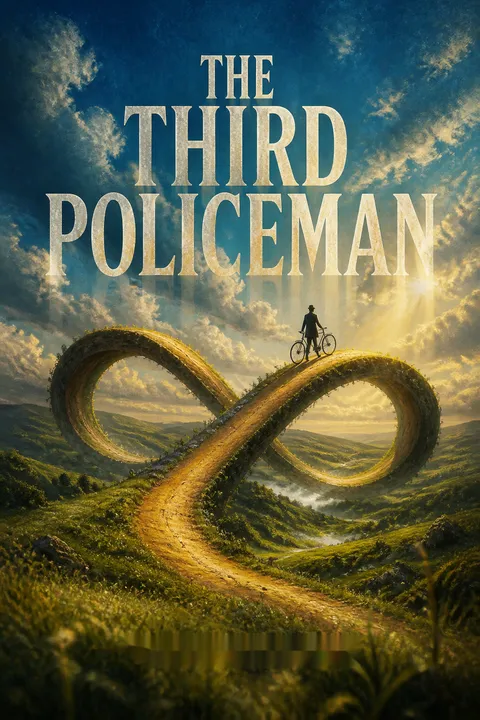
The novel ends as it began: the narrator, accompanied by Divney, approaches the police station, greeted by the same surreal policeman and the same questions about bicycles. The cycle is unbroken, and the narrator is condemned to repeat his journey through guilt, confusion, and absurdity forever. Hell, in this world, is not fire and brimstone but the endless recurrence of one's worst mistakes, the inability to escape the consequences of one's choices, and the perpetual deferral of meaning and resolution. The story closes on a note of existential horror, leavened by the dark comedy of its circular structure.
Analysis
A darkly comic meditation on guilt, reality, and the search for meaningThe Third Policeman is a masterwork of absurdist fiction, blending black comedy, philosophical inquiry, and psychological horror. At its core, the novel is an exploration of the consequences of violence and the impossibility of escaping one's past. The narrator's journey through a world governed by arbitrary rules and circular logic mirrors the experience of guilt and the search for redemption in a universe that offers neither justice nor closure. The novel's use of metafiction, parody, and surrealism challenges the reader's assumptions about reality, identity, and narrative itself. In a modern context, The Third Policeman can be read as a critique of bureaucratic authority, the dangers of intellectual obsession, and the existential condition of being trapped in cycles of desire and regret. Its lessons are both timeless and timely: that the search for meaning is fraught with uncertainty, that the consequences of our actions are inescapable, and that hell is not a place of punishment but a state of endless repetition and deferred resolution. The novel's enduring power lies in its ability to make us laugh at the absurdity of our predicament even as it confronts us with the deepest questions of existence.
Review Summary
The Third Policeman receives widespread praise for its surreal, absurdist brilliance, with many reviewers comparing it to Kafka, Joyce, and Lewis Carroll. Readers marvel at its imaginative concepts — atomic theory, bicycles merging with humans, omnium, and a hellish circular existence. Several note its remarkable modernity despite being written in 1940. Some reviewers found it chaotic or inaccessible, and a few caution against reading the spoiler-filled introduction. Its dark humor, metafictional footnotes, and philosophical depth leave most readers simultaneously bewildered and enchanted.
People Also Read
Characters
The Narrator
The unnamed narrator is a man consumed by intellectual obsession, guilt, and a desperate need for meaning. His relationship with de Selby's philosophy reflects his own detachment from reality and his tendency to rationalize or evade responsibility. Psychologically, he is fractured—his inner voice "Joe" serves as both conscience and commentator, highlighting his divided self. The murder of Mathers is both a literal and symbolic act of self-destruction, setting him on a path through a world where identity, morality, and logic are constantly undermined. As he loses his name and sense of self, he becomes a cipher, trapped in a cycle of repetition and unable to escape the consequences of his actions. His journey is both a quest for the black box and a search for redemption, but he is ultimately condemned to an eternity of uncertainty and futility.
John Divney
Divney is the narrator's partner in crime and eventual betrayer. He is practical, cunning, and self-serving, using the narrator's intellectual distractions to further his own ends. Divney's refusal to share the spoils of their crime and his evasions about the box's location create a dynamic of paranoia and mutual surveillance. Psychologically, Divney represents the narrator's own capacity for denial and rationalization, as well as the corrosive effects of guilt and mistrust. His transformation into an old, terrified man upon the narrator's return underscores the inescapability of the past and the ultimate futility of self-deception.
Old Mathers
Mathers is both the murdered man and a spectral presence who haunts the narrator's journey. In life, he is a reclusive miser; in death, he becomes a figure of enigmatic wisdom, embodying a philosophy of perpetual refusal. Mathers' insistence on saying "No" to every request is both a defense against the world's demands and a symbol of the narrator's own inability to engage with reality. As a ghost, Mathers is both judge and confessor, forcing the narrator to confront the emptiness of his desires and the impossibility of escape from guilt.
Sergeant Pluck
Sergeant Pluck is the chief policeman in the surreal parish, obsessed with bicycles and the "Atomic Theory." He is both comic and menacing, embodying the arbitrary and circular logic of the world the narrator inhabits. Pluck's insistence that people and bicycles exchange atoms until they become indistinguishable is a parody of scientific reasoning and a metaphor for the loss of individuality. Psychologically, Pluck represents the forces of authority and conformity, enforcing rules that are both meaningless and inescapable. His geniality masks a profound indifference to justice or truth.
Policeman MacCruiskeen
MacCruiskeen is Pluck's subordinate, a man of endless hobbies and pointless ingenuity. His creation of infinitely nested chests and invisible inventions mirrors the narrator's own descent into madness and the endless deferral of meaning. MacCruiskeen's polite, almost childlike demeanor conceals a capacity for cruelty and a deep engagement with the absurd. He is both a guide and a tormentor, leading the narrator deeper into the labyrinth of unreality. Psychologically, he represents the dangers of obsession and the futility of seeking order in a chaotic world.
Policeman Fox
Fox is the third policeman, rarely seen and always on his "beat." He is associated with disappearance, madness, and the breakdown of boundaries between self and other. Fox's private barracks within Mathers' house and his manipulation of the machinery of omnium suggest a power that is both creative and destructive. Psychologically, Fox is the shadow self, the part of the narrator that is both feared and desired, capable of both revelation and annihilation.
Joe (the Narrator's Soul)
Joe is the narrator's internal commentator, offering advice, criticism, and occasional comfort. He serves as both conscience and alter ego, reflecting the narrator's divided self and his inability to integrate thought and action. Joe's presence highlights the narrator's isolation and the fragmentation of his identity, as well as the futility of seeking guidance from within when the self is fundamentally unstable.
Martin Finnucane
Finnucane is a one-legged wanderer who offers the narrator cryptic advice and assistance. He represents the possibility of solidarity among the marginalized and the hope of escape from the system, but his efforts are ultimately futile. Psychologically, Finnucane is a figure of resistance and rebellion, but also of impotence in the face of overwhelming absurdity.
Pegeen Meers
Pegeen is Divney's wife or partner, a figure of domestic normalcy who has aged and become embittered in the narrator's absence. Her presence in the narrator's former home underscores the passage of time and the irreversibility of the narrator's choices. Psychologically, she represents the life the narrator might have had, now lost forever.
de Selby
Though never appearing directly, de Selby's writings and theories pervade the novel, shaping the narrator's worldview and providing a framework for the book's exploration of reality, time, and identity. De Selby's absurd speculations mirror the narrator's own descent into unreality, and his influence is both liberating and destructive. Psychologically, de Selby is the voice of skepticism and doubt, undermining all certainties and leaving the narrator adrift in a world without meaning.
Plot Devices
Circular Narrative Structure
The novel's structure is circular: it begins and ends with the narrator approaching the police station, condemned to repeat his journey forever. This device reinforces the theme of damnation as endless recurrence, where the consequences of one's actions can never be escaped or resolved. The circularity is both a source of dark comedy and existential horror, trapping the narrator in a world where every attempt at escape only leads back to the beginning.
Unreliable Reality and Identity
Throughout the novel, the boundaries between reality and unreality are constantly blurred. The narrator's loss of his name, the instability of time and space, and the surreal logic of the world he inhabits create a sense of disorientation and uncertainty. This device mirrors the psychological effects of guilt and the impossibility of redemption, as the narrator is unable to anchor himself in any stable identity or reality.
Absurd Bureaucracy and Parody
The policemen's obsession with bicycles, their nonsensical rules, and their parody of scientific reasoning serve as a satire of bureaucracy and the arbitrary exercise of power. The world of the barracks is governed by circular logic and meaningless procedures, highlighting the futility of seeking justice or order in a system that is fundamentally absurd.
Metafiction and Philosophical Digression
The novel is filled with digressions on the works of de Selby, presented in the form of footnotes and philosophical asides. These metafictional elements both enrich and undermine the narrative, drawing attention to the constructed nature of the story and the impossibility of definitive interpretation. The digressions serve as a commentary on the search for meaning and the dangers of intellectual obsession.
Symbolism of the Black Box and Omnium
The black box is both a literal object and a symbol of the narrator's desires, guilt, and the consequences of his actions. Its contents—ultimately revealed as omnium, the substance from which all things are made—represent the promise of unlimited power and the futility of wish-fulfillment. The inability to possess or use the box's contents underscores the emptiness of material and egotistical pursuits.
Foreshadowing and Irony
From the beginning, the novel is filled with hints that the narrator is dead and trapped in a hellish afterlife. The surreal events, the loss of identity, and the circular structure all foreshadow the final revelation. Irony pervades the narrative, as the narrator's quest for meaning and redemption only leads him deeper into confusion and repetition.
Download PDF
Download EPUB
.epub digital book format is ideal for reading ebooks on phones, tablets, and e-readers.








































