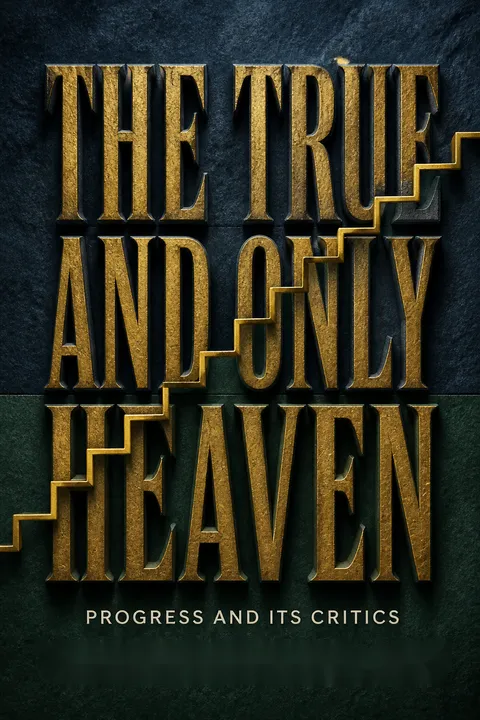

Key Takeaways
1. The Obsolescence of Progress and Traditional Political Ideologies
The premise underlying this investigation—that old political ideologies have exhausted their capacity either to explain events or to inspire men and women to constructive action—needs an introductory word of explanation.
Exhausted ideologies. The traditional political spectrum of Left and Right has lost its explanatory power and ability to inspire. Both sides, despite their acrimony, share a fundamental, unexamined belief in the desirability and inevitability of technical and economic progress, rendering their conflicts superficial. This shared conviction blinds them to deeper societal issues.
The forbidden topic: limits. A critical omission in modern political discourse is the discussion of limits—environmental, social, and moral. Both the Left and Right vehemently repudiate "pessimism," preferring to maintain an illusion of boundless growth. This refusal to confront finite resources or the consequences of indefinite expansion leads to self-defeating programs, whether it's the Right's plan to maintain living standards at the world's expense or the Left's attempt to extend Western consumption globally.
A personal journey. The author's own intellectual evolution, from a New Deal liberal to a critic of both the New Left and the New Right, stemmed from questioning core liberal assumptions about family, sexual liberation, and the nature of "Middle America." He observed that the New Right, despite its rhetoric of "traditional values," ultimately sanctioned unlimited economic growth and acquisitive individualism, failing to address the spiritual disrepair it claimed to oppose.
2. Progress as Endless Desire, Not Utopian Perfection
The expectation of indefinite, open-ended improvement, even more than the insistence that improvement can come only through human effort, provides the solution to the puzzle that is otherwise so baffling—the resilience of progressive ideology in the face of discouraging events that have shattered the illusion of utopia.
Beyond utopia. The enduring appeal of the idea of progress, particularly in its Anglo-American form, does not lie in a millennial vision of earthly perfection, which has been discredited by 20th-century calamities. Instead, its resilience stems from the seemingly more realistic expectation of continuous, open-ended improvement, driven by an indefinite expansion of human wants and productive forces. This modern conception of history, unlike ancient cyclical views, posits no foreseeable end to growth.
Adam Smith's rehabilitation of desire. Eighteenth-century liberals like Adam Smith were pivotal in transforming insatiable desire from a moral vice into a powerful economic stimulus. They argued that human needs are historical, not natural, and constantly redefine standards of comfort. This continuous redefinition fuels production and wealth, ensuring that luxuries become necessities, and demand remains elastic, providing a seemingly solid foundation for progress.
Moral costs of progress. Despite championing economic expansion, Smith harbored misgivings about the moral implications of commercial society. He regretted the decline of "great and awful virtues" like self-command and martial spirit, which he believed were essential for a robust citizenry. The division of labor, while boosting productivity, also dulled the mind and sapped virility, leading to a society where "justice and humanity" might replace more demanding ideals, effectively banishing moral concerns to the realm of "harmless speculation."
3. Nostalgia as the Abdication of Memory, Mirroring Progress
Nostalgia appeals to the feeling that the past offered delights no longer obtainable. Nostalgic representations of the past evoke a time irretrievably lost and for that reason timeless and unchanging.
Memory vs. nostalgia. While memory links past, present, and future, drawing lessons and continuity, nostalgia is an abdication of memory. It idealizes a past that is irretrievably lost, frozen in unchanging perfection, and uses this idealized image to implicitly condemn the present. This attitude obscures the complex connections between historical periods.
Historicized pastoralism. The pastoral convention, once an aristocratic literary device, became historicized in the 18th and 19th centuries. As industrialism destroyed agrarian life, the contrast between town and country evolved into a temporal one, with the rural past becoming a symbol of lost innocence. This romanticized view of a vanishing countryside, often created by genteel writers, coexisted easily with the celebration of progress, as both implicitly agreed on the inevitability of the old order's demise.
The politicization of the past. By the 20th century, "nostalgia" shed its medical connotations and became a political epithet, used to dismiss opponents of progress as backward or irrational. This "frozen past" mentality, whether idyllic or condemnatory, denies history's active influence on the present. It reduces history to a succession of cultural styles or static sociological types, preventing a nuanced understanding of how past struggles and values continue to shape contemporary challenges.
4. The Sociological Tradition's Ambivalent View of Modernity
The distinction between memory and custom can be elaborated by adding a further distinction between action and behavior. Whereas every action is unique and idiosyncratic, behavior falls into patterns that repeat themselves in a predictable fashion.
Enlightenment's universalism vs. Burke's prejudice. The Enlightenment championed cosmopolitanism, believing commerce and reason would dissolve local prejudices and foster universal benevolence. In contrast, Edmund Burke, reacting to the French Revolution, defended "prejudice" and custom as vital moral restraints, arguing that abstract reason led to reckless social engineering and terror. He saw custom as a "decent drapery" covering humanity's "naked, shivering nature."
The discovery of "society" and "behavior." The Romantic reaction, coupled with rapid commercial development, led to the "discovery" of "society" as a realm governed by impersonal, law-like forces (customs, habits, routines) distinct from individual "action" and political will. This sociological perspective, exemplified by Tönnies's Gemeinschaft and Gesellschaft, devalued politics and emphasized the "ineluctability" of social change, often with a painful ambivalence about the loss of organic community.
Marxism and modernization as sociological offshoots. Both Marxism and later modernization theory, despite their ideological differences, shared the sociological tradition's deterministic view of history. They saw the demise of the old agrarian order as preordained and irreversible, leading inevitably to either socialism or a modern, affluent society. This structuralist thinking, however, often overlooked the persistence of traditional elements, the independent role of the state, and the capacity for human agency in shaping historical outcomes.
5. Populism's Defense of Proprietary Virtue Against "Improvement"
Populists inherited from earlier political traditions, liberal as well as republican, the principle that property ownership and the personal independence it confers are absolutely essential preconditions of citizenship.
The populist critique of progress. Nineteenth-century populism, a broad movement encompassing small farmers, artisans, and shopkeepers, expressed deep skepticism about commercial progress. They condemned "improvement" not for undermining custom, but for eroding proprietary independence and creating "wage slavery." This radical critique, distinct from Burkean conservatism, sought to preserve a way of life rooted in self-sufficiency and local control.
Wage labor as "slavery." Populists, drawing on Lockean liberal and republican ideas, viewed wage labor as a form of "slavery" that deprived individuals of the independence essential for true citizenship. They opposed the "paper system" of finance, speculators, and monopolies, seeing them as parasitic forces that enriched a few at the expense of the "producing classes." Their ideal was a society of small proprietors, where individuals owned their means of production and enjoyed the dignity of honest work.
The enduring relevance of producerism. Figures like Tom Paine, William Cobbett, and Orestes Brownson, despite their differences, articulated a "producerist" ideology that valued competence, craftsmanship, and local attachments over abstract universalism or the pursuit of boundless wealth. This tradition, often dismissed as "petty-bourgeois" or "backward-looking" by progressives, offers a vital counterpoint to the modern emphasis on consumption and centralized control, raising fundamental questions about the moral foundations of a democratic society.
6. The Prophetic Tradition: Wonder, Virtue, and Limits
To renounce our claims on the world is the "first preliminary moral Act," because it enables us to value life for itself and not because it smiles on our ambition to enjoy the best of everything, to prosper in all our undertakings, and to remain the center of cosmic attention.
Carlyle's "Clothes Philosophy" and wonder. Thomas Carlyle, a spiritual heir to Calvinism, critiqued modern society's superficiality and excessive self-consciousness, which he termed the "Mechanical Age" and "Age of Metaphysics." He argued that custom and technology, like "clothes," obscure the "Miraculous" and stifle the capacity for "wonder." True heroism, for Carlyle, lay in a "vital Force" and "Power of Insight" that recognized life as a gift, not a claim to happiness.
Emerson's "Compensation" and "Fate." Ralph Waldo Emerson, also deeply influenced by Puritan thought, confronted the "terror of life" and the "ferocity" of nature. His doctrine of "Compensation" asserted that every action has its price, and "unearned increment" (getting something for nothing) invites retribution. Freedom, for Emerson, came not from defying fate but from "joyous submission" to necessity, recognizing that "evil is good in the making" and that virtue is an "incoming of God himself," a creative force that adds to the world.
William James's philosophy of wonder. William James, grappling with the "desiccation" of modern life, sought a "moral equivalent of war" to restore heroism and the "strenuous life." He distinguished between "optimism" (denying evil) and "hope" (affirming life despite tragedy), advocating the "twice-born" religious experience rooted in an awareness of suffering. James's "philosophy of wonder" valued passionate conviction and the "cash value" of beliefs that inspired devotion, rather than the "mawkish" complacency of a purely "pleasure economy."
7. Syndicalism's Heroic Challenge to Wage Slavery
Slavery, not poverty, was the "fundamental evil." Socialists "fixed their eyes upon the material misery of the poor without realizing that it rests upon the spiritual degradation of the slave."
The cult of "mere excitement." At the turn of the 20th century, the decline of heroism led to a cult of "mere excitement" and militarism, exemplified by figures like Oliver Wendell Holmes Jr. and Theodore Roosevelt. William James, while acknowledging the "permanent human goods" of martial virtues, sought a "moral equivalent of war" to channel the innate human need for arduous discipline and self-sacrifice into peaceful, productive endeavors.
Sorel's "heroic pessimism." Georges Sorel, influenced by James, launched a radical critique of progress and parliamentary socialism. He advocated "heroic pessimism" and revolutionary violence (conceived as disciplined aggression, not vengeful terror) as a "spiritual discipline against resentment." Sorel believed that only a movement like syndicalism, which aimed for workers' control of production rather than mere redistribution of wealth, could instill the moral independence and craftsmanship necessary to overcome "wage slavery."
Guild socialism's compromise. G.D.H. Cole and the Guild Socialists attempted to reconcile syndicalism's emphasis on workers' control with the practicalities of large-scale production and the need for state coordination. They envisioned unions as "embryonic governments" that would foster civic virtue and pride in workmanship. However, their efforts to make syndicalism "practical" often led to compromises with social democracy, diluting its radical challenge to the wage system and ultimately being absorbed by the very "collectivism" they sought to oppose.
8. Liberalism's Retreat from Public Discourse to Expert Rule
The public interest in a problem... is limited to this: that there shall be rules.... The public is interested in law, not in the laws; in the method of law, not in the substance.
Post-WWI disillusionment. After World War I, American liberals, disillusioned by wartime repression and the perceived irrationality of public opinion (e.g., prohibition, McCarthyism), retreated from the ideal of popular self-government. Figures like H.L. Mencken and Walter Lippmann articulated a contempt for the "booboisie," advocating for a "civilized minority" of experts to guide society.
Lippmann's "farewell to virtue." Walter Lippmann, in works like Public Opinion and The Phantom Public, argued that complex industrial society rendered the "omnicompetent citizen" obsolete. He proposed limiting public participation to procedural questions, leaving substantive policy decisions to administrative elites and scientific experts. This "spectator theory of knowledge" dismissed public debate as mere "manufacture of consent" and effectively abandoned the democratic ideal of virtue for the promise of efficient governance and material well-being.
Dewey's belated defense. John Dewey attempted to counter Lippmann's critique by arguing for a participatory democracy rooted in "socially generated knowledge" and improved public communication. However, his arguments were often "too little, too late," failing to adequately address how loyalty and responsibility could thrive amidst large-scale production and mass communications. Dewey's commitment to progress ultimately prevented him from fully confronting the "disintegration of the family, church and neighborhood" or the challenge of self-government beyond the local level.
9. The Civil Rights Movement: Hope Against Resentment
The spiritual discipline against resentment... discriminated 'between the evils of a social system... and the individuals who are involved in it.'
Niebuhr's "spiritual discipline." Reinhold Niebuhr, a critic of liberalism's naive optimism, argued that only "myths" and "emotionally potent oversimplifications" could inspire effective political action. He proposed "nonviolent coercion" as a way to break the "endless cycle of social conflict," emphasizing a "spiritual discipline against resentment" that recognized the "evil in the foe is also in the self." This approach sought to mitigate the cruelties of conflict by appealing to "profound and ultimate unities" rooted in a sense of common human frailty.
Martin Luther King Jr.'s realistic pacifism. Martin Luther King Jr., deeply influenced by Niebuhr, developed a "realistic pacifism" that combined militancy with moral forbearance. Rooted in the Southern black church tradition, his movement drew strength from indigenous institutions and a "petty-bourgeois" ethic of self-help and responsibility. King's ability to speak to diverse audiences, affirming the "goodness of things" despite suffering, allowed him to challenge segregation without succumbing to the politics of resentment.
The movement's decline in the North. The civil rights movement's success in the South, built on strong black community institutions and a shared culture, faltered when it moved North. In demoralized urban ghettos lacking such infrastructure, King faced mounting criticism from militants who renounced nonviolence and embraced "black power." King's later shift towards social democracy and economic redistribution, advocating for a guaranteed income, inadvertently redefined the core issue from "slavery" to "poverty," and from participation to consumption, weakening the movement's original moral force.
10. The New Class and the Cultural Class War
The truth about the new class... is that its members, in spite of the diversity of their occupations and their political beliefs, have a common outlook, best described as a 'culture of critical discourse.'
The "civilized minority" vs. "Middle America." Post-1960s liberalism faced a "white backlash" from working and lower-middle-class Americans who felt alienated by liberal policies (busing, affirmative action) and cultural values (permissiveness, anti-patriotism). This cultural class war saw liberals, often from professional and managerial backgrounds, as a "civilized minority" contemptuous of "Middle America's" traditional values, while the latter resented the perceived snobbery and moral relativism of the elites.
The "new class" theory. Neoconservatives appropriated the concept of a "new class"—an elite of "verbalists," bureaucrats, and professionals—to deflect populist resentment from capitalists to these "problem solvers" and "moral relativists." This theory, drawing on traditions from Veblen to Tocqueville, depicted the new class as unaccountable, wielding power through "expertise" and promoting a "permissive" social morality that undermined traditional values, thereby creating a convenient scapegoat for societal ills.
Consumerism as the true "permissiveness." A deeper analysis reveals that the "permissiveness" and moral decay attributed to the new class are more accurately understood as products of capitalist consumerism itself. Modern capitalism, reliant on planned obsolescence and demand creation, fosters a hedonistic ethic that undermines traditional values of thrift and self-denial. The "culture of critical discourse" of the new class, while often insular, is ultimately intertwined with a consumer economy that promotes endless novelty and external stimulation, leading to a "desiccation" of genuine meaning and purpose.
11. The End of Progress and the Imperative of Limits
The belated discovery that the earth’s ecology will no longer sustain an indefinite expansion of productive forces deals the final blow to the belief in progress.
The exhaustion of progressive optimism. The 20th century's events, particularly the looming environmental crisis, have dealt a fatal blow to the belief in progress. The promise of universal abundance, which underpinned progressive ideology, is no longer sustainable given finite resources and population growth. The idea that economic equality can be achieved by extending lavish Western living standards globally is now a recipe for disaster, exposing progress as a form of "wishful thinking."
The need for a vigorous hope. In this era of limits, a "more vigorous form of hope" is essential, one that confronts life's tragic character without denying its inherent goodness. This hope, distinct from naive optimism, is rooted in a "sense of limits" and a deep trust in life that endures adversity. It is a disposition of the heart and mind, not an estimate of historical direction, and it becomes more crucial as the illusion of boundless growth dissipates.
Populism against progress. The populist tradition, with its skepticism about progress and its emphasis on "competence" (proprietary independence, craftsmanship, localism) over universal consumption, offers a vital, if imperfect, moral inspiration for the 21st century. While lacking a fully developed economic theory, it asks the right questions about virtue, the moral foundations of work, and the "endless cycle" of injustice. Recovering this "petty-bourgeois" sensibility, with its recognition of limits, is crucial for navigating a future where equality demands a more modest, yet more meaningful, standard of living for all.
Review Summary
Readers widely regard The True and Only Heaven as Lasch's greatest achievement, praising its sweeping intellectual history, erudition, and prescient critique of progress. Reviewers consistently highlight its relevance to contemporary politics, particularly regarding the Democratic Party's abandonment of working-class values and the rise of right-wing populism. Many note the book's challenging density while appreciating its brilliant analysis of thinkers from Edwards to MLK. Critics occasionally flag its lack of concrete solutions and tendency toward excessive tangents.
People Also Read






About the Author

Download PDF
Download EPUB
.epub digital book format is ideal for reading ebooks on phones, tablets, and e-readers.








































