

Key Takeaways
Survival wasn't enough; the men who lived had to win the story war
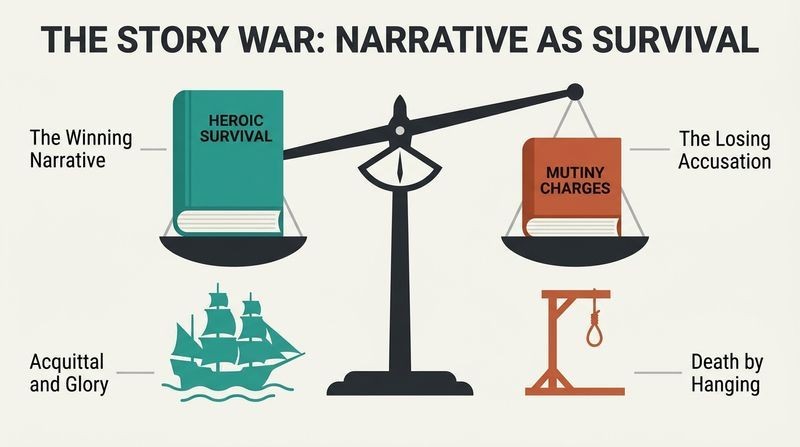
The real battle came after the shipwreck. In 1741, the British warship Wager wrecked off Patagonia during a secret mission to seize a Spanish treasure galleon. Two groups of survivors staggered home to England years apart, telling opposite stories. One group, led by gunner John Bulkeley, arrived first, hailed as heroes who navigated 3,000 miles in a patched-together boat. The other group, led by Captain David Cheap, accused them of mutiny.
Their lives literally depended on narration. In the Royal Navy, mutiny meant hanging from the yardarm. Each faction published dueling accounts, insisting on their own truth. Grann frames the whole saga around this: humans impose coherence on chaos, casting themselves as heroes so they can live with what they did.
What's striking is how Grann turns a shipwreck tale into an epistemology lesson. The book echoes Rashomon and Kurosawa's insight that truth fractures across witnesses. Modern memory science supports him: reconstructive memory research (Elizabeth Loftus) shows we edit recollections to preserve self-image, not accuracy. The Wager survivors weren't simply lying; they genuinely became protagonists of their own justifications. This connects to legal scholarship on how courtrooms privilege the most coherent narrative over the most accurate one, a point Grann makes explicitly through Janet Malcolm. The takeaway generalizes: institutions, nations, and individuals all curate self-serving stories, and power often decides which version survives.
Strip away authority and civilized men descend into a Hobbesian state fast
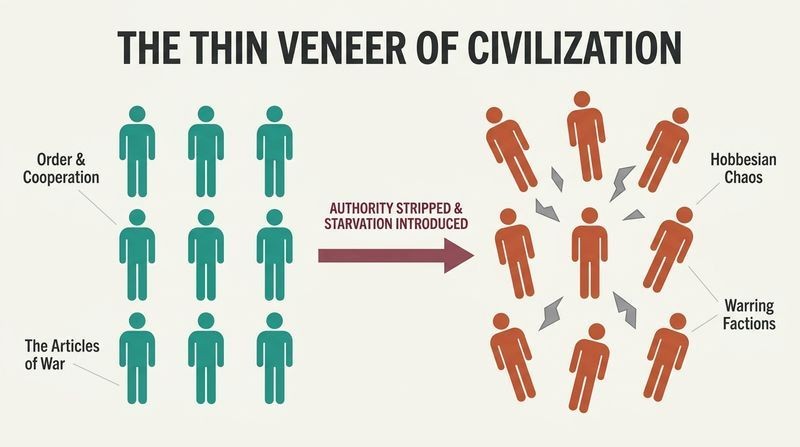
Order dissolved within weeks on the island. Roughly 145 survivors reached the barren island off Chile. At first Captain Cheap tried to recreate naval discipline, reciting the Articles of War and holding courts-martial. But as food vanished, the company splintered into warring factions: Cheap's loyalists, Bulkeley's partisans, a breakaway band of marines under Pemberton, and the marauding "seceders." Theft, floggings, abandonment, murder, and eventually cannibalism followed.
Science echoes what unfolded. Grann cites the 1945 Minnesota Starvation Experiment, where 36 fit, cooperative pacifist volunteers had calories halved. They became obsessive, deceitful, and violent, shocked at "how thin their moral and social veneers seemed." The castaways, starving in freezing storms with no controlled conditions, unraveled far faster and further, proving how fragile the supposed apostles of Enlightenment civilization really were.
The Minnesota parallel is the book's most powerful scientific anchor, and it lands. It resonates with Philip Zimbardo's Stanford Prison Experiment and Golding's Lord of the Flies (which Grann quotes as an epigraph): remove enforced structure and hierarchy curdles into predation. Yet there's a counterpoint worth noting. Not everyone descended. The Kawesqar indigenous people thrived in the same environment through cooperation, and figures like seaman John Jones showed gallantry throughout. This suggests behavior under deprivation isn't purely deterministic but shaped by culture, skills, and leadership. The "veneer theory" of civilization is contested; disaster sociologists like Rebecca Solnit document communities that grow more altruistic, not less, in crisis.
The empire's deadliest enemy wasn't Spain; it was scurvy and rot
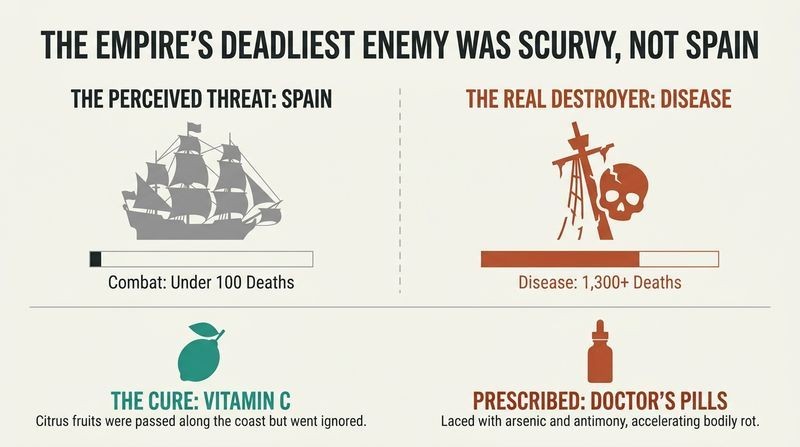
Disease killed far more than combat. Of roughly 2,000 men who set sail with Commodore Anson, over 1,300 died, the vast majority from disease, not enemy fire. Typhus, spread by lice, was planted in the ships before departure. Then scurvy struck: gums rotted, old wounds reopened, teeth fell out, men went mad. Nearly 300 of the Centurion's 500 men were listed "Discharged Dead."
The cure was tragically simple and unknown. Scurvy comes from vitamin C deficiency, halting collagen production. Citrus fruit would have saved them, and they had passed abundant limes at St. Catherine. Instead surgeons prescribed Dr. Ward's "pill and drop," a purgative laced with antimony and possibly arsenic that stripped nutrients and hastened death. The lifesaving lime was, as Grann puts it, right within their grasp.
This is a devastating case study in how ignorance compounds catastrophe. The tragedy deepens because the solution existed decades before the Navy adopted it (giving British sailors the nickname "Limeys"). What's instructive is the epistemic failure: surgeons had theories (bad air, cold climate) that felt authoritative but were untethered from evidence, and Dr. Ward's quack cure actively worsened outcomes. This mirrors modern debates about medical practices adopted before rigorous testing. The story also underscores a logistics truth military historians emphasize: expeditions are won or lost by supply chains and health, not heroics. Napoleon's Russia campaign and Gallipoli tell the same grim lesson.
Competence, not rank, is what men actually follow in a crisis
Two models of authority collided. Captain Cheap based his command purely on the chain of command, the letter from Anson naming him captain. When the ship still floated, that worked. But stranded and starving, Cheap grew rigid, paranoid, and violent, refusing to consult his officers. Bulkeley, a mere gunner socially beneath the aristocratic officers, rose through sheer merit: he built the best shelter, foraged relentlessly, kept a meticulous journal, and devised the Brazil escape plan.
The men gravitated to whoever kept them alive. As Bulkeley observed, Cheap knew how to govern aboard ship but tried to establish command ashore through courage and force alone. Grann notes the only leader sailors despise as much as a tyrant is one who cannot maintain order or protect their well-being.
This maps neatly onto modern leadership theory's distinction between positional power (authority from title) and personal power (authority from expertise and trust). Bulkeley embodies what management scholars call "emergent leadership," arising organically from demonstrated value rather than formal appointment. Yet Grann complicates the hero narrative: Bulkeley also relished his new status, and his self-serving journal was crafted partly as legal defense. The lesson isn't that merit-based leaders are morally superior, but that in extremis, legitimacy flows to whoever delivers results. Anson himself, notably, embodied both: he had rank and earned loyalty by sharing the crew's hardest labor, a servant-leadership model that never provoked mutiny.
The people the English called savages held the actual survival knowledge
The Kawesqar thrived where the British starved. These indigenous "nomads of the sea" had survived Patagonia's brutal coast for thousands of years, traveling in bark canoes, diving 30 feet for sea urchins, oiling their skin with seal blubber against the cold rather than wearing bulky clothes, and keeping fires burning even in their boats. When they visited the castaways, they brought mussels and sheep, offering a genuine lifeline.
English prejudice destroyed the opportunity. The King had given Anson a manifesto offering to civilize any "benighted" peoples encountered. Yet the Kawesqar held the key to salvation. When sailors tried to steal their canoes and harass their women, the Kawesqar silently packed up and vanished. Byron lamented that had they been treated well, they would have been of great assistance.
Grann quietly inverts the colonial hierarchy: the supposed bearers of civilization were helpless, while the "primitive" Kawesqar possessed sophisticated environmental mastery so advanced that NASA later studied their cold-adaptation methods. This aligns with anthropologist Wade Davis's argument about the "ethnosphere," the vast repository of indigenous knowledge that colonizers dismissed and destroyed. The episode is a compact tragedy of ethnocentrism sabotaging self-interest: the British couldn't see expertise through their racial contempt. It also foreshadows the book's darkest thread, the human cost of empire, culminating in John Duck, a free Black castaway later kidnapped into slavery, his story deliberately erased.
He who publishes first writes history, so Bulkeley weaponized his journal
A gunner staged a literary rebellion. Bulkeley was the only castaway keeping a contemporaneous daily journal, recording every event that showed Cheap unfit to lead. He understood that logbooks could serve as court-martial evidence, so he built an unassailable paper trail justifying each action. Back in England, destitute and facing hanging, he published his journal as a book in 1743, defying the convention that only senior officers wrote such accounts.
The first draft shaped public opinion. Lieutenant Baynes had raced home to blame Bulkeley, but Bulkeley countered that a memory-based account had less value than a contemporaneous one. His book, written in a crisp, modern "plain maritime style," went into a second printing and swayed the public. He had not only written the first draft of history but seemingly changed the future.
Bulkeley intuited what media scholars call "first-mover advantage" in narrative framing: the initial account becomes the anchor against which all later versions are judged. This is why crisis-communication experts insist on controlling the story immediately. His self-awareness about documentation prefigures modern practices, from police body cameras to corporate paper trails, where contemporaneous records carry outsized evidentiary weight. There's irony worth flagging: the very journal that reads as authentic truth-telling was strategically constructed as legal armor. Grann invites healthy skepticism toward any account that arrives pre-packaged as objective, especially one whose author had life-or-death stakes in how it was received.
Byron chose honor over survival and rowed back to a doomed captain
One man refused the easy exit. Sixteen-year-old midshipman John Byron (grandfather of the poet) faced an agonizing choice. He had joined Bulkeley's group heading home, but when they abandoned Captain Cheap on the island with a broken boat, Byron couldn't bear the dishonor. He deserted the escape party, rowed back through freezing waves, and rejoined Cheap's tiny, near-hopeless faction.
Loyalty nearly killed him. Byron's group tried three times to round a brutal cape and failed each time, eventually forced back to the island, reduced to eating rancid sealskin. Captured by the Spanish, Byron didn't reach England until 1746, five and a half years after leaving. He'd been presumed dead. Grann uses Byron's choice to dramatize how personal codes of honor can override rational self-interest, for better and worse.
Byron's decision illuminates the psychology of honor cultures, where reputation and self-respect outweigh survival calculus. Behavioral economists would call this apparently irrational, yet evolutionary psychologists argue honor signaling built the trust networks that let human groups function. Byron romanticized the sea through the adventure books he devoured, and his choice was partly a refusal to betray that self-image. The poignant detail is that his loyalty achieved nothing tangible; Cheap's plan failed utterly. Honor, Grann suggests, is not always adaptive. Yet Byron's later reputation for tenderness toward his own crews suggests the island forged a leader precisely because he had chosen principle over expedience.
Empires survive on the stories they tell and the silences they impose
The court-martial was rigged to forget. In 1746 the Admiralty finally tried the survivors, but the hearing pointedly examined only the loss of the ship, not the mutiny, the shooting of Cozens, the floggings, or the murders. Everyone was essentially acquitted. Grann argues the authorities didn't want either story to prevail, because documenting the savagery would have undercut the empire's central justification: that its officers were civilized gentlemen spreading enlightenment.
A triumphant myth buried the ugly truth. Meanwhile Anson's capture of the Spanish galleon (worth nearly $80 million today) was spun into a glorious tale. His official Voyage Round the World, secretly engineered and partly ghostwritten by Anson himself, became a bestseller that influenced Rousseau, Darwin, and Cook, while the Wager's descent into anarchy faded into what one historian called "the mutiny that never was."
This is Grann's most ambitious claim, elevating a survival yarn into a critique of imperial memory-making. It resonates with Michel-Rolph Trouillot's Silencing the Past, which argues power operates by deciding what enters the historical record. The War of Jenkins' Ear itself rested on a fabricated pretext, and the smuggling and slave-trading motives were, as historian David Olusoga notes, "expunged from the mainstream narrative." The deliberate non-prosecution of an obvious mutiny reveals institutions choosing reputational preservation over justice. What makes this durable is its universality: every nation curates a flattering self-portrait, and the archive's gaps, from John Duck's erased fate onward, are as telling as its contents.
Analysis
The Wager is popular narrative history at its most sophisticated, using a single 1741 shipwreck to interrogate how truth is manufactured, contested, and buried. Grann, a master of the New Yorker long-form tradition, structures the book as competing testimonies precisely because no impartial account exists. His authorial note declares he will present all sides and leave readers as history's jury, a framing that transforms an adventure story into a meditation on epistemology, memory, and power.
The book's genius is layering. At the surface it delivers visceral spectacle: hurricanes off Cape Horn, scurvy-blackened bodies, cannibalism, a captain shooting an unarmed midshipman. Beneath that runs a study of institutional decay under extreme stress, anchored by the Minnesota Starvation Experiment. Deeper still lies a postcolonial critique, contrasting the helpless "civilized" British with the masterful Kawesqar, and tracking how empire preserves itself through selective storytelling. The John Duck thread, a free Black seaman sold into slavery whose story vanishes, is Grann's sharpest instrument, showing that historical silence is itself a form of violence.
What elevates the work is Grann's restraint. He resists moralizing, letting the archival fragments (logbooks, court records, dueling published narratives) collide. This mirrors his method in Killers of the Flower Moon: patient archival excavation surfacing suppressed truths.
The book's limitation is that its central thesis, that we are all heroes of self-serving stories, is more asserted than proven, and the survival-under-deprivation determinism it implies is contestable, given documented cases of crisis altruism. Still, the synthesis is masterful. Grann demonstrates that the most dangerous thing aboard the Wager was neither the sea nor the Spanish, but the human need to narrate oneself into innocence. For contemporary readers awash in competing narratives and institutional spin, the book reads less like distant history than an unsettlingly current parable about whose version of events gets to become the truth.
Review Summary
The Wager is a gripping true story of shipwreck, survival, and mutiny. Readers praise Grann's meticulous research and vivid storytelling, bringing 18th-century naval life to life. The book explores themes of imperialism, class, and human nature under extreme conditions. While some found the pacing uneven, most were captivated by the harrowing tale and its complex characters. The narrative's focus on multiple perspectives and the subsequent trial adds depth to the survival story. Overall, it's a compelling read that rivals fiction in its suspense and historical detail.
People Also Read





FAQ
What is The Wager: A Tale of Shipwreck, Mutiny and Murder about?
- Shipwreck and Survival: The book recounts the harrowing tale of the HMS Wager, a British warship that is shipwrecked off the coast of Patagonia in 1741. The story focuses on the crew's desperate struggle for survival on a desolate island.
- Mutiny and Conflict: As conditions worsen, the crew divides into factions, leading to a mutiny against their captain. The narrative explores the power struggles and moral dilemmas faced by the men as they fight for control and survival.
- Conflicting Narratives: The book examines the wildly different accounts of the events that unfolded, as told by the survivors. It delves into the complexities of truth, memory, and the human tendency to shape stories to serve their own interests.
Why should I read The Wager: A Tale of Shipwreck, Mutiny and Murder?
- Compelling True Story: The book offers a gripping, real-life adventure story filled with suspense, danger, and human drama. It explores the extremes of human behavior when faced with unimaginable hardship.
- Exploration of Human Nature: The narrative delves into the psychological and moral complexities of the characters, revealing the dark side of human nature when pushed to the brink. It examines themes of leadership, loyalty, and the struggle for survival.
- Historical Insight: The book provides a fascinating glimpse into the world of eighteenth-century naval exploration and the brutal realities of life at sea. It also sheds light on the power dynamics and social hierarchies of the time.
What is the background of The Wager: A Tale of Shipwreck, Mutiny and Murder?
- Historical Context: The story is set during the War of Jenkins' Ear, a conflict between Great Britain and Spain in the 1740s. The book explores the imperial ambitions and naval rivalries of the time.
- Geographical Setting: The narrative takes place in the treacherous waters off the coast of Patagonia, a region known for its harsh climate and unforgiving seas. The desolate landscape of Wager Island becomes a character in itself.
- Naval Culture: The book delves into the rigid structure and codes of conduct of the British Royal Navy. It examines the power dynamics between officers and crew, and the challenges of maintaining order and discipline in extreme circumstances.
What are the most memorable quotes in The Wager: A Tale of Shipwreck, Mutiny and Murder?
- "We are the hero of our own story.": This quote, from Mary McCarthy, highlights the subjective nature of memory and the human tendency to shape narratives to portray oneself in a favorable light. It underscores the book's exploration of conflicting perspectives.
- "Maybe there is a beast….Maybe it's only us.": This quote, from William Golding's Lord of the Flies, foreshadows the descent into savagery and violence that the crew experiences on Wager Island. It speaks to the book's exploration of the dark side of human nature.
- "We stand or fall by the truth; if truth will not support us, nothing can.": This quote, from one of the survivors, emphasizes the importance of truth and integrity in the face of adversity. It also highlights the conflicting narratives and the struggle to determine what really happened.
What writing style, narrative choices, and literary techniques does David Grann use?
- Detailed Historical Research: Grann meticulously weaves together historical documents, journals, and firsthand accounts to create a vivid and immersive narrative. He brings the past to life with rich details and compelling characters.
- Multiple Perspectives: The book presents the story from various viewpoints, allowing the reader to see the events through the eyes of different characters. This technique highlights the subjective nature of truth and the complexities of human motivation.
- Suspenseful Pacing: Grann masterfully builds suspense throughout the narrative, keeping the reader engaged and eager to uncover the truth. He uses foreshadowing and dramatic irony to create a sense of unease and anticipation.
Hidden Details & Subtle Connections
What are some minor details that add significant meaning?
- The Name "Wager": The ship's name, given in honor of Sir Charles Wager, the First Lord of the Admiralty, foreshadows the high stakes and risks involved in the voyage. It also highlights the gamble that the men were taking with their lives.
- The Red Lion Figurehead: The Centurion's red lion figurehead, a symbol of British power and pride, contrasts with the ship's vulnerability to the forces of nature. It also foreshadows the violence and bloodshed that will occur during the voyage.
- The Missing Logbooks: The fact that some of the Wager's logbooks were destroyed or went missing suggests a deliberate attempt to conceal the truth about what happened on the island. It also highlights the importance of narrative control in shaping historical events.
What are some subtle foreshadowing and callbacks?
- Captain Kidd's Prophecy: The dying words of Captain Kidd, who predicted "poverty, vermin, famine, death and destruction," foreshadow the grim fate that awaits the Wager's crew. It also adds a sense of foreboding to the narrative.
- The Albatross: The mention of the albatross near Staten Island, a reference to Coleridge's "Rime of the Ancient Mariner," foreshadows the ill fortune that will befall the Wager. It also highlights the superstitious nature of the seamen.
- The Island of Blood: The mention of St. Julian, also known as the Island of Blood, where Magellan and Drake had executed mutineers, foreshadows the violence and bloodshed that will occur on Wager Island. It also highlights the cyclical nature of history.
What are some unexpected character connections?
- Cheap and Anson: Despite their different personalities, Cheap and Anson share a deep respect for naval discipline and a desire for glory. Their relationship highlights the complexities of leadership and the challenges of maintaining order in extreme circumstances.
- Bulkeley and Cheap: Despite their conflict, Bulkeley and Cheap share a certain level of respect for each other's abilities. Their relationship highlights the tension between authority and pragmatism, and the challenges of leading men in a crisis.
- Byron and Cozens: The friendship between Byron and Cozens, two midshipmen from different social classes, highlights the bonds that can form in the face of adversity. Their relationship also underscores the tragic consequences of dissent and the limits of authority.
Who are the most significant supporting characters?
- John Bulkeley: As the gunner, Bulkeley is a skilled seaman and a natural leader. His journal provides a crucial perspective on the events that unfolded, and his actions shape the course of the narrative.
- Lieutenant Baynes: As the second-in-command, Baynes's indecisiveness and lack of leadership contribute to the chaos and division among the crew. His actions highlight the challenges of maintaining authority in a crisis.
- John Cummins: As the ship's carpenter, Cummins is a skilled craftsman and a loyal friend to Bulkeley. His efforts to repair the longboat provide a glimmer of hope for the castaways.
Psychological, Emotional, & Relational Analysis
What are some unspoken motivations of the characters?
- Cheap's Need for Validation: Cheap's rigid adherence to naval regulations and his pursuit of glory stem from a deep-seated need to prove himself after a history of personal setbacks. His actions are driven by a desire to overcome his past failures and achieve the recognition he craves.
- Bulkeley's Desire for Control: Bulkeley's ambition and his desire to lead the men stem from a need to assert his own authority and to take control of his own destiny. His actions are driven by a desire to escape the limitations of his social status and to shape his own narrative.
- Byron's Search for Identity: Byron's internal conflict between loyalty to Captain Cheap and the pragmatic leadership of Bulkeley reflects his struggle to define his own identity and to find his place in the world. His actions are driven by a desire to live up to his family's expectations while also forging his own path.
What psychological complexities do the characters exhibit?
- Cheap's Obsessiveness: Cheap's obsession with naval regulations and his refusal to deviate from his orders reveal a rigid and inflexible personality. His inability to adapt to changing circumstances contributes to his downfall.
- Bulkeley's Self-Righteousness: Bulkeley's unwavering belief in his own righteousness and his tendency to see himself as a victim of circumstance reveal a complex and sometimes contradictory character. His actions are driven by a desire to be seen as a hero.
- Byron's Idealism: Byron's romantic view of the sea and his struggle to reconcile his ideals with the harsh realities of life at sea reveal a sensitive and conflicted personality. His actions are driven by a desire to live up to his own moral code.
What are the major emotional turning points?
- The Shipwreck: The shipwreck of the Wager is a major emotional turning point, plunging the crew into a state of fear, despair, and uncertainty. It marks the beginning of their desperate struggle for survival and the breakdown of naval order.
- The Mutiny: The mutiny against Cheap is another major emotional turning point, highlighting the crew's growing discontent and the breakdown of their unity. It marks the beginning of a power struggle that will shape the rest of their journey.
- The Death of Cozens: The shooting of Cozens is a major emotional turning point, revealing the depths of Cheap's rage and the fragility of life on the island. It also underscores the moral dilemmas faced by the crew and the consequences of their actions.
How do relationship dynamics evolve?
- Cheap and the Crew: Cheap's relationship with his crew deteriorates as his authority is challenged and his decisions are questioned. His inability to connect with his men on a personal level contributes to the growing discontent and the eventual mutiny.
- Bulkeley and the Crew: Bulkeley's relationship with the crew evolves as he emerges as a leader among the dissenters. His ability to connect with the men on a personal level and to offer a pragmatic plan for survival earns him their loyalty and support.
- Byron and His Messmates: Byron's relationships with his messmates, particularly Cozens, highlight the bonds that can form in the face of adversity. Their friendships are tested by the challenges of survival and the shifting allegiances within the crew.
Interpretation & Debate
Which parts of the story remain ambiguous or open-ended?
- The True Cause of the Wreck: The book leaves open the question of whether the Wager's shipwreck was the result of negligence, incompetence, or simply bad luck. It highlights the difficulty of determining the truth in the face of conflicting accounts.
- The Extent of Cheap's Tyranny: The book presents conflicting perspectives on Cheap's leadership, leaving the reader to decide whether he was a tyrannical and incompetent commander or a victim of circumstance. It underscores the subjective nature of truth and the challenges of judging historical figures.
- The Fate of the Seamen Left Behind: The book leaves open the question of what happened to the men who were left behind on Wager Island, including the four marines and the seceders. It highlights the tragic consequences of the expedition and the uncertainty of their fate.
What are some debatable, controversial scenes or moments in The Wager: A Tale of Shipwreck, Mutiny and Murder?
- Cheap's Shooting of Cozens: The shooting of Cozens is a highly controversial moment, raising questions about the limits of authority and the use of violence. It highlights the moral dilemmas faced by the characters and the consequences of their actions.
- Bulkeley's Mutiny: The mutiny against Cheap is a highly debatable moment, raising questions about the legitimacy of rebellion and the nature of leadership. It highlights the tension between duty and self-preservation, and the challenges of maintaining order in a crisis.
- The Abandonment of Cheap: The decision to abandon Cheap on Wager Island is a highly controversial moment, raising questions about the limits of loyalty and the moral implications of leaving a fellow human being to die. It underscores the desperate measures that the castaways were willing to take to survive.
The Wager: A Tale of Shipwreck, Mutiny and Murder Ending Explained: How It Ends & What It Means
- No Clear Resolution: The book's ending is not a neat resolution, but rather a complex and ambiguous conclusion that leaves the reader to grapple with the moral and psychological implications of the events. It highlights the difficulty of determining the truth and the lasting impact of trauma.
- The Power of Narrative: The ending underscores the power of narrative in shaping our understanding of history and the human experience. It reveals how stories can be used to justify actions, to conceal the truth, and to create a sense of meaning in the face of chaos.
- The Enduring Legacy: The book's ending suggests that the legacy of the Wager affair is not just about the events that occurred on the island, but also about the stories that were told about them. It highlights the enduring power of human experience and the importance of remembering the past.
About the Author
Other books by David Grann


Download PDF
Download EPUB
.epub digital book format is ideal for reading ebooks on phones, tablets, and e-readers.








































