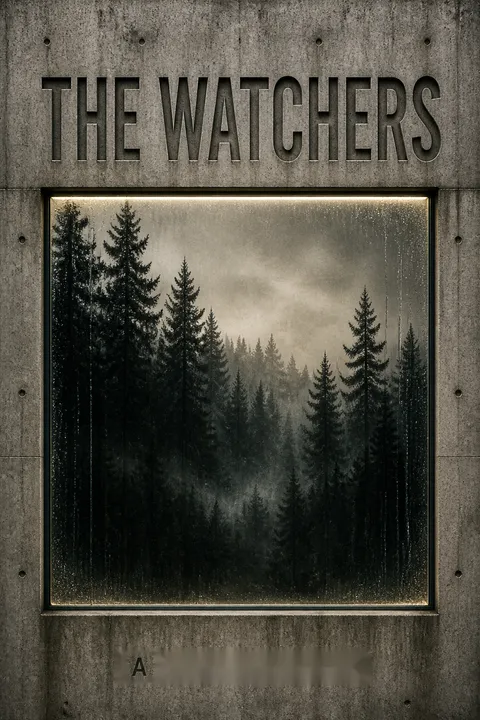

Plot Summary
Into the Forest's Maw
Mina, a struggling artist, accepts a job to deliver a rare parrot to a remote buyer in Connemara. Her car breaks down at the edge of a dense, ancient forest, and she's forced to seek help on foot. The forest is unnaturally dark and silent, and as night falls, Mina is stalked by inhuman shrieks. She stumbles through the oppressive woods, her fear mounting, until she sees a distant light—a beacon of hope in the suffocating gloom. The forest's oppressive atmosphere and the sense of being watched set the tone for the terror to come, as Mina's journey into the unknown begins.
The Shelter of Glass
Mina is rescued by Madeline, a gaunt, severe woman who drags her into a concrete shelter just before nightfall. Inside, she meets Daniel, a nervous young man, and Ciara, a gentle woman broken by grief. The shelter's main room is dominated by a huge mirrored window, and at night, a blinding light comes on, trapping them inside. Madeline explains the rules: never go out after dark, never let the light go out, and never let the watchers see you sleep. The group's fragile dynamic is established, with Madeline's authority unchallenged and the others cowed by fear and hunger.
Rules of Survival
The group's daily existence is a grim routine of foraging for berries and water, setting bird traps, and enduring the long, sleepless nights under the shelter's harsh light. The watchers—creatures that emerge from underground pits at night—surround the shelter, screaming and clawing at the glass if they sense weakness. Madeline enforces strict discipline, believing that only ruthlessness ensures survival. Mina, Daniel, and Ciara struggle with despair, hunger, and the psychological toll of being watched, while Madeline's cold pragmatism keeps them alive but breeds resentment.
The Watchers' Gaze
Mina is dared to look into the mirrored glass at night, and is nearly driven mad by the sudden, monstrous face that appears on the other side. The watchers are not just beasts—they mimic human forms, their faces twisted parodies of the living. The group realizes they are being studied as much as imprisoned. The watchers' fascination is both predatory and curious, and their nightly presence becomes a psychological torment. The shelter is both a prison and a stage, with the survivors as unwilling performers.
Fractured Companionship
As food dwindles and hope fades, the group's unity fractures. Daniel, desperate for approval, fails at trapping birds and is berated by Madeline. Ciara mourns her missing husband, John, whose failed escape attempt haunts her. Mina tries to mediate, but her own doubts about Madeline's motives grow. The group's fragile trust is shattered when John's screams are heard outside one night—he has been captured by the watchers, and Madeline refuses to open the door, condemning him to a horrific fate. Ciara's grief turns to bitterness, and Daniel's guilt festers.
The Failed Escape
The psychological strain reaches a breaking point. Daniel, pushed to the edge by Madeline's cruelty, steals her keys and locks her and Mina out of the shelter just before nightfall. Trapped outside, Mina and Madeline must hide in the darkness as the watchers prowl the building, their inhuman forms glimpsed in the firelight. The terror of being hunted cements Mina's dependence on Madeline, even as she questions her humanity. Inside, Ciara and Daniel are wracked with guilt, and the group's survival is now in jeopardy.
Night of Screams
The next night, the watchers launch a full assault on the shelter, enraged by the group's disobedience. The glass is nearly shattered, the door battered, and the survivors are pushed to the brink. In the chaos, Mina discovers a hollow in the floor beneath the table—a hidden steel hatch. As the shelter is overrun, the group bands together to break through the floor, desperate for any escape from the relentless siege above.
The Hollow Beneath
Beneath the shelter, the group finds a hidden steel chamber—a safe house stocked with food, water, and surveillance equipment. The room was built by Professor Kilmartin, a scholar obsessed with the watchers. His video diary reveals the truth: he lured workers to their deaths to build the shelter, studied the watchers' mimicry, and ultimately went mad. He leaves instructions for escape: a boat hidden by a southern river, and a plea to destroy all evidence of the watchers' existence. The group's hope is rekindled, but the cost of survival weighs heavily.
Kilmartin's Secret
Kilmartin's research and Madeline's reluctant confession reveal the watchers' true nature: they are changelings, ancient beings banished underground by humans, able to mimic human appearance but not emotion. The shelter was built as both a trap and a stage for their study. Madeline, it is implied, is not fully human herself—her knowledge and detachment hint at a deeper connection to the watchers. The group must decide whether to trust her as they plan their escape.
The Plan to Flee
With the shelter destroyed and the watchers enraged, the group prepares to flee at dawn, following Kilmartin's directions to the river. Madeline takes charge, her authority unchallenged in the face of mortal danger. The journey is grueling—Mina is barefoot, Ciara injured, Daniel terrified—but they push on, driven by the hope of freedom. The watchers' pursuit is relentless, their screams echoing through the forest as night falls.
The Desperate Flight
As the group nears the river, Daniel is lured away by a watcher mimicking Ciara's lost husband. He is surrounded and killed, his sacrifice buying the others precious moments to reach the boat. The escape is frantic—Mina nearly drowns, Madeline pulls her aboard, and the group rows desperately as the watchers swarm the shore. The cost of survival is made clear: not all can be saved, and the trauma of loss will haunt the survivors.
The River's Salvation
The boat carries Mina, Ciara, and Madeline downriver, away from the forest and the watchers' domain. The night is filled with screams, but the river proves a barrier the watchers cannot cross. As dawn breaks, the survivors reach a bridge and a road, where they are rescued by a passing bus. The return to civilization is surreal—after months of terror, the ordinary world feels alien and unsafe. The survivors are changed, their ordeal invisible to those around them.
After the Darkness
Back in the city, Mina struggles to adjust. She is plagued by paranoia, unable to trust reflections or strangers' faces. Ciara returns to her empty home, mourning John and Daniel. Madeline disappears, her fate uncertain. The survivors are bound by trauma and secrecy, unable to share their story with the world. The cost of survival is isolation, and the threat of the watchers lingers in every shadow.
The Truth of Madeline
Mina investigates Kilmartin's past and discovers a photograph of Madeline—she was Kilmartin's wife, dead for years. The Madeline who survived with them is a watcher, a changeling who learned to mimic humanity from Kilmartin. When Mina confronts her, Madeline reveals her true form, nearly killing Ciara before relenting. She demands Mina keep the secret, then vanishes into the night. The line between human and monster is blurred, and Mina is left questioning what it means to belong.
The Last Loose Ends
Mina fulfills Kilmartin's last wish, destroying his research at the university to prevent others from seeking the watchers. Ciara, traumatized but alive, tries to rebuild her life. The survivors agree never to speak of the forest, but the threat remains—Madeline is still out there, and the watchers' existence is not so easily erased. The burden of knowledge isolates Mina, who is haunted by what she has seen.
The Return to Light
Mina and Ciara attempt to resume their lives, meeting regularly for comfort and support. The world seems unchanged, but they are not. Mina's art is tainted by her experiences, her trust in others shattered. The memory of Daniel and John lingers, and the fear of being watched never fully fades. The survivors are marked by their ordeal, struggling to find meaning in a world that cannot understand their trauma.
The Cost of Survival
Mina's paranoia grows—she sees Madeline's face in strangers, fears the watchers' return, and is unable to fully reconnect with her old life. The trauma of survival is a wound that will not heal, and the knowledge of what lurks in the dark is a burden she cannot share. The story ends with Mina spotting Madeline—now wearing a new face—watching her from the crowd, a chilling reminder that the watchers are still among us.
Shadows in the Sun
The final chapter leaves Mina—and the reader—with the unsettling truth: the watchers have learned to walk in daylight, to mimic humanity perfectly. Madeline warns Mina that she is not safe, that the watchers are everywhere, and that they have been watching her all along. The cycle of fear and secrecy continues, and the boundary between human and monster is forever blurred.
Analysis
A modern fable of fear, identity, and the cost of survivalThe Watchers is a masterful blend of folk horror and psychological thriller, using the claustrophobic setting of the forest and the shelter to explore themes of surveillance, mimicry, and the boundaries of humanity. The watchers are both monsters and mirrors, reflecting the survivors' fears, desires, and failures. The story interrogates the price of survival—what must be sacrificed, who must be left behind, and how trauma reshapes identity. Madeline's ambiguous nature challenges the binary of human and monster, suggesting that belonging is as much about choice as nature. The novel's cyclical structure and unresolved ending underscore the persistence of fear and the impossibility of returning to innocence. In a world where the watchers can walk in daylight, the true horror is not what lurks in the dark, but what hides in plain sight. The lesson is clear: survival demands vigilance, empathy, and the courage to face the monsters within and without.
Review Summary
Reviews for The Watchers are largely positive, averaging 3.87/5. Readers consistently praise the atmospheric Irish folklore setting, creepy creature design, and compelling premise. Many compare it favorably to Bird Box and A Quiet Place. Common criticisms include overly purple prose, slow pacing in the middle sections, and a twist some found predictable. Several reviewers suggest the story would have worked better as a novella. Highlights include the claustrophobic bunker setting, strong protagonist Mina, and an memorable ending that left many eager for the sequel.
People Also Read


Characters
Mina
Mina is the protagonist, a thirty-something artist whose cynicism and self-doubt mask a deep well of resilience. Her journey from urban isolation to primal terror in the forest forces her to confront her own fears and limitations. Mina's empathy and curiosity set her apart—she questions Madeline's authority, seeks the truth about the watchers, and ultimately becomes the group's emotional anchor. Her trauma lingers after escape, manifesting as paranoia and alienation, but she remains determined to protect others from the horrors she has witnessed. Mina's arc is one of reluctant leadership, forced to choose between survival and compassion.
Madeline
Madeline is the group's stern, enigmatic matriarch, enforcing strict rules and brooking no dissent. Her knowledge of the watchers and the shelter's workings is uncanny, and her cold pragmatism keeps the group alive but breeds resentment. As the story unfolds, it becomes clear that Madeline is not fully human—she is a changeling, a watcher who learned to mimic humanity from Kilmartin. Her struggle is one of identity: she yearns for belonging but is trapped between worlds. Madeline's actions oscillate between cruelty and mercy, and her final choice to spare Mina and Ciara suggests a capacity for growth, even as she remains a threat.
Ciara
Ciara is the group's emotional heart, a gentle, optimistic woman devastated by the loss of her husband, John. Her kindness and vulnerability make her a target for Madeline's scorn, but also inspire loyalty in Mina and Daniel. Ciara's arc is one of endurance—she survives unimaginable loss, clings to hope, and ultimately chooses to forgive those who failed her. Her relationship with Daniel is sibling-like, and her bond with Mina provides both women with the strength to carry on. Ciara's struggle to rebuild her life after the forest is a testament to the resilience of the human spirit.
Daniel
Daniel is a nineteen-year-old runaway, desperate for acceptance and approval. His anxiety and self-doubt make him vulnerable to Madeline's manipulation, but his loyalty to Ciara and Mina is unwavering. Daniel's arc is one of tragic heroism—he is pushed to rebellion, makes fatal mistakes, and ultimately sacrifices himself to save the others. His death is the story's emotional nadir, a reminder of the cost of survival and the cruelty of the watchers. Daniel's memory haunts the survivors, symbolizing lost innocence and the price of hope.
John
John is Ciara's husband, whose failed escape attempt and subsequent death at the hands of the watchers is a turning point for the group. His presence is felt through Ciara's grief and the group's guilt, and his fate serves as a warning against false hope. John's memory motivates Ciara to survive, but also haunts her with what might have been. His mimicry by the watchers is a chilling demonstration of their power and cruelty.
Professor Kilmartin
Kilmartin is the unseen architect of the shelter and the safe house beneath it. His obsession with the watchers leads him to sacrifice countless lives in pursuit of knowledge, and his video diary reveals both his brilliance and his madness. Kilmartin's relationship with Madeline (his dead wife, mimicked by a watcher) is the emotional core of his tragedy. His final plea to destroy all evidence of the watchers is both a warning and a curse, binding the survivors to secrecy.
The Watchers
The watchers are the story's primary antagonists—creatures banished underground, able to mimic human appearance but not emotion. Their nightly surveillance is both predatory and curious, and their attacks are marked by cruelty and psychological torment. The watchers' fascination with humanity is mirrored by their horror at their own exile, and their ability to walk in daylight by the story's end suggests an evolution that threatens the world beyond the forest.
The Parrot (Golden Conure)
The parrot, initially a simple errand, becomes a symbol of Mina's lost innocence and her determination to protect something pure in a world of horror. Its survival mirrors Mina's own, and its presence provides comfort and a tenuous link to the world outside the forest.
Peter
Peter is the gruff, well-meaning pub regular who gives Mina the job that leads her into the forest. His presence bookends the story, representing the ordinary world Mina longs to return to. Peter's obliviousness to Mina's ordeal underscores the isolation of trauma.
The Android Woman
The android woman is a recurring figure in Mina's sketches and, by the story's end, is revealed as Madeline's new face. Her appearance in the city is a chilling reminder that the watchers have learned to blend in, and that the cycle of fear is not over.
Plot Devices
The Mirrored Glass
The shelter's mirrored window is both a literal and symbolic barrier between the survivors and the watchers. It allows the watchers to observe and mimic their captives, while forcing the survivors to confront their own fears and identities. The glass's dual nature—transparent by day, reflective by night—mirrors the story's themes of surveillance, performance, and the blurring of human and monster. Its eventual destruction signals the collapse of the survivors' fragile safety and the need to confront the truth beneath the surface.
The Changelings' Mimicry
The watchers' ability to mimic human appearance is the story's central horror. Their imperfect imitations are both grotesque and pitiable, reflecting a longing for connection and a fundamental alienation. The mimicry extends to Madeline, whose struggle to belong drives much of the narrative tension. The device raises questions about identity, empathy, and the boundaries of humanity.
The Hidden Bunker
The steel chamber beneath the shelter is both a literal and metaphorical descent into the past. It offers temporary safety and the hope of escape, but also reveals the dark history of Kilmartin's obsession and the cost of knowledge. The bunker's surveillance equipment and video diary serve as expository devices, delivering crucial backstory and raising the stakes for the survivors' escape.
Foreshadowing and Circular Structure
The story is structured around cycles—day and night, hope and despair, escape and entrapment. Early hints (the parrot's distress, the forest's silence, Madeline's oddness) foreshadow later revelations. The survivors' return to civilization is haunted by the same fears that plagued them in the forest, and the final chapters suggest that the watchers' threat is ongoing, their ability to blend in now perfected.
Psychological Horror
The narrative leverages the characters' psychological deterioration—sleep deprivation, hunger, guilt, and trauma—to heighten the horror. Mina's perspective is often unreliable, her perceptions colored by fear and doubt. The story blurs the line between external threat and internal breakdown, making the horror as much about what the characters become as what they face.
Download PDF
Download EPUB
.epub digital book format is ideal for reading ebooks on phones, tablets, and e-readers.








































