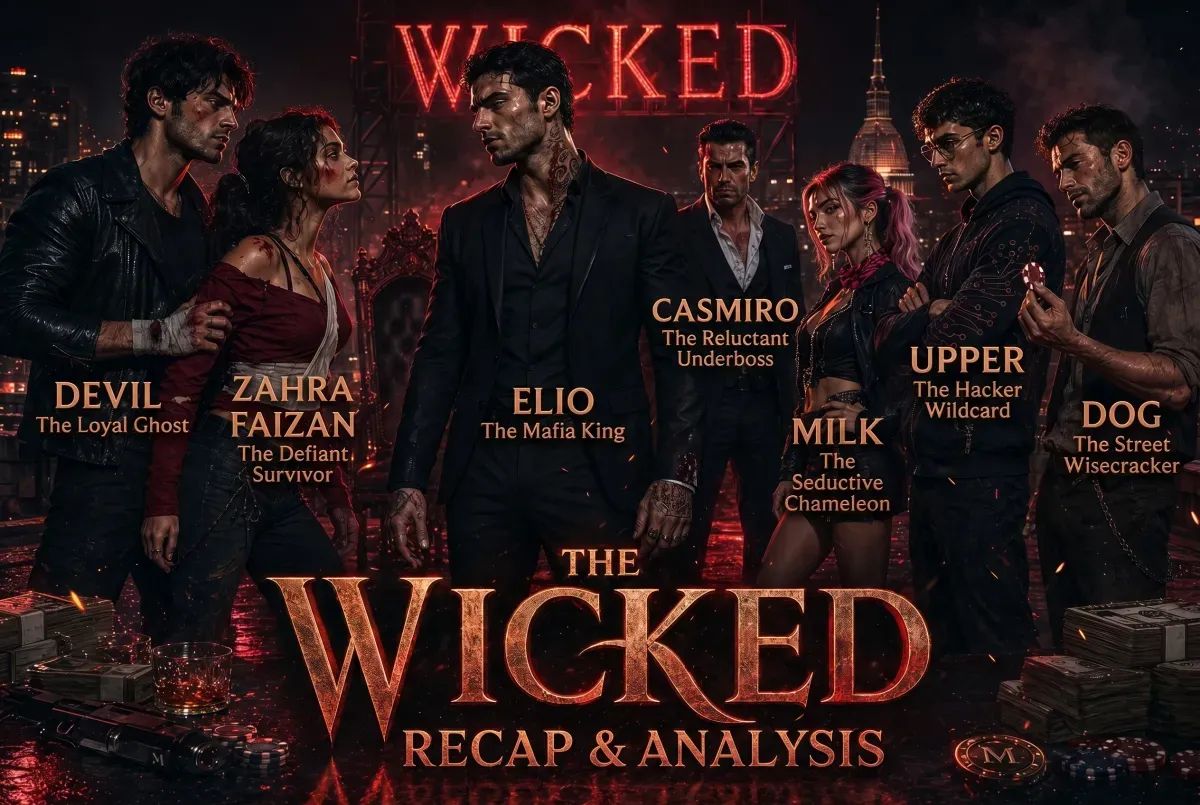


Plot Summary
Prologue
Elio Marino,2 the mafia boss the underworld calls The Wicked,2 hears that a crew named Street has burned one of his vault houses and destroyed six billion in revenue. His underboss Casmiro4 and the associate Basilio insist a rival family must be responsible, and Basilio pushes the theory until Elio simply shoots him dead at his own desk, presses a lit cigar into the spreading blood, and orders Basilio's family and home erased.
He cares nothing for the lost money; only power moves him. The scene draws a man without loyalty, mercy, or fear, who trusts no one and dismisses the unknown thieves as children throwing tantrums, even as Casmiro4 quietly disapproves of how he runs everything.
The prologue establishes Elio as a closed system: a man who has converted every human impulse into calculation. Killing Basilio mid-sentence demonstrates that he punishes usefulness and disloyalty alike, and that information matters less to him than dominance. The cigar in the blood is ritual, not rage. Crucially, his indifference to six billion lost signals that the coming conflict will not be about money but about control, ego, and meaning. Casmiro's smothered objection plants the book's central tension: those closest to Elio crave a trust he refuses to extend. We meet the myth of The Wicked before we meet the wounded man beneath it.
Street's Triumphant Vault Heist
Zahra1 and her crew, a found family of street-bred criminals who rob other criminals, celebrate the biggest score of their lives: looting and torching a Marino vault house. They fantasize aloud about a year-long vacation, America, Hawaii, freedom at last. Dog6 readies the bill counter, Milk7 dreams of a salon, Devil3 holds Zahra1 close. Then glass shatters.
Masked men flood their studio with choking white smoke and gunfire. Zahra1 fights to stay upright, reaching for a screaming Milk,7 before a gun butt drops her into darkness. The crew that prides itself on never being seen has finally been caught, their celebration curdling into a trap that delivers them to the very empire they robbed, undone by a single careless thing left behind.
The opening inverts the heist-glamour fantasy almost immediately, letting the reader taste freedom before snatching it away. Johnpee frames Street as a chosen family whose criminality is survival, not greed, which buys them sympathy before the violence lands. The vacation talk functions as dramatic irony: the more vividly they imagine escape, the more devastating the raid. Zahra's instinct to reach for Milk rather than save herself quietly establishes her defining trait, the compulsion to protect her crew above her own life. The unnamed mistake left at the scene becomes the engine of everything that follows, a reminder that in this world, one slip rewrites a destiny.
The Hot Room Bargain
Zahra1 wakes lashed to a chair in a sweltering, reeking cell. Elio2 arrives, pours water into her nose to simulate drowning, then shoots her shoulder and digs his thumb into the wound, demanding the name of her employer. She insists Street answers to no one.
Unconvinced, he orders her and her friends killed, the others forced to watch her die. Refusing to beg her way out, Zahra1 instead proposes a deal: Street will become his invisible assets, slipping into his legal world to bend outcomes in his favor, indebted to him for life.
Intrigued by her nerve, Elio2 lets the death threat hang in the air. She cannot know he has already decided to keep them, leaving her to assume the worst because, as he tells Casmiro,4 fear kills faster than death itself.
The torture scene refuses to eroticize cruelty; it is clinical, suffocating, and grotesque, which makes Zahra's pivot from victim to negotiator the more striking. Where most would plead, she pitches value, recasting herself from prey into asset. This is her core survival strategy: never powerless, always bargaining. Elio's choice to withhold the truth that they will live, letting assumption torment them, reveals his belief that psychological terror is the superior weapon. The chapter sets the relational template, two strategists circling, each trying to control the other's mind. Her shoulder wound becomes a literal scar of their origin, a debt written in blood that neither will let the other forget.
Guests, Not Quite Prisoners
Zahra1 wakes healed in guest quarters; Street is alive but furious she signed their lives away. They reconcile, agreeing to observe and scheme. Summoned to Elio's2 casino boardroom, the crew dissolves into a ridiculous argument over whether black counts as a color, accidentally displaying their genius: Upper8 educated himself crawling through school vents, Dog6 memorizes everything he reads, Milk7 bends people with a smile.
Watching, Elio2 recognizes their worth as political tools rather than corpses. He assigns their first job, infiltrate the Pablo syndicate and harvest intel on Dion Juan Pablo, the man whose dog Street once accidentally killed.
The most controlled man alive has hired a crew that runs entirely on chaos, and the friction between their methods sparks at once, half threat, half fascination.
The boardroom comedy is strategic characterization: beneath the bickering, each crew member's superpower is revealed, justifying why Elio spares them. The argument about color also seeds a motif, Elio's insistence that black is the absence of all color mirrors his self-erasure, his refusal to be one knowable thing. Zahra's needling, correcting him in front of his men, asserts that she will not perform submission, and his irritation is laced with intrigue. The scene shifts the power geometry from captor and captives to uneasy collaborators. By making chaos useful, the book argues that the qualities that mark Street as broken misfits are precisely what make them indispensable to a man who controls everything but feels nothing.
The Brother He Erased
Elio2 holds Devil3 back after the meeting, and the truth detonates: they are half-brothers. Their father sired Devil,3 murdered Devil's3 mother, and ordered the boy killed; a fifteen-year-old Elio2 claimed he would do it himself, then secretly smuggled Devil3 to Los Angeles, sacrificing a piece of his soul to keep him breathing.
Devil,3 who buried his old name, never forgave the abandonment or the broken promise to never send him away. Their reunion erupts into a brawl, Devil3 pounding Elio's2 face while Elio2 refuses to defend himself. When Casmiro's4 men aim at Devil,3 Elio2 shields him and threatens death to anyone who touches a hair on his head. Afterward, alone, Elio2 forgets how to count, sinks to the floor, and reaches for a shard of glass.
The reveal reframes the entire premise: the heist that began everything quietly reunited estranged blood. Johnpee uses the brothers to dramatize the book's thesis about inheritance, that Elio's protective love and his monstrousness spring from the same poisoned root. Devil's rage is the grief of a child who waited for a brother who never came; Elio's refusal to fight back is penance. The moment he shields Devil from Casmiro's gun shows that beneath the tyrant lives a fifteen-year-old still trying to save someone. The shard of glass exposes self-harm as his regulation strategy, foreshadowing the depth of his illness and the cost of the secret he has carried alone.
Best of Five
Reckless and bored, Street slips into Elio's2 casino to gamble loudly and stir trouble. Elio2 descends and challenges Zahra1 to chess, best of five, her winnings and a briefcase of cash against her life, with the right to renegotiate Street's terms if she wins. She plays the opening rounds like an amateur, dropping two, then reveals she was only baiting him and takes three straight, beating the unbeatable man at his own game.
As they shake hands, Elio2 registers how small and warm hers feels and holds it a beat too long; Zahra1 catches him and teases him for it. The duel quietly rewrites their relationship from jailer and prisoner into two players who never fold, each unnerving the other in ways neither anticipated.
Chess literalizes the entire romance: a contest of patience, misdirection, and nerve where surrender means death. Zahra's sandbagging is pure characterization, she lets her opponent underestimate her, then strikes, the same con she runs on everyone. Crucially, the stakes make survival contingent on outthinking the smartest man in the room, leveling a relationship that began with him torturing her. The lingering handshake is the first crack in Elio's armor, a sensory detail breaching his rigid control. By winning the right to renegotiate, Zahra reclaims agency over Street's fate, but the deeper game has begun, one where the prize and the penalty are increasingly the same person.
The Knife at Eden
Street infiltrates the Eden club to clone Dion's phone and breach the Pablo servers. Drugged and pawed by the sleazy Dion, Zahra1 is led to a private room, where she reveals her real face and an old score. Dion belongs to her buried past: the years she spent as a trafficked Plant, groomed from childhood to lure predatory men, and a child named Maya whom Dion raped and murdered.
Zahra1 strangles and stabs him, then claims pure self-defense to her crew. Devil3 helps her flee past the unconscious guards. The mission succeeds, but the kill drags Zahra's1 history into the light, including the mobster Manuel Conti,10 who pulled her from trafficking only to make her trauma worse. She walks away hollow, yet entirely without regret.
The chapter reframes Zahra's bravado as armor over catastrophic abuse, recasting her recklessness as the defiance of someone who decided long ago that fear is a luxury. Killing Dion is both justice and self-recognition: she destroys a man who embodies the system that made her. Her lie to Street, self-defense rather than vengeance, reveals how compartmentalized her identity is, how the leader they follow is partly a performance shielding a girl who survived the unspeakable. Manuel's introduction as savior-turned-tormentor establishes the book's interrogation of false rescue, the way protection and possession blur. The hollowness afterward marks her cost: each kill takes a piece she pretends she can spare.
Baptism in the Pool
Enraged that Zahra1 killed Dion and endangered Elia, Elio2 confronts her at his poolside, the place his father once baptized him by drowning him over and over while his mother watched. He holds Zahra1 under, intending to finish what his childhood began. She survives, coughing back to life, and dares him to shoot her instead.
Devil3 bursts in and refuses to move, daring his brother to pull the trigger. Cornered, Elio2 shatters, screaming that protecting Elia stripped him of everything and that no one may call his sacrifice meaningless. He spares them both and orders them away. Privately, he clings to his brother's hatred as the cruelest and most fitting punishment he could ever earn, worse than dying.
The pool is the book's primal scene, where abuse, water, and identity fuse. Elio reenacting his father's drowning ritual on Zahra shows how trauma replicates itself, the victim wielding the very weapon used against him. Yet his inability to finish, broken open by Devil's defiance, reveals the limit of his conditioning: love still overrides programming. His confession that protecting Elia cost him his whole life reframes his monstrousness as the residue of an impossible sacrifice. The disturbing final note, that he savors his brother's hatred as deserved punishment, exposes the masochistic logic governing him: he cannot accept care, only condemnation, because condemnation confirms the self he believes he is.
The Father in the Motel
The empire believes Ricardo Marino12 is dead, but Elio2 keeps his starved, broken father alive in a remote motel, visiting to taunt him. His years-long plan crystallizes: build the Marino name into a monstrous political force, then burn the entire legacy to ash before his father's eyes, and finally kill them both.
Elio2 carries untreated clinical depression, an addictive personality, and a habit of self-harm, watched only by Angelo,5 who once saved him and lost a sister to suicide. He reads romance novels engraved with his dead sister Mariana's name, vowing to finish every one before he ends himself. His tenderness toward Elia, the brother he sent away, is the single fragile thread still tethering him to staying alive at all.
This is the book's structural keystone, recasting the entire empire-building plot as an elaborate suicide note. Elio is not chasing power for its own sake but staging a revenge so total it consumes the avenger. Keeping his father alive to witness the ruin literalizes his need for an audience to his pain, and the engraved novels show grief sublimated into ritual, a reason to delay his own end. Angelo functions as conscience and witness, his dead sister mirroring the suicide Elio courts. The chapter weaponizes empathy: knowing his interior, we can no longer read his cruelty as simple villainy. Elia becomes the plot's pressure point, the one love that could unmake the plan.
The Chihuahua and the Gold
A dead mastermind, Arturo Garza,13 left a deranged quest: ninety-nine forged paintings of his ugly chihuahua scattered worldwide, and one original concealing a map to three hundred million in gold plus flash drives of damning secrets on powerful families.
Elio2 secretly covets those drives for ultimate leverage. Street, hired months earlier to steal the painting, brings Zahra1 as Elio's2 plus-one to a Turin art exhibit, where he retrieves the artwork he had already secured, itself a fake.
At the docks handoff, their client lies dead and Russian and French gunmen ambush them. Casmiro's4 prized Lamborghini is rammed into the sea. Elio2 and Zahra1 fight back to back through a chaotic car chase, discovering, to their mutual unease, how dangerously well they work together.
The painting quest externalizes the book's themes into a literal scavenger hunt: everyone is chasing a worthless image that secretly contains both wealth and ruinous truth, much as the characters chase surfaces hiding devastating interiors. Arturo's scheme, making the dog he loved into bait the world grovels for, is a posthumous revenge that rhymes with Elio's own. The ambush escalates the stakes from familial to global, drawing in rival powers and proving the prize is real. Tactically, the chase is the romance's turning gear: shared danger reveals compatibility neither wants to admit. Their synchronized violence is courtship in this world, intimacy expressed as the ability to survive together under fire.
Blood on the Roadside
Stranded, Elio2 and Zahra1 camp in the woods overnight, trading guarded confidences; he wraps her in his coat and warns her how carelessly she courts danger. At dawn, masked Frenchmen drug and abduct her. Elio2 watches it happen, then tracks her down with a borrowed baseball bat and kills her torturer to free her.
When the man's teenage son rushes in, Elio2 shoots him too, citing his creed that sin passes through blood. Horrified, Zahra1 forces the car to stop and tells him the world would be better without him. Because Elio2 absorbs words as permanent affirmations, the blow lodges deep. En route he reconnects with Gemma,9 a kind stranger who once gave him a ride, blind to the blood on his hands.
The chapter sharpens the moral chasm between the leads: Zahra kills abusers; Elio executes innocents under a doctrine of inherited guilt, the same logic that defined his father. The murdered teenager forces Zahra, and the reader, to stop romanticizing him. Her verdict, that the world would be better without him, is catastrophic precisely because of his literalism, which the book has carefully established; she hands a suicidal man a sanctioned reason. Gemma's introduction offers a tonal counterweight, normalcy and uncomplicated kindness, hinting at a path Elio cannot imagine for himself. The woods intimacy followed by roadside rupture models the relationship's whiplash rhythm: closeness and recoil in relentless alternation.
High on the Rooftop
Back at the compound, Street fractures over hidden tensions while Zahra1 escapes to the roof, finding Elio2 drinking, sleepless, half-joking about which side of the railing offers a cleaner fall. She offers him one of Dog's6 pills; despite warning her of his addictive personality, he swallows it.
High together under a moon they both swear is smiling, their insults dissolve into a kiss, then a desperate grind toward release, until Angelo5 interrupts and Zahra1 flees. The next day she writes it off as meaningless hormones. But Elio,2 who has never kissed anyone in his life, cannot stop replaying it, and her dismissal festers into a three-week obsession that derails his focus and unravels the iron control he has guarded for decades.
The rooftop scene stages vulnerability as transgression. Drugs lower Elio's defenses, and the kiss, his first ever, becomes seismic for a man who has weaponized intimacy avoidance into a survival principle. Zahra flees not from disgust but from the terror of feeling, then reaches for her oldest defense, denial. Her casual dismissal wounds him disproportionately because, as established, words are affirmations he cannot unhear. The asymmetry is poignant: she protects herself by minimizing, he is destroyed by being minimized. The scene also marks the romance's point of no return, where attraction stops being deniable and becomes a destabilizing force that compromises Elio's grand, lethal plan.
A Story Before the Snap
To extract the painting's secret, Elio2 tortures Arturo's13 captured artist, Fio, narrating the man's entire life back to him, then parading his pregnant wife before snapping his neck. Fio gasps the tell: every fake bears a faint white stroke beneath the chihuahua's eye, absent in the original, which Arturo13 hid himself.
Shaken by his own cruelty, Elio2 spares the widow against his own creed, then storms to Zahra,1 demanding she fix what she has done to his mind. They talk instead of fight; he confides, she counsels, and the hatred curdles into something more dangerous. They strike a bargain, a single sexual encounter to burn the attraction out of both their systems, governed by his rules, the chief among them being no kissing.
The Fio interrogation is the book's most unsettling set piece, dramatizing Elio's belief that he tortures minds, not bodies; narrating a man's life back to him before killing him is psychological obscenity. Yet sparing the widow signals Zahra's influence eroding his creed, the first time his certainty bends. His demand that she fix his mind is an addict's plea disguised as accusation. The negotiated single encounter is pure denial architecture: both pretend a transaction can contain a feeling. The no-kissing rule is telling, kissing is the one act he experienced first with her, the intimacy too dangerous to repeat, the line that proves the wall is already cracked.
The Secrets Street Kept
Zahra1 overhears that Devil3 and Upper8 have quietly been involved, and that Upper,8 hurt and convinced he ruins families, plans to leave Street once they find the gold. She confronts them, then chooses tenderness over fury, helping Devil3 untangle his confusion and comforting Upper.8
Later the crew bares the truths behind their code names: Dog6 accidentally shot his childhood dog; Milk7 found her mother hanging and survived days on milk beside the rotting body; Upper8 is a runaway bastard prince; Zahra1 fastened her own anklet to remember who she is; and Devil3 finally says aloud that Elio2 is his brother. The confessions bind them tighter than ever, even as Upper's8 unspoken intention to leave hangs over the warmth of the room.
This interlude deepens Street from comic crew into a genuine family of survivors, and the name-confessions function as a structural counterpart to Elio's solitary trauma: where he hoards his pain alone, they finally share theirs. Each origin reframes a quirk as a scar, Milk's resilience, Dog's deflection, Upper's poise. The Devil-Upper romance complicates the Zahra-Devil bond with surprising grace, refusing jealousy in favor of care, modeling the chosen-family ethos against the blood-family curse driving Elio. Zahra's revelation that she fastened her own anklet to remember herself becomes the book's quietest tragedy: she is the one member still performing for everyone, including the people she loves most.
The Turin Betrayal
Zahra1 accompanies Elio2 to a political dinner in Turin, teasing him to the edge of collapse beneath the table before finishing him in a bathroom. That same night gunmen, Manuel Conti's10 men, shoot Casmiro4 three times, and Upper,8 who had tagged along, barely escapes. At the safe house, Elio's2 gut insists Zahra1 arranged the hit, and he accuses her outright.
Their fury detonates through a gunfight and a roadside brawl that collapses into ferocious sex in the car. Afterward she swears she had nothing to do with it and asks only that he give her the benefit of the doubt. He says he believes her and breaks his own rule, agreeing the affair will continue. Both of them are concealing something the other cannot see.
The dinner inverts power again, Zahra controlling the untouchable man with a hand beneath a table, intimacy as dominance. Casmiro's shooting by Manuel's men weaponizes Zahra's hidden past against the present, and Elio's accusation, built on instinct rather than proof, exposes how trust remains impossible even amid desire. The fight-to-sex collapse literalizes their dynamic: violence and tenderness as interchangeable currencies. His decision to believe her and break the no-repeat rule is a gamble against his own nature, a man who trusts no one choosing to suspend judgment. The closing note, that both lie, sustains the dramatic engine: this is a romance built on mutual, lovingly maintained deception.
Healing in the Bathtub
Their secret affair deepens. Elio2 confides his abuse, his sleeplessness, his death-date thinking, and his certainty he will not outlive thirty-three; Zahra1 coaxes him into the bathtub he has avoided since childhood, riding him while she rewrites the water in his mind from drowning into intimacy, telling him to feel only her.
He confesses he likes her, cannot explain why, and calls her his addiction. She exploits his belief that words are affirmations to soothe him, all while guarding a hidden agenda and her own unspoken, frightening feelings.
Through texts he befriends Gemma,9 whose grandmother urges him to make peace with his only brother. Zahra,1 meanwhile, keeps secrets from Street and chases the painting alone, convinced leverage will buy the crew their freedom.
The bathtub reverses the pool: water, once his instrument of self-punishment, becomes a site of reclamation under Zahra's direction. Yet the scene is morally double-edged, the book is explicit that Zahra manipulates his literalism even as she helps him, refusing to let healing be pure. This ambivalence is the chapter's sophistication: care and control are entangled, and her tenderness coexists with calculation. Elio naming her his addiction situates love within his pathology, beautiful and dangerous in equal measure. Gemma's grandmother voicing the theme aloud, make peace with family, plants the redemptive possibility the plot will test. Zahra's solo scheming foreshadows the rupture, as she protects Street the only way she trusts, alone.
The Bomb on the Bus
An anonymous source from Sicily delivers Chika,11 Arturo Garza's13 bitter adopted son, who claims to know where the paintings are stored. Zahra1 hides him from Elio's2 people and stages his kidnapping, but at the sock-company stakeout Chika11 unmasks himself as the enemy, cuffing Devil,3 Dog,6 and Zahra1 and forcing them onto a school bus rigged with a bomb and twenty-three children.
Dog6 steadies the terrified kids with gallows humor while Zahra,1 paralyzed by memories of Manuel's10 bomb-defusal training, nearly breaks down entirely.
Devil3 grounds her with a kiss, and she pulls the white wire, stopping the countdown seconds from zero. The city watches the rescue unfold on live news, the painting quest now blown public, and Chika11 soon turns up dead in an alley.
The bus is the book's thriller climax and a trauma crucible. Chika's betrayal punishes Zahra's defining flaw, choosing secrecy over her crew's counsel, and his backstory rhymes with Elio's, another discarded child weaponizing inheritance. The defusal forces Zahra's buried past to surface operationally: the same Manuel who abused her also trained her to survive this exact moment, fusing wound and skill. Her near-collapse strips the invincible leader bare, and Devil's grounding kiss reframes their bond as steady refuge rather than romance. The public spectacle externalizes the quest's escalation, while Chika's swift death signals an unseen hand cleaning up, raising the question of who truly protects, or owns, Zahra now.
The Mistake He Names
While the bus crisis plays out, Elio2 is at Gemma's9 home, where she shows him a photo she once took in Mexico: the original chihuahua painting, hidden in Arturo's manor, the tell absent. His instinct about her finally pays off. Learning his brother nearly died on that bus because of Zahra's1 recklessness, he races back enraged, kills Chika,11 and locks Zahra1 in a cell.
He grants Street freedom, payment, and new identities, then interrogates her, why she hid Chika,11 why she lied that she and Devil3 were nothing, whether she ordered Casmiro's4 shooting. He names the entire affair a mistake, names her the mistake, and orders the crew gone by morning. Alone in the cell, Zahra1 understands at last that she chose the wrong path.
The finale collapses every withheld truth into a single rupture. Gemma's photograph rewards the gut-feeling motif and reveals why Elio's instincts fixated on her, structure paying off character. His fury is the inevitable cost of the one love he could not protect, Elia, being endangered by the woman he could not stop wanting. By freeing Street yet caging Zahra, he separates mercy from punishment with surgical cruelty. Calling her the mistake weaponizes her own dismissal of their first kiss back at her. The closing recognition, that the master manipulator chose leverage over honesty and lost the only person who saw through her, lands the book's central lesson and its cliffhanger ache.
Analysis
The Wicked stages a collision between two people who survived monstrous childhoods by becoming someone else. Zahra1 performs fearlessness to bury a trafficked girl's helplessness; Elio2 performs nothing, trained to feel nothing, until he no longer knows which of his selves is real. Johnpee's dark romance is less about whether two killers can love than about whether either can risk being known. Trust is the book's scarcest currency: every character hoards it like contraband, and the central betrayals, Casmiro's4 suspicion, Chika's11 double game, Zahra's1 hidden agenda, all dramatize the cost of withholding it. The novel is preoccupied with inheritance, the idea that sins, traumas, and identities pass through blood. Elio's2 creed that he must kill the children of his enemies literalizes generational violence, and his entire revenge, build the empire then burn it with himself inside, is an attempt to detonate that inheritance. Against this, Street offers chosen family as rebuttal: a crew that adopts orphans, renames them, and insists origin need not be destiny. Johnpee places mental illness at the center rather than the margins. Elio's2 depression, literalism, self-harm, and death-date thinking are the engine of his behavior, not decoration, and the book repeatedly frames care, Angelo's5 vigilance, Zahra's1 bathtub intervention, as simultaneously healing and manipulative, refusing to let tenderness off the hook. The structure withholds resolution on purpose. The gold, the flash drives, and Zahra's1 true purpose remain unanswered, and the romance ends in rupture rather than union. As the first installment of a trilogy, its cautionary lesson is sharp: Zahra,1 the master manipulator, finally chooses leverage over honesty and loses the one man who saw through her, learning too late that the path that protects the self at love's expense is the wrong one.
Review Summary
Reviews for The Wicked are sharply divided. Enthusiastic readers praise its fierce enemies-to-lovers dynamic, morally grey characters, fast pacing, witty banter, and compelling dual perspectives between Zahra and Elio. Many highlight the heist elements and found-family tropes as standout features. Critics, however, find the characters insufferable and immature, the plot chaotic and underdeveloped, and feel it is mischaracterized as dark romance. Several note its Wattpad origins. The audiobook narration receives consistent praise. Most agree the story ends on a cliffhanger, leaving readers either desperate for or indifferent to the next installment.
People Also Read



Characters
Zahra Faizan
Fearless thief crew leaderTwenty-six and electric, Zahra is the mouthpiece and de facto leader of Street, a crew of orphan thieves who rob other criminals. Sharp-tongued, reckless, and allergic to authority, she weaponizes charm and provocation to seize control of every room she enters. Beneath the bravado lies a survivor of childhood trafficking who learned that trust is a liability and that lying is the safest default. She craves attention and command because powerlessness once nearly destroyed her, and she compulsively repairs other people's broken pieces while refusing to examine her own. Her hero complex, her hunger for the present over any future, and her dread of uncertainty all trace to a past she has buried so deep she pretends not to remember. She is at once the bravest and most self-deceiving person in the story.
Elio Marino
Feared boss called The WickedThe boss of the legal-and-illegal Marino empire, feared as a tyrant rumored to have slaughtered his own family. In truth he is a man hollowed by childhood abuse, untreated clinical depression, and an addictive personality, who absorbs spoken words as literal affirmations and answers only direct questions, never assumptions. Groomed by a sadistic father to feel nothing, he has built so many selves to survive that he no longer knows which is real. He pursues power as the only thing that makes sense to him and nurtures a vast, self-destructive design rooted in love and grief. Methodical, eerily literal, and unexpectedly tender, he tortures minds rather than bodies and punishes himself more harshly than any enemy. Zahra1 is the first person to make him talk, feel, and doubt his own certainty.
Devil
Enigmatic ghost of StreetThe all-black-clad weapons expert of Street and Zahra's1 closest confidant and sometime lover. A ghost with no records anywhere, he carries old anger and a buried history that ties him painfully to the Marino world. Loyal, protective, and quietly conflicted, he is torn between the family he chose and the blood he cannot escape, and between his feelings for Zahra1 and someone else he never expected to want.
Casmiro
Loyal, resentful underbossElio's2 underboss and the closest thing he has to a brother. Hot-tempered, loyal, and wounded by being held at arm's length, he longs for the trust Elio2 refuses to give anyone. He reads people for a living, distrusts Zahra1 on sight, and is convinced she conceals something dangerous beneath her charm, a suspicion that puts him on a collision course with both of them.
Angelo Mancini
Watchful former consigliereElio's2 former consigliere who refuses to leave his side. The only person who knows the truth of Elio's2 mental illness, he once saved Elio's2 life and is haunted by a sister lost to suicide. Watchful, gentle, and religious through his devout mother, he nags Elio2 toward therapy and a phone and guards him like a conscience that will not be silenced, distrustful of Zahra1 throughout.
Dog
Street's crude comic heartStreet's crude, hilarious heart, a gifted cook and capable hacker who deflects terror with jokes. Loyal to the bone, he calms frightened children with gallows humor, threatens Zahra1 over hidden pills and pot, and dreams of opening a restaurant where the whole crew eats free for life.
Milk
Pink-haired seductressPink-haired and disarmingly beautiful, Street's seductress who can talk almost anyone into anything. Beneath the easy charm sits a childhood horror she refuses to forget, the source of her chosen name, and a fierce loyalty that makes her the emotional glue holding the crew together through every disaster.
Upper
Brilliant highborn hackerStreet's brilliant hacker, posh-accented and secretly highborn, who claims to have educated himself in unlikely ways. Observant and warm, he hides aristocratic origins and a deep fear of breaking the families he loves. His quiet entanglement with Devil3 cracks the crew open and forces feelings none of them are ready to name.
Gemma
Kind oblivious strangerA free-spirited blonde who once gave Elio2 a ride and refuses to fear him. Cheerful, generous, and devoted to her grandmother, she becomes Elio's2 unlikely friend, reminding him of his late sister and, without knowing it, holding a crucial piece of the painting puzzle in her phone.
Manuel Conti
Zahra's shadowy former captorThe Sicilian mobster who pulled teenage Zahra1 out of trafficking only to make her his obsession and his equal in a deeply abusive bond. He looms over her psyche and the plot from the shadows of her past, his influence surfacing at the worst moments.
Chika
Arturo's bitter heirArturo Garza's13 abandoned adopted son, who poses as a kidnapped fast-food worker with a roadman accent. Resentful of the father who discarded him, he hunts the gold he believes is rightfully his and proves far more dangerous than he first appears.
Ricardo Marino
Elio's sadistic fatherThe former boss of the Marino empire and Elio's2 abuser, the man who drowned and brutalized his son into the weapon he became. His fate is the secret engine of Elio's2 long, self-consuming revenge.
Arturo Garza
Dead quest mastermindThe deceased Mexican mastermind who turned his beloved ugly chihuahua into a worldwide treasure hunt, scattering ninety-nine fakes and hiding one original to make powerful men grovel for his secrets long after his death.
Plot Devices
The Dropped Anklet
The clue that dooms StreetZahra's1 tracking anklet, which she secretly fastened on herself to remember her own identity, slips off at the arson scene and lets the Marino empire trace and capture the entire crew. It is the single careless mistake that converts Street's greatest triumph into captivity and launches the whole story. Beyond its plot function, the anklet recurs as a symbol of Zahra's1 fragile sense of self: she wears it because she forgets who she is, and losing it parallels the way she keeps performing a fearless version of herself for everyone, including the people she loves. Its absence quietly mirrors her deeper disconnection from the girl she once was.
Arturo's Chihuahua Painting Quest
A treasure hunt of forgeriesA dead mastermind scatters ninety-nine forged paintings of his ugly chihuahua across the world, hiding inside one original a map to three hundred million in gold and flash drives loaded with incriminating secrets on the most powerful families alive. The quest drives the entire back half of the plot, drawing in rival syndicates, Russians, the French, and Elio2, who secretly wants the drives for ultimate leverage rather than the gold. A tiny tell, a white stroke beneath the dog's eye present only in fakes, separates the worthless from the priceless. The hunt externalizes the book's obsession with surfaces concealing devastating interiors, and ties Zahra's1 crew, Elio's2 endgame, and her hidden agenda into one lethal scavenger hunt.
Elio's Literal Mind
Words become permanent affirmationsElio2 answers only direct questions, never assumptions, and absorbs spoken words as inescapable, lodged truths. Characters who understand this, especially Zahra1, learn to navigate and even soothe him through careful phrasing, while careless cruelty buries itself in him forever. This trait functions as both a puzzle and a weapon throughout the story: it shapes how interrogations unfold, how the romance communicates, and how a single sentence, that the world would be better without him, can push a suicidal man toward his plan. It externalizes his psychological wiring, making his mental illness legible to the reader and turning ordinary dialogue into a minefield where the right words heal and the wrong ones destroy.
The Drowning Pool and Bathtub
Water as trauma and healingHis father's baptism drownings made water Elio's2 lifelong instrument of self-punishment and dread. The same element becomes the site where he nearly kills Zahra1 in his pool, reenacting his abuse, and later where she leads him into the bathtub he has avoided since childhood, riding him while she rewrites the memory from terror into intimacy. The recurring water imagery tracks the arc of his damage and the ambiguous possibility of repair, since even the healing is laced with Zahra's1 manipulation. It is the book's clearest symbol that trauma replicates itself, victim becoming drowner, and that tenderness in this world is never entirely clean of control.
Street's Code Names
Chosen identities over given onesDog6, Milk7, Upper8, and Devil3 each hide their real selves behind nicknames secretly tied to private wounds, while Zahra1 alone goes by her true name. When the crew finally confesses the origins of those names, the device pays off emotionally, revealing the trauma beneath each quirk and cementing their identity as a chosen family that refuses to be defined by where it came from. The names encode the book's central counter-argument to Elio's2 creed of blood and inheritance: identity can be claimed rather than inherited. They also sustain mystery, since several members remain ghosts to outsiders, and the gradual unveiling deepens both characterization and the bonds that hold Street together.
Download PDF
Download EPUB
.epub digital book format is ideal for reading ebooks on phones, tablets, and e-readers.








































