
Key Takeaways
1. ADHD is a unique brain wiring, not a defect or a limitation
ADHD is a condition you’re born with. It is not your fault or something you did.
Understanding the brain. ADHD stands for attention deficit hyperactivity disorder, which is a biological condition involving a delay in the prefrontal cortex—the brain's "executive functioning" or boss area. While this mental boss moves at its own pace, it actually processes thoughts incredibly fast, leading to a race of brilliant ideas.
Three distinct profiles. Depending on how symptoms manifest, individuals generally fall into one of three categories, each resembling a unique animal archetype:
- Primarily Hyperactive-Impulsive ("High-Spirited Hummingbird"): Constantly on the move, highly curious, and prone to fidgeting or interrupting.
- Primarily Inattentive ("Drifting Duck"): Struggles with following directions, staying on task, and frequently loses items.
- Combined Type ("Going, Going, Gone Gazelle"): Exhibits a mix of both hyperactive and inattentive traits, jumping rapidly from task to task.
A path to success. Having ADHD does not limit a child's potential; rather, it is a different way of experiencing the world. Countless highly successful figures—from Olympic champions like Michael Phelps and Simone Biles to creative geniuses like Dav Pilkey—have thrived with ADHD by utilizing the right tools and behavioral strategies.
2. Reframing challenges reveals hidden strengths and builds self-esteem
My goal is to help your child understand that ADHD isn’t a “defect” at all, and with the right tools, ADHD can be an asset.
The strength-based approach. Instead of focusing on limitations, a strength-based perspective highlights what a child can do right. Children with ADHD often enter the world with negative self-views due to academic or social struggles, making it vital to lift them up by identifying their natural talents.
Reframing personal traits. Every perceived weakness has a positive flip side that can be leveraged as a superpower:
- Distracted translates to being able to do many things at once.
- High energy indicates ambition and drive.
- Stubbornness represents determination and a refusal to give up easily.
- Talkative means being highly social and expressive.
Learning from failure. True self-esteem is built by viewing failure not as a dead end, but as a stepping-stone to success. Famous figures like Walt Disney, Steven Spielberg, and Thomas Edison faced massive rejections and "flops" before their breakthroughs, proving that perseverance and a positive mindset can transform any setback into an achievement.
3. Emotions are like weather, and body awareness helps manage outbursts
The first lesson I want to teach you is to think of emotions like the weather—they both come and go.
Emotions are temporary. Just like a rainstorm eventually clears, intense feelings of anger, frustration, or sadness are temporary states that will pass. By understanding that emotions are not permanent, children can learn to sit with uncomfortable feelings without reacting impulsively or feeling ashamed of their internal weather.
Identifying personal triggers. Preparing for emotional storms requires identifying the specific "triggers" that cause distress. Once children recognize what upsets them, they can collaborate with adults to find proactive solutions:
- Setting timers to resolve conflicts over shared spaces.
- Carrying a book or toy to prevent boredom during unexpected delays.
- Asking for help or taking a structured break when homework becomes overwhelming.
Listening to the body. Anger and anxiety manifest physically before they erupt behaviorally. By "pinning the tail on the emotion," children can track physical warning signs—such as clenched fists, a hot face, or shallow breathing—and use these signals to make calmer choices before losing control.
4. Mind follows breath: Simple physical tools can anchor focus and calm the brain
My dear friend taught me that the mind follows the breath.
Slowing down the mind. When a child's mind is racing like a high-speed train, physical breathing exercises act as natural brakes. Because the nervous system responds directly to respiration, slowing down the breath is the fastest, most reliable way to quiet a hyperactive brain and restore emotional balance.
Practical calming exercises. Simple, tactile breathing techniques can be used anywhere to ground a child when they feel overwhelmed:
- Elevator Breathing: Lying down with a stuffed animal on the belly, watching it rise and fall like an elevator with each deep breath.
- Stop, Drop, and Breathe: Exhaling fully, inhaling for a count of five, holding for five, and releasing for five.
- Anchor Down: Placing both feet flat on the floor and taking three deep, focused breaths to transition between activities.
Creating safe spaces. In addition to breathing, having a physical "calming corner" at home provides a sanctuary for self-regulation. Equipped with blankets, pillows, soft music, or books, this designated space allows children to voluntarily retreat and reset when the world becomes too noisy or frustrating.
5. Hyperfocus is a superpower that can be channeled with the right environment
Many people don’t understand that ADHD isn’t about not being able to focus; it’s that sometimes we focus hard on one particular thing that interests us.
The reality of hyperfocus. ADHD is not a lack of attention, but rather a difficulty in regulating where that attention goes. When highly interested in a task, a child can enter a state of deep, uninterrupted absorption called hyperfocus, which explains why they can play video games for hours but struggle with dry schoolwork.
Optimizing the workspace. To help transition this intense focus to less exciting tasks like homework, parents and children must identify what environmental factors are helpful or harmful:
- Helpful: Standing up, using a timer, or holding a quiet fidget toy.
- Harmful: Working while hungry, keeping distracting electronics nearby, or studying in a chaotic room.
Using emergency focus cards. Children can create personalized "Emergency Focus Cards" listing five quick, non-disruptive activities that help them refocus. Keeping one card at school and one at home ensures they always have a quick, pre-approved strategy to get back on track when boredom strikes.
6. Self-control is built by pausing, identifying feelings, and reframing thoughts
Kids are always amazed when I tell them they have more control over their feelings than they think.
The power of the pause. Self-control is the ability to pause between a stimulus and a reaction. By imagining a red stoplight, children can practice stopping to think, evaluating their impulses on yellow, and proceeding with the best choice on green, preventing impulsive mistakes before they happen.
Reframing negative thoughts. Children can act as their own "Positive Police," capturing negative self-talk and actively replacing it with realistic, positive thoughts. This cognitive reframing shifts their mindset from defeat to capability:
- Replacing "I don't do well in school" with "I just got an 80% on my math test."
- Replacing "No one likes me" with "Carolina just asked me to sit with her at lunch."
- Replacing "I can't do this" with "I can try my best and ask for help."
Third-person self-motivation. Talking to oneself in the third person (using one's own name) is a scientifically proven way to reduce stress and boost motivation. Saying "Nicole, you've got this!" or "Daniel, take a deep breath" helps distance the child from the immediate panic, allowing them to self-soothe like a supportive friend.
7. Routines and visual maps provide the essential structure for daily success
Our brains can get distracted, so we need the structure of a routine to keep us on course.
The necessity of structure. Just as a skyscraper requires a solid steel foundation to stand, a child with ADHD needs the firm structure of daily routines to navigate a distracting world. Establishing predictable patterns reduces the mental energy required to transition between tasks and prevents forgetfulness.
Visualizing the day. Because verbal instructions can easily slip out of an inattentive mind, visual aids are highly effective. Creating a "Morning Map" with pictures of essential tasks—such as brushing teeth, eating breakfast, and packing a backpack—and placing it on the bathroom mirror keeps children independently on track.
Proactive preparation. Preparing for the next day the night before dramatically reduces morning stress and chaos. Simple habits ensure a smooth exit:
- Laying out clothes and packing backpacks the night before.
- Placing jackets and shoes directly by the front door.
- Using mnemonic shortcuts like "Better Have Fun" (Brush teeth, Homework, Food).
8. Empathy and polite communication are the keys to building strong friendships
One of the best ways to really connect with a friend is to know how they feel.
Developing social empathy. Empathy is the ability to put oneself in another person's shoes and imagine what they are feeling. By conducting "empathy checks" during daily interactions, children with ADHD can better understand social cues, anticipate how their actions affect others, and build deeper, more meaningful connections.
Polite versus demanding communication. Children must learn the difference between respectful, polite communication and demanding, disrespectful language. Expressing needs politely makes others far more willing to cooperate and play, whereas demanding behavior alienates peers and triggers conflict.
The Sandwich Method. When expressing difficult feelings or resolving conflicts, children can use the "Sandwich Method" to keep the conversation constructive. This technique wraps a difficult truth (the meat) between two positive, affirming statements (the bread):
- Top Bread: Say something nice (e.g., "I really like playing soccer with you...").
- The Meat: State the problem and what you need (e.g., "...but when you grab the ball, it hurts my feelings. I need us to take turns...").
- Bottom Bread: End on a positive note (e.g., "...because you're a great teammate!").
9. Break big goals into "Boulders, Bricks, and Pebbles" to prevent overwhelm
How do you eat an elephant? One bite at a time.
Understanding learning styles. Every child processes information differently, generally falling into one of three learning categories: hearing, seeing, or feeling. Identifying whether a child learns best by listening to instructions, viewing visual demonstrations, or physically moving and touching objects allows them to tailor their study habits for maximum efficiency.
Prioritizing with the rock analogy. When faced with a mountain of schoolwork, children can categorize their tasks into three distinct sizes of "rocks" to determine what needs immediate attention:
- Boulders: Large, high-priority projects or major tests that require significant effort but bring immense relief once finished.
- Bricks: Medium-priority daily tasks, like regular homework assignments or chapter readings, that are important but manageable.
- Pebbles: Low-priority, optional, or long-term tasks, such as extra credit or organizing a desk, that can wait.
Three-step goal planning. To prevent paralysis when facing a massive goal, children should break it down into highly specific, bite-sized steps. By turning a broad ambition ("get better grades") into smaller goals ("study regularly") and then into daily, actionable steps ("work on science project for 30 minutes after school"), any daunting task becomes achievable.
Review Summary
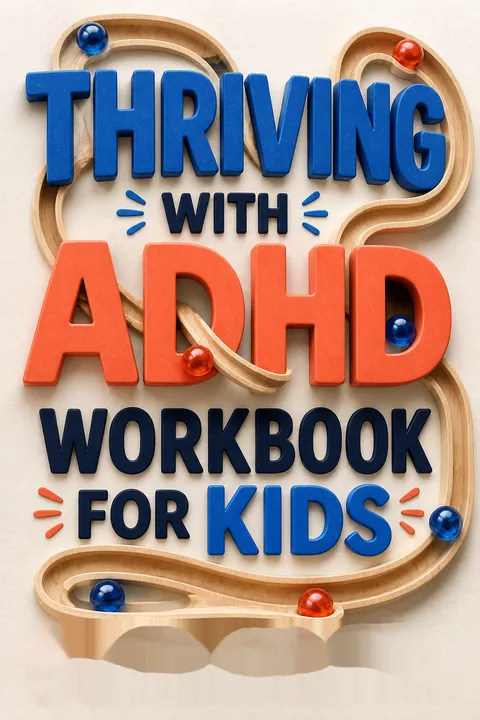
Thriving with ADHD Workbook for Kids holds a strong 4.26 rating, with most readers praising its positive, encouraging approach and variety of activities covering focus, organization, emotional regulation, and impulse control. Many parents, tutors, and caregivers found it a valuable resource. Some concerns noted include the text being too wordy for younger or struggling readers, most activities focusing on emotional rather than inattentive ADHD, and limitations with the Kindle format. Reviewers generally recommend obtaining a physical copy or previewing before purchasing.
Download PDF
Download EPUB
.epub digital book format is ideal for reading ebooks on phones, tablets, and e-readers.








































