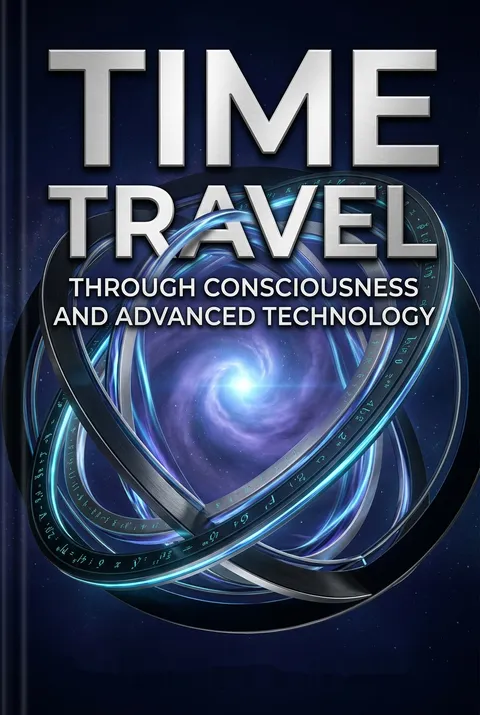

Key Takeaways
1. Time is Malleable: Beyond Linear Perception
Almost every news article I read on the topic, while researching for this book, referred to it as “whacky”, “crazy”, “far out” and “mind boggling. How small minded would you have to be to see it that way?
Challenging fixed time. The conventional belief in linear, fixed time is a limited viewpoint. The author argues that time is not an unchangeable constant but can be stretched or condensed, a concept supported by scientific phenomena like time dilation. Clocks on satellites, for instance, run slower than those on Earth due to denser gravity, making surface dwellers "time travelers" into the future by a few seconds from the satellites' perspective. Ancient spiritual texts also speak of different time experiences across various realms of consciousness, reinforcing this idea.
Perception shapes reality. The experience of the "paranormal," including time travel, is deeply personal and often feels natural during the event itself. Society's conditioning, however, often leads people to dismiss such experiences as "far out crazy," hindering their ability to perceive beyond the ordinary. The author suggests that life is structured so that individuals perceive what they are ready for, implying that an open mind is a prerequisite for experiencing time's true flexibility.
Beyond common belief. Time travel is not as outlandish as commonly believed and can be used for exploration of the Multi-verse by anyone willing to challenge their ingrained beliefs. The author's intention is to make the fantastic sound rational and personally accessible, encouraging readers to consider intellectual, physical, technological, and spiritual aspects of time travel as a cohesive whole.
2. Consciousness is the Ultimate Time Machine
In my view, technology is not needed to accomplish something, that Consciousness can do more effectively, cost efficiently and cleanly.
Consciousness transcends limits. The core of consciousness exists outside of conventional time and space, allowing it to observe and interact with these dimensions. From this perspective, time travel, remote viewing, and other extrasensory perceptions become accessible abilities, rather than requiring complex, multi-billion-dollar machines. The author posits that the universe is within us, not the other way around, suggesting that our "knowledge" about reality is often conditioned and empty.
Infinite being's perspective. Approaching time travel as an "Infinite Being" – a divine entity having a temporary human experience – makes the task less daunting. This viewpoint awakens the part of us that already knows how to time travel, as our true, non-physical self exists beyond time. The author emphasizes that time travel is not mere imagination but a focused perception of events across space and time, without physical presence.
Remote viewing's power. Remote Viewing, the ability to perceive across space and time with consciousness, is a verifiable skill, even researched by military intelligence agencies. The author, having experienced non-linear time in out-of-body states since childhood, asserts that projecting oneself into other times and parallel worlds is achievable through conscious intent.
3. Precognitive Dreams: Your Personal Time Travel Proof
His discovery: Precognitive dreams are time travel to the Future.
Dreams defy linear time. Precognitive dreams offer compelling evidence that time is neither linear nor fixed, serving as an accessible entry point to understanding time travel. The author shares personal anecdotes, like dreaming of a bookshelf falling or construction noise before they happened, illustrating how dream consciousness operates in a fluid time continuum, often stretching or cracking time.
Dunne's groundbreaking research. J.W. Dunne's 1927 book, "An Experiment in Time," established precognitive dreams as "memories of the future." His meticulous dream journaling revealed that he often dreamed of events he would later perceive, sometimes even misreading details in his dream that matched his later misreading in a newspaper. Dunne's experiments showed that:
- Dream journaling increases awareness of precognitive experiences.
- Most people have precognitive dreams but don't notice them without deliberate research.
- Interrupting daily routines (e.g., vacation) enhances dream recall and precognition.
- Precognition can occur in a waking state by clearing the mind.
Unlocking your inner time traveler. By consistently writing down dreams, individuals can uncover their innate ability to "see into the future" and travel to the past. This practice helps bridge the rigid borders between dream life and waking life, leading to practical benefits, such as the author using a precognitive dream about a vague presentation to prepare better and secure a contract.
4. Spontaneous Time Slips: Real-World Anomalies
Timeslips usually refer to spontaneous or unintended Time Travel, a temporary distortion of the fabric of time that eventually self-corrects.
Ubiquitous temporal distortions. Millions of unexplained disappearances and thousands of documented time slip reports suggest that temporary distortions in the fabric of time are more common than acknowledged. These "timeslips" can manifest as individuals disappearing and reappearing, or even entire buildings and cities appearing and vanishing, often accompanied by an odd distortion of perception.
Notable historical accounts:
- Versailles "Ghost Story" (1901): Two English academics, Moberly and Jourdain, reported stepping into 1780s Versailles, encountering people in period dress and a changed landscape.
- Victor Goddard's Flight (1934): A British pilot accidentally flew into the future, seeing Drem airfield as it would appear six years later, complete with yellow planes and blue uniforms.
- The Hotel from Nowhere (1979): Two couples in France spent a night in an old-fashioned hotel from the past, paying a minuscule sum, only for the hotel and their photos of it to vanish upon their return.
- The Woolwich Tunnel (2011): Contractors working on a London tunnel experienced time freezing, with some aging three years while only minutes passed outside, and others camping for days returning at the exact moment they left.
Personal and collective experiences. The author shares personal time slips, such as finding a wallet from seven years prior in the woods or experiencing a repeated Tuesday on Malta after a spinning sensation. These incidents, along with others like the "disappeared laundromat" or the "shop that transformed," highlight how time travelers often blend into the past, with discrepancies in their appearance or objects going unnoticed or disintegrating, suggesting a strong link to consciousness and perception rather than physical transposition.
5. Non-Linear Causality: The Interconnectedness of Events
I assert that Cause and Effect are identical and simultaneous.
Beyond linear thinking. The conventional understanding of cause and effect as a linear progression (A leads to B leads to C) is fundamentally flawed. The author proposes non-linear causality, where cause and effect are simultaneous and interconnected within an overarching energy field. This means that events that appear separate are actually part of a larger, already present context, like fish jumping in a river stream—it's simply what fish do in that environment, not a singular cause-and-effect chain.
Inner states shape reality. A person's inner emotional state or attitude often precedes and attracts external events, rather than being merely a reaction to them. For example, an overreaction to a minor incident indicates pre-existing anger, which likely contributed to attracting the incident itself. This principle applies to goals as well: if a goal is "already manifest" in consciousness, one doesn't question how long it will take to appear.
The "why" over the "how." Focusing solely on "how" something happened limits understanding to physical mechanics, while asking "why" delves into the metaphysical reality underlying all things. Success or failure is determined by an inner stance, attitude, or belief system—an invisible blueprint that sets the stage for all subsequent actions and perceptions. By adjusting this inner essence, corresponding events will spontaneously manifest across a timeline, demonstrating that "well begun is completely done."
6. Practical Techniques for Conscious Time Travel
To time travel, you have to time travel a lot.
Conscious preparation. Time travel through consciousness is an ability that can be honed through specific practices, not merely an ascent in spiritual levels. Preparation involves:
- Breathing in the World: Increasing well-being and lucidity by breathing in positive and negative aspects, objects, and humans.
- Aligning Consciousness: Speculating about the future (50, 100, 250, 500, 1000, 10000 years) to stretch awareness and discern future-times.
- Discerning Imagination vs. Perception: Practicing to differentiate between self-created impressions and received impressions, crucial for accurate remote viewing.
Anchors and immersion. The core time travel technique involves:
- Higher Self Viewpoint: Adopting a relaxed, neutral, humorous, and compassionate state.
- Locating an Anchor: Using a drawn timeline, an image/book, or a purely mental focus on a specific past or future point.
- Creating a "Bubble": Mentally enclosing the desired time-span and place.
- Entering the Bubble: Projecting consciousness into it, dissolving imagination, and waiting for genuine impressions ("flashes").
- Experiencing and Exiting: Following interesting impressions, using imagination as a temporary crutch if needed, and then consciously naming the time-span to return to one's native time.
Practice and verification. Consistent practice is paramount, as is verification. The author recommends verifying at least 20% of time travels, using historical records or books, to build confidence and discern between fantasy and genuine perception. While imagination can serve as a bridge, the goal is to reduce it as pure perceptions arise, eventually leading to full immersion where one can see, hear, taste, smell, and feel the targeted time.
7. The Power of Synchronicity and Predictive Imagination
Sci-Fi books are History books but the History they are describing is usually of some future timeline.
Synchronicity as temporal evidence. The phenomenon of synchronicity, where seemingly unrelated events occur with meaningful coincidence, serves as powerful evidence that time is not fixed but interconnected. These occurrences suggest a flexible timeline where future probabilities can influence the present.
Authors as accidental seers. Numerous authors have uncannily predicted future events, often with astonishing specificity:
- Morgan Robertson (1898): "The Wreck of the Titan" accurately foretold the sinking of the Titanic 14 years later, down to details like ship size, speed, and iceberg collision.
- Ingersoll Lockwood (1889-1900): His "Baron Trump" novels and "The Last President" eerily mirrored aspects of Donald Trump's presidency and political climate over a century later.
- Jules Verne (19th Century): Predicted rockets, computers, airplanes, the Eiffel Tower, facsimile machines, and even the Apollo 11 mission's details (Florida launch, Pacific splashdown, aluminum rocket, retro-rockets, weightlessness).
- H.G. Wells (late 19th/early 20th Century): Foresaw World Wars, World Governments, email, genetic engineering, laser weapons, and the atomic bomb.
Imagination as a preview. These predictions, often found in science fiction, suggest that imagination is not merely fantasy but a filtering of information from other realms—a "memory of the future" or a peek into hidden realities. The author believes that sci-fi authors, by allowing their minds to wander freely without egoic intent, tap into strong probabilities, effectively acting as time travelers who describe what they see.
8. Discernment is Key: Navigating Time Travel Claims
If you want to know whether something is authentic or not, check what the bottom-line benefit is or whether you have learned anything new.
Skepticism for clarity. While the author believes in time travel, a healthy skepticism is crucial when evaluating the thousands of claims circulating annually, especially online. Many claims are easily debunked, some are well-orchestrated hoaxes, and others are genuine but lack verifiable proof. The author's own 2002 book contained a personal precognition of his future living situation, which he only realized years later, highlighting the subtle nature of genuine experiences.
Questionable evidence and motives:
- Ancient Phones and Laptops: Videos of a woman seemingly talking on a cell phone in 1928 and 1938, or ancient Greek "laptops," are intriguing but often have alternative explanations or are too ambiguous for definitive proof.
- Chronicles of the Future (Paul Dienach): A coma patient's diary describing life in 3906 AD is compelling but feels exaggerated and lacks specific, actionable insights, raising doubts about its authenticity as a direct time travel account.
- Noah from the Future: Internet videos featuring a blurred-face teenager claiming to be from 2030, showing "footage" from 2120, offer no hard proof and make generic predictions, serving more as entertainment than genuine information.
The nature of genuine experience. True time travelers often engage in personal exploration and may not feel the need for public verification or sensationalism. The author notes that many secret government projects, like "Project Pegasus" or "Project Looking Glass," are shrouded in contradictory stories, which is a common tactic by intelligence agencies to obscure what is truly happening. Remote Viewing, however, stands out as a verifiable government-researched ability that is publicly dismissed as "pseudo-science" but is genuinely accessible.
9. Ancient Portals and Modern Physics Hint at Dimensional Travel
Modern physics acknowledges that time travel is theoretically possible.
Physics validates the impossible. Modern physics, particularly Einstein's relativity theory, acknowledges the theoretical possibility of time travel, proposing that speed and gravity can bend spacetime. Kurt Godel's work in 1937 suggested the entire universe could be a time machine, allowing travel through "closed time curves" without violating physical laws. This scientific backing lends credibility to the concept, moving it beyond mere fantasy.
Wormholes and black holes. Physicists theorize that wormholes could shorten extreme distances and enable time travel, with time flowing differently at each end. Similarly, the immense gravity of a black hole could create a singularity—a ring-shaped construct in spacetime—allowing passage to other places or times. Ronald Mallett's research on ring lasers and circulating light cylinders further explores the creation of closed timelike curves for past travel, suggesting that harnessing such energies could make time travel feasible for advanced civilizations.
Legends of dimensional doorways. Ancient legends and fairy tales across cultures describe "dimensional doorways," "portals," and "stargates" that connect distant locations, times, or parallel universes, often involving de-materialization. Examples include:
- Puerta de Hayu Marca, Peru: A T-shaped "Gate of the Gods" linked to legends of Incan priests using a golden disk to enter a shimmering blue light.
- Mher's Door, Turkey: A sacred cave where a hero is said to emerge annually, connecting to other realms.
- Tiahuanaco, Bolivia's 'Gate of the Sun': An ancient structure believed to be a portal used by the sun-god Viracocha.
- Ranmasu Uyana Stargate, Sri Lanka: A stone carving depicting a "rotating circle of the Universe," hinting at portals activated by specific codes or movements, often associated with spinning.
These ancient accounts, coupled with modern scientific theories, suggest a deep, underlying reality to the concept of travel beyond conventional space and time.
Review Summary
Time Travel receives positive feedback from readers with an overall rating of 4.14 out of 5 stars based on 14 reviews. Reviewers praise the book for presenting amazing and highly specialized information that stands out as very different from typical offerings. Readers appreciate the abundance of thought-provoking material and concepts to consider. The content is described as unique and engaging, offering perspectives that encourage deep reflection and contemplation.
About the Author
Other books by Frederick Dodson



Download PDF
Download EPUB
.epub digital book format is ideal for reading ebooks on phones, tablets, and e-readers.








































