


Plot Summary
Prologue
Under a bright June sky, a sixteen-year-old girl on crutches buries her mother7 beside her long-dead father, attended only by her stepfather James,4 her stepbrother Shay,2 and the leather-clad men of the Celtic Beasts. Her mother was not merely killed but mutilated, and Mina1 suspects the club's enemies orchestrated the horror to abduct her.
Her knee, shattered that night, ends her dancing before it truly began. Shay2 never leaves her side, promising she will never be alone again. Grief, terror, and a desperate hunger for love fuse inside her. She clings to the one person who makes her feel safe, not yet grasping that her devoted protector is quietly becoming her jailer.
The funeral establishes the emotional physics of the entire book: a girl hollowed by loss will attach to whoever fills the void, regardless of the cost. Page frames Shay's constant presence as comfort precisely so it can later read as encirclement. The mutilation of the mother introduces the motif of ritualized cruelty that will haunt Mina's psyche, while the shattered knee severs her one imagined escape route, dance. Grief here is not merely sadness but disorientation, a stripping of identity that leaves Mina newly moldable. The prologue seeds the trauma bond, showing how safety offered by a dangerous man becomes indistinguishable from captivity to someone with nothing left to lose.
The Buried Shoebox Goodbye
In August a phone beeps beneath Mina's1 floorboards, and Shay,2 sensing a hidden second cell, demolishes her bedroom hunting for it. Mina1 snatches the shoebox holding years of notes, a pearl necklace, and a burner phone from Keenan Mathers,3 then bolts barefoot into a thunderstorm.
Hiding beneath a maple, she calls Keenan,3 who begs to rescue her, but she refuses, certain Shay2 will slaughter him and his club. She buries the box, severing her one lifeline, then trudges home. Rather than punish her, Shay2 bathes her tenderly and takes her virginity, murmuring that she belongs to him. Compliance becomes her strategy: obey Shay,2 and no one she loves gets hurt.
This opening fuses coercion with intimacy, the signature of the trauma bond. Mina sacrifices Keenan not from indifference but from love, converting self-erasure into a moral act. Shay's post-rampage tenderness is textbook intermittent reinforcement: destruction followed by care rewires her nervous system to crave the source of her fear. The buried shoebox is a literal interment of selfhood, autonomy laid in the ground beside her parents. The storm externalizes her psychic chaos, and her barefoot flight mirrors a child fleeing an inescapable house. Consent here is a fiction negotiated under threat, and the narrative refuses to let the reader mistake surrender for desire.
Biker Trash in the Halls
Limping on a cane, Mina1 begins senior year only for Shay2 to appear at her locker, kiss her publicly, and threaten any boy who glances her way. By lunch the whole school knows. Her former friend Becca,11 seething with jealousy, corners her in the cafeteria and brands her an incestuous slut before everyone.
Mina,1 once the celebrated dancer bound for a wider life, becomes an isolated object of whispers, her ruined knee a public emblem of the kidnapping that killed her mother.7 Shay2 polices her clothing using photos taken by junior prospects planted in the building. Every avenue of ordinary teenage life narrows, tightening the cage around a girl who now has nowhere left to simply be herself.
Social death compounds domestic captivity. Becca's venom weaponizes shame, transforming Mina from admired to abject, and the crowd's complicity dramatizes how communities police female sexuality while ignoring female victimization. Shay's surveillance apparatus reveals control as panopticon: Mina internalizes the watching eye and self-censors her own body. The cane, once a temporary aid, becomes a semaphore of everything stolen, her art, her mother, her future. The chapter stages the collapse of Mina's public identity, leaving no space to exist except inside Shay's orbit. That is precisely the isolation an abuser engineers, ensuring the victim has no witness, no ally, and no reflection of a self worth protecting.
Three Shots in the Alley
Determined to flee, Mina1 packs her documents, disarms the house alarm with a trick she learned, and slips through the woods toward the bus depot before dawn. A kind homeless veteran shares his newspapers and warmth, listening to her story without judgment. Then five Harleys roar in: the Beasts have tracked her.
Shay,2 cold and expressionless, drags her to his bike, then executes the old man with three bullets to punish her disobedience. Back home he demands she prove her devotion, and she surrenders completely, channeling her rage into their violent coupling. The lesson brands itself into her: every act of defiance will spill someone else's blood, and only her obedience keeps the innocent alive.
The murder converts abstract threat into unbearable proof, and Mina's guilt becomes a chain no lock could match. The nameless veteran, himself a casualty of untreated trauma and neglect, mirrors the systemic abandonment that produced Shay: society breeds both its monsters and its discarded. Shay's demand that she prove herself weaponizes sex as a submission ritual, and Mina's decision to attack him during it reveals how survivors smuggle agency into powerlessness, converting assault into a controlled outlet for fury. Her interior voice, the cruel woman who blames her, marks the internalization of the abuser's logic, the moment captivity migrates from the house into her own mind.
Property of Manic
Weeks later Shay2 drives Mina1 to BB's tattoo parlour, ignoring her furious refusals. As she bolts for the door, she glimpses Keenan's3 charcoal SUV across the street, proof he still watches over her. Shay2 hauls her back, pins her in a chair, and holds her arm still while the artist inks a Celtic dragon and a banner reading Property of Manic onto her inner wrist.
She slaps him, begs, promises to wear his leather cut instead, but the brand is permanent. Earlier he had forced her into a jacket bearing the same claim, marking her as his old lady in every biker's eyes. Her captivity is now literally skin-deep, an ownership she cannot wash away or outgrow.
Tattooing transforms Mina's body into a text authored by another, the ultimate objectification rendered indelible. The fleeting sight of Keenan's SUV punctures her isolation with a reminder that an outside witness exists, someone who wants her free rather than owned. Shay's insistence on both patch and tattoo betrays his terror of loss disguised as dominance: the more precarious his grip, the more absolute the branding he demands. The wrist, a site of pulse and vulnerability, becomes the register of possession. Mina's slap, delivered even as she is restrained, is the last flicker of a self refusing complete erasure, a small mutiny inside total defeat.
Torn Earlobes and Staples
When Becca11 ambushes Mina1 outside and mocks her dead mother,7 Mina1 snaps, beating her bloody and ripping the hoops from her ears. Dragged to the principal's office, she refuses to apologize, exposing weeks of unpunished bullying the faculty ignored, likely because the principal fears the Beasts.
Shay2 storms in, smashes the principal's face into his desk, and staples his scalp until the man agrees to suspend Becca11 and waive punishment. Only the guidance counselor, Miss Gibson,12 dares stand between Shay2 and Mina,1 demanding assurance the girl is safe with him. Shay2 answers that Mina1 is the one person he would never harm, then walks her out. The club, it is now unmistakable, owns even the school.
Mina's explosion of violence marks a grim assimilation: brutalized, she brutalizes, tasting the power her captors wield. Yet the scene shows justice perverted, since the only protection available runs through terror rather than institutions. Miss Gibson is the lone adult who reads the danger correctly, embodying the bystander who chooses to intervene, however inadequately. Shay's declaration that he would never hurt Mina is both sincere and monstrous, spoken over a bleeding man, exposing the contradiction at the core of his love: tenderness bordered by atrocity. The chapter interrogates whether being defended by a predator is protection at all, or merely a deeper, better-decorated trap.
A Cottage and a Second Phone
During her suspension Shay2 assigns his calm, tattooed friend Gavin5 to guard Mina,1 and the two grow genuinely close over homework and quiet days, though the dining table still triggers visions of her mother's blood. A folded note from Keenan3 appears among her books, then a fresh burner cell in her locker, promising he has not given up and will wait one week for her answer.
Meanwhile Shay2 reveals the secret he has been building: a snug forest trailer decorated just for her, stocked with her favorite books. The gesture chokes Mina1 with guilt and something dangerously close to love, deepening her confusion about the man who both cages and cherishes her.
This chapter braids two competing rescues: Keenan's patient offer of exit and Shay's construction of a gilded cage disguised as devotion. The trailer is seduction through domesticity, an abuser rebranding confinement as home, and it works because Mina is starved for belonging. Gavin emerges as the story's moral hinge, a dangerous man with a tender core who witnesses the wrongness others ignore. The persistent hallucination of the bloody table signals unprocessed trauma metastasizing beneath the routine, a reminder that no cozy decor can paper over the crime at the family's foundation. Mina's guilt reveals how thoroughly she has absorbed responsibility for violence that was never hers.
Headless Dolls in the Oven
At the town library Gavin5 receives frantic texts and rushes outside, where Mina1 overhears him pleading with Shay2 by phone. In a paranoid delusion, Shay2 has broken into bartender Lindsey's10 home and left her daughter's decapitated dolls in the oven, convinced Lindsey10 has betrayed the club. Gavin,5 who loves Lindsey10 and little Jenny, is terrified Shay2 will kill them.
Mina1 makes a decision: she phones Shay2 herself, sweetly luring him home for a quiet night to keep him distracted. Her ploy buys Gavin5 the hours he needs to pack up Lindsey10 and Jenny and hide them. For once, Mina's1 performance of devotion saves lives rather than merely purchasing her own survival.
Here Mina weaponizes the very submission that imprisons her, transmuting learned helplessness into strategic agency. The doll heads externalize Shay's disintegrating psyche, his paranoia now manufacturing victims from mere suspicion, signaling the Manic persona is spreading beyond even the club's control. Gavin's desperation humanizes the outlaw and establishes the reciprocal debt that will later prove decisive. Mina's seduction-as-rescue is a moral inversion: she must simulate love for a killer to shield innocents, a grotesque calculus that nonetheless restores a sliver of purpose. The chapter reframes her compliance as covert resistance, complicating the tidy binary of captive and captor and granting her a fragile, dangerous form of power.
The Faceless Own the Beasts
Through walls at night Mina1 overhears Shay2 arguing with someone called Elias8 about drug runs, missing men, and a feared enforcer named Jeremy,9 and warning that if anyone touches her he will kill them all. At a strained dinner in James's4 cabin, tension detonates: when James4 discovers the property tattoo and threatens to appeal to club president Bull,14 Shay2 slams his father against the wall.
He reveals the fracture openly, that the older Beasts sold the club into servitude to the Faceless, and that he now does their dirty work directly, making himself indispensable and untouchable. James,4 disgusted and grieving, backs down. The wholesome family Mina1 still longs for has curdled into open war between father and son.
The intelligence Mina gathers reframes her private nightmare as one node in a vast criminal ecology, and the reader begins to see Shay less as a lone monster than as a product and instrument of organized predation. The dinner brawl stages the Oedipal rupture at the story's center: the son who once needed the father now dominates him, while James's guilt renders resistance impossible. The Faceless function as an off-page leviathan whose gravity bends every character's fate. Shay's vow to kill anyone who touches Mina is love spoken in the only grammar he owns, violence, and it quietly foreshadows the sacrifice the ending will demand of him.
Spades at the Bar
Shay2 reluctantly brings Mina1 to a boys' night at Colby's pub, where his friend Cody6 turns unexpectedly menacing, warning her to fall in line. Gavin5 needles Shay2 all evening, questioning why Mina1 seems a terrified shell rather than a happy partner, and hinting he knows about Lindsey.10 Then Keenan's3 club, the Black Spades, walks in.
When Mina1 slips to the restroom, Keenan3 follows and they kiss desperately, five stolen minutes of warmth she has been starving for. Gavin5 discovers them but chooses to cover for her, repaying his debt. Back in the bar, Shay2 and Keenan3 trade venomous threats about mutilated prospects before Mina1 feigns collapse to defuse the standoff and get home.
The pub becomes a pressure chamber where every alliance is tested. Cody's sudden hostility signals the rank-and-file closing around Mina as property, stripping away her childhood illusion of him as harmless. Gavin's interrogation of Shay is the narrative conscience speaking aloud, naming the abuse the lovers cannot. The bathroom reunion offers Mina reciprocal, non-possessive tenderness, throwing Shay's ownership into stark relief. Keenan and Shay embody two masculinities: one that wants to free her, one that wants to keep her. Gavin's silence transforms him into a secret ally, and the debt economy of the outlaw world quietly becomes the machinery of Mina's eventual escape.
The Beach Confession
Skipping class, Mina1 meets Keenan,3 who drives her to the lakeside beach where they once grew close. He forces her to hear the ugly truth: the Faceless are a mafia running drugs, even into high schools, plus trafficking women, and Shay2 is their soldier. Then Keenan3 confesses his own history.
Years ago he lured a young Mina1 into the woods to use her as leverage against Shay,2 but seeing her innocence, and recognizing in her mother7 the same addiction that killed his own, he kept meeting her to save her from the life that trapped him. Somewhere along the way he fell in love. Mina1 admits she loves Shay2 too, and Keenan,3 heartbroken, promises to wait in the wings.
Keenan's confession reframes the entire romance as originating in manipulation, then transcending it, a rare acknowledgment that care can be born from instrumentalization and still become genuine. His backstory doubles Mina's: two children conscripted into a violent world by fathers, both mothers destroyed by isolation and addiction. This mirroring universalizes the book's thesis that trauma is inherited and environmental, not chosen. Mina's admission that she loves Shay despite everything is the trauma bond spoken plainly, and Keenan's refusal to coerce her, unlike Shay, defines the moral contrast: love that waits versus love that owns. The beach, site of first longing, becomes the altar of an impossible choice.
The Knife Between Them
Betrayed by a resentful junior prospect who tips off Shay,2 Mina1 is caught returning to school by Cody,6 who slaps her, seizes her throat, and drags her toward his truck, raging that Shay2 is too soft on her. Keenan3 intervenes, and the two men brawl on the frozen grass. When Cody6 draws his knife, the struggle turns lethal: the blade drives into Cody's6 own chest.
Dying, he asks Keenan3 to pull it free, then clutches Mina's1 hand and whispers an apology as he bleeds out. A Harley approaches. Mina,1 splattered in his blood and drowning in flashbacks of her mother,7 screams at Keenan3 to flee. Another seemingly innocent bond has ended in death, and the club will demand answers.
Cody's death is tragedy without a villain, a scuffle spiraling past intention, indicting the entire culture of armed masculinity that turns every conflict fatal. His deathbed apology complicates him: the man who slapped her dies begging forgiveness, human to the last. For Mina, the blood reactivates the primal wound of her mother's murder, collapsing past into present and priming the revelation to come. The scene also weaponizes loyalty: the prospect's betrayal shows how Shay's cruelty breeds enemies within his own ranks. Keenan, the gentle one, becomes a killer by accident, dramatizing how this world contaminates even those who most resist its logic.
Blood on His Hands
Taken to the Beasts' clubhouse amid mourning for Cody,6 Mina1 slips into the forbidden basement, a corridor of cell-like interrogation rooms. Outside one door she overhears Shay2 and Gavin.5 Gavin5 accuses Shay2 of breaking Mina1 and forcing their relationship, and warns that Elias8 is hunting the men who vanished after attacking her, men Shay2 hired.
The horror crystallizes: there were four attackers that night, not three, and the fourth was Shay2 himself. He confesses, weeping, that he only wanted her and never wanted her to leave. Then Elias8 calls. Shay2 orders Gavin5 to hand Mina1 to James4 for safekeeping. Mina,1 shattered, flees before he can see her, the foundation of her captivity finally exposed as fratricidal design.
The basement, a literal architecture of torture, becomes the space where buried truth surfaces, the unconscious made concrete. The revelation retroactively rewrites every prior chapter: Shay's protection was always the aftermath of his own atrocity, the abuser who engineers the danger from which he then rescues. Mina's earlier intrusive count, four not three, pays off as suppressed knowledge she could not let herself hold. Gavin voicing the truth to Shay's face is the confession by proxy the story has withheld. Shay's sobbing insistence that he only wanted her exposes the infantile core of possessive love: the annihilation of the other to prevent abandonment, the ultimate solipsism.
The Father's Confession
Hidden at James's4 cabin, Mina1 confronts the stepfather she adored. He confesses a cascade of failures: bringing troubled young Shay2 into club life, frightening Emily7 into staying by ending her one escape attempt, ignoring his son's worsening illness, and finally allowing Shay2 to take Mina1 because she was the only thing anchoring the boy from madness.
He admits the Beasts sold themselves to the Faceless out of paranoia about the Spades. Furious yet still loving, Mina1 punches him, then reveals the identity of her secret man: Keenan Mathers,3 a Black Spade. James,4 swallowing his rage, swears on Emily's7 memory to protect him. Then Shay2 bursts in, frantic, warning that Elias8 and the enforcer Jeremy9 are coming for him.
James's monologue is the story's grand aetiology, tracing catastrophe to a father's well-meaning refusals to let go, of a wife, of a son, of control. His guilt reframes him not as villain but as tragic architect, the ordinary man whose small selfish choices compounded into ruin. His confession indicts a masculinity that knows only possession as love, the same disease he transmitted to Shay. Mina naming Keenan, and James swearing on his dead wife to protect a rival club's son, marks a reversal: the father at last choosing his daughter's freedom over his son's need. Shay's frantic arrival converts revelation into the urgent motion of the final act.
The Night We Met
Panicking that Elias8 will torture him and destroy Mina1 to punish his betrayal, Shay2 races her to the trailer, packs a bag, and confesses everything: he hired the attackers, murdered Emily,7 and never meant for Mina1 to be harmed. She beats him and rages, but he only weeps that he wanted them to be forever.
He drives her to the park where they first met and hands her to Gavin,5 who relays her to a waiting Keenan3 for escape, on James's4 arranged plan. Alone at the frozen playground, haunted by the ghost of the little girl who once gave him a daisy, Shay2 clutches the dog tags she gave him, presses his gun to his mouth, and ends himself so that no captured man can ever talk.
Shay's final act reframes suicide as the only selfless deed his ruined psyche can produce: dead men cannot be made to betray the beloved. The narrative refuses easy redemption yet grants a warped grace, the abuser who, cornered, finally puts her survival above his hunger. The park and the daisy return as leitmotifs, folding his end into his beginning, the unloved boy who was briefly seen. Passing Mina through Gavin to Keenan literalizes the transfer of guardianship from possessive love to freeing love. The song looping through his mind renders his death elegiac, and the deliberate ambiguity honors the impossibility of tidy closure after such harm.
Epilogue
Months later a lonely, artistic teenager named Casey13 visits Ashland's cemetery to sit with her dead mother and stepfather. She watches a young family arrive at a solitary grave: a golden-haired, tattooed man,3 a petite white-blonde woman,1 and a small dark-haired boy with striking silver eyes and dog tags jingling at his neck.
The woman lays a single daisy on the stone, whispers to it, and guides her son's hand across its surface before the man gathers them close. Casey,13 soon to be sent back to the brutal Harley neighborhood and her childhood friends Lee, Shaw, and Vail, envies their obvious love. She never reads the name on the grave.
The shift to an outside observer grants the aftermath a tender objectivity: Casey sees only a beautiful family, oblivious to the cemetery's weight. The silver-eyed boy with dog tags is the story's quiet devastation, an unmistakable echo of the buried man, implying Mina carried his child and honors him even after everything. The single daisy closes the motif that defined the one moment he ever felt seen. Casey's own trajectory, exile to Harley and its dangers, seeds a future narrative while thematically rhyming: children forged by violent worlds, some escaping, some returning. The epilogue insists life continues indifferent to buried tragedy, and that love, however scarred, persists in a child's laughter.
Analysis
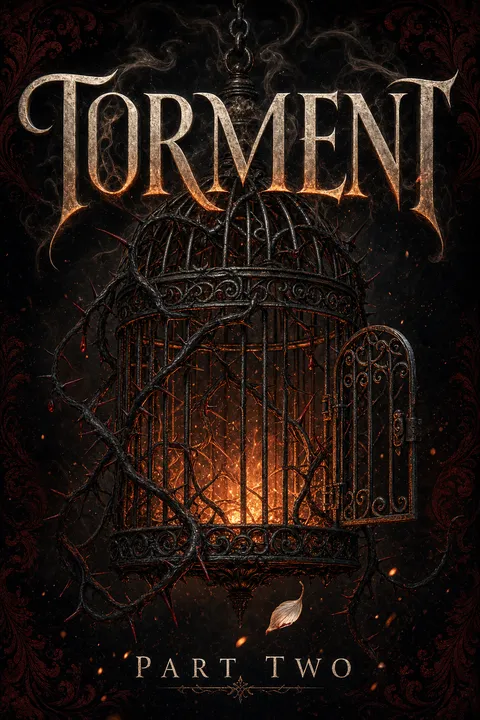
Torment: Part Two is a harrowing anatomy of the trauma bond, the trap in which fear and affection fuse until a victim can no longer separate love from the source of harm. Dylan Page builds Mina's1 captivity through the mechanics abusers actually use: isolation from friends and family, surveillance, intermittent tenderness after cruelty, and the manufacturing of a threat from which the abuser then heroically rescues. The book's cruelest insight is that Shay's2 protection was always predicated on danger he himself created, the abuser as both arsonist and firefighter. Mina's1 compliance is never framed as consent; it is a survival calculus, obedience purchased with other people's lives.
The novel is equally a study of intergenerational damage. Shay,2 Keenan,3 and Mina1 are all children conscripted into a violent world by adults, and their mothers are all destroyed by isolation and addiction. James's4 confession makes the thesis explicit: catastrophe grows from a father's inability to let go, and from a masculinity that recognizes only possession as love. That disease passes from father to son like an inheritance no one chose.
Page refuses redemption arcs that absolve. Shay's2 final act grants him a warped grace without erasing his atrocities, and the narrative insists the reader hold his monstrousness and his woundedness at once. The recurring daisy and dog tags render his end elegiac rather than triumphant.
The epilogue's outside observer reframes everything with quiet devastation, showing that life continues indifferent to buried tragedy while seeding the next story with another child of a brutal place. Ultimately the book argues, through the contrast between love that waits and love that owns, that genuine care liberates rather than confines. It is a deliberately uncomfortable meditation on how the starving heart mistakes captivity for home, and how difficult and costly it is to name that difference.
Review Summary
Torment by Dylan Page is a controversial dark duet depicting the toxic, abusive relationship between stepsibling Shay and Mina. Reviewers report intense emotional reactions, with many praising the raw portrayal of grooming and manipulation while acknowledging the deeply disturbing content. Shay's character—controlling, obsessive, and violent—evokes conflicted feelings; readers simultaneously hate and empathize with him. The tragic ending, featuring Shay's suicide and Mina ending up with Keenan, devastated many. Several reviewers emphasize this isn't traditional romance but rather a character study of abuse and trauma, with strong trigger warnings necessary.
People Also Read

Characters
Mina Westberg
Captive stepsister, ex-dancerA seventeen-year-old former ballet prodigy, orphaned and pulled ever deeper into a motorcycle club's dark world. Grief-stricken and starved for affection after losing both parents, she craves love and safety with an intensity that makes her vulnerable to those who offer it on cruel terms. Intelligent, stubborn, and secretly defiant, she performs obedience to shield the people she loves while a harsh inner voice punishes her for every choice. Torn between the fierce, terrifying devotion of her stepbrother2 and the gentle patience of a forbidden outsider3, she struggles to locate her own desires beneath everyone else's demands. Her arc is a fight to reclaim a self that has been methodically dismantled, and to decide whether survival requires surrender or escape.
Shay O'Hare (Manic)
Obsessive stepbrother enforcerA young enforcer for the Celtic Beasts, tall, tattooed, and silver-eyed, and profoundly mentally ill. Since boyhood he has fixated on Mina1 as the single anchor keeping him from the darkness he names Manic, a persona that surfaces whenever his control slips. His love is total, possessive, and dangerous, expressed through protection and knife-play in equal measure. Charismatic and frightening, he treats devotion and domination as the same act and cannot distinguish loving someone from owning them. Beneath the menace lies an abandoned child desperate to be seen, whose deepest terror is being left behind. His volatility fuels the story's dread, and his contradictions, tenderness folded into atrocity, make him its tragic engine.
Keenan Mathers (Dodger)
Forbidden Black Spade protectorA golden-haired member of the rival Black Spades, warm, encouraging, and quietly desperate to escape the outlaw life forced on him. For years he has been Mina's1 secret confidant, meeting her in an abandoned theatre and championing dreams her family would smother. Where Shay2 owns, he waits; where Shay2 isolates, he offers exit. Haunted by his own mother's fate, he sees in Mina1 a chance to save someone from the trap he could not escape himself. Patient and self-sacrificing, he becomes both her temptation toward freedom and the moral counterweight to her captor2, a man who insists that love should liberate rather than confine.
James (Sheik)
Guilt-ridden stepfather guardianMina's1 stepfather and legal guardian, a graying Celtic Beast who genuinely loves her as a daughter yet is paralyzed by guilt over choices he can never undo. Torn between loyalty to his troubled son2 and protectiveness toward Mina1, he retreats into silence and club business as their household curdles. A tragic figure whose small selfish decisions accumulated into catastrophe, he embodies a fatherhood that mistook control for care.
Gavin (Storm)
Shay's conscience-stricken friendShay's2 most loyal friend, a black-haired, heavily tattooed, pierced biker with a startlingly gentle heart. Calm where others are volatile, well-read, and protective, he becomes Mina's1 guardian and confidant, torn between fealty to Shay2 and his own conscience. His love for a certain woman10 and her child gives him a personal stake that tests his loyalty and ultimately shapes the story's course.
Cody (Cobalt)
Flirtatious hardening clubmateA handsome, dimpled, flirtatious member of the Beasts whom Mina1 has known since childhood. Once playful and teasing, he reveals a harder, controlling edge as the club closes ranks around Mina1 as property, insisting she learn her place in their brutal world and resenting Shay's2 leniency toward her.
Emily
Mina's murdered motherMina's1 mother, whose brutal death opens the book. Once sweet and beautiful, she descended into alcoholism and depression after being trapped in a life she never wanted, and clashed bitterly with Shay2 over her daughter1.
Elias
Unseen cartel kingpinThe unseen head of the Faceless, the mafia-like syndicate that has bent the Beasts to its will through drugs and trafficking. His reach and cruelty loom over every character, a gravitational threat felt but never met on the page.
Jeremy
Feared nomad enforcerA hired nomad enforcer whose name alone unnerves even hardened bikers. Held in reserve as the syndicate's ultimate instrument of pain, he represents the fate awaiting anyone who betrays the Faceless.
Lindsey
Bartender single motherA bartender at the clubhouse and single mother to young Jenny, cared for deeply by Gavin5. Her ordinary vulnerability becomes a target of Shay's2 spiraling paranoia, forcing others to act to protect her and her daughter.
Becca
Jealous former friendMina's1 former friend, jealous of her closeness to Shay2 and cruel in her resentment. She leads the campaign to brand Mina1 an incestuous outcast at school, turning classmates against her.
Miss Gibson
Protective school counselorThe school guidance counselor, the lone adult who reads the danger surrounding Mina1 correctly and dares to challenge her captor2, insisting on knowing whether the girl is truly safe.
Casey
Grieving epilogue observerA grieving, artistic teenager introduced late, mourning her mother and stepfather and soon to be returned to the violent Harley neighborhood of her childhood. Her outside observations frame the story's quiet aftermath.
Bull (Shawn)
Paranoid club presidentPresident of the Celtic Beasts who steered the club into its disastrous alliance with the Faceless out of fear that the rival Black Spades were secretly plotting to seize their territory.
Plot Devices
The burner cell and buried shoebox
Secret lifeline to freedomMina's1 clandestine channel to Keenan3, a burner phone and years of notes hidden in a shoebox beneath her floorboards. Its accidental beep triggers the opening catastrophe; its burial marks her surrender; its reappearance in her school locker reopens the possibility of escape. The object physically embodies the choice between captivity and rescue, and every time it surfaces it forces Mina1 to weigh her own longing against the deadly risk to the man on the other end. Recurring across the book, it converts a small device into the fulcrum on which the entire plot turns, a tangible measure of how much freedom she is willing to gamble a life for.
The property tattoo and cut
Branding as ownershipA leather jacket and an inked wrist, both reading Property of Manic2, externalize Shay's2 claim on Mina1. In biker culture these signify an old lady, the closest thing to marriage. Forced onto her against her furious will, they transform her body and wardrobe into public declarations of possession, visible to every member of the club and every student at her school. Their permanence dramatizes the inescapability of her situation and the abuser's compulsion to make ownership indelible. The tattoo in particular, etched onto the vulnerable inner wrist while she is physically restrained, becomes the story's cruelest symbol of a self overwritten by another's authorship.
The dripping table memory
Intrusive trauma flashbackA recurring, involuntary vision of blood dripping from a table, tied to her mother's7 mutilation, seizes Mina1 whenever she nears a dining table or witnesses fresh bleeding. The motif tracks her untreated post-traumatic stress, showing how the past ambushes the present without warning. It also quietly threads toward buried truths her mind is not yet ready to face, functioning as both psychological realism and structural foreshadowing. Each recurrence measures her deteriorating stability, and the family's shift to eating away from the table shows how the household reorganizes itself around a wound no one will name aloud.
Manic, the alter persona
The self that killsShay's2 dissociative persona, summoned when his control fractures, is distinct enough that Mina1 names and negotiates with it. Manic is the killer, the knife-player, the paranoid delusion; Shay2 is the tender protector and doting caretaker. The oscillation between the two structures the household's constant dread and forces Mina1 into perpetual calibration of her behavior, soothing one to keep the other buried. The device dramatizes untreated mental illness compounded by a violent life, and it frames Mina's1 survival as an endless performance aimed at keeping the gentler self in charge of a body that is capable of atrocity.
The engraved dog tags
A gift that outlives himSilver dog tags Mina1 gave Shay2 years earlier, engraved with meaning he never removes and wears every single day. They recur throughout as the emblem of the one pure bond he clings to amid his darkness, the proof that he was once truly seen. In the story's final movements the tags return in a way that quietly reveals the shape of the aftermath and the persistence of that bond beyond the choices Shay2 makes, transforming a small keepsake into the object that carries the whole tragedy's emotional resolution.
The Bleeding Hearts Series

Download PDF
Download EPUB
.epub digital book format is ideal for reading ebooks on phones, tablets, and e-readers.








































