


Plot Summary
Prologue
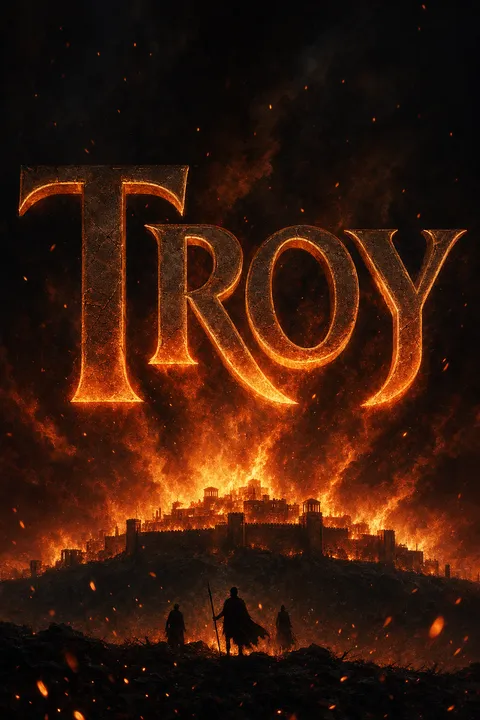
Troy stands as the jewel of the Aegean, gatekeeper between Greece and the barbarous east, a city of gold and horses beloved by Apollo, Ares, Artemis and Aphrodite.16 To grasp how so glorious a kingdom came to burn, the storyteller reaches back to Zeus15 and the founding dynasty of Dardanus, tracing dynasties, curses and marriages the way a weaver picks out bright threads.
A promise threads through it all: actions carry consequences. What Tantalus and Pelops did, what Laomedon did, what a herdsman prince1 would do, all of it accumulates toward one doom. The reader is asked not to memorize every name, but to trust that the tangle will resolve into a tapestry.
Fry frames Troy as both history and myth, invoking the oral tradition that kept the city alive after its ruin. The insistence that poets must sing the tale repeatedly reveals the book's central preoccupation: memory as a form of survival. By opening with genealogy rather than battle, the narrator establishes causality as the engine of tragedy. The moral he names, that actions have consequences, functions less as comfort than as sentence. This prologue also positions the reader as initiate, gently coached through overwhelming detail, mirroring how ancient audiences absorbed epic. The tone mixes reverence and wry modernity, signaling that these gods and heroes will feel psychologically legible, flawed, and unnervingly familiar.
The Idol That Fell From Sky
Following a prize heifer to the plain of Ilium, Prince Ilus kneels to pray for a sign that he has chosen well for his new city. A carved image of Pallas Athena17 drops from the heavens in a cloud of dust, blinding him instantly for gazing on so holy a thing. After a week of devotion his sight returns, and he lays out streets radiating like spokes from a central temple.
Inside the innermost sanctum he sets the fallen idol, the Palladium, the Luck of Troy. So long as it rests undisturbed, the city will prosper and endure. People flock to build and populate the place, renaming themselves Trojans after Ilus's father Tros. Troy is born beneath divine protection, its survival bound to a single sacred object.
The Palladium establishes the book's logic of conditional grace: divine favor is real but contingent, a contract that can be voided. Ilus's blinding dramatizes the danger of proximity to the sacred, a recurring motif in which mortals who overreach toward the gods pay in flesh. By rooting Troy's fate in a portable talisman, Fry plants a mechanical vulnerability that patient readers will remember when the endgame arrives. The city's founding also introduces horses and gold as leitmotifs of Trojan identity and pride. Crucially, prosperity here is inheritance rather than achievement, setting up the moral question of whether later kings will honor or squander what the gods conditionally bestowed.
Laomedon Cheats the Gods
Laomedon commissions Apollo and Poseidon to raise Troy's magnificent walls, then refuses to pay them, just as he later refuses Heracles after the hero rescues his daughter Hesione from a sea monster. The insulted gods answer with plague and a blockading dragon; the insulted hero answers with an army.
Heracles storms the city, kills Laomedon and nearly all his sons, and hands Hesione to his friend Telamon. Only the youngest boy survives, his freedom bought by his sister with a golden veil. The Trojans nickname him Priam,7 the one who was bought. Standing amid the ashes, the boy prophesies that Troy will rise finer than before, and under his rule it does, growing into the richest kingdom in the world.
This episode is the book's rehearsal for its finale: Troy has already fallen once, and the pattern of hubris and retribution is thereby naturalized. Laomedon embodies the miser who mistakes gold for wisdom, and his broken bargains model the recklessness that invites cosmic punishment. Priam's origin is quietly profound. A boy literally purchased from death builds an empire on gratitude and shrewd economics, becoming the story's most sympathetic king. Fry uses this cyclical destruction to suggest that cities, like curses, repeat themselves, and that survival is never final. The golden veil, a woman's small mercy redeeming a doomed bloodline, foreshadows how female choices, from Hesione to Helen, will bend the fate of nations.
The Uninvited Apple
Every immortal is invited to the marriage of the sea nymph Thetis8 to the mortal Peleus, a union arranged only because a prophecy warns that Thetis's son will surpass his father, frightening off Zeus.15 Every immortal comes except Eris, goddess of strife. Snubbed, she rolls a single golden apple across the cave floor, inscribed with two words: to the fairest.
Hera,18 Athena17 and Aphrodite16 each seize it, certain of their claim. Zeus,15 unwilling to choose between his wife,18 his favorite daughter17 and the goddess of love,16 refuses to judge. Hermes proposes a solution: a mortal of impeccable honesty should decide instead. The most consequential beauty contest in history is thus set in motion by wounded pride and one small, deliberately poisonous gift.
The Apple of Discord literalizes how exclusion breeds catastrophe, a psychological truth about slighted parties who weaponize resentment. Fry stages divine pettiness with comic timing, yet the stakes are genocidal, exposing the terrifying gap between the gods' triviality and mortal suffering. The wedding itself is elegiac, described as the last great gathering of immortals, so joy carries the scent of ending. Zeus's cowardice, passing judgment to a human, reveals authority's habit of offloading impossible decisions onto the powerless. Thetis's forced marriage, meanwhile, seeds the tragedy of Achilles: a mother who knows greatness and early death are the same gift. Vanity, not war, is named as the true first cause.
Paris Chooses Love
Hermes brings the golden apple to a young cattle-herder1 on Mount Ida, chosen for his proven honesty after fairly crowning a rival's bull. Three goddesses appear before him. Hera18 offers empire and dominion over all peoples. Athena17 offers wisdom and mastery of war and thought. Aphrodite16 offers only love, opening a shell to reveal the face of the most beautiful mortal woman alive.2
Dazzled, Paris1 presses the apple into Aphrodite16's hands, and she vows that Helen2 will be his. Hera18 and Athena17 rise away in fury and grief, becoming Troy's implacable enemies. Paris1 wakes as if from a dream, haunted by a single name he does not yet understand. He is unaware he is a lost prince of Troy, or what his choice has purchased.
The Judgement crystallizes character as destiny. Paris rejects statesmanship and intellect for erotic gratification, and the war that follows is essentially the externalized consequence of adolescent desire. Fry frames the choice as revealing rather than deciding: Paris was always this person. The scene also converts three goddesses into permanent geopolitical alignments, so that Olympian grudges become the invisible architecture of a decade of slaughter. Aphrodite's gift is a bribe disguised as romance, and the shell containing Helen's face reduces a queen to a prize before she has spoken a word. The episode indicts a culture that treats women as trophies awarded by men, planting the ethical unease that will shadow Helen throughout.
The Oath of the Suitors
Helen2 of Sparta, daughter of Leda and Zeus,15 grows so famous for her beauty that every king and warlord in Greece crowds her father Tyndareus's hall, threatening bloodshed over her hand. The clever Odysseus5 of Ithaca offers a solution in exchange for help winning his own beloved, Penelope. Let every suitor swear a binding oath to accept the chosen husband and to defend that marriage against anyone who breaks it.
The suitors kneel and swear before the gods. Helen2 goes to Menelaus,13 who becomes king of Sparta. Her sister Clytemnestra marries the powerful Agamemnon6 of Mycenae. Odysseus5's ingenious oath keeps the peace for now, but it also forges a weapon: a whole nation contractually obligated to march if Helen2 is ever taken.
Odysseus's oath is a masterstroke of preventive diplomacy that becomes the mechanism of total war, a bitter lesson in how safeguards can be repurposed as tripwires. Fry highlights the irony that the war's vast coalition exists not from loyalty to Menelaus but from a legal contract sworn years earlier. The episode introduces Odysseus's defining intelligence, at once admirable and unsettling, and establishes the tension between cunning and honor that the book interrogates. Helen, meanwhile, remains an object of negotiation, her preferences a formality. The parallel marriages of the two sisters quietly seed future domestic tragedy, reminding us that the epic's public catastrophes are inseparable from private wounds inside royal households.
The Vulnerable Heel
Married to mortal Peleus, the immortal Thetis8 cannot bear that her children will die. Six infant sons perish as she tries to burn away their mortality, following botched advice. For her seventh, she first grips the baby by one heel and dips him in the river Styx to make him invulnerable, then holds him over flame to complete the ritual.
Peleus, horrified, snatches the child from the fire, and Thetis8 flees in fury, the process left unfinished. The boy, renamed Achilles3 and raised by the centaur Chiron, grows swifter and more gifted than any mortal alive. Only the heel his mother clutched, untouched by the sacred water, remains mortal. His two possible fates are fixed: a long obscure life, or a short blazing one remembered forever.
Achilles' heel is the book's most famous emblem of the flaw within perfection, but Fry roots it in maternal grief rather than fate alone. Thetis's love is monstrous and tender at once, an immortal's doomed attempt to spare her child from time itself. The six dead brothers underscore the horror beneath the myth. The dual prophecy, obscurity versus glory, transforms Achilles into a philosophical figure confronting the trade every mortal secretly negotiates: to be forgotten and safe, or celebrated and consumed. His invulnerability paradoxically isolates him, since a body that cannot be wounded still houses a soul that can. The single mortal point becomes a metaphor for how greatness always conceals a lethal intimacy.
Paris Steals a Queen
Recognized at last as Priam7's abandoned son, Paris1 joins the Trojan royal house despite Cassandra10's shrieked warnings that he will burn the city. Haunted by the face Aphrodite16 promised, he persuades Priam7 to let him sail to Sparta, pretending he means to recover his aunt Hesione. Menelaus13 welcomes him warmly for nine days, then leaves for a funeral, trusting his guest.
With the king absent, Paris1 loots the palace and carries off Helen,2 her young son, and vast treasure, whether by seduction, Aphrodite16's arrows, or force. When Menelaus13 returns to find his wife2 gone, Agamemnon6 roars for war, seizing the insult as pretext for the conquest and plunder he has long craved. The suitors' old oath is invoked, and Greece begins to arm.
Paris's abduction violates xenia, the sacred bond between host and guest, the gravest social crime in the Greek moral universe, which is why it demands collective vengeance. Fry keeps Helen's agency deliberately ambiguous, refusing to resolve whether she chose, was bewitched, or was seized, thereby preserving the moral discomfort at the epic's core. Cassandra's ignored prophecy introduces the tragedy of true sight without belief, a recurring cruelty. Agamemnon's secret delight exposes the war's economic engine: honor is the language, but gold and dominion are the appetite. The betrayal of Menelaus's hospitality, coming from a man who owes his very life to being restored to a family, ironically echoes Priam's own bought salvation.
Madness, Skyros, and a Girl's Throat
Two great warriors resist the muster. Odysseus5 feigns insanity, ploughing his fields with mismatched beasts and sowing salt, until Palamedes places baby Telemachus before the plough, forcing the father to swerve and expose the ruse. Achilles3 is hidden by Thetis8 among the daughters of King Lycomedes on Skyros, dressed as a girl, until Odysseus5 flushes him out by presenting weapons and staging a mock attack.
At Aulis the vast fleet lies becalmed, and the seer Calchas19 reveals that Agamemnon6 must sacrifice his daughter Iphigenia to appease Artemis. Lured with a false promise of marriage to Achilles,3 the girl offers her own life. As the knife falls she vanishes, a stag left in her place, and the winds finally rise to carry the ships to Troy.
This sequence exposes the moral corrosion required to make war possible. Odysseus's evasion and its brutal unmasking reveal that even the cunning would rather stay home, while Achilles' cross-dressing concealment complicates heroic masculinity. Iphigenia's sacrifice is the war's original sin against the innocent, converting a father into a killer of his own child and seeding the vengeance that will later consume Agamemnon's house. Fry lets the stag substitution offer ambiguous mercy, but the psychological damage is done: the girl was still led to the altar believing in love. The becalming dramatizes how the gods extort obedience through delay, and how leadership repeatedly means choosing which innocents to destroy for collective glory.
First Blood, Then Ten Years
As the black fleet blackens the horizon, Calchas19 warns that the first Greek to touch Trojan soil will die. Achilles3 hesitates, but eager Iolaus leaps down and is promptly cut down by Hector,4 earning the name Protesilaus, the first to fall.
The invincible-skinned Trojan Cycnus tears through the Greeks until Achilles3 throttles him with his own helmet straps, since even an unwoundable man must breathe. The Trojans retreat behind their walls, and a grinding deadlock begins.
Troy proves too vast to encircle and too disciplined to be lured into one decisive battle. For nine years the Greeks build a fortified stockade, raid the surrounding countryside for grain, cattle and slave women, and sack more than twenty neighboring towns while the great city stands untaken.
Fry demystifies heroic warfare by insisting on its tedium: nine years of plunder rather than thunder, a siege that resembles modern attrition more than legend. Protesilaus's death fulfills prophecy while dignifying the anonymous courage of being first, and Fry notes his lasting veneration, meditating on how the obscure can achieve immortality through a single act. Cycnus's defeat teaches that invulnerability is never total, quietly echoing Achilles' heel and foreshadowing limits. The long stalemate reframes the Iliad's famous events as occurring in a war already grown old and cynical. The raids also establish the human currency, captured women, that will detonate the central quarrel, connecting economics of war to its coming crisis.
The Quarrel Over Briseis
Plague strikes the Greek camp after Agamemnon6 refuses to return Chryseis, a priest's captive daughter, to her father. Forced by Apollo's arrows to give her up, the king spitefully compensates himself by seizing Briseis,23 the captive woman Achilles3 was awarded.
Enraged at the public humiliation, Achilles3 nearly draws his sword before Athena17 stays his hand. He withdraws himself and his Myrmidons entirely from the fighting and begs his mother Thetis8 to persuade Zeus15 to let the Trojans slaughter the Greeks until they crawl back begging.
Zeus,15 indebted to Thetis,8 agrees. Deprived of their finest champion, the Greeks are steadily driven back toward their ships, and Hector4's Trojans press forward with mounting confidence, the tide of the war turning on one man's wounded pride.
The rupture between Agamemnon and Achilles is the psychological heart of the Iliad, dramatizing how honor culture makes prestige indistinguishable from selfhood. To Achilles, losing Briseis is not losing a person but losing recognition, the visible proof of his worth. Fry stresses that both men are wrong: Agamemnon petty and grasping, Achilles willing to let comrades die to nurse a grievance. Athena's intervention models self-control as divinely difficult rather than natural. The tragedy is structural, since the same warrior ethos that produces glory produces the ego that squanders it. By having Achilles pray for his own side's massacre, Fry exposes the terrifying solipsism of the aggrieved, whose sense of injury outweighs all other loyalty.
Patroclus in Borrowed Armour
As the Trojans reach the ships and set one ablaze, Achilles3 still refuses to fight, but allows his dearest companion Patroclus9 to wear his gleaming armour and lead the Myrmidons, on the strict condition that he only drive the enemy from the ships.
Mistaken for Achilles,3 Patroclus9 scatters the Trojans, kills Zeus15's son Sarpedon, and in his battle-fury forgets the warning, chasing the enemy to the very walls of Troy. There the god Apollo strikes him, dazing him and stripping away his armour.
A Trojan spears him, and Hector4 delivers the killing blow, boasting until Patroclus,9 dying, prophesies Hector4's own imminent death at Achilles3 'hands. A savage struggle erupts over the corpse, and news of the loss shatters Achilles3 into inconsolable grief.
Patroclus's death is the hinge that converts private sulking into personal catastrophe, showing how withdrawal from responsibility boomerangs onto what one loves most. Fry treats the friendship, described also as love, with tenderness, making the loss intimate rather than merely strategic. The borrowed armour is rich symbolism: Patroclus dies inhabiting Achilles' identity, and in a sense Achilles' refusal to fight kills the better half of himself. Apollo's intervention reminds us that mortal glory is always permitted rather than earned. The dying prophecy binds the two men's fates together, so that avenging Patroclus means embracing his own doom. Grief here becomes the only force capable of ending Achilles' self-absorption, at a monstrous cost.
Achilles Avenges, and Defiles
Reconciled with Agamemnon6 and armed in a magnificent new panoply forged overnight by Hephaestus, Achilles3 returns to battle transformed into a shrieking engine of slaughter, choking the river Scamander with Trojan dead until the river god himself rises against him.
He hunts Hector4 to the Scaean Gate. Hector4 runs, and Achilles3 chases him three times around the walls before Athena17 tricks the Trojan into standing his ground. Achilles3 spears him through the throat at the one gap in the stolen armour Hector4 wears.
As Hector4 dies begging that his body be returned for burial, Achilles3 refuses with contempt, lashes the corpse to his chariot, and drags it around Patroclus9's tomb for days, a sacrilege so cruel that even the watching gods avert their eyes.
Achilles' aristeia is both magnificent and monstrous, Fry refusing to let readers cleanly admire the hero. His attack on the river dramatizes hubris literally overflowing, a mortal warring against nature. The killing of Hector fulfills the interlocking prophecies while destroying Troy's true guardian, the only figure who embodied duty, tenderness and courage together. The defilement of the body crosses a sacred line, since proper funeral rites are the bedrock of Greek and Trojan honor alike. Fry frames Achilles' cruelty as grief metastasized into desecration, revealing that vengeance cannot restore the dead and only degrades the avenger. The gods' revulsion signals that even in a brutal world, some violations exceed what heaven will tolerate.
A Father Kisses the Killing Hand
Guided secretly through the Greek camp by Hermes, King Priam7 comes alone by night to the tent of the man who slaughtered so many of his sons.3 He kneels, clasps Achilles3 'knees, and kisses the very hands that killed Hector,4 asking Achilles3 to imagine his own aged father waiting for news back home. The image pierces Achilles.3
The two enemies weep together, one for a lost son, one for a lost friend9 and an absent father he will never see again. Achilles3 accepts a ransom, and though the body has lain exposed for days it remains uncorrupted, preserved by the gods. They agree to a twelve-day truce for the funeral. Troy cremates Hector4 and mourns its greatest defender, bidding farewell to its last true hope.
This is the moral summit of the entire book, the moment vengeance dissolves into shared humanity. Priam's supplication inverts every hierarchy of the warrior code, a king humbling himself to a killer, and it works precisely because it appeals not to honor but to filial love. Fry stages the mutual weeping as recognition: enemies discover they inhabit the same grief. Achilles' capacity for pity, surfacing at last, redeems him partially without erasing his savagery. The preserved body signals divine approval of mercy after the earlier disgust at cruelty. The scene argues that compassion, not conquest, is the rarest heroism, and that the truce it buys is only a fragile pause before ruin resumes.
The Arrow That Finds the Heel
Fresh champions rally to Troy. The Amazon queen Penthesilea rides in and is slain by Achilles,3 who weeps over her beauty too late. When the mocker Thersites jeers at his grief, Achilles3 kills him with a single blow. The Ethiopian king Memnon kills Nestor24's son Antilochus before Achilles3 cuts him down in the war's longest duel.
Charging at last to the Scaean Gate, ignoring both his mother8's old warnings and Apollo's, Achilles3 is struck by an arrow loosed by Paris1 and guided by the god. It pierces his one mortal spot, the heel his mother once held. The greatest warrior alive dies still spearing Trojans as his legs buckle. Ajax11 carries his body from the field, and both armies grieve the passing of something the world will never see again.
Achilles' death fulfills the prophecy he chose knowingly, trading long life for undying fame, so his fall is less defeat than deliberate self-completion. Fry uses the string of dying allies, Penthesilea, Memnon, to show glory as a currency built on other people's ends, and the tears over the Amazon reveal Achilles' recurring pattern of feeling too late. The heel's payoff, planted chapters earlier, closes the loop between maternal love and lethal vulnerability. That Paris, the least martial of Trojans, kills the greatest Greek underscores the epic's irony: greatness falls to opportunism guided by divine grudge. Fry's closing meditation makes Achilles the patron of every mortal who burns bright and brief.
The Armour and the Unraveling
Achilles3 'god-forged armour is awarded not to mighty Ajax11 but to cunning Odysseus,5 decided by asking captive Trojans whom they feared most. Humiliated, Ajax11 is driven mad, slaughters a flock of sheep believing them his commanders, and, waking to his shame, throws himself on Hector4's sword.
Meanwhile the Greeks fetch Achilles3 'son Neoptolemus20 and the marooned archer Philoctetes, who carries Heracles' poisoned arrows. Philoctetes strikes Paris,1 whose estranged first wife Oenone refuses to heal him, and Paris1 dies in agony.
Guided by the defector Helenus, Odysseus5 and Diomedes12 creep into Troy and steal the Palladium, the sacred idol guaranteeing the city's safety. With its luck removed and its heroes dead, Troy stands stripped of every protection it once trusted.
The armour dispute exposes the fault line between brute valor and intelligence, and Fry lets Odysseus win in a way that feels both clever and slightly shabby, deepening the book's ambivalence about cunning. Ajax's suicide, on the very sword Hector gave him, is a tragedy of an honest man broken by the politics of prestige, proving the warrior code destroys its most loyal servants. Paris's squalid death, denied mercy by the wife he abandoned, delivers poetic justice while Oenone's refusal mirrors his own faithlessness. The theft of the Palladium is the crucial mechanical payoff of the founding chapter: strip away conditional grace and destruction becomes inevitable. Troy is now a shell awaiting one final deception.
The Horse at the Gates
Athena17 inspires Odysseus5 with a final stratagem. The craftsman Epeius builds a colossal wooden horse, and thirty warriors, Odysseus5 among them, hide inside its belly while the Greek fleet burns its camp and sails out of sight to nearby Tenedos.
Left behind, Odysseus5's kinsman Sinon25 lets himself be captured and spins a tale that the horse is an offering to Athena,17 built too large to fit through Troy's gates on purpose.
When the priest Laocoon warns against it and hurls a spear at its flank, sea serpents drag him and his sons to their deaths, and the terrified Trojans read the omen as divine command. Ignoring Cassandra10's frantic pleas to burn it, they tear down part of their own wall and haul the horse triumphantly inside, celebrating a war they believe is won.
The horse is the triumph of Odyssean intelligence over strength, the war's decade of force resolved by a single lie that Troy tells itself. Fry emphasizes that the Trojans destroy their own defenses, dismantling the wall to admit their doom, a devastating image of self-inflicted ruin born of relief and wishful thinking. Sinon's performance weaponizes hospitality and pity, the very virtues Troy prides itself on. Laocoon's death and Cassandra's ignored warnings complete the tragic pattern of truth silenced by fear and desire. The scene is a study in how people believe what they long to believe, and how a besieged psyche, desperate for the war to end, will rationalize any hope into fatal certainty.
The Night Troy Burned
At midnight the warriors climb down from the horse, cut the sentries' throats, and open the gates to the returned army. Troy is butchered in its sleep. Neoptolemus,20 savage as his father, murders the boy Polites before his parents and then slaughters old Priam7 at the altar. Cassandra10 is dragged from Athena17's temple and violated. Hector4's infant son is hurled from the walls, and Andromache22 is claimed as a slave.
Aeneas,21 spared by fate, escapes carrying his aged father and the rescued Palladium toward a distant future in Italy. Menelaus13 finds Helen,2 raises his sword to kill her, and drops it, undone once more by her beauty. As dawn breaks over smoking ruins, even the gods recoil at the atrocities, and Zeus15 regrets ever having made mankind.
The sack is deliberately unbearable, Fry refusing to let victory feel clean, insisting that conquerors become monsters. Neoptolemus's slaughter of a suppliant king at an altar mirrors and surpasses his father's earlier sacrileges, showing violence inherited and amplified across generations. The murder of children and the enslavement of women expose war's endpoint as the annihilation of the innocent, echoing Iphigenia at the start and closing a grim frame. Menelaus dropping his sword before Helen renders the entire war absurd: ten years and a city for a beauty that disarms even righteous fury. Aeneas's escape with the Palladium transplants Troy's luck elsewhere, suggesting destruction is also seed, and that empires migrate rather than end.
Epilogue
As Troy smolders, the gods survey what their favorites have done and are sickened. Athena,17 whose beloved Greeks have won total victory, declares herself unsatisfied, for sacred laws have been trampled and abominations committed. Apollo and Artemis agree the Greeks cannot simply sail home to comfortable lives after such profanities; they must pay in full.
Zeus,15 weary and grieving, confesses that he wishes Prometheus had never persuaded him to create mankind at all. The victory is hollow, staining the reputations of the conquerors forever. The dawn light falls on vultures moving into the rubble, on wagon trains of looted treasure, and on Greeks already quarreling over slaves, most of them keeping their backs turned to the ruin they made.
Fry ends not with triumph but with divine nausea, collapsing the distinction between winners and losers. The gods' insistence on punishment sets up the disastrous homecomings that lie beyond this book, framing victory as the beginning of a new curse. Zeus's regret over creating humanity is the story's bleakest note, a creator disowning his creation after watching it exceed even the gods in cruelty. By lingering on scavengers and squabbling looters rather than glory, Fry strips war of its epic gilding and reveals its true residue: shame, plunder, and averted eyes. The coda affirms the prologue's thesis that actions carry consequences, and that no conquest escapes the moral accounting that follows.
Analysis
Fry's retelling insists on causality as tragedy's true machinery: the fall of Troy is not one event but the maturation of countless small acts, from Laomedon's stinginess to Paris1's vanity to Agamemnon6's pride. The opening promise, that actions carry consequences, governs everything, so that gods and mortals alike are trapped in chains of provocation and retribution they cannot see whole. The book's great subject is the gap between the trivial and the catastrophic. A snubbed goddess, a stolen wife, a seized captive, each a private slight that expands into mass death, exposing how honor cultures convert ego into apocalypse. Fry refuses clean heroism. Achilles3 is magnificent and monstrous, Odysseus5 brilliant and shabby, victory itself an atrocity that sickens the gods who willed it. His genius is tonal: he modernizes the psychology, letting us recognize in these bronze-age figures the familiar mechanics of grief, resentment, wishful thinking, and delegated responsibility, while preserving the mythic scale. Women haunt the margins as the real casualties of male appetite, from Iphigenia to Cassandra10 to Helen,2 whose ambiguous agency the narrator deliberately never resolves, keeping the ethical discomfort raw. Prophecy functions less as fate than as knowledge unheeded, and the recurring failure to believe truth, Cassandra,10 Laocoon, becomes its own indictment of human denial. The war's most transcendent moment is not triumph but Priam7 kneeling before his son's killer,3 where enemies dissolve into shared grief, arguing that compassion is the rarest heroism. In the appendices, Fry meditates on history versus myth, embracing the productive uncertainty that lets fact and symbol coexist. The lasting takeaway is bleak and humane at once: glory and ruin are the same fire, and civilizations, like curses, tend to repeat.
Review Summary
Troy receives high praise from readers for Stephen Fry's engaging retelling of the Trojan War. Many appreciate his accessible writing style, wit, and ability to bring the complex mythology to life. Readers enjoy Fry's narration in the audiobook version. Some found the extensive cast of characters challenging to follow, but overall the book is commended for its comprehensive coverage of the Troy legend, from its origins to its fall. Fry's footnotes and historical context are also highlighted as valuable additions.
People Also Read


Characters
Paris
Trojan prince, Helen's loverA herdsman raised in ignorance of his royal blood on Mount Ida, Paris is beautiful, athletic, charming, and fatally shallow. Given the impossible task of judging three goddesses, he chooses love over power and wisdom, a decision that reveals his appetite for pleasure above duty. Vain and self-justifying, he abandons his first wife Oenone and their son, then carries off another man's queen2 and treasure, dragging his adoptive city toward destruction while resenting any suggestion of cowardice. Skilled with a bow but disliked in the ranks as pretty and preening, he embodies desire untethered from responsibility. Fry paints him as a man who mistakes wanting for deserving, and whose small choices ripple outward into catastrophe he never troubles to understand.
Helen
The most beautiful womanDaughter of Zeus15 and Leda, raised in Sparta, Helen possesses a beauty said to appear once in an age, a gift she experiences as much as curse as blessing. Witty, gifted at mimicry, and warm-natured, she is passed among men as prize, wife, and pretext, her own desires rarely consulted. Whether bewitched by Aphrodite16 or genuinely swayed, she leaves Menelaus13 for Paris1 and comes to loathe both her vanity-driven lover and the war her presence feeds. Fry renders her as a woman burdened with guilt for deaths she did not choose to cause, oscillating between complicity and helplessness. Her longing for home and for the daughter she left behind gives the epic its quiet, aching moral center.
Achilles
Greece's peerless warriorSon of the mortal Peleus and the sea nymph Thetis8, Achilles is the swiftest and deadliest fighter alive, nearly invulnerable but for one heel. Raised by the centaur Chiron and bound in fierce love to Patroclus9, he knowingly faces a choice between a long forgotten life and a short glorious one. Proud, sentimental, headstrong and capable of terrifying cruelty, he is ruled by his sense of honor and his griefs. When slighted he withdraws in wounded pride; when bereaved he becomes a force of savagery that even gods flinch from. Fry presents him as the pattern of every champion since, magnetic and monstrous, whose flaw is not the heel but the ungovernable passion that makes his glory and his ruin one.
Hector
Troy's noble defenderEldest son of Priam7 and Hecuba14, husband to Andromache22 and father of an infant son, Hector is Troy's greatest warrior and its moral heart. Where Achilles3 fights for glory, Hector fights from duty, defending a city endangered by his brother Paris1's recklessness. Courageous, courteous, and clear-eyed about his likely fate, he chooses honor over safety while grieving what it costs his family. He treats even Helen2 with kindness and observes the codes of war scrupulously. Fry makes him the story's most sympathetic fighter, a man who embodies the tragedy of the good soldier serving an unworthy cause, carrying the weight of a doomed people on shoulders that never sought the war he must nonetheless die fighting.
Odysseus
The cunning Ithacan kingKing of rocky Ithaca, descended from the trickster Hermes, Odysseus is the wiliest mind in Greece, prized by allies and feared by enemies for his guile. He devises the oath that binds the suitors, feigns madness to dodge the war, and later engineers its decisive stratagems. Loyal to his wife Penelope and infant son, he nonetheless serves the cause with ruthless ingenuity, capable of framing rivals, deceiving friends, and smiling through betrayal. Fry treats him with fascinated ambivalence, admiring the intellect while noting the shabbiness beneath the charm. He is the herald of a new kind of heroism, wit over war, that will outlast the age of brute champions, for better and for morally uneasy worse.
Agamemnon
High king of the GreeksKing of Mycenae and supreme commander of the Greek alliance, Agamemnon is a brilliant general undone by monumental self-importance. He speaks of himself in the third person, mistakes slights for wounds, and craves the plunder and fame that conquering Troy would bring. Willing to sacrifice his own daughter for a favorable wind and to seize another man's prize out of spite, he embodies power without wisdom. Fry shows him swinging violently between tears and bravado, capable of real courage in battle yet catastrophically blind to human feeling. His appetite for prestige ignites the quarrel that nearly loses the war, marking him as a leader gifted in strategy but ruinous in judgment of the human heart.
Priam
Troy's aged, devout kingOnce a boy bought from death by his sister, Priam rebuilt ruined Troy into the richest kingdom in the world through shrewd governance and piety. Now old, he presides over a vast family and a besieged city with dignity, warmth, and a grief he refuses to visit upon others, never blaming Helen2 for the doom her presence brings. His courage surfaces most memorably when he crosses enemy lines to beg for his son's4 body. Fry makes him the counterweight to Agamemnon6's vanity, a ruler whose greatness lies in humility and love rather than conquest, and whose suffering, watching his sons die one by one, gives the war its most human face of loss.
Thetis
Achilles' immortal motherA sea nymph wrestled into marriage with mortal Peleus after a prophecy scared the gods away, Thetis is consumed by the knowledge that her son3 will die young. Her love expresses itself as desperate, sometimes horrifying protectiveness, from dipping Achilles3 in the Styx to hiding him in disguise to petitioning Zeus15 on his behalf. Empathy pains her, an immortal feeling mortal grief. Fry portrays her as a mother whose devotion cannot save what she loves.
Patroclus
Achilles' beloved companionA prince raised alongside Achilles3 after a childhood accident sent him into exile, Patroclus is the gentler, kinder half of the pair, friend and lover to the great warrior3. Thoughtful and compassionate, he shows tenderness even to captives. His empathy for the suffering Greeks moves him to a fateful act of courage. Fry frames him as the soul whose loss transforms Achilles3 utterly.
Cassandra
The prophetess never believedA beautiful daughter of Priam7 who chose Apollo's temple over royal life, Cassandra received the gift of true prophecy and, for refusing the god, the curse that none would ever believe her. She foresees Troy's destruction again and again, greeting Paris1, Helen2, and the wooden horse with accurate warnings dismissed as madness. Fry makes her the embodiment of the tragedy of unheeded truth, doomed to witness catastrophe she cannot prevent.
Ajax
The mighty, steadfast giantTelamonian Ajax, cousin of Achilles3, is the largest and strongest of the Greeks, a tower shield made flesh. Less clever than the schemers around him, he is prized for unwavering loyalty, tireless courage, and sheer defensive strength, repeatedly rescuing comrades and guarding the fallen. Fry celebrates his massive steadfastness as a kind of heroism equal to golden brilliance, an honest man in a war run by cunning ones.
Diomedes
Athena's favored warriorKing of Argos and close friend of Odysseus5, Diomedes is a fierce, gifted fighter beloved by Athena17, who once empowered him to wound gods on the battlefield. Trusted, brave, and reliable, he partners Odysseus5 on the war's riskiest missions, from night raids to the theft of Troy's sacred idol. Fry gives him steady valor and a moral center that occasionally checks his companion's slyness.
Menelaus
Helen's wronged husbandKing of Sparta and brother of Agamemnon6, Menelaus wins Helen2 by lottery and loses her to Paris1, becoming the war's nominal cause. A capable and brave warrior, he is defined chiefly by his tormented love for the wife who left him, an obsession that survives every insult. Fry shows a man whose fury toward Helen2 collapses the instant he sees her face again.
Hecuba
Troy's grieving queenWife of Priam7 and mother to Hector4, Paris1, Cassandra10 and many more, Hecuba is the matriarch of Troy. Her prophetic dream while pregnant with Paris1 foretells the city's burning, forcing a terrible choice. Loving and devout, she endures the loss of son after son, embodying maternal suffering as the war grinds toward its end. Fry gives her dignity in overwhelming sorrow.
Zeus
Conflicted king of godsRuler of Olympus, Zeus fancies himself a neutral arbiter above the war yet is endlessly pulled by promises, favorites, and his formidable wife. He forbids divine meddling then indulges it, honors a debt to Thetis8, and shakes events into motion without patience to control them. Fry portrays him as a manager hemmed in by treaties and rebellion, powerful yet strangely unfree, who ultimately regrets what mortals become.
Aphrodite
Goddess of love, Troy's allyGoddess of desire and protector of Troy, Aphrodite wins the golden apple by promising Paris1 the love of Helen2, then relentlessly enforces that union. Vain, powerful and easily insulted, she claims her power over gods and mortals exceeds even Zeus15's thunderbolts. She shields her favorites in battle and manipulates Helen2's heart. Fry casts her as the deity whose gift of love proves more destructive than any weapon.
Athena
War-wise goddess against TroyGoddess of wisdom and warcraft, spurned by Paris1 in the judgment, Athena becomes Troy's implacable enemy and champion of Odysseus5, Diomedes12 and Achilles3. She stays Achilles3' sword, guides spears, and inspires the final stratagem of the horse. Fry shows her cold brilliance and her insistence on justice, unsatisfied even by total victory when sacred laws are broken.
Hera
Vengeful queen of heavenWife of Zeus15 and goddess of marriage, Hera never forgives Paris1 for denying her the apple, demanding nothing less than Troy's complete destruction. She badgers, manipulates and outmaneuvers her husband to advance the Greek cause. Fry portrays her jealous, relentless will as one of the war's driving forces, an anger that will accept only total ruin.
Calchas
The Greeks' unerring seerA priest of Apollo serving Agamemnon6, Calchas reads the future in the flight and cries of birds. His prophecies, always accurate and often unwelcome, shape the campaign, from the sacrifice at Aulis to the ten-year duration to the need for Achilles'3 son and Heracles' arrows. Fry gives him a wry survivor's diplomacy, delivering doom while managing a volatile king.
Neoptolemus
Achilles' savage young sonAlso called Pyrrhus, the flame-haired son Achilles3 fathered while hidden on Skyros, Neoptolemus is summoned to Troy as a prophesied requirement for victory. Barely bearded, he possesses his father's speed, skill and lust for killing, but little of his capacity for grief or mercy. Fry presents him as inherited violence without restraint, the next generation amplifying the cruelty of the last.
Aeneas
Fated Trojan survivorA Trojan prince, son of Anchises and the goddess Aphrodite16, and a herdsman like Paris1 before joining the royal house. A brave and honorable fighter, he is repeatedly rescued by the gods from certain death because destiny marks him for something greater beyond Troy. Fry frames him as the seed of a future carried out of the ashes, loyal to family and to the sacred.
Andromache
Hector's devoted wifeA Cilician princess married to Hector4 and mother of their infant son, Andromache dreads a future of widowhood and slavery. Her tender farewell to Hector at the gate is among the war's most human moments, love shadowed by certain loss.
Briseis
The captive who sparks furyA princess of Lyrnessus captured by Achilles3 after he kills her family, Briseis becomes his prize and, through Agamemnon6's seizure of her, the flashpoint of the war's central quarrel. Kindly treated by Patroclus9, she mourns her captors as much as her losses.
Nestor
The aged wise counselorKing of Pylos and the oldest of the Greek commanders, Nestor is valued for wisdom earned across a lifetime of legendary adventures. He counsels diplomacy, mediates quarrels, and steadies morale, though his advice does not always land as intended.
Sinon
The liar left behindA kinsman and supposed enemy of Odysseus5, Sinon volunteers to be captured by the Trojans and, through a performance of bitter grievance and false piety, persuades them to take the wooden horse into their city.
Plot Devices
The Palladium
Conditional guarantee of safetyA small, plainly carved wooden image of Athena17 that falls from the sky at Troy's founding and is enshrined in the city's central temple. It carries a divine condition: so long as it remains within the walls undisturbed, Troy cannot fall. Introduced in the opening chapter as the Luck of Troy, it functions as a dormant mechanism the reader is invited to remember. For most of the war it goes unmentioned, a promise held in reserve. Its eventual theft near the climax converts an unbreakable siege into an inevitable collapse, paying off the founding setup with mechanical precision. Fry uses it to dramatize how divine grace is always contingent, a contract that can be voided by human daring or sacrilege.
The Apple of Discord
Catalyst disguised as a giftA single golden apple inscribed to the fairest, rolled into a divine wedding by the uninvited goddess of strife. It provokes an unresolvable quarrel among Hera18, Athena17 and Aphrodite16, which Zeus15 refuses to settle, delegating judgment to a mortal. The apple sets in motion the Judgement of Paris1 and thus the entire war, functioning as the tiny object whose consequences cascade into the fall of a civilization. Fry uses it to argue that catastrophe often begins in petty exclusion and wounded vanity rather than grand ambition. It also permanently aligns the goddesses for or against Troy, turning a beauty contest into the invisible architecture behind a decade of slaughter and shaping which mortals the gods will protect or destroy.
The Oath of the Suitors
Binding obligation to make warDevised by Odysseus5 to prevent bloodshed among Helen2's many suitors, the oath requires every applicant to accept her chosen husband and to defend that marriage against anyone who violates it, sworn before the gods and on their children's lives. Intended as a peacekeeping safeguard, it becomes the legal engine of total war. When Paris1 carries Helen2 off, the oath compels a vast coalition of Greek kings to sail, regardless of personal stake. Fry uses it to explore how instruments designed to secure peace can be repurposed as tripwires for conflict, and to explain the otherwise improbable unity of the Greek alliance. It also establishes Odysseus5's defining trait: ingenuity whose long-term consequences outrun its clever intentions.
Achilles' Heel
The single fatal vulnerabilityWhen Thetis8 dips the infant Achilles3 in the river Styx to make him invulnerable, she holds him by one heel, which the sacred water never touches. That heel remains his only mortal point, a weakness planted early and dormant through years of unstoppable warfare. Fry roots the device in maternal grief rather than mere fate, making it an emblem of how love can leave a lethal intimacy. The vulnerability pays off precisely when least expected, ensuring the mightiest warrior falls not to another champion in fair combat but to a single well-guided arrow. It has become the archetype of the flaw within perfection, and Fry frames it as a truth about all mortals: every strength conceals one undefended place.
The Trojan Horse
Deception ending the siegeA colossal hollow wooden horse built by the craftsman Epeius, presented as an offering to Athena17 while thirty Greek warriors hide inside its belly and the fleet feigns departure. It is the culmination of cunning over strength, resolving a ten-year deadlock through a single elaborate lie sustained by the captured Sinon25 and reinforced by ominous portents. The device functions as the ultimate test of belief: the Trojans must want the war over so badly that they dismantle their own defenses to admit their doom. Fry uses it to dramatize how besieged minds rationalize hope into fatal certainty and how hospitality and pity can be weaponized. Its acceptance, over Cassandra10's warnings, seals a fate the founding Palladium had once forestalled.
Stephen Fry's Great Mythology Series

About the Author

Download PDF
Download EPUB
.epub digital book format is ideal for reading ebooks on phones, tablets, and e-readers.








































