Key Takeaways
1. Democracy's Stealthy Undoing
The thing to fear from the Trump presidency is not the bold overthrow of the Constitution, but the stealthy paralysis of governance; not the open defiance of law, but an accumulating subversion of norms; not the deployment of state power to intimidate dissidents, but the incitement of private violence to radicalize supporters.
Gradual erosion. Democracy's decline is a slow, incremental process, not a sudden collapse. The American republic, founded on a commitment to the rules of the game, saw these rules erode over decades, leading to an "all-or-nothing" political climate. This shift created fertile ground for a leader who would exploit, rather than respect, constitutional boundaries.
Pre-existing conditions. Before Trump, the political system was already strained by intensifying partisanship and a breakdown of traditional compromise.
- Debt ceiling fights became weapons, threatening national bankruptcy.
- President Obama asserted executive power on immigration, reversing his own prior legal interpretations.
- The Birther hoax, widely accepted by Republicans, revealed a radical denial of a sitting president's legitimacy.
- Judicial nominations became all-out ideological battles, culminating in the unprecedented blocking of Merrick Garland.
Elite disconnect. A growing disconnect between political elites and the electorate, coupled with economic stagnation and cultural anxieties, further destabilized the system. This environment, marked by rising tolerance for violence and a sense of national decline, created the "pre-existing conditions" that Trump masterfully exploited, turning long-standing vulnerabilities into pathways to power.
2. The Enablers' Complicity
If (when?) his enablers withdraw from Donald Trump, he will be left isolated and helpless, a dead tooth in the gums of the US government.
Many hands. Donald Trump's ascent and sustained power were not solitary achievements but the result of widespread complicity. A diverse array of actors, from conservative media to Republican candidates, party apparatus, wealthy donors, and rank-and-file voters, actively supported or passively enabled his rise. Many expressed private discomfort but remained publicly ineffectual.
Cultural grievances. Trump's success stemmed less from an affirmative conservative agenda and more from his astute exploitation of conservative anger and alienation. The infamous Access Hollywood tape, revealing Trump's confessed sexual assault, was swiftly overshadowed by the WikiLeaks dump of Hillary Clinton's emails, strategically deployed to stoke anti-Catholic sentiment and divert attention. This manipulation allowed many conservatives to overlook Trump's moral failings.
Negative partisanship. Trump cannily leveraged "negative partisanship," where voters dislike one party more than they like the other, to consolidate support he couldn't earn on merit. His appeal to those who felt devalued and disrespected, often expressed as a rejection of "political correctness," resonated deeply. This dynamic, fueled by a conservative entertainment complex and a compliant Republican Party, sustained "Trumpocracy" despite his chaotic decision-making and policy failures.
3. Plunder as Policy
The main benefit of controlling a modern bureaucratic state is not the power to persecute the innocent. It is the power to protect the guilty.
Unprecedented self-enrichment. Donald Trump transformed the presidency into an instrument for personal and family enrichment on an unprecedented scale. His administration burned public money to sustain his lavish lifestyle, with travel costs projected to surpass eight years of Obama's spending in just one year. His properties, like Mar-a-Lago, doubled fees, and his 2020 reelection committee funneled hundreds of thousands to his businesses.
Kushner's financial desperation. The Trump family's financial entanglements extended to Jared Kushner, whose family's $1.8 billion Fifth Avenue property faced catastrophic debt. Post-election, the Kushners aggressively sought foreign investment, marketing "investor visas" in China and attracting interest from Russian state-owned banks. These dealings blurred the lines between public service and private gain, raising serious ethical questions.
Erosion of ethical norms. Trump systematically dismantled post-Watergate ethical standards, refusing to release tax returns, ignoring conflict-of-interest rules, and appointing relatives to senior positions. His administration's slow staffing of US attorney positions and his demands for personal loyalty from law enforcement further corroded the rule of law. This culture of impunity, where corruption is protected rather than punished, risked transforming the federal government into a tool for self-enrichment.
4. Betrayal of Trust and Principles
To work for Donald Trump, you must ready yourself to lie and lie.
Demands for subservience. Trump's presidency was characterized by an unstable temperament, demanding absolute loyalty while offering none in return. Staffers like Sean Spicer, Kellyanne Conway, and Mike Pence were repeatedly forced to defend Trump's falsehoods, only to be publicly contradicted by the president himself. This created a "snake pit" environment, where mutual vindictive leaks and ritual humiliations were commonplace.
Compromised figures. Trump surrounded himself with individuals whose pasts or actions were deeply compromised.
- Jay Sekulow, his legal adviser, funneled millions from charities to his family.
- Michael Flynn, his national security adviser, accepted foreign payments and engaged in mob-like political rhetoric.
- Weak White House leadership, such as Don McGahn and Reince Priebus, failed to curb Trump's impulses or prevent the appointment of compromised individuals.
Abandoned promises and allies. Trump betrayed his campaign promises, escalating conflicts in Syria and Afghanistan, reneging on NATO commitments, and failing to deliver on the Mexico wall. He also alienated his own party, attacking congressional leaders and members who dared to criticize him. This transactional approach, prioritizing personal power and ego over policy or party unity, left a trail of broken trust and unfulfilled agendas, demonstrating that loyalty to Trump was a one-way street.
5. Media as the Enemy
The FAKE NEWS media (failing @nytimes, @CNN, @NBCNews and many more) is not my enemy, it is the enemy of the American people. Sick!
Weaponizing "fake news." Donald Trump masterfully weaponized the term "fake news" to delegitimize honest journalism and wall his supporters within an alternative information system. Despite his own unprecedented reliance on falsehoods and fantasies, he convinced his base that he was the victim of a vast media conspiracy. This strategy allowed him to dismiss inconvenient truths, such as Russian election interference, as partisan fabrications.
Attacks and threats. Trump's attacks on the press escalated from "unfair" to "enemy of the American people," a phrase he repeated at rallies and in tweets. He threatened retaliation against media organizations like Amazon/Washington Post and CNN, even exploring ways to block mergers. His press secretary, Kellyanne Conway, issued veiled threats against journalists, and Sean Spicer punitively barred outlets from briefings.
Incitement to violence. Trump's rhetoric often incited violence against journalists, with rally crowds chanting "CNN Sucks" and a Republican candidate, Greg Gianforte, physically assaulting a reporter. This violence was not only condoned but celebrated and even monetized by conservative media and the Republican Party. The blurring lines between intentional disinformation and right-of-center journalism, often amplified by Russian social media infrastructure, created a dangerous environment where truth was actively subverted for political gain.
6. The Rigged System Narrative
Beyond the evidence, however, was fear: fear that the time would soon come, and maybe already had come, when democracy would be turned against those who regarded themselves as its rightful winners and proper custodians.
Electoral vulnerabilities. The 2016 election revealed significant vulnerabilities in American democracy, particularly concerning voter access. Republican-led states, empowered by the 2013 Shelby County v. Holder Supreme Court decision, implemented new voting restrictions, such as cuts to early voting and stricter voter ID laws. These changes disproportionately affected minority voters, contributing to an unprecedented decline in African American turnout.
Fueling anxieties. Trump capitalized on a deep-seated anxiety among some white Americans who felt their country was changing too rapidly and that democracy was being "rigged" against them. His claims of widespread illegal voting, though baseless, resonated with fears that "makers" were being outnumbered by "takers." This narrative, amplified by anti-Semitic undertones in his final campaign ad, legitimized actions that would once have been considered antidemocratic.
Protecting the president. The Pence commission on electoral integrity, despite its stated goal, was widely seen as an attempt to justify voter suppression. When states refused to cooperate due to security concerns, Trump accused them of hiding something. Meanwhile, the Republican Party, initially hesitant about Russian interference, rallied to protect Trump from investigations into his campaign's contacts with Moscow. This collective defense, even in the face of potential treason, underscored a willingness to prioritize partisan power over democratic integrity.
7. America Alone: Eroding Global Alliances
America’s friends might hope that the Trump presidency would prove short, its activities limited and ineffectual. They could count the months and minutes until a return to something more like normal. But things could never wholly return to normal again, could they?
Isolationist rhetoric, global impact. Trump's "America First" policy, despite assurances to the contrary, led to the increasing isolation of the United States from its traditional allies. His aggressive rhetoric against North Korea was undermined by simultaneous insults and demands for payment from South Korea, leading to a sharp decline in trust. This transactional approach to alliances, exemplified by his false claims about a naval "armada," left allies feeling belittled and deceived.
Empowering authoritarians. Trump's presidency inadvertently empowered dictators and authoritarian regimes worldwide. His deference to Vladimir Putin, coupled with his hostility towards the European Union, signaled a diplomatic revolution. He cheered Brexit, made common cause with populist nationalists, and received figures like Nigel Farage before traditional allies. This approach, prioritizing commercial opportunities over democratic ideals, emboldened leaders like the Philippines' Rodrigo Duterte and Turkey's Recep Tayyip Erdoğan.
Undermining the world order. Trump's administration actively sought to dismantle the post-1945 world order, which was built on rules and cooperation rather than dominance. His refusal to acknowledge the EU's common trade policy and his belief in one-on-one deals, where the US could overawe smaller partners, directly challenged the system designed to prevent global empires. This shift, driven by a transactional worldview, left allies questioning America's reliability and forced them to make new arrangements for their own security.
8. Autoimmune Disorder: Internal Resistance and Dysfunction
In order to stop him from betraying his office and the country, the professionals around him have also effectively prevented him from fulfilling his office and serving his country, supposing he were ever minded to do that.
Leaks as a defense mechanism. The Trump administration was plagued by an unprecedented volume of leaks, which served as an internal defense mechanism against the president's more destructive impulses. These leaks exposed critical information, such as Michael Flynn's compromised position and Trump's blabbing of classified intelligence to Russian officials, leading to swift corrective actions. However, this came at the cost of compromising US surveillance capabilities and revealing sensitive national secrets.
White House chaos. The White House under Trump was a hub of dysfunction, marked by mutual sabotage, careless errors, and a lack of basic operational security. From misspelled names in official documents to Trump discussing classified information on an open patio at Mar-a-Lago, the casual incompetence risked authentic harm. This chaos, while sometimes inadvertently thwarting sinister plans, also prevented the administration from effectively pursuing any coherent policy agenda, including healthcare and tax reform.
Erosion of checks and balances. Trump's abuse of presidential power provoked reciprocal abuses from other branches of government. Courts, for instance, disregarded long-established legal precedents to block his travel ban, citing his "religious animus." This created a dangerous precedent where the judiciary asserted new powers based on presidential motives. The unprecedented concentration of military figures in high office, while providing competence, also raised concerns about civilian supremacy and the potential for military leaders to quietly sideline an unfit commander-in-chief.
9. The Politics of Resentment
Trump the loser, the outsider, the hot mess, the pathetic joke, embodies this duality. Trump represents both the alpha and the beta.
"Political correctness" as a rallying cry. Donald Trump skillfully tapped into deep-seated resentments by denouncing "political correctness," a phrase he used to encompass everything from good manners to equal protection under the law. This resonated with many Americans, particularly white men, who felt bullied, humiliated, and silenced by evolving cultural norms. They saw Trump as a defiant outsider who dared to speak his mind, regardless of the offense.
Economic and cultural displacement. Trump's support was fueled by the anxieties of a segment of white America experiencing significant social and economic trauma.
- Declining life expectancy and surging opioid overdoses among non-Hispanic whites.
- A 9% income decline for working-class white men between 1996 and 2014.
- Plummeting rates of marriage, church attendance, and civic participation.
- Pessimism about future prospects, leading to a feeling of being "strangers in their own country."
Tribalism and identity. Trump's message, devoid of traditional conservative religiosity, offered a politics of resentment and domination. He promised to restore cultural power to those who felt displaced, exemplified by his "Merry Christmas" rhetoric and "All Lives Matter" stance. This tribalism, intensified by rapid demographic change, created a "we versus them" mentality, where economic redistribution was perceived as ethnic redistribution, and the "Flight 93 election" narrative underscored a desperate, existential struggle for survival.
10. Hope and Renewal: Unexpected Gifts
This moment of danger can also be your finest hour as a citizen and an American.
A surge in civic spirit. Despite the darkness of the Trump presidency, it inadvertently sparked a profound renewal of civic spirit across America. Millions of citizens, previously disengaged, began actively participating in political action, from contacting legislators to engaging in self-education about the republic's ideals. This newfound engagement represents a crucial "gift" from the Trump era, demonstrating a reawakened commitment to democratic responsibility.
Rediscovery of truth and decency. Trump's incessant lying and his administration's "alternative facts" inadvertently led to a rediscovery of the preciousness of truth. A growing majority of Americans now crave and vindicate truth, rejecting the "post-truth" narratives that had gained traction in academic and intellectual circles. Furthermore, Trump's public displays of cruelty and bullying, rather than normalizing such behavior, have re-ignited a widespread disgust for those who wield power with malice, reminding Americans that "the bully is a coward."
Opportunity for a stronger future. The Trump presidency, while deeply damaging, has also presented unexpected opportunities for growth and reform. It has forced the Left to appreciate the vital role of national security agencies and confront the dangers of authoritarianism, while offering the Right a chance to move beyond outdated dogmas towards a more modern, inclusive, and responsible conservatism. By serving as a "warning to others," Trump may paradoxically preserve and enhance liberal democracy, prompting a younger generation to value the compromises and limits that prevent the "violent brutalities of fascism, communism, and Nazism."
Review Summary
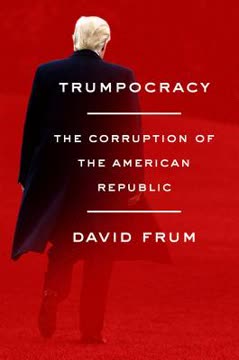
Trumpocracy receives an average rating of 3.88/5, with readers praising Frum's articulate, well-researched analysis of how Trump's presidency corrodes democratic norms and institutions. Reviewers appreciate his conservative credentials, which lend unique credibility to his critique. Many note the book effectively contextualizes Trump's rise through cultural, political, and historical factors. Common criticisms include a lack of truly new information for news-followers, occasional false equivalences between parties, and some disorganization. Most agree it serves as a valuable, consolidated examination of Trumpism's dangers to American democracy.