

Key Takeaways
Your energy field stores your life history like rings in a tree
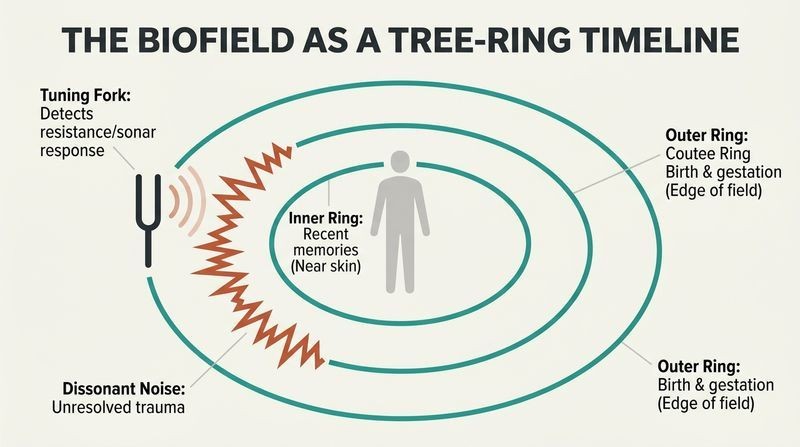
The core claim of Biofield Tuning. McKusick proposes that a torus-shaped field of energy and information surrounds the body, extending roughly five feet to the sides and three feet above the head. This biofield allegedly records every memory as standing waves, compartmentalized like brain regions, and organized chronologically: information near the skin is recent, while the outer edge holds birth and gestation. A forty-year-old's midpoint corresponds to age twenty.
Trauma shows up as noise. Unprocessed painful experiences supposedly create dissonant oscillations, disrupting the body's order. Passing a vibrating tuning fork through the field acts like sonar, revealing blockages as changes in the fork's overtones that both practitioner and client can hear.
The tree-ring timeline is the book's boldest and most testable claim, and also its most speculative. It resonates with somatic-memory work like Bessel van der Kolk's The Body Keeps the Score and polyvagal theory, which document how trauma imprints in the nervous system. What is striking is McKusick's own intellectual honesty: she recounts a physics professor's experiment where clamping the fork (removing her hand) eliminated the volume changes she relied on, suggesting her own energy drives the effect. She also cites a dowser who manufactured an imaginary energy line his students then detected. She holds her hypothesis loosely, a rare posture in this genre.
Coherent sound nudges a chaotic body back toward its factory settings
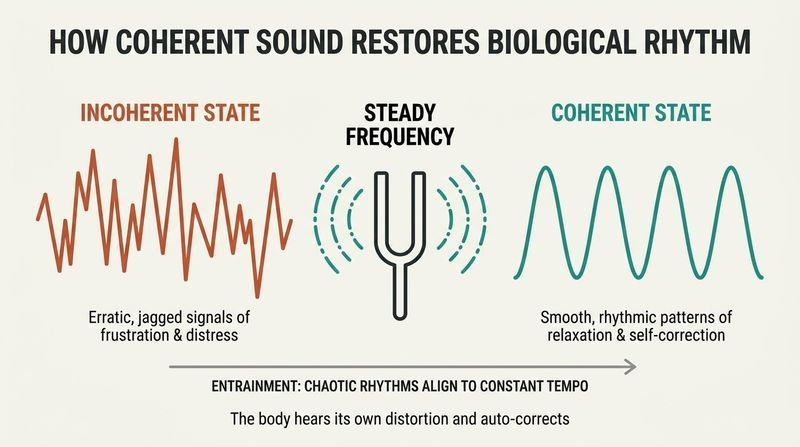
Resonance then entrainment. A tuning fork produces a coherent, ordered frequency. When held in a distressed area, McKusick says it first resonates with (matches) the distortion, then entrains it, coaxing the body's own rhythm back into a harmonious pattern, the way a metronome pulls a musician back to tempo. The HeartMath finding that gratitude produces smooth heart-rate waves while frustration produces jagged ones illustrates coherent versus incoherent biological signals.
The body self-corrects by hearing itself. Crucially, she abandoned the idea of matching specific frequencies to specific organs. Any fork works, because the body already knows its own healthy tone and only needs to hear its own noise to autocorrect. Bruce Lipton's cell receptors that vibrate like tiny antennas offer her proposed mechanism.
Entrainment is genuine physics: Huygens observed pendulum clocks synchronizing in 1665, and neural entrainment to rhythm is well documented. Music therapy's iso principle (meeting a patient's mood, then shifting it) is mainstream and evidence-backed. The weaker link is the leap from audible music affecting mood to a tuning fork held in empty air correcting tissue. McKusick candidly admits she found zero peer-reviewed studies supporting unweighted forks used off-body. The honest reframe: the mechanism may be relaxation, expectancy, and attentive witnessing rather than acoustic field correction, which does not make the relief less real to clients.
Specific emotions park in predictable spots around the body
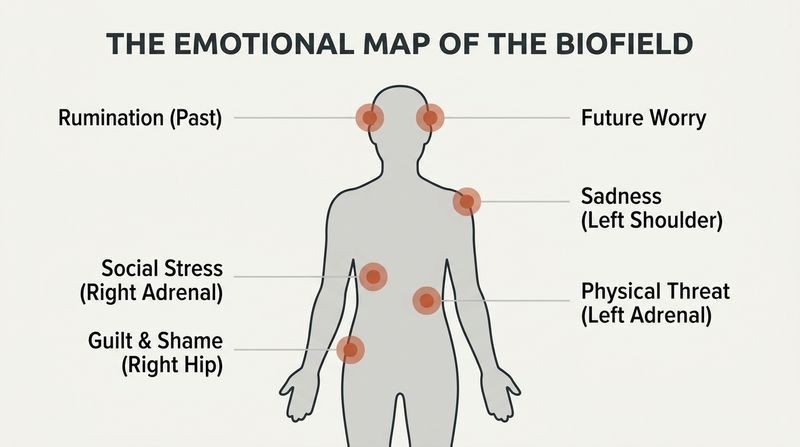
A repeatable emotional map. After working on hundreds of people, McKusick reports finding the same feelings in the same locations: sadness off the left shoulder, guilt and shame off the right hip, anger stored in the liver, worry about the future off the left side of the head, rumination about the past off the right. Each chakra has left and right imbalances, for example the sacral chakra holds frustration on the left, guilt on the right.
Physical patterns follow. She links a worn-out right hip to a lifetime of guilt-driven overdoing, fibromyalgia to chronically putting others first, and adrenal exhaustion to two distinct stressors: a left adrenal firing under physical threat and a right adrenal firing under social stress.
The map echoes older systems (Chinese medicine assigns anger to the liver, fear to the kidneys) and Carolyn Myss's chakra-emotion correspondences, which McKusick acknowledges. The appeal is diagnostic elegance; the risk is confirmation bias and the Forer effect, where vague, universally applicable readings (who lacks father issues or guilt?) feel eerily accurate. Her observation that she could only detect fear in clients after recognizing it in herself is psychologically astute and cuts both ways: it suggests the practitioner's projection shapes what gets found. Still, the somatic clustering of emotion has partial support in interoception research mapping bodily sensation to feeling states.
Treat truth as a 144-sided object, not a battle to win
Borrowed from biophoton researcher Johan Boswinkel, the phrase truth has 144 sides reframed McKusick's whole outlook. If any perspective is only a sliver of the whole, other people's views become necessary rather than threats to argue against. She pairs this with Dunbar's number (the roughly 150 stable relationships a human can maintain), suggesting a cohesive worldview requires that many vantage points.
True versus pseudo-skeptic. Citing psychologist Gary Schwartz, she distinguishes the true skeptic (humble, open to changing their mind with evidence) from the pseudo-skeptic (who reacts with hostility and simply disbelieves). Her challenge to reflexive dismissers: have you actually read the studies showing subtle energy does not exist, or are you repeating what you were told?
This is the book's most portable wisdom, independent of tuning forks. The pseudo-skeptic critique is fair and mirrors philosopher of science concerns about motivated reasoning cutting both ways. Yet the framing can become a rhetorical shield: labeling critics pseudo-skeptics risks dodging the burden of proof, which rests on the claimant, not the doubter. The strongest version of her point is epistemic humility, the same instinct behind Bayesian updating and Tetlock's superforecasters, who treat beliefs as probabilities to revise. The number 144 is evocative but arbitrary; the principle, that no single observer sees the whole elephant, is ancient and sound.
Repressed emotions rot in the body; feel them or pay in illness
Purplewashing is McKusick's term for glossing over uncomfortable feelings by spiritualizing them or being nice, skipping straight past anger to forgiveness, past jealousy to feeling happy for others. Purple stands for spiritual bypassing, mirroring corporate greenwashing. Drawing on neuroscientist Candace Pert, she argues emotions are electrochemical events that, when unexpressed, get stored rather than digested, surfacing later as fat deposits, inflammation, or disease.
Practical antidotes. Say I am having anger instead of I am angry, a shift she notes Romance languages make naturally, to hold the emotion as a passing wave rather than an identity. Cultivate neutrality (neither high nor low) rather than chasing happiness. She cites the claim that 85 percent of disease is stress-driven, meaning driven by unacknowledged emotion.
The core insight aligns with robust research: James Pennebaker's expressive-writing studies show naming emotions improves immune markers, and suppression is linked to worse health outcomes. The linguistic reframe (having versus being an emotion) is essentially cognitive defusion from Acceptance and Commitment Therapy, now empirically supported. Where caution is warranted is the causal overreach. The 85-percent-of-disease-from-stress figure is not well substantiated, and attributing autoimmune conditions to repressed shame can slide into blaming patients for illness. The defensible claim is that chronic emotional suppression is a genuine health risk factor, not the master key to every diagnosis.
Sensing energy is a learnable skill, not a psychic gift
Anyone can read the field. McKusick insists she has no special powers; she is dyslexic, was called tone-deaf by five voice teachers, and had to learn to hear. Her organization has trained over two thousand people, and she says none failed to feel resistance in the field. Roughly 60 percent are kinesthetic (feeling it in the fingertips), 30 percent auditory (hearing tonal shifts), and 10 percent struggle at first but still stop when they hit something.
The click, drag, and drop technique. Find the edge of a stuck pocket (click), move the vibrating fork toward the body like dragging iron filings with a magnet (drag), stop before the sound dies (drop), then deposit the energy into the body's midline. Doubt and fear, she notes, create static that makes it harder.
The democratizing message is refreshing and matches how expertise actually forms: perceptual learning through repetition builds discrimination, whether in wine tasting, radiology, or chicken sexing (where experts cannot articulate what they detect). The universal success rate, though, is a red flag rather than a strength. If literally everyone senses the phenomenon and no one fails, the test lacks a control for suggestion and ideomotor effects, the same unconscious muscle movements that drive Ouija boards and dowsing rods. The nine-year-old Emily Rosa study she critiques found therapeutic-touch practitioners performed at chance. Genuine skill and unconscious self-cueing can feel identical from the inside.
You are an electrical being wired into an electric universe
A cosmological reframe. McKusick argues we are taught only about solids, liquids, and gases while ignoring plasma, the ionized fourth state that makes up an estimated 99 percent of the universe. She champions the fringe Electric Universe theory, which holds that electricity, not gravity, organizes galaxies along filament-like Birkeland currents. The body mirrors this: collagen, bone, blood, heart, and brain all conduct current.
The Schumann resonance connection. Earth's electromagnetic pulse, a 7.83 Hz standing wave generated by global lightning, sits in the alpha-theta brain-wave range of calm and meditation. Astronauts got sick without it until generators were added to spacecraft. Her weighted forks are tuned to its harmonics to help the body sync with Earth's rhythm.
The verifiable parts are solid: the body is genuinely bioelectric, the Schumann resonance is real, and grounding research hints at physiological benefits from earth contact. Plasma is indeed underemphasized in basic education. But the Electric Universe theory is rejected by mainstream astrophysics, not merely from dogma but because it fails to predict phenomena that general relativity and dark matter models capture. McKusick candidly presents herself as a self-taught generalist who avoids math and cherry-picks quotes like Planck's, so the cosmology functions more as inspiring metaphor than physics. The practical takeaway, tending your electrical health via rest, grounding, and nature, survives regardless of the cosmology's status.
Guarding your energy starts with the word no and a grounding breath
Self-care as electrical hygiene. McKusick names patterns she sees drain people: the good soldier who never asks for help, the 80 percent syndrome (finishing most of a project but never the last stretch, which she ties to third-chakra energy trapped in unresolved parent wounds), and saying yes when you mean no. Gracious receiving, she argues, is generous because it lets others enjoy giving.
Portable techniques. Flip the spin: instead of blocking someone's bad vibes, catch the energy, feel it briefly, and mentally flick it back with compassion. Hollow bone: empty yourself of your own agenda so you become a neutral witness. And the centering-and-grounding breath, exhaling energy down through the tailbone or feet, prevents absorbing others' distress.
Stripped of the energy vocabulary, this is emotionally intelligent boundary-setting, and it is sound. The reframe of receiving as a gift to the giver is genuinely counterintuitive and echoes research on how helping others boosts the helper's wellbeing, meaning refusing help can be a subtle selfishness. The 80 percent syndrome is a vivid label for what psychologists study as the completion problem and the Zeigarnik effect. Hollow-bone neutrality parallels the therapeutic stance clinicians train for and the mindfulness concept of the observing self. The value here does not depend on believing in literal energy transfer; it depends on treating attention and emotional labor as finite resources worth protecting.
Know the limits: this is for tune-ups, not cancer or crises
McKusick names clear contraindications, an unusually responsible move for an alternative-modality author. She warns against full sessions for people with pacemakers (sound can disrupt the device's rhythm), pregnancy, and cancer or serious illness, because the work can trigger detox reactions the depleted body cannot process. In her experience, sessions left cancer patients exhausted, as if the body lacked reserves to push the process through.
Best as a supplement, not a rescue. She positions Biofield Tuning as effective for mild to moderate issues (anxiety, pain, PTSD, digestion, stuckness) and best combined with bodywork and nutrition, not as a stand-alone cure once disease is entrenched. She also warns of a detox response where clients feel worse before better, with fatigue, emotional release, or flu-like symptoms lasting a day or two.
This candor is the book's ethical high point and worth flagging for readers, who often encounter alternative practitioners claiming to treat everything. Her refusal to work with cancer as a stand-alone therapy and her insistence on medical support show restraint. One tension deserves naming: the detox or healing crisis concept, where worsening symptoms signal progress, is scientifically unfalsifiable and appears across dubious therapies, since it reframes any negative outcome as success. That framing can delay appropriate care. The safest reading treats Biofield Tuning as a relaxation and emotional-processing aid alongside, never instead of, evidence-based medicine for serious conditions.
Underneath everyone's noise is a signal that sounds like worthiness
The unexpected discovery. McKusick reports that when a person's distortions clear, what remains is invariably harmonious; she kept coming home astonished that the client she worked on was simply great. This contradicted her culturally absorbed belief that humans are flawed or fallen, and led her to a working conviction: at the core of nearly every dysfunction sits the belief I am not worthy.
Words build reality. Drawing on Charles Capps, she argues most people wait for circumstances to change before feeling abundant, when the feeling must come first. She recounts regaining 20/20 vision on a macrobiotic diet but only perceiving it after her optometrist confirmed it, because seeing clearly contradicted her belief I need glasses. We filter reality to match what we already believe possible.
The worthiness thesis converges with Carl Rogers's unconditional positive regard and self-compassion research by Kristin Neff, both showing that self-acceptance predicts resilience better than self-esteem built on achievement. The perception anecdote gestures at real cognitive science: predictive-processing models show the brain constructs experience partly top-down from expectation, and inattentional blindness experiments prove we miss what we do not expect. The overreach is the law-of-attraction claim that feelings magnetize circumstances, which lacks evidence and can induce guilt when wishing fails. The durable insight is gentler: self-limiting beliefs act as perceptual filters, so changing the internal story genuinely changes what opportunities you notice and act on.
Analysis
Tuning the Human Biofield is three books braided together: a candid memoir of a bulimic, depressed New England restaurateur turned self-taught sound healer; a speculative grand theory of energy, plasma, and aether; and a practical manual for moving invisible energy with tuning forks. Its genre is alternative-health-meets-New-Age cosmology, and its central innovation, the biofield anatomy hypothesis, claims the human energy field stores memory chronologically like tree rings, with specific emotions filed in specific spatial locations.
What distinguishes McKusick from typical practitioners in this space is her epistemic posture. She repeatedly flags that her findings may be constructs of her own mind, recounts the clamp experiment that undercut her mechanism, cites the dowser who conjured a detectable energy line from imagination, and admits she found no peer-reviewed support for her core technique. She names contraindications and refuses to treat cancer as a stand-alone therapy. This honesty is rare and commendable, even as the book leans heavily on cherry-picked quotes (Planck, Einstein), fringe physics (the Electric Universe theory rejected by astrophysics), and unfalsifiable escape hatches like the healing-crisis concept.
The most defensible material sits at the human layer, not the physics layer. Emotional suppression as a health risk, boundary-setting, self-compassion, attentive witnessing, and the iso-principle of meeting then shifting a mood are all supported outside the book by Pennebaker, Neff, van der Kolk, and mainstream music therapy. The mechanism she proposes (acoustic correction of a measurable field) remains unproven; the outcomes she observes (relaxation, emotional release, relief from psychosomatic pain) are plausibly explained by expectancy, ritual, touch, and above all being deeply listened to.
Read as literal science, the book overreaches. Read as a phenomenology of embodied emotion and a humane practice built on presence and self-trust, it offers real value. The wise reader keeps the boundaries, the breathwork, and the worthiness, and holds the plasma cosmology as poetry.
Glossary
Biofield Tuning
Tuning-fork therapy in the energy fieldMcKusick's trademarked sound-therapy method that uses the frequencies of tuning forks, held in and passed through the energy field around the body, to detect and correct distortions. Forks act diagnostically (like sonar, revealing dissonance in their overtones) and therapeutically (introducing a coherent tone the body entrains to). Official practice requires certification; the book teaches the underlying approach, called sound balancing.
Biofield anatomy hypothesis
Energy field stores memory spatiallyThe premise that the torus-shaped field around the body records all memories as standing waves, compartmentalized by region and organized along a timeline. Information near the skin is recent; the outer edge (about five feet out) holds birth and gestation, with life history arranged in between like tree rings. Specific emotions supposedly occupy consistent locations across different people.
Click, drag, and drop
Core combing technique with forksThe foundational Biofield Tuning move. The practitioner finds the outer edge of a stuck energy pocket (click), moves the vibrating fork slowly toward the body as if dragging iron filings with a magnet (drag), and stops the fork before its sound fades (drop), then deposits the gathered energy into the body's midline or chakra to be reintegrated.
Purplewashing
Spiritually bypassing uncomfortable emotionsMcKusick's term for glossing over, repressing, or denying difficult emotions by spiritualizing the situation or being nice, for example jumping straight to forgiveness instead of feeling anger. Modeled on greenwashing, with purple standing for spirituality. She argues these unexpressed emotions get stored in the body rather than processed, contributing to inflammation, excess weight, and illness.
Mail slot
Metaphor for intuitive guidanceMcKusick's image for intuition: a slot in the back of the mind through which notes of guidance randomly drop. Following these promptings tends to yield beneficial outcomes, so she learned to trust them. She uses it to describe how much of Biofield Tuning developed intuitively rather than through formal instruction.
Coherent versus incoherent frequency
Ordered versus disordered vibrationA coherent frequency is ordered, consistent, and in phase, like the pure tone of a tuning fork; an incoherent one is disordered and out of phase. HeartMath research links love and gratitude to coherent heart rhythms and anger to incoherent ones. Biofield Tuning uses the fork's coherent tone to entrain a distressed body back toward order.
Schumann resonance
Earth's 7.83 Hz electromagnetic pulseA standing electromagnetic wave, roughly 7.83 Hz, generated in the cavity between Earth's surface and ionosphere by continuous global lightning, sometimes called Earth's heartbeat. It sits in the alpha-theta brain-wave range of calm and meditation. McKusick tunes her weighted forks to its harmonics, citing astronauts who fell ill without exposure to it in space.
Hollow bone
Practitioner's neutral, emptied stateThe inner state a Biofield Tuning practitioner cultivates while working: clearing away one's own emotional agenda and reactivity to become a neutral witness, so personal energy does not contaminate perception of the client's field. Achieved through grounding, breathwork, and a body scan that mentally illuminates the bones.
Syntropy
Order-creating opposite of entropyA term McKusick borrows from physiologist Albert Szent-Gyorgyi (proposed to replace negative entropy) for the force that builds order, structure, and function in living systems, the counterbalance to entropy's tendency toward disorder. In her framework, clearing stuck field energy is a syntropic act that returns order to the body.
Flip the spin
Deflecting others' negative energyA self-care technique for sensitive people facing others' bad vibes. Rather than blocking the energy, you catch it with the solar plexus, briefly feel and empathize with it, then mentally flick it to reverse its direction, sending it back with a positive, compassionate spin. McKusick calls this a form of spiritual alchemy.
80 percent syndrome
Never finishing the last stretchMcKusick's label for the pattern of starting projects and completing roughly 80 percent but never fully finishing, leaving lives littered with unfinished tasks. She attributes it to third-chakra vital energy trapped in unresolved wounds with one or both parents, leaving insufficient drive to reach completion.

Download PDF
Download EPUB
.epub digital book format is ideal for reading ebooks on phones, tablets, and e-readers.








































