Key Takeaways
1. A Summer of Ominous Warnings
Nobody was surprised, but everyone remarked on it, and many wondered idly why it seemed so much worse than usual this year, and what if anything it portended.
Nature's prelude. The summer of 1894 across the Upper Midwest was marked by extreme heat and an unprecedented drought, creating a tinderbox environment. A yellow-gray murk of smoke constantly obscured the sky, a persistent reminder of hundreds of small fires burning in the north woods of Minnesota and Wisconsin. This pervasive smoke, though common for the season, was notably worse, hinting at a larger, concealed threat.
Ignored red flags. Despite the unusual intensity of the smoke and the record-breaking dry conditions—with rainfall significantly below normal—most people remained complacent. They attributed the conditions to typical summer fires, failing to grasp the escalating danger. A devastating fire in Phillips, Wisconsin, in late July, which obliterated a town and killed dozens, served as a stark, illuminating flash of what was to come, yet its warning went largely unheeded.
Scientific blind spots. The nascent fields of meteorology and fire science in the 1890s meant that forecasters could not predict catastrophic events like firestorms. While they understood basic principles like wind and dryness, the complex dynamics of mass fires, their self-generated weather, and the explosive potential of super-dry fuels were unknown. This lack of scientific understanding, coupled with human complacency, left communities like Hinckley vulnerable.
2. Hinckley's Illusions of Safety
Hinckley could boast of its accomplishments and look forward to a bright future.
Boomtown confidence. Hinckley, a bustling lumber town of over 1,200 people, was the financial epicenter of Pine County, Minnesota. It boasted two railroads, a thriving lumber mill, churches, hotels, a new schoolhouse, and a firehouse. Its citizens, mostly adventurous newcomers from Europe, had found prosperity and believed in their town's bright future, as proudly proclaimed by the local newspaper, the Hinckley Enterprise.
Misplaced security. The town's primary industry, the Brennan Lumber Company, was a massive complex covering thirty-six acres, surrounded by mountains of sawdust and twenty-eight million board feet of air-dried lumber. Despite this inherent fire risk, the mill was considered well-protected by:
- Firebreaks
- A millpond
- Water mains and hydrants
- Hogsheads of water on the saw shed roof
The town's volunteer fire department, proud of its new Waterous engine, also believed they could defeat any "fire king."
Daily routines persist. Even as the smoke thickened and the heat intensified on September 1, 1894, most residents went about their daily business, planning for church, school, and the upcoming Labor Day holiday. The growing unease was not enough to disrupt the ingrained routines or shatter the collective belief that Hinckley was safe. This deep-seated optimism and reliance on perceived defenses blinded them to the true scale of the impending disaster.
3. The Perfect Firestorm's Genesis
As two already large fires approach one another, they often begin a kind of tug-of-war, competing over the available fuel and oxygen in the space between them.
Converging infernos. On the morning of September 1, two separate fires, one near Quamba and another near Beroun, began to move. Fueled by weeks of extreme dryness and record heat, they initially crept through pine needles and brush. As the day progressed, a powerful low-pressure system moving eastward from Canada generated strong southwest winds, rapidly intensifying these fires and driving them directly towards Hinckley.
The blow-up. By early afternoon, the fires crowned, erupting into the forest canopy with flames reaching ninety feet high. They developed convection columns, sucking in air violently and creating their own erratic, hurricane-force winds. As these two massive fronts converged on Hinckley, the area between them became superheated and dried, leading to a sudden, explosive "blow-up." This merger transformed them into a single, colossal mass fire—a true firestorm.
Unleashed fury. This perfect firestorm exhibited terrifying characteristics:
- Fire whirls: Tornadoes of fire spinning off, igniting new blazes.
- Radiant heat: So intense it caused buildings to smolder and shatter before flames arrived.
- Flaming gas bubbles: Gigantic, glowing bubbles of gas detaching and exploding over terrified citizens.
- Rapid spread: Advancing at speeds faster than a man could flee, even on horseback or by train.
The firestorm consumed over 300,000 acres and more than 400 lives in a matter of hours, demonstrating a destructive power far beyond any ordinary forest fire.
4. Heroism Amidst the Flames
"Poor Root! He ought to live, such men are always heroes in time of need."
Engineers' impossible choices. As the firestorm engulfed Hinckley, two railroad engineers, William Best (Eastern Minnesota) and James Root (Saint Paul and Duluth), found themselves in the path of the inferno, responsible for hundreds of lives. Despite the overwhelming chaos and the immediate danger, both made courageous, often contrarian, decisions that saved countless passengers. Their actions defied standard operating procedures and personal safety.
Best's defiant stand. Engineer Best, arriving in Hinckley precisely on time, faced a burning town and a critically low water reservoir. He defied his conductor's frantic pleas to leave, holding his train for precious minutes to allow more refugees to board. He then orchestrated a daring escape, backing his two-headed train (coupled with another locomotive) across a burning bridge, saving nearly 500 souls. His steadfastness in the face of certain doom was remarkable.
Root's desperate dash. Engineer Root, initially complacent, found his train caught in the heart of the firestorm north of Hinckley. With his cab windows blown out, his face cut, and eventually lapsing into unconsciousness, he instinctively kept the throttle open, driving his train backward towards Skunk Lake. His fireman, Jack McGowan, and porter, John Blair, also displayed immense bravery, tending to passengers and fighting flames, ultimately saving over 300 people by reaching the shallow lake.
5. The Brutality of Fire's Embrace
"With heartbreaking screams, more like the cries of beasts than of human beings, these suffering ones writhed like worms in the mud as they endeavored to escape."
Horrific demise. The firestorm killed in multiple, agonizing ways. Many victims, like those in the Grindstone River ravine, were broiled alive by radiant heat, their bodies writhing in the mud as flames consumed them. Others suffocated from carbon monoxide, often in their sleep or in seemingly safe shelters like wells and root cellars, unaware of the silent killer.
Unrecognizable remains. The intensity of the heat, soaring above 1,600 degrees Fahrenheit, cremated many victims instantly, leaving behind:
- Piles of white ashes and bone fragments
- Melted steel rails and boxcar wheels
- Twisted, charred bodies, often naked and grotesque
The sheer scale of destruction made identification nearly impossible, leaving families to mourn unrecognizable lumps of flesh.
A landscape of death. The aftermath revealed a scene of utter devastation. Hundreds of bodies lay scattered across the landscape:
- Huddled together in the foundations of homes
- Splayed facedown in the streets
- Half-buried in the mud of rivers and swamps
- Animals, wild and domestic, also perished in vast numbers, their carcasses adding to the unbearable stench.
The sight and smell of the dead, particularly the children, left an indelible mark on the rescuers and survivors.
6. Survival Against All Odds
"I just resolved I would not lose my head, and if I had to die, I would do it without making a fool of myself."
Ingenious escapes. Faced with an unstoppable wall of fire, survivors employed desperate and often ingenious methods to stay alive. These included:
- Water immersion: Huddling in shallow rivers, millponds, or even flooded gravel pits, often with wet blankets over their heads.
- Underground shelters: Seeking refuge in wells, root cellars, or storm cellars, though these often became death traps due to asphyxiation or collapsing structures.
- Train evacuations: The heroic efforts of engineers Best and Root, who backed their trains through the inferno, saving hundreds.
- Potato patches: Lying face down in freshly plowed furrows, covering themselves with wet blankets, as the fire roared overhead.
Moments of clarity. Amidst the panic, some individuals maintained remarkable composure. John Blair, a Black porter on Root's train, calmly moved through the burning coaches, sprinkling passengers with water and distributing wet towels, becoming a beacon of strength. Albert Speyer, a young man, risked his life to re-enter a burning train car to rescue a crying child, emerging with her wrapped in his coat. These acts of selflessness highlight the extraordinary human capacity for courage in the face of unimaginable terror.
Sheer luck. For many, survival was a matter of pure chance. A donkey crashing through a root cellar roof provided ventilation, saving a family from asphyxiation. A wagon with four barrels of water, abandoned by one family, became a life raft for another. These serendipitous events underscore the unpredictable nature of who lived and who died in the firestorm.
7. The Psychological Scars of Trauma
"The wild panic was horrible. There was no humanity in it. Every fear-crazed person was for himself, and they did not care how they got out of the swirling, rushing avalanche of flames."
Invisible wounds. The Hinckley firestorm inflicted profound psychological trauma on its survivors, long before the concept of Post-Traumatic Stress Disorder (PTSD) was understood. Many, like the author's grandfather, Bill Grissinger, suffered from nightmares and screaming episodes for decades. Tom Sullivan, Root's conductor, experienced what was likely PTSD with psychosis, ranting about a child he believed he had thrown from the train.
Symptoms of distress. Survivors exhibited a range of psychological responses:
- Psychic numbing: Difficulty participating in normal social relationships.
- Hyperarousal: Panic attacks, extreme vigilance, and exaggerated startle reactions.
- Intrusive recollections: Nightmares and flashbacks, reliving the horror.
- Disorientation: Many, like Bill Grissinger, struggled to comprehend their surroundings or the fate of their loved ones.
Unrecognized suffering. In 1894, there was no understanding of PTSD, nor any therapies to treat it. Survivors were often deemed "weak" or "crazy" if they couldn't simply "pick themselves up" and move on. Heroes, in particular, carried a special burden, expected to be larger than life even after their ordeal, often suffering their demons in silence. This lack of recognition compounded their suffering, leaving many to cope alone with their shattered minds.
8. An Outpouring of Compassion
"Relief temporary, substantial, and immediate is needed and needed bad …"
Immediate response. As news of the catastrophe spread, an unprecedented wave of spontaneous relief poured into the region. Pine City, Hinckley's nearest surviving neighbor, quickly organized a relief committee, collecting food, clothing, and blankets. Doctors and volunteers rushed to the scene, transforming skating rinks and churches into temporary hospitals and shelters.
Duluth's embrace. Duluth became a major hub for survivors, sheltering nearly 1,200 people in its Armory, Bethel mission, churches, hotels, and private homes. Women's relief societies cooked thousands of meals, distributed tens of thousands of garments, and undertook the wrenching task of caring for lost and orphaned children. This outpouring of generosity came from individuals and institutions alike, from local businesses to international donors.
Global solidarity. Donations flowed in from around the world, demonstrating a widespread human response to the tragedy:
- James J. Hill's Great Northern Railway donated $5,000 and 5,000 acres of land.
- Lord Mount Stephen sent $5,000 from London.
- A Sunday school class in Connecticut sent $2.00.
- John D. Rockefeller wired $1,000.
- The Sultan of Turkey sent 300 Turkish pounds.
- A Duluth newspaper boy, Billie Groosky, sent three cents.
This collective act of compassion provided crucial aid and a sense of hope amidst the desolation.
9. The Lingering Legacy of Exploitation
"The fire on Sept. 1 did in 15 minutes what it would have taken the husbandman 15 years to accomplish. All nature is with us; it seemingly knew our needs, and came to clear the land."
Reckless logging practices. The Hinckley firestorm was not a purely natural disaster but a man-made catastrophe, fueled by decades of unsustainable logging. Lumber companies had laid waste to vast areas of virgin pine forest, leaving behind immense quantities of highly combustible slash—pine branches, broken saplings, and trampled brush—to dry in the sun. This created a tinderbox, ensuring that any spark would ignite an inferno.
A "beneficial" fire? In a shocking display of callousness and self-serving logic, some, like Hinckley Enterprise editor Angus Hay, initially framed the fire as a "benefit." They argued it had cleared the land for farming, echoing similar sentiments after other fires. This perspective, driven by the lumber interests, actively resisted calls for better forest management, prioritizing short-term profit over long-term ecological and human well-being.
Slow shift to conservation. Despite the immense human suffering and destruction of natural resources, meaningful change in forest management was slow. Christopher Columbus Andrews, Minnesota's first chief fire warden, faced an inadequate budget and resistance from local communities reluctant to prosecute neighbors. It took decades and a series of even larger, more devastating fires—in 1908, 1910, 1918, and 1925—to finally compel state legislatures and lumber companies to grudgingly embrace conservation and fire-protection measures. By then, the vast virgin pine forests of the Upper Midwest were irretrievably gone.
10. A Town Reborn, But Never the Same
"Our town will stand though a thousand destructions come upon us … God made the world, but we built Hinckley."
Resilience and rebuilding. Within days of the fire, a tent city emerged from Hinckley's ashes, and survivors began the arduous task of rebuilding their homes and businesses. Temporary telegraph offices, cook shacks, and even makeshift saloons quickly appeared. The State Relief Commission provided funds for simple wood-frame relief houses, and a new town hall was dedicated within months, symbolizing the community's defiant spirit.
Dreams shattered. Despite the rebuilding efforts, Hinckley's core reason for existence—the vast pine forests—was gone forever. The land, now sandy and gravelly, was ill-suited for extensive agriculture. The final blow came from railroad magnate James J. Hill, who, in a calculated move, relocated the Eastern Minnesota's terminal facilities and rail yards to Sandstone, effectively stripping Hinckley of its economic future.
A changed landscape and memory. Hinckley never regained its former prosperity, becoming a quiet town bypassed by progress. The fire left an indelible mark on the landscape and the collective memory:
- The cemetery's mass graves serve as a solemn memorial.
- The Hinckley Fire Museum preserves the stories and artifacts.
- Survivors, like the author's grandfather, carried the trauma for life.
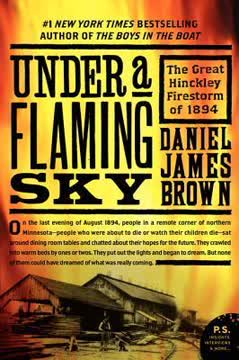
The firestorm remains a powerful reminder of human vulnerability, resilience, and the profound consequences of environmental exploitation, a story passed down through generations, ensuring that the lessons of "Under a Flaming Sky" are never truly forgotten.
Review Summary
Under a Flaming Sky receives strong praise from readers, averaging 4.13 out of 5 stars. Most reviewers commend Daniel James Brown's ability to blend personal narratives with scientific explanations of fire behavior, creating a gripping, emotionally intense read. Many highlight the vivid, unflinching descriptions of the 1894 Hinckley firestorm as both harrowing and educational. Some readers found the multi-character structure occasionally difficult to follow, and a few felt the post-fire chapters were anticlimactic. Overall, readers consider it a compelling, well-researched account of a lesser-known American disaster.
People Also Read