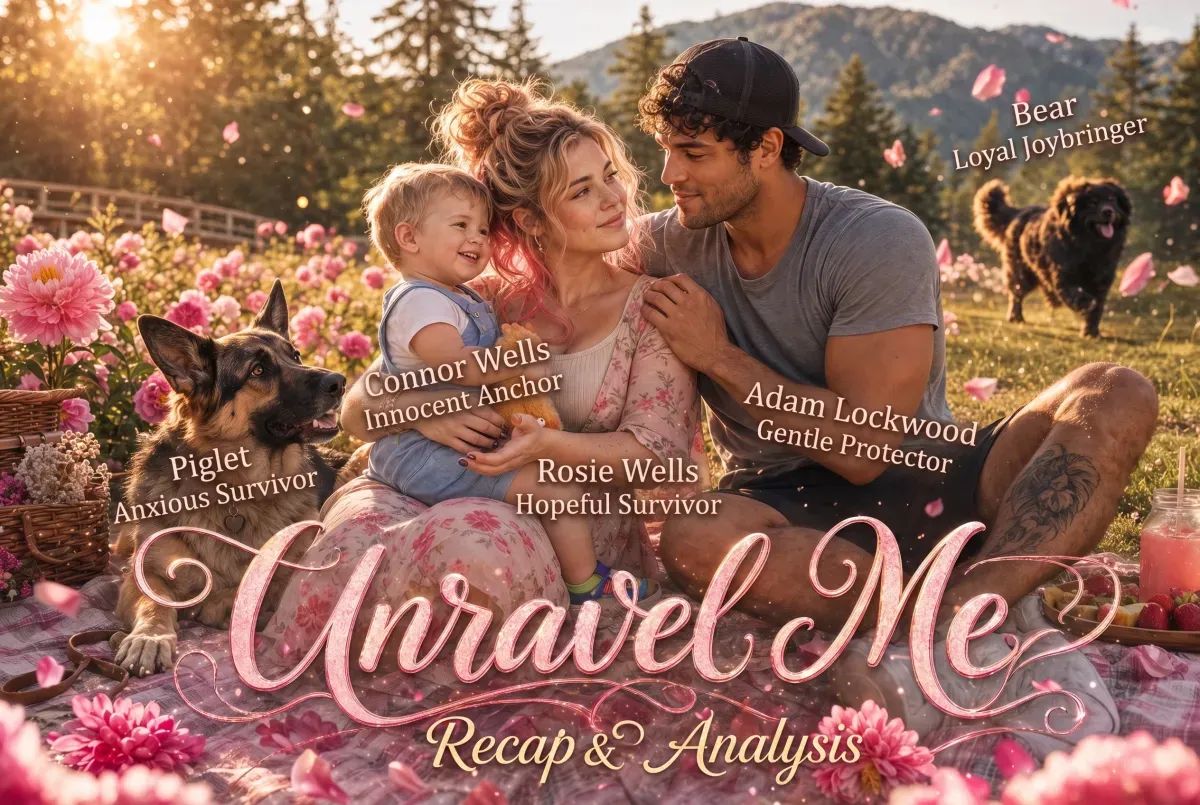


Plot Summary
The Devil in His Kitchen
Adam Lockwood1 wakes from a keg-stand bender to find his ex-girlfriend Courtney4 cooking in his kitchen, wearing his shirt, insisting she belongs there. Eighteen months earlier he came home from a road trip to find her in bed with another man, the engagement ring he had planned to give her still tucked in his drawer.
She wants him back; she frames her cheating as his fault for being absent. This time Adam1 refuses to crumble. He tells her he deserves more, shoves her purse into her hands, and slams the door. Exhausted by meaningless Tinder dates and the loneliness behind his fame, he decides he is done searching for love that wants his money instead of him.
The opening weaponizes the romance trope of the toxic ex to establish Adam's central wound: being valued as a commodity rather than a person. Courtney functions as the embodiment of conditional love, the version that treats a partner as a lifestyle accessory. Adam's eviction of her is less about anger than about self-reclamation, a man drawing a boundary he has been too tired to draw before. The hockey-bro group chat and the playful chaos soften the heartbreak, signaling the book's tonal register: comedic surface, tender ache beneath. His resolve to stop performing for love seeds the deception that will later threaten everything.
Mistaken for a Bear
On a quiet trail beneath Mount Fromme, Adam's1 enormous Tibetan Mastiff, Bear,6 bolts and flattens Rosie Wells,2 who is hiking with Piglet,7 a traumatized rescue German Shepherd she is rehabilitating. Rosie,2 certain a wild bear is charging her, braces for death and instead gets licked. Adam1 arrives, charming and apologetic, and something rare happens: Piglet,7 who fears men, slowly approaches him and Bear.6
The two dogs bond instantly. Adam1 introduces himself only by name, and Rosie2 shows no flicker of recognition, no idea he is a famous athlete. She shares her homemade sandwiches; he carries the stair-shy Piglet7 down the rickety steps. He leaves without her number but calls her trouble, already smitten.
The meet-cute is engineered around animals as emotional proxies. Piglet's wariness of men mirrors Rosie's own guarded heart, while Bear's exuberance externalizes Adam's longing for connection. Crucially, Rosie's failure to recognize Adam grants him the anonymity he craves, the chance to be loved for himself. This is the book's structural keystone: a relationship founded on a truth Rosie possesses (her ordinariness) and a truth Adam withholds (his fame). The forest setting, where breathing feels cleaner, codes nature as the space where authentic selves emerge, away from cameras and contracts. Their shared patience with anxious creatures signals compatibility long before either admits attraction.
The Picnic and the Lie
After a disastrous Tinder date and advice from his best friends' wives during a chaotic girls' night, Adam1 returns to the shelter, steals Rosie's2 hat as an excuse, and asks her to dinner. He stages a private picnic under an oak strung with solar lights, brings peonies that move her to tears with memories.
When she asks what he does, he panics and says only that he works with professional athletes, omitting that he is the athlete, an NHL goalie worth millions. They dance without music; he calls the omission protection of their bubble. Rosie,2 who never lets anyone in, opens up about needing control, and Adam1 coaxes her to let go for one perfect evening.
This section dramatizes the seductive logic of the lie. Adam's deception is not malicious but defensive, born of accumulated wounds from being courted for his wealth. The peonies, tied to Rosie's late mother, reveal how grief and tenderness braid together for her. The girls'-night ensemble (Cara, Olivia, Jennie, Hank) establishes the found-family scaffolding that will eventually hold both protagonists up. Thematically, the chapter stages a paradox: Adam achieves genuine intimacy precisely by concealing a piece of himself, planting a contradiction that guarantees future rupture. The motif of relinquishing control, framed as therapeutic for Rosie, foreshadows the trust she will later feel betrayed.
Two for the Price of One
When Adam1 shows up at Rosie's2 apartment, a small boy3 toddles out holding mismatched shoes and calls him Dada. Rosie2 braces for rejection, certain Connor,3 her fifteen-month-old son, will scare Adam1 off the way he scared off her last date who fled mid-dinner. Instead Adam1 crouches, introduces himself, and asks to come along to the park.
He squeezes his hockey butt down a child's slide, shares sandwiches, and treats Connor3 like a gift rather than a complication. Rosie2 explains that Connor's3 father, Brandon,5 drifts in and out, treating fatherhood as a chore. Adam,1 unbothered, declares he gets two for one and starts planning their third date before the second has ended.
The single-mother reveal tests the depth of Adam's stated desire for genuine love. His immediate, uncalculated warmth toward Connor distinguishes him from every man who has measured Rosie's worth and found a child disqualifying. Psychologically, the scene exposes Rosie's core fear, encoded in her history: she has only ever been a second choice, and a child makes her, in her mind, harder to choose. Adam's reframing (two for one) converts perceived liability into abundance. Connor's instinctive Dada, dismissed as a phase, plants a longing that will recur as a tender refrain, measuring Adam's evolution from accidental father figure to the man the boy genuinely claims.
The Drowning She Survived
Adam1 invites Rosie2 and Connor3 to swim. Rosie2 freezes at the water's edge, and clinging to Adam1 she confesses she nearly drowned at eleven in her own pool, saved by a firefighter. He holds her, promising not to let go, and she takes her first real steps back into deep water for her son's sake.
Later, beside the pool, Adam1 dismantles her body insecurities with reverent attention, calling her stretch marks tiger stripes and refusing to let her call herself average. As he finally moves to claim their first kiss, Connor's3 cry crackles through the baby monitor. That night Adam1 shares his own story: abandoned by an addicted birth mother, adopted at five by Deacon and Bev.17
Water operates as the novel's primary fear-symbol, a controlled environment where Rosie practices trusting another body to keep hers afloat. The deferred kiss, interrupted by Connor, comically enforces the slow burn while reminding both that parenthood reorders desire. Adam's reframing of her postpartum body confronts the cultural scripting of maternal shame, modeling a gaze that finds strength where she sees damage. His adoption backstory creates an asymmetry the narrative will mine: both were in foster care, but his ended in rescue and hers in abandonment, a difference that breeds Rosie's guilty, unspoken envy. Vulnerability is exchanged in increments, each confession a brick in their fragile trust.
Mine, in the Truck Bed
On a late-night back road, Adam1 feigns getting lost so he can dance with Rosie2 under headlights. When she admits she craved his touch during the movie, where anyone might have seen, he lifts her onto his tailgate and brings her to her first orgasm with another person, repeating that she belongs to him alone.
Their relationship deepens fast: Saturday hikes with Bear6 and Piglet,7 weekday Starbucks deliveries, Connor's3 bath-time routines folded into Adam's1 care. He installs a borrowed car seat, lends his patience, and builds Connor3 a corner in his home. Rosie2 tells him she will not bring her son into anything casual; Adam1 swears he wants the whole, permanent thing, family included.
This beat shifts the romance from courtship to commitment, the physical escalation mirroring an emotional one. Adam's repeated word, mine, reads as possessive but functions as restorative for Rosie, who has spent her life unclaimed; being wanted aggressively is the antidote to being chronically overlooked. The mundane intimacies (coffee orders memorized, car seats installed) matter more than the sex, demonstrating love as logistical devotion rather than grand gesture. Rosie's insistence on permanence before involving Connor reveals her maternal protectiveness as the organizing principle of her life. The chapter quietly raises the stakes: the more real this becomes, the more catastrophic Adam's withheld truth grows.
Lost Scholarship, Lost Family
Summoned to the dean, Rosie2 learns her full-ride veterinary scholarship has been revoked; the donor decided her maternity leave proved misplaced priorities. Earlier that day, returning to retrieve Connor's3 stuffed kitty, she overheard Brandon5 telling friends he never chose her, that he feels stuck, that he suspects she trapped him.
Gutted, she sits on a campus bench and falls apart, and Adam,1 sensing something wrong, finds her there. She finally tells him everything: her parents died in a house fire when she was eleven, her father carrying her out first and returning for her mother, never coming back. She aged out of foster care, never adopted, never anyone's first choice.
The novel's emotional engine room. Rosie's two blows, financial and personal, converge to validate her deepest belief that loving herself first (choosing Connor) costs her everything else. The fire memory recontextualizes her drowning trauma: she survived the pool only to learn her parents had not survived the house, layering grief beneath grief. Her father's broken promise to return becomes the template for every abandonment since. Crucially, Adam offers presence rather than solutions, sitting in her pain instead of fixing it, the exact form of love she earlier said she needed. The scene also weaponizes dramatic irony: she trusts Adam with her whole history while he still guards his.
Seven Condoms and a Secret
Vulnerable and finally unguarded, Rosie2 initiates their first time. Adam,1 nervous after eighteen celibate months, produces an absurd variety pack of condoms gifted by his teammate Jaxon.10 They spend the night exhausting them, and he tells her she is not his first choice but his only option.
Yet even mid-bliss, Adam1 is haunted: she has handed him her every fracture while he clutches his fame in a closed fist. Days later, doing preseason media interviews, he confides to Jaxon10 that he still has not told her the truth, that the longer the lie stretches the more impossible confession becomes. A reporter asks on camera whether there is someone special in his life.
Consummation arrives as the apex of trust and the nadir of Adam's integrity, the two curves crossing. The comedic condom motif undercuts what is genuinely a sacred exchange for Rosie, who has never been pleasured or cherished by a partner. Adam's only option reframes choice as inevitability, romantic destiny replacing the painful arithmetic of being ranked. But the chapter refuses to let him off easily: his interior monologue names his hypocrisy precisely, that he feared being deceived and became the deceiver. The looming interview question functions as a narrative trapdoor, the public sphere poised to expose the private lie he keeps postponing.
Hockey's Golden Boy Exposed
At the shelter, Rosie's2 friend Marco15 recognizes Adam1 and, scrolling his phone, reveals the truth: Adam Lockwood1 is the Vipers' starting goalie, recently re-signed for ten point five million a year, hockey's most eligible bachelor, photographed on countless public dates and beside his ex Courtney.4 Rosie's2 ice cream sundae slips from her hand and shatters.
When Adam1 arrives to find her, Archie14 blocks the door. She is not angry that he is famous; she is devastated that he hid whole pieces of himself while she surrendered her every secret, that he dated others publicly but kept her in a private bubble, confirming her lifelong fear of being someone's hidden, temporary thing.
The midpoint rupture lands with precision because the betrayal is not infidelity but asymmetry of vulnerability. Rosie articulates the real injury: she gave everything and received a curated fraction in return, reproducing the abandonment pattern of her life. The shattered sundae, a treat Adam himself introduced as comfort, becomes an apt emblem of trust broken by the very person who built it. The chapter resists melodrama by having Rosie comprehend Adam's wound (fear of being loved for status) even as she names her own. Her request for space rather than a clean break demonstrates emotional maturity, refusing both martyrdom and rupture, insisting instead on the slow repair of earned trust.
Bear Collapses, Hearts Reopen
During their separation, Adam1 quietly funds a new anonymous scholarship, named Stardust Lane after Rosie's2 childhood street, so she can finish school. Then Bear6 suddenly collapses with a twisted, gas-filled stomach, a life-threatening emergency, and Adam1 races him to Rosie's2 teaching clinic, refusing to let anyone but her touch his best friend.6
Days earlier Rosie2 had watched a St. Bernard named Pepper die of the same condition on her table. Now she assists the surgery that saves Bear,6 holding his paw throughout. Afterward she breaks down in the parking lot, confessing she feared losing both the dog and Adam1 forever, and he holds her, vowing he is not going anywhere.
Reconciliation is brokered through crisis rather than apology, the surgery forcing proximity and reactivating their fundamental compatibility, their shared devotion to vulnerable creatures. Bear, the catalyst of their meeting, becomes the catalyst of their return, closing a structural loop. The recent death of Pepper raises genuine stakes, denying the reader a guaranteed save and making Bear's survival feel earned. Adam's anonymous scholarship reveals love as quiet provision rather than performance, honoring Rosie's autonomy (she refused his money) while still rescuing her dream. Her parking-lot collapse exposes the truth beneath her requested space: distance never lessened her love, it only deferred it. Trust begins rebuilding on action, not words.
Breaking Down Brandon's Door
Reconciled but moving slowly, Adam1 and Rosie2 discover Brandon5 left fifteen-month-old Connor3 locked alone in the apartment while he drank at a downstairs bar with the alarm set. Hearing Connor's3 screams through the door, Adam1 cancels an important meeting, shoulders the reinforced door off its hinges, and finds the boy trapped beneath a tipped-over playpen with a gashed forehead.
When Brandon5 arrives mocking Rosie2 and calling her a worthless charity case, Adam1 punches him repeatedly, warning that losing this family will be the worst thing to ever happen to him. Brandon,5 never even on the birth certificate, exits their lives for good, soon discarding Connor's3 belongings by the curb.
This is the decisive externalization of Adam's transformation from wounded man to protector-father. Where Brandon embodies fatherhood as inconvenience, Adam embodies it as fierce, unhesitating presence, the contrast sharpened to moral clarity. The broken door literalizes barriers falling, both physical and emotional, as Adam forces his way fully into the family's defense. Brandon's cruelty echoes Courtney's, both reducing love to transaction, but here the threat targets a child, raising the moral stakes. Significantly, Rosie's lifelong wish, someone who chooses Connor without condition, is answered in violent, definitive action. The curbside discard of the boy's things crystallizes the abandonment theme one last time before the narrative pivots toward chosen family.
Twenty-Five and Finally Driving
Adam1 secretly schedules Rosie's2 road test for her twenty-fifth birthday, having taught her to drive despite her terror of unexpected death rooted in her parents' loss. He coaxes her through her fears, and she passes, becoming a licensed driver for the first time.
Then he blindfolds her and leads her to the Capilano Suspension Bridge, ablaze with winter lights, the very destination her parents promised for her twelfth birthday before they died. He has gathered their entire found family there, and beneath the glowing trees declares them all her family now. Rosie2 weeps, certain her parents are present, finally given the gift grief had stolen thirteen years earlier.
The birthday double-gift fuses practical empowerment with emotional restitution. Teaching Rosie to drive confronts her catastrophizing anxiety about mortality, reframing her fear as inherited grief she has been carrying on her parents' behalf, a striking therapeutic insight Adam offers. The bridge delivers the unredeemed promise of her childhood, a symbolic completion of the trip that death interrupted. By populating the moment with the Vipers ensemble, the narrative redefines family as chosen and abundant rather than lost and singular. This is the emotional payoff of all her foster-care wounds: not the recovery of what vanished, but the construction of something new and load-bearing around the old absence.
Courtney Returns, Pregnant
At Adam's1 first charity gala, where he publicly calls Connor3 his son and proudly names his found family, Courtney4 sweeps in visibly pregnant and announces the child is Adam's,1 conceived the night of his July party. She produces a photo of herself in his bed and demands he be a father. Adam1 is certain he never touched her, though his memory of that drunken night is foggy.
The accusation detonates Rosie's2 deepest insecurities about being temporary and replaceable. Adam1 rages, defending Rosie2 fiercely, but must board a team flight to Tampa minutes later. Rosie,2 shaken, promises they will figure it out, and he watches his world recede through the bus window, terrified.
The third-act bombshell escalates the external threat from private deception to public scandal, with Courtney returning as the recurring antagonist of conditional, manipulative attachment. The pregnancy claim is the ultimate weaponization of family against the family Adam has built, attacking the very thing the gala celebrated. Notably, Rosie does not flee; her promise to figure it out marks her growth from a woman braced for abandonment into a partner who stays through chaos. Adam's forced departure heightens helplessness, separating the couple precisely when unity is needed, while seeding doubt through his unreliable memory of the party, a deliberate suspense mechanism the narrative will soon resolve in his favor.
The Lie That Deported Itself
Investigation reveals Courtney4 was already five weeks pregnant by an on-again boyfriend at the time of the party; she had only photographed herself beside a passed-out Adam1 to fabricate proof. Adam1 confronts her publicly at their old coffee shop, threatening a two point five million dollar defamation suit unless she takes a paternity test or recants and clears Rosie's2 name.
Rosie2 stands beside him, declaring she will choose him every single day. Courtney4 refuses the test, the baby proven not his, and a no-contact order pressures her visa. On Christmas Eve, Cara13 reveals she secretly filmed the confrontation and leaked it; the internet turns on Courtney,4 who flees the country for good.
The climax resolves through truth-as-liberation, the recurring motif of honesty defeating manipulation. Adam, who once hid behind a lie, now insists on full exposure, completing his arc from concealment to courage. Cara's covert recording reframes the found family as an active defensive unit, loyalty expressed through cunning rather than sentiment, a satisfying inversion of the lone wolf hero. Rosie's vow to choose Adam daily directly answers her lifelong ache to be chosen, now spoken aloud as agency rather than longing. Courtney's deportation cleanly excises the conditional-love antagonist, allowing the narrative to close the wound Adam opened in chapter one. The threat that fame would always poison love is finally neutralized.
A Bedroom Painted in Mountains
Adam1 and Rosie2 merge their lives: she and Connor3 move into his home, where he has built Connor3 a floor bed under glow-in-the-dark stars. On Christmas Day they host Lily,16 the shy, motherless five-year-old from the foster home where Adam1 volunteers, a child Rosie2 has fallen for. Bev17 shares her philosophy that people are puzzle pieces who slide into spaces saved just for them.
Devastated that her beloved Piglet7 was adopted from the shelter, Rosie2 comes home to discover Adam1 adopted Piglet7 himself, plus a kitten Connor3 names Dinosaur. Surrounded by dogs, cat, child, and parents, Rosie2 realizes she has assembled the family she spent a lifetime craving.
The denouement converts every earlier wound into restoration through the metaphor of completion. Piglet, the anxious rescue who mirrored Rosie, gets her forever home with Rosie herself, healing the shelter-worker's fear that love always belongs to someone else. Lily's introduction reactivates the foster-care theme not as trauma but as opportunity: Rosie, never chosen as a child, now holds the power to choose another child. Bev's puzzle-piece wisdom reframes family as architecture, spaces reserved before the pieces arrive, dignifying both biological loss and chosen gain. The expanding household (children, animals, grandparents) literalizes abundance as the answer to scarcity, the emotional thesis the entire novel has been building toward.
Epilogue
Months later, the family fosters and then officially adopts Lily,16 who finally unpacks her go-bag and asks to call Rosie2 Mommy and Adam1 Daddy. Wearing his jersey to a playoff game, she proudly points him out as her father, his goalie mask painted with her drawing of their family.
On a sunrise hike to the carved tree where Rosie's2 parents once marked their initials, Adam1 fumbles a proposal, recovers, and slides on a teardrop ring the pink shade of her hair, promising she is his gravity rather than his chaos. Then Lily16 presses Rosie's2 hand to her belly: a winter baby is coming. Adam1 weeps, and Rosie2 simply grins, oops.
The epilogue resolves the novel's governing wound, abandonment, through its mirror image: chosen permanence. Lily unpacking her bag is the precise reversal of a foster child's perpetual readiness to be sent away, and her request to use the parental names completes the Dada refrain that began as Connor's accidental phase. The proposal at the parents' tree braids the dead into the living, grief into joy, honoring continuity across loss. Adam's gravity-not-chaos formulation reframes true love as stabilization rather than upheaval, a quietly radical claim against the storm-and-passion model. The surprise pregnancy, the playful oops, returns the book to its comedic register, insisting that abundance, not scarcity, is the family's new baseline.
Analysis
Unravel Me dresses a serious meditation on abandonment in the bright costume of hockey-romance comedy. Its two protagonists are wounded inversions of each other: Adam,1 adopted and rescued, fears being loved for what he has; Rosie,2 orphaned and never chosen, fears being loved temporarily, if at all. Becka Mack builds the central conflict not around external obstacles but around asymmetrical vulnerability, the precise calibration of who has risked what. Adam's1 lie is the structural sin, and tellingly, it is not infidelity but concealment, a refusal of full disclosure that reproduces in Rosie2 the very abandonment she dreads. The novel argues that love demands the surrender of all one's pieces, the broken ones included, and that withholding even a protective fragment constitutes a kind of betrayal. Mack's recurring imagery, puzzle pieces, gravity versus chaos, peonies blooming after winter, insists that genuine partnership stabilizes rather than destabilizes, a quiet rebuke to the storm-and-passion ideal. The found-family ensemble enacts the thesis at scale: belonging is constructed, chosen daily, and defended collectively. Notably, the book reframes maternal and bodily shame, foster-care grief, and anxiety not as flaws to be cured but as histories to be witnessed; Adam's1 love language is presence, sitting in pain rather than fixing it. The animal subplots, especially Piglet's7 rehabilitation, let healing unfold through action rather than monologue. If the novel risks anything, it is tonal whiplash, lacing trauma with crude comedy, yet that juxtaposition is also its argument: joy and grief coexist, and a family laughing through chaos is itself a form of survival. Ultimately it proposes that being someone's first choice, chosen again each ordinary day, is the deepest human hunger, and that abundance, not scarcity, can become a life's new baseline.
Review Summary
Unravel Me received mostly positive reviews, with readers praising the sweet romance, heartwarming family dynamics, and character development. Many found Adam and Rosie's relationship touching, though some felt it moved too quickly. Readers appreciated the found family trope and the inclusion of Connor, Rosie's son. Critics noted the book's length and occasional unrealistic dialogue. Overall, fans of the series enjoyed revisiting characters and found the story emotionally resonant, while others struggled with the pacing and instalove elements.
People Also Read









Characters
Adam Lockwood
Star goalie, gentle giantThe Vancouver Vipers' starting goalie, adopted at five after his birth mother abandoned him, raised by loving parents Deacon and Bev17. Outwardly confident and effortlessly charming, Adam is privately fractured by his ex's4 betrayal and exhausted by being valued for fame and money rather than himself. His defining hunger is connection, not sex, and his defining fear is being loved conditionally. Tender with children and animals, he volunteers with foster kids and funds family-building charities. His central flaw is the protective lie he tells Rosie2, a deception born from longing to be ordinary. Big, flexible, anxious, and a worst-case-scenario thinker like Rosie2, he loves with possessive devotion, craving a family of his own above any trophy.
Rosie Wells
Vet student single momA final-year veterinary student on scholarship, shelter volunteer, and devoted single mother to Connor3. Orphaned at eleven when a house fire killed her parents (her father saving her first), she aged out of foster care never adopted, leaving her convinced she is destined to be everyone's second choice. She dyes her hair rose-pink to be noticed and to honor her mother's peonies. Anxious, controlling about routine, prone to catastrophizing, she nonetheless shows extraordinary patience with frightened animals and her son. Her near-drowning left a fear of water she battles for Connor's3 sake. Warm, self-deprecating, emotionally porous, she gives her whole heart once trust is earned, and longs above all to belong to someone permanently.
Connor
Rosie's beloved toddlerRosie's2 son, around fifteen months at the story's start, all blond wisps, green eyes, and a dimpled chin like his mother. Easygoing, flexible, and affectionate, he loves buses, bananas, dogs, and shoes, and instinctively calls Adam1 Dada. His simple, open-hearted attachments model the unconditional love the adults are learning to trust.
Courtney
Manipulative ex-girlfriendAdam's1 ex of seven years, who cheated in their shared bed and reframed it as his fault for being absent. Beautiful, calculating, and money-motivated, she embodies conditional, transactional love. She resurfaces repeatedly to reclaim Adam1 and salvage the lifestyle his fame provided, weaponizing media and manipulation against everything he is trying to build.
Brandon
Connor's negligent fatherConnor's3 biological father, never listed on the birth certificate, who treats parenting as an inconvenient chore. He drifts in and out, belittles Rosie's2 body and worth, and resents being stuck with a family he claims he never chose. Selfish and careless, he serves as the cautionary contrast to Adam's1 devoted fatherhood.
Bear
Adam's enormous loyal dogAdam's1 one-hundred-forty-pound Tibetan Mastiff, more lap dog than guard dog, who literally tackles Rosie2 into Adam's1 life. Gentle, food-motivated, endlessly affectionate, Bear bonds with the anxious Piglet7 and adores Connor3, functioning as both comic relief and emotional barometer for Adam's1 heart.
Piglet
Anxious rescue shepherdA traumatized German Shepherd Rosie2 rehabilitates at Wildheart shelter, found malnourished and fearful of men. Patient work earns her trust; she blossoms outdoors and bonds with Bear6 and Adam1. Her arc of learning to trust mirrors Rosie's2 own guarded, slowly opening heart.
Carter Beckett
Team captain, devoted girl-dadVipers captain, underwear model, and self-proclaimed Mr. Incredible, married to Olivia9 and obsessed with daughter Ireland. Loud, ego-driven, and relentlessly affectionate, he dispenses surprisingly sound dad advice beneath the antics. His exuberant fatherhood and bottomless love for his friends anchor the found-family ethos.
Olivia
Carter's grounded wifeCarter's8 small, sharp-witted wife and mother to Ireland, a former teacher with a commanding presence. Warm, sensible, and quietly fierce, she offers Adam1 compassionate counsel and welcomes Rosie2 unreservedly into the group, embodying the steady, accepting love the protagonists crave.
Jaxon Riley
Single playboy turned cat-dadThe team's tattooed enforcer and the other single member of the group, a self-described fuckboy who adopts a polydactyl cat named Mittens and becomes hilariously obsessed. Beneath the bravado he gives Adam1 genuine, vulnerable advice about honesty, hiding a soft heart behind punches and jokes.
Garrett
Antagonizing best friendA Vipers player dating Carter's8 sister Jennie12, gleefully needling Carter8 about it. Bold, goofy, and devoted, he provides comic friction and steady friendship.
Jennie
Carter's spirited sisterCarter's8 younger sister, Garrett's11 girlfriend, who has come into her own after past hurt of being wanted for the wrong reasons. Funny and warm, she befriends Rosie2 quickly.
Emmett & Cara
The fierce married duoEmmett, a sweet Vipers player, and Cara, his sharp-tongued, fearless wife who orchestrates the group's schemes. Cara's loyalty turns ferocious in defense of family, proving decisive against Courtney4.
Archie
Rosie's protective roommateRosie's2 coworker, best friend, and roommate of three years, a tattooed vet professional in puppy-print scrubs. Steady and nurturing, he validates her feelings, helps raise Connor3, and fiercely vets Adam1, embodying the chosen family Rosie2 had before romance.
Marco
Archie's dramatic boyfriendArchie's14 flamboyant, fashion-obsessed boyfriend who teases Rosie2 relentlessly and, by recognizing Adam1, inadvertently exposes the secret that shatters her trust.
Lily
Shy foster childA five-year-old at the foster home where Adam1 volunteers, withdrawn and motherless, who slowly opens to Adam1 through Rainbow Loom bracelets and shared books. Tender and brave, she keeps a packed go-bag, ready to be sent away, and longs quietly to belong.
Deacon & Bev
Adam's loving adoptive parentsAdam's1 adoptive parents, retired NFL quarterback Deacon and warm-hearted Bev, who chose him from a group home and love him unconditionally. Bev's puzzle-piece philosophy frames the novel's vision of chosen family.
Hank
Wise elderly friendAn eighty-six-year-old blind friend of the group and former owner of guide dog Dublin, dispensing sage, unexpectedly profound advice about fate and self-worth during girls' night.
Plot Devices
The Hidden Identity
Engine of deception and trustRosie's2 failure to recognize Adam1 as a famous goalie lets him conceal his fame, ostensibly to be loved for himself. The lie grants the couple an idyllic private bubble while guaranteeing eventual rupture. It externalizes Adam's1 wound of being valued for money and Rosie's2 fear of being someone's hidden secret. The device pays off when Marco15 exposes him, collapsing the bubble and forcing both to confront what genuine, fully disclosed love requires. Its resolution reframes the romance's central question: not whether Rosie2 can love a millionaire, but whether Adam1 can risk being fully seen.
Animals as Mirrors
Externalize emotional statesBear6 and especially the rescue dog Piglet7 function as emotional proxies. Piglet's7 fear of men and slow learning to trust mirrors Rosie's2 guarded heart, while Bear's6 exuberant longing reflects Adam's1. The dogs catalyze the meeting, measure the couple's compatibility through shared patience, and mark milestones (Bear's6 medical crisis reunites the estranged lovers; Piglet's7 eventual placement resolves Rosie's2 fear that love always belongs to someone else). The animals let the novel show interior change through external action, dramatizing healing without exposition.
Peonies and Stardust Lane
Link grief to belongingPeonies, planted with Rosie's2 late mother and inspiring her pink hair, recur as symbols of memory and being captivating. Adam1 gives them at pivotal moments, plants them beneath her parents' carved tree, and grows a garden so she feels at home. Paired with Stardust Lane, her childhood street repurposed as a scholarship name, these motifs braid mourning into chosen family, signaling that her parents remain present and approving. They transform private loss into shared, living tribute, culminating at the carved tree where past and future converge.
The Carved Tree
Anchor of memory and continuityA pine on the mountain trail bears a heart and the initials of Rosie's2 family from the last trip before her parents died. She searches for it fruitlessly for years; Adam1 finds it, an act she reads as proof he is now her family. It becomes the sacred site where grief and renewal meet, later marked with new initials as the family grows. The tree literalizes the theme that the dead remain woven into the living, and stages the novel's most emotionally loaded later milestone.
The Found-Family Ensemble
Model unconditional belongingThe boisterous Vipers crew and their partners, plus Rosie's2 roommates, form a chosen family that contrasts sharply with both protagonists' histories of abandonment and conditional love. They dispense advice, stage interventions, welcome Rosie2 and Connor3 without hesitation, and ultimately mobilize to defend the family against external threat. The ensemble embodies Bev's17 puzzle-piece philosophy and supplies the comedic texture that balances heavy themes. Their loyalty, expressed through both warmth and cunning, demonstrates the novel's thesis that family is built and chosen rather than merely inherited.
FAQ
Synopsis & Basic Details
What is Unravel Me about?
- Second chances and found family: Unravel Me explores the journey of Adam Lockwood, a professional hockey player, as he navigates the complexities of love, trust, and family after a painful breakup. He meets Rosie Wells, a veterinary student and single mother, and their connection sparks a new chapter in his life.
- Overcoming past hurts: The story delves into themes of vulnerability and honesty as Adam and Rosie grapple with their pasts, including betrayals and insecurities, while building a relationship based on mutual support and understanding.
- Building a blended family: The narrative highlights the importance of chosen family as Adam and Rosie integrate their lives, including Rosie's son, Connor, and a young girl named Lily, into a loving and supportive unit.
Why should I read Unravel Me?
- Emotional depth and character growth: The novel offers a compelling exploration of complex characters, their emotional journeys, and their personal growth as they navigate love, loss, and the challenges of building a family.
- Heartfelt romance and found family: Readers will be drawn to the genuine connection between Adam and Rosie, as well as the heartwarming portrayal of their blended family, which emphasizes the power of love and acceptance.
- Humor and relatable themes: The story balances emotional depth with humor and relatable themes, making it an engaging and enjoyable read for those who appreciate stories about second chances and the importance of human connection.
What is the background of Unravel Me?
- Contemporary setting: The story is set in a contemporary world, with references to modern technology, social media, and current cultural trends, making it relatable to a modern audience.
- Professional sports context: The background of professional hockey provides a unique setting for the story, highlighting the challenges and pressures faced by athletes while also showcasing the camaraderie and support within a team.
- Focus on community and support: The story emphasizes the importance of community and support systems, particularly within the foster care system and the animal rescue community, highlighting the impact of these organizations on individuals' lives.
What are the most memorable quotes in Unravel Me?
- "I deserve more.": This quote, spoken by Adam to his ex-girlfriend, Courtney, encapsulates his journey of self-discovery and his determination to find a love that values him for who he is, not what he represents.
- "You're trouble, aren't you?": This recurring phrase, used by Adam to describe Rosie, highlights the playful and teasing nature of their relationship, while also acknowledging the challenges and complexities that come with loving her.
- "I'm not your first choice, but I'm your only choice.": This quote, spoken by Adam to Rosie, encapsulates his commitment to her and their family, emphasizing the depth of his love and his desire to be her forever partner.
What writing style, narrative choices, and literary techniques does Becka Mack use?
- Dual POV with emotional depth: Becka Mack employs a dual point-of-view narrative, allowing readers to delve into the inner thoughts and emotions of both Adam and Rosie, creating a rich and immersive reading experience.
- Humorous and heartfelt dialogue: The dialogue is often witty and humorous, reflecting the characters' personalities and adding levity to the story, while also showcasing their vulnerability and emotional depth.
- Use of internal monologue and reflection: The author uses internal monologues and reflective passages to explore the characters' inner struggles, fears, and desires, providing insight into their motivations and personal growth.
Hidden Details & Subtle Connections
What are some minor details that add significant meaning?
- The significance of the color pink: Rosie's pink hair, her pink-themed bedroom, and the pink peonies all symbolize her journey of self-discovery and her connection to her past, while also representing her unique and vibrant personality.
- The recurring mention of "trouble": Adam's use of "trouble" as a nickname for Rosie highlights his playful affection for her, while also acknowledging her independent spirit and the challenges she brings to his life.
- The importance of the number forty: Adam's jersey number, forty, becomes a symbol of his identity and his connection to his team, while also representing his journey of self-acceptance and his commitment to his new family.
What are some subtle foreshadowing and callbacks?
- The mention of a "three out of five" kiss: The initial mention of Adam's kiss rating foreshadows his later desire for a genuine connection, not just physical intimacy, and his need to be loved for who he is.
- The recurring image of the heart carved in the tree: The heart and initials carved into the tree foreshadow Rosie's connection to her past and her parents, while also symbolizing the enduring nature of love and family.
- The repeated use of "I'll see you": The phrase "I'll see you," used by both Adam and Rosie, becomes a symbol of their commitment to each other and their belief in a future together, despite the challenges they face.
What are some unexpected character connections?
- The shared experience of foster care: The revelation that both Adam and Rosie were in the foster system creates a deeper connection between them, highlighting their shared experiences of loss and their desire for a loving family.
- The bond between Bear and Piglet: The connection between Adam's dog, Bear, and Rosie's dog, Piglet, mirrors the bond between Adam and Rosie, showcasing the power of companionship and the importance of finding a sense of belonging.
- The unexpected friendship between Jaxon and Mittens: Jaxon's unexpected bond with the cat, Mittens, reveals a softer side to his character, while also highlighting the importance of finding love and connection in unexpected places.
Who are the most significant supporting characters?
- Olivia and Cara: As Adam's best friends' wives, Olivia and Cara provide support and guidance to Adam, offering a female perspective on his relationships and helping him navigate his feelings. They also serve as a model for the type of loving and supportive relationships he desires.
- Archie and Marco: As Rosie's best friends and roommates, Archie and Marco provide her with a sense of community and support, offering her advice and encouragement as she navigates her relationship with Adam. They also serve as a reminder of the importance of chosen family and the power of friendship.
- Deacon and Bev Lockwood: As Adam's adoptive parents, Deacon and Bev provide him with a sense of stability and love, serving as a reminder of the importance of family and the transformative power of adoption. They also offer a glimpse into Adam's past and the challenges he has overcome.
Psychological, Emotional, & Relational Analysis
What are some unspoken motivations of the characters?
- Adam's fear of vulnerability: Adam's hesitation to reveal his career and his past stems from a deep-seated fear of vulnerability and a desire to protect himself from further heartbreak. He is driven by a need to be loved for who he is, not what he represents.
- Rosie's need for control: Rosie's reliance on routine and her hesitancy to let go of control stem from a deep-seated fear of the unknown and a desire to protect herself and her son from further pain. She is driven by a need for stability and security.
- Courtney's desire for validation: Courtney's attempts to rekindle her relationship with Adam stem from a deep-seated need for validation and a desire to reclaim what she has lost. She is driven by a need to feel wanted and important.
What psychological complexities do the characters exhibit?
- Adam's internal conflict: Adam struggles with an internal conflict between his desire for genuine connection and his fear of repeating past mistakes. He grapples with his public persona and his need to be loved for who he is, not what he represents.
- Rosie's anxiety and self-doubt: Rosie exhibits anxiety and self-doubt stemming from her past experiences, particularly her time in foster care and her failed relationship with Connor's father. She struggles with feelings of inadequacy and a fear of not being good enough.
- Courtney's manipulative tendencies: Courtney exhibits manipulative tendencies, using lies and deceit to try to control Adam and reclaim her place in his life. Her actions reveal a deep-seated insecurity and a desperate need for validation.
What are the major emotional turning points?
- Adam's vulnerability with Rosie: Adam's decision to share his past with Rosie marks a major emotional turning point, as he begins to open up and trust her with his deepest fears and insecurities.
- Rosie's discovery of Adam's identity: Rosie's discovery of Adam's career as a professional hockey player creates a significant emotional turning point, as she grapples with feelings of betrayal and questions her place in his life.
- The confrontation with Courtney: The confrontation with Courtney forces Adam and Rosie to confront their fears and insecurities, ultimately strengthening their bond and solidifying their commitment to each other.
How do relationship dynamics evolve?
- From casual to committed: The relationship between Adam and Rosie evolves from a casual connection to a deep and committed partnership, marked by mutual support, understanding, and a shared desire for a future together.
- From mistrust to trust: The relationship between Adam and Rosie evolves from a place of mistrust and hesitation to one of honesty and vulnerability, as they learn to open up to each other and share their deepest fears and insecurities.
- From individual to family: The relationship between Adam and Rosie evolves from a focus on their individual journeys to a shared commitment to building a family, as they integrate Connor and Lily into their lives and embrace the challenges and joys of parenthood.
Interpretation & Debate
Which parts of the story remain ambiguous or open-ended?
- The long-term impact of Courtney's actions: While Courtney is ultimately exposed and removed from Adam's life, the long-term impact of her actions on Adam's emotional well-being and his ability to trust remains somewhat open-ended.
- The future of Adam's career: The story does not fully explore the long-term implications of Adam's career on his relationship with Rosie and his family, leaving the reader to wonder how he will balance his professional life with his personal commitments.
- The specific details of Rosie's past: While the story reveals that Rosie was in foster care, the specific details of her experiences and the challenges she faced remain somewhat ambiguous, leaving the reader to imagine the full extent of her journey.
What are some debatable, controversial scenes or moments in Unravel Me?
- Adam's initial hesitation to reveal his career: Some readers may debate whether Adam's initial hesitation to reveal his career to Rosie was justified, or if it was a form of deception that ultimately undermined their relationship.
- Rosie's decision to take a break from school: Some readers may debate whether Rosie's decision to take a break from school to focus on her son was the right choice, or if it was a sign of her prioritizing her personal life over her professional goals.
- The intensity of Adam's possessiveness: Some readers may find Adam's possessiveness over Rosie to be a sign of his deep love and commitment, while others may view it as a red flag, highlighting the potential for controlling behavior.
Unravel Me Ending Explained: How It Ends & What It Means
- A new beginning for Adam and Rosie: The ending of Unravel Me sees Adam and Rosie finally embracing their love and commitment to each other, with a proposal and a promise of a future together. This ending signifies the culmination of their emotional journeys and their willingness to build a family based on honesty, trust, and mutual support.
- The importance of chosen family: The ending emphasizes the importance of chosen family, as Adam and Rosie integrate Connor and Lily into their lives, creating a loving and supportive unit that transcends traditional definitions of family.
- A message of hope and resilience: The ending conveys a message of hope and resilience, illustrating that love can overcome obstacles and that individuals can find happiness and fulfillment by embracing their true selves and the people who love them for who they are.
Playing for Keeps Series




About the Author
Other books by Becka Mack
Download PDF
Download EPUB
.epub digital book format is ideal for reading ebooks on phones, tablets, and e-readers.








































