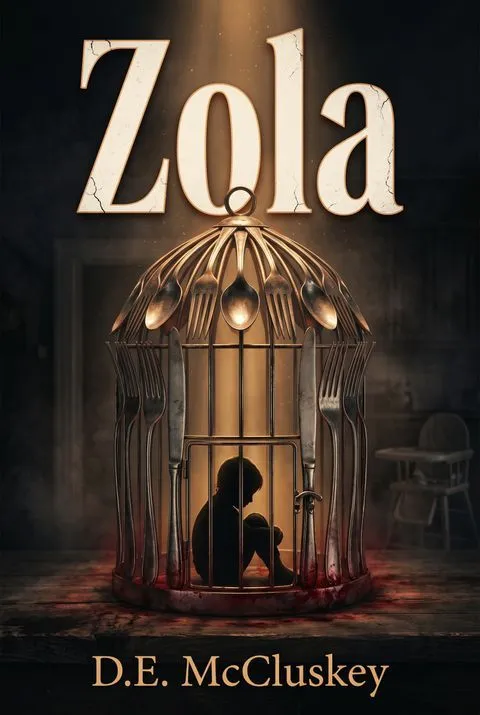

Plot Summary
The Cruelest Joke
In a small rural house, Andrea1 endures a marriage that curdled the moment the honeymoon ended. Anthony Zola,3 a hard worker and harder drinker, perfected a private cruelty: jokes that became fists, isolation disguised as love. When their son2 is born yellow with jaundice, Anthony3 christens him to ridicule the wife he beats, choosing a name that braids the family surname into her favorite food.
The boy becomes Gordon Zola.2 Andrea,1 ballooning on the gin and cheese she uses to survive, lets her family and friends drift away under Anthony's3 control. She hates the name and the man, but she clings to one fierce, uncomplicated love: her boy,2 the single reason she still rises each morning.
McCluskey opens by weaponizing comedy. The pun name is a literalized act of domestic violence, an inscription of the abuser's contempt onto the victim's child forever. Cheese and gin function as coping mechanisms that the abuser also mocks, trapping Andrea in a self-reinforcing loop of shame and consumption. The narration's grim humor refuses catharsis, forcing readers to sit inside coercive control: the gradual severing of social ties, the financial dependence, the reframing of cruelty as affection. Establishing food as both comfort and humiliation plants the seed for the novella's eventual collapse of nourishment into atrocity, where the very thing that sustains Andrea becomes the medium of her revenge.
Andrea's Fragile Rebirth
When Anthony3 begins lavishing attention on seven-year-old Gordon,2 taking him to bars to meet friends who hand the boy sweets and money, Andrea1 distrusts the sudden warmth but tells herself a boy needs his father.3 The cash starts flowing, fifty dollars, then hundreds, which she stockpiles in her hygiene box. Catching her reflection one morning, she revolts against what she has become.
She pours the gin down the sink, bins the cheese, eats clean, sheds weight, and phones her estranged sister Chrissy5 after years of silence. With nearly a thousand dollars saved, she begins quietly plotting to take Gordon2 and walk away. For a few bright weeks, the beatings ease and hope returns. She does not yet understand where the money comes from.
This is the false dawn that makes the coming horror unbearable. Andrea's recovery is genuine and recognizable: the addict's clarity, the reclaimed body, the tentative reconnection with kin. McCluskey grants her real agency precisely so it can be stolen. The escalating cash is dramatic irony at its cruelest, the reader sensing what a hopeful mother refuses to compute. Her self-image, repaired in a mirror she once avoided, drives the narrative forward, because pride in her son becomes the lever. The section studies how abuse survivors rationalize red flags, mistaking a predator's grooming of their child for paternal investment, the willful blindness that proximity to monstrosity demands.
Blood on the Sheets
On a Tuesday she will never forget, Anthony3 brings Gordon2 home with a black eye and bloody nose, claiming a scuffle with another boy. After Anthony3 forces himself on her and falls asleep, Andrea1 hears her son2 sobbing. She finds Gordon2 bleeding from a torn anus, his pajamas soiled with blood and worse.
With chilling calm she cleans him, improvises a dressing, and sings him to sleep. Then she asks the question she dreads. Gordon2 answers that his father3 and his father's friends did this to him. The money was payment. Anthony3 had been selling his own son2 to the men at the bar. Something inside Andrea1 goes quiet and cold, a tide of wrath gathering offshore, waiting to break.
The novella's moral engine ignites here. McCluskey stages the revelation through a mother's hands rather than her ears, letting the body testify before the words confirm. Andrea's eerie composure, the recurring image of a calm beach awaiting a tsunami, dramatizes dissociation as survival: she becomes a blank canvas so she can function through the unthinkable. The horror pivots from domestic to monstrous, recoding Anthony from abuser to trafficker. Crucially, the text frames what follows not as madness but as a perverse maternal logic. The reader's sympathy is deliberately fused to an impending atrocity, the splatterpunk genre's signature move: forcing identification with vengeance that will exceed all proportion.
Vengeance Served with Cheese
Carrying a serrated bread knife and a chunk of ripe cheese upstairs, Andrea1 wakes Anthony3 with the one act guaranteed to please him. As he nears climax, she reveals the blade, gags him with a sock, and saws his erection in two. She packs the wound and his mouth with cheese, eats part of him before his eyes, and forces the remainder down his throat until he chokes to death in their bed.
The deed done, she panics: she has no plan for a corpse. She wrestles his body into the wardrobe among his hanging clothes and waits for the phone to ring. It never does. No employer, no drinking buddy, no relative misses Anthony Zola3 at all.
The set piece is grotesque retributive symmetry: the organ of his crimes becomes his last meal, dressed in the food he used to humiliate her. McCluskey laces the scene with the angel and devil on Andrea's shoulders both urging slaughter, collapsing conscience into appetite. The total absence of any aftermath, no calls, no inquiries, indicts the social invisibility of predators and victims alike, a household so isolated that murder leaves no ripple. This silence is also enabling: it converts a one-time act of justice into a sustainable practice. The corpse in the wardrobe is Chekhov's body, a problem that the narrative's twisted ingenuity will soon reframe as opportunity rather than evidence.
The Cheese Steak Recipe
As the body rots and flies swarm, Andrea1 discovers that smelly cheese masks the stench, and worse, that the mingled aromas make her ravenous. Tasting flesh blended with mold, she crosses a threshold she cannot recross. Using an unwanted wedding gift, an electric carving knife, she fillets Anthony3 into steaks, smears them with cheese, and freezes them.
She boils his bones and organs into broth seasoned with garlic and herbs. For months she and Gordon2 dine on what she calls cheese steaks and special broth, the boy2 believing the meat is chicken or pork. Money and corpse together solve two problems at once. When supplies dwindle, she eyes a darker solution already forming in her mind.
Necessity births taboo. McCluskey routes cannibalism through domestic thrift, the language of recipes, freezer bags, and stretching a budget, so that atrocity wears an apron. The transformation of grief and rage into appetite is the book's psychological core: consumption literalized, the abuser ingested by those he tormented. The dramatic irony of Gordon innocently relishing his own father is both blackly comic and deeply tragic, sealing his corruption through the most intimate act, eating. Crucially, the discovery that murder feeds them converts trauma response into economic model. The wardrobe corpse becomes a renewable resource, and the narrative quietly establishes the engine that will run for the next twelve years.
The Gentlemen Callers
Recognizing one of Anthony's3 friends, the leering man from the local diner4 who remembered Gordon2 from the club, Andrea1 dresses up and walks into the bar her husband3 haunted. She plays the lonely widow, weaponizing the very explicit photos Anthony3 once made her pose for, and lures the predator home. Beneath the mattress wait a bread knife, a sock, and a chunk of cheese.
So begins her system: she entertains men for money and meat, targeting the perverts who once paid to hurt her boy.2 Each visitor leaves Gordon2 with new clothes, fresh cash, and weeks of his favorite meals. Vengeance and survival fuse into a single grim economy that will sustain mother and son for years.
Andrea evolves from impulsive avenger into methodical predator, inverting the trafficking ring that destroyed her family. Her targets are chosen with moral precision, the men who abused Gordon, which lets the novella sustain a queasy sympathy even as she becomes a serial killer. McCluskey reclaims the instruments of her degradation, the staged pornographic photos, repurposed as bait, turning humiliation into lure. The repeated trinity of knife, sock, and cheese becomes ritual, a liturgy of retribution. Yet the section also quietly damns her: the same hunger that began as justice now requires fresh victims to feed an appetite, blurring the line between righteous reckoning and addiction to the kill.
Gordon's Feral Inheritance
Years dissolve. In Andrea's1 imagination Gordon2 grew into a balanced young man; in truth he becomes monstrously obese, unwashed, illiterate, never leaving the house, a body colonized by insects he eats from his own skin. He learns the household rhythm: hide when callers arrive, peep as his mother1 bludgeons them with an iron bar, watch her bathe in faintly pink water, then feast for weeks.
He develops private rituals, hoarding his semen in a jar he calls Gordon Cakes, lusting after his aging mother.1 Recurring nightmares replay hooded men passing him around a candlelit circle, the buried memory of his father's friends. He knows nothing else and wants nothing more: food, his mother,1 and the silence of their rotting home.
Part Two relocates the horror from act to consequence. Gordon is the abuse cycle's terminal product, a man arrested in infancy, his desires fused permanently to feeding and to the only person who ever stayed. McCluskey renders him pitiable and repulsive at once, an experiment in how far isolation and grooming can deform a soul. The gap between Andrea's fantasy of a well-adjusted son and the feral reality exposes maternal love as both shelter and prison: she saved him from predators by sealing him away from the world entirely. His incestuous fixation and self-consuming habits foreshadow a horror that no longer needs an external villain. The monster is now homegrown.
The Morning Mother Stopped
Gordon2 wakes to a house gone unbearably quiet. Searching for his mother,1 he creeps into her room and, mistaking her stillness for sleep, masturbates over her, only to realize as his fluid runs into her open mouth that she has died, her nipples purpled, her skin cold. He collapses in terror. With Andrea1 gone, the boy2 who never learned to cook or hunt faces starvation.
He devours a severed head left in the fridge, scraping rotten brain mixed with cheese, and licks gore from the floor. Grief and hunger braid together into one animal panic. He cannot make her cheese steaks. He cannot lure callers. He has only her corpse, the cheese in the cupboard, and the unbearable weight of being utterly alone.
The mother's quiet death, natural and undramatic after a life of orchestrated killing, is the novella's structural hinge. McCluskey strips Gordon of the one regulating presence in his universe, exposing how completely Andrea's protection doubled as incapacitation. The Oedipal horror crests as desire, grief, and appetite become indistinguishable, the son unable to process loss except through the body. His feeding on a stranger's severed head literalizes the inheritance she leaves: a pantry of human remains and no knowledge of any other way to live. This is the cruelest irony of her maternal project. By making herself indispensable, she condemned her child to helplessness the instant she was gone.
Cheese from His Own Body
Desperate to recreate his mother's1 flavors, Gordon2 experiments. He marinades steaks of her flesh1 in her own feces and toilet water, gagging at the failures. Then inspiration strikes: he liquefies cheese in his mouth, pipes it through joined drinking straws into his penis, and ejaculates the warm sauce onto her body1 before carving and eating the basted meat, including her breasts.
It is, to him, the finest thing he has ever tasted. But while butchering her with the electric knife, he gashes his hand deeply. The wound swells green and yellow, the infection spreading up his arm as he keeps feasting. Fever takes him. His bowels and stomach revolt at once, and his body begins to fail him completely.
McCluskey pushes splatterpunk to its logical extreme, the abused child literally producing his own grotesque nourishment from his body and his mother's corpse, a closed loop of consumption with no exit. The cheese sauce, once Andrea's loving signature, becomes a self-generated perversion, collapsing the boundaries between food, sex, and decay entirely. The infected hand introduces the only force the household's sealed reality cannot outwit: biology, indifferent and unstoppable. There is grim justice in it. The knife that processed so many victims finally turns on its wielder. Gordon's ingenuity, the human spirit improvising in extremity, is real, but it is ingenuity in service of damnation, intelligence with nowhere clean to go.
A Dream of Young Mother
The infection wins. Gordon2 wakes too weak to move, vomiting and voiding himself, his swollen arm useless. Face down in his own waste, unable to breathe, he chokes as the foul mixture fills his mouth and nose. In his final moments the buried nightmare returns fully: his father and the hooded men ejaculating cheese sauce over him, the abuse and the cuisine revealed as one.
Then darkness softens. A figure steps from it, not the bloated corpse he butchered but Andrea1 young, slender, beautiful, the mother before Anthony3 broke her. She opens her arms. Gordon2 reaches back with the arms of an infant and goes to her. Their embrace is warm and alive. She smells of flowers, and of cheese.
The ending withholds judgment and offers terrible mercy. Gordon dies as he lived, immersed in filth and appetite, the trauma circle finally closing as the dream fuses molestation with the cheese motif that defined his every pleasure. Yet McCluskey grants a hallucinatory grace: reunion with the idealized mother, restored to the woman she was before the abuse deformed them both. The infant arms signal regression to a love that predates all harm, the only paradise either character could imagine. The closing scent, flowers and cheese, marries innocence and corruption in a single breath, refusing to let comfort be clean. It is damnation rendered as homecoming, horror's bleakest tenderness.
Analysis
McCluskey's novella is extreme horror with an unexpectedly coherent moral architecture, using transgression as a scalpel rather than a sledgehammer. Its governing pun, a child named for cheese, is a deliberate bait-and-switch: comedy lures the reader into a study of domestic violence, child trafficking, and the intergenerational transmission of abuse. The book's two-part structure mirrors its thesis. Part One traces how a victim becomes a perpetrator through a love so total it abandons all proportion; Part Two reveals the cost of that love, a son so thoroughly sheltered that he cannot survive his protector's absence. Andrea1 saves Gordon2 from predators by sealing him from the world, and in doing so she dooms him more completely than his father3 ever could. The central metaphor is consumption: the abuser literally ingested,3 trauma metabolized into appetite, nourishment and atrocity rendered indistinguishable. Cheese, the substance of comfort and humiliation alike, charts the family's descent from kitchen to charnel house, insisting that horror here is domestic, intimate, and home-cooked rather than monstrous from without. McCluskey refuses easy catharsis. Andrea's1 revenge is satisfying and then nauseating; Gordon2 is repulsive and then unbearably pitiable. The reader is implicated by their own shifting sympathies, the genre's signature ethical trap. The recurring dream of the hooded circle binds everything, exposing the cheese cuisine as a direct mutation of the abuse that began it, a closed loop with no clean exit. Even the final mercy, reunion with the idealized young mother,1 is poisoned, its closing scent of flowers and cheese marrying innocence to corruption. Beneath the splatter lies a bleak meditation on how cycles of harm replicate, how isolation deforms, and how protective love, untethered from the world, becomes its own kind of cage.
Review Summary
People Also Read
Characters
Andrea
Battered wife turned avengerA woman slowly erased by marriage, Andrea enters the story already isolated, overweight, and dependent on gin and cheese to survive her husband's3 beatings and humiliations. Her single uncorrupted devotion is to her son2, the axis around which her entire shattered psyche organizes itself. Capable of startling composure under horror, she dissociates into a cold, methodical calm when pushed past endurance, recurring in the imagery of a tranquil beach awaiting a destroying wave. McCluskey draws her as both victim and engine: a survivor whose maternal love, once weaponized, knows no upper limit. Her resourcefulness, blackly practical, transforms catastrophe into a grim domestic system. She is tender and monstrous in the same breath, a study in how protection can curdle into possession and ruin.
Gordon Zola
Isolated, feral grown sonBorn jaundiced and saddled with a name designed to mock his mother, Gordon is the novella's tragic terminus, a child of abuse who never escapes infancy. Homeschooled into total isolation, illiterate, obese, and unwashed, he experiences the world through appetite and a fixation on the only person who never left him. His inner life is childlike yet warped, narrated with a naive cheer that makes his grotesque habits unbearable. McCluskey frames him less as villain than as wreckage, the predictable product of a father who trafficked him3 and a mother who sheltered him1 by sealing him away from everything. He wants almost nothing: food, his mother's1 presence, the comfort of routine. That smallness of desire, deformed by horror, is precisely what makes him devastating.
Anthony Zola
Abusive father and traffickerA hard worker, harder drinker, and habitual hitter, Anthony reveals his true cruelty only after the wedding. He controls Andrea1 through violence, isolation, and contempt dressed as humor, and he names his son2 to wound her. Behind the petty tyrant lurks something far worse: a man who grooms and sells his own child2 to his drinking companions for cash. He is the rot from which the entire story grows, a predator whose disappearance no one even notices.
The diner man
Leering accomplice from the barOne of Anthony's3 drinking companions, he recognizes Gordon2 at the diner and lets slip that the boy and his father3 were missed at the club. His knowing leer and reference to Anthony's3 explicit photos of Andrea1 mark him as complicit in the abuse, and make him Andrea's1 first chosen target.
Chrissy
Estranged younger sisterAndrea's1 younger sister, lost to years of silence during the worst of the marriage. When Andrea1 briefly reclaims her life, a long phone call with Chrissy signals hope and the possibility of reconnection, a thread of the outside world that the coming horror severs.
Plot Devices
Cheese
Comfort turned to atrocityCheese threads through every layer of the book, beginning as Andrea's1 harmless comfort food and the cruel basis of her son's name. It becomes her addiction alongside gin, then, astonishingly, the agent that masks the smell of decay and awakens her appetite for human flesh. From there it flavors the cheese steaks and broth made from corpses, and finally becomes the medium of Gordon's2 most grotesque self-generated recipe. McCluskey uses a single mundane food to track the family's descent, so that the same substance signifies love, humiliation, addiction, vengeance, and damnation by turns. Its constant presence makes the horror feel domestic and intimate rather than supernatural, rooting atrocity in the kitchen cupboard.
The gentleman callers
Sustainable murder economyAfter her first killing, Andrea1 turns predation into a system: she lures men, especially her son's2 abusers, back to the house, kills them with an iron bar, and processes their bodies into food. To Gordon2 these visitors are simply gentleman callers who appear briefly, never leave, and are always followed by new clothes, extra money, and weeks of his favorite meals. The device lets the novella compress years of repeated atrocity into a chillingly normalized routine, and it doubles as both vengeance against the trafficking ring and the household's grim means of survival. It also defines Gordon's2 entire understanding of how the world feeds itself.
The electric carving knife
Instrument of butchery and ruinAn unwanted wedding gift from a guest never seen again, the electric carving knife sits boxed until Andrea1 needs to fillet a body. It becomes the household's defining tool, the sound of its twin blades signaling, to the hidden Gordon2, that meals are coming. McCluskey gives the object a quiet life of its own across the years, a banal appliance domesticating the unspeakable. In Part Two it passes to Gordon2, who has always been forbidden to touch it, and the moment he finally wields it the blade turns the household's logic of consumption back on its operator, opening the wound that decides his fate.
The hooded circle dream
Buried trauma made visibleGordon2 is haunted by recurring nightmares of standing within a circle of hooded, candlelit figures who pass him around and abuse him. Childlike and uncomprehending, he cannot place the images, but the reader recognizes them as the repressed memory of his father3 and the men who paid to molest him. McCluskey deploys the dream to carry the novella's central wound across the twelve-year time skip without exposition, and to fuse, in Gordon's2 final moments, the sexual abuse of his childhood with the cheese-sauce cuisine of his adulthood, revealing them as the same inheritance. It is the psychological key that explains who Gordon2 became.
The name Gordon Zola
Cruelty inscribed for lifeAnthony's3 drunken naming of his jaundiced son2 is the book's founding act of violence, a pun that fuses the family surname with Andrea's beloved cheese to humiliate her permanently. The name is presented as a joke and functions as a curse, marking the child2 as an object of his father's contempt before he can speak. It seeds the cheese motif, signals the coercive dynamics of the marriage, and lends the entire grotesque saga its mordant, blackly comic frame. Throughout, the gap between the name's silly surface and the suffering beneath it embodies the novella's strategy of weaponizing humor against the reader.
Download PDF
Download EPUB
.epub digital book format is ideal for reading ebooks on phones, tablets, and e-readers.








































