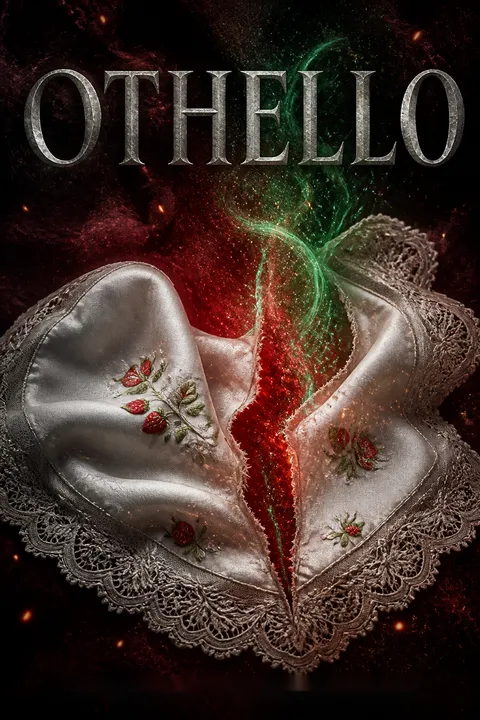
Resumen de la trama
Los celos encienden el engaño
En Venecia, Iago, sintiéndose menospreciado por Othello al haber promovido a Cassio por encima de él, trama su venganza. Recluta a Roderigo, pretendiente de Desdemona, para que le ayude a arruinar a Othello. El plan de Iago consiste en aprovechar las inseguridades y los celos de Othello, preparando así el escenario para una caída trágica.
El matrimonio secreto del moro
Othello, un respetado general moro, contrae matrimonio en secreto con Desdemona, hija de un senador veneciano, Brabantio. Al enterarse, Brabantio acusa a Othello de brujería. Sin embargo, Othello defiende su amor por Desdemona ante el Duque, quien apoya su unión.
El siniestro plan de Iago
Mientras Othello es enviado a Chipre para defenderse de los turcos, Iago comienza a envenenar la mente de Othello contra Cassio y Desdemona. Sugiere que Desdemona le es infiel, usando la amistad entre ella y Cassio como prueba, y planea utilizar un pañuelo, regalo de Othello para Desdemona, como evidencia falsa.
La súplica de Desdemona por Cassio
Tras ser degradado por una pelea en estado de ebriedad, Cassio busca la ayuda de Desdemona para recuperar el favor de Othello. Las persistentes súplicas de Desdemona en favor de Cassio alimentan sin querer los crecientes celos de Othello, mientras Iago continúa manipulando la situación a su favor.
La traición del pañuelo
La esposa de Iago, Emilia, encuentra el pañuelo de Desdemona y se lo entrega a Iago. Este lo planta en posesión de Cassio, usándolo para convencer a Othello de la infidelidad de Desdemona. El pañuelo se convierte en la pieza clave de la "prueba" que lleva a Othello a la locura.
La caída de Othello en la locura
Dominado por los celos y la ira, Othello confronta a Desdemona, quien clama su inocencia. A pesar de sus protestas, la mente de Othello está decidida a vengarse. Las mentiras de Iago han echado raíces, y la confianza de Othello en Desdemona se rompe, llevándolo a una decisión trágica.
El desenlace trágico
Impulsado por el engaño de Iago, Othello mata a Desdemona. Emilia descubre la traición de Iago, pero la revelación llega demasiado tarde. Al darse cuenta de su grave error, Othello se quita la vida. Iago es arrestado, pero el daño ya está hecho, dejando un rastro de destrucción y pérdida.
Personajes
Othello
Othello es un general moro en el ejército veneciano, respetado por su liderazgo pero vulnerable a los celos. Su amor por Desdemona es profundo, aunque sus inseguridades lo hacen susceptible a las manipulaciones de Iago, lo que conduce a su trágica caída.
Iago
Iago es el alférez de Othello, movido por los celos y la ambición. Orquesta la caída de Othello mediante el engaño, explotando las debilidades de quienes le rodean. Su astucia y falta de conciencia lo convierten en uno de los villanos más notorios de la literatura.
Desdemona
Desdemona es la esposa amorosa y fiel de Othello, cuya inocencia y lealtad son trágicamente malinterpretadas. Su defensa de Cassio y su amor inquebrantable por Othello la convierten en víctima de las maquinaciones de Iago y de los celos de Othello.
Cassio
Cassio es el leal teniente de Othello, cuya reputación se ve empañada por las intrigas de Iago. Su estrecha amistad con Desdemona es manipulada para despertar los celos de Othello, aunque él desconoce la conspiración en su contra.
Emilia
Emilia, esposa de Iago y doncella de Desdemona, es un personaje pragmático y fiel. Sin querer, ayuda a Iago al entregarle el pañuelo de Desdemona, pero finalmente revela su traición, demostrando integridad y valentía.
Roderigo
Roderigo es un rico veneciano enamorado de Desdemona, fácilmente manipulado por Iago. Su confianza ciega en las promesas de Iago lo lleva a participar en la conspiración contra Othello, lo que finalmente provoca su propia ruina.
Brabantio
Brabantio es el padre de Desdemona, quien se siente traicionado por el matrimonio secreto de su hija con Othello. Su indignación inicial y las acusaciones de brujería reflejan las tensiones raciales y culturales de la época.
Recursos narrativos
Celos y manipulación
Los celos son el tema central, y la manipulación de Iago sobre las inseguridades de Othello desencadena los eventos trágicos. Las acciones engañosas de Iago y la susceptibilidad de Othello a los celos crean una narrativa poderosa sobre la confianza y la traición.
El pañuelo
El pañuelo, regalo de Othello a Desdemona, se convierte en símbolo de su amor y en la falsa prueba de su infidelidad. Su papel en la trama destaca el poder destructivo de la mala interpretación y la manipulación.
Análisis
"Othello" profundiza en temas como los celos, la confianza y el poder destructivo de la manipulación. La representación que hace Shakespeare de la trágica caída de Othello debido a la astucia de Iago pone de manifiesto las vulnerabilidades de la naturaleza humana. La obra funciona como una advertencia sobre los peligros de las emociones descontroladas y las consecuencias del engaño, manteniéndose vigente en su exploración de las complejidades del amor, el honor y la traición.
Resumen de reseñas
Otelo es ampliamente considerada una de las más grandes tragedias de Shakespeare. Los lectores elogian la complejidad de sus personajes, en particular la del villano Yago, así como la exploración de temas como los celos, el racismo y la traición. La profundidad psicológica de la obra y su lenguaje poético son aspectos que se destacan con frecuencia. Muchos encuentran frustrante la credulidad de Otelo, pero reconocen el papel fundamental que desempeña en la trama trágica. Algunos lectores señalan la vigencia que tienen los temas de la obra en relación con los problemas actuales. En conjunto, Otelo es considerada una obra poderosa y atemporal que pone de manifiesto el genio de Shakespeare para el desarrollo de personajes y la narrativa dramática.
También leyeron





Preguntas frecuentes
Synopsis & Basic Details
What is Othello about?
- A respected general's downfall: Othello, a Moorish general in the Venetian army, secretly marries Desdemona, a noble Venetian woman, defying her father's wishes.
- Seeds of deceit are sown: Othello's ensign, Iago, resentful over a perceived slight and passed over for promotion in favor of Cassio, plots to destroy Othello's happiness and reputation.
- A web of manipulation: Iago uses cunning lies and psychological manipulation to convince Othello that Desdemona is unfaithful with Cassio, exploiting Othello's insecurities and trust.
- Tragedy unfolds in Cyprus: The play moves to Cyprus, where the characters are isolated, allowing Iago's plan to escalate, leading to jealousy, violence, and ultimately, death.
Why should I read Othello?
- Masterclass in villainy: Iago is one of literature's most compelling and chilling villains, offering a deep dive into the psychology of pure malice and manipulation.
- Powerful exploration of human vulnerability: The play starkly portrays how easily trust can be shattered and how quickly jealousy can consume even a noble mind, offering timeless insights into human nature.
- Rich thematic depth: Othello explores complex themes like race, prejudice, love, betrayal, reputation, and the dangerous power of language and perception.
What is the background of Othello?
- Venetian society and the "Other": The play is set against the backdrop of 16th-century Venice, a powerful, cosmopolitan city-state, and the island of Cyprus, a Venetian outpost. Othello's status as a Moor highlights themes of racial and cultural difference within this society.
- Military context: The characters are deeply embedded in a military structure, where reputation, rank, and loyalty are paramount, providing fertile ground for Iago's professional and personal resentments.
- Cultural anxieties: The play touches upon contemporary anxieties about interracial relationships, female chastity, and the perceived exoticism or "otherness" of non-Europeans, which Brabantio's accusations of witchcraft initially reflect ("Sans witchcraft could not").
What are the most memorable quotes in Othello?
- "I am not what I am." (Iago, Act I, Scene I): This chilling line is Iago's declaration of his deceptive nature, establishing his core identity as a dissembler and foreshadowing his entire scheme.
- "O, beware, my lord, of jealousy; It is the green-eyed monster which doth mock The meat it feeds on." (Iago, Act III, Scene III): Iago's famous warning ironically plants the very seed of jealousy he intends to cultivate, defining the destructive force that will consume Othello.
- "When I have pluck'd the rose, I cannot give it vital growth again. It must needs wither." (Othello, Act V, Scene II): Othello uses this metaphor just before killing Desdemona, illustrating his belief that he is destroying something beautiful and irreplaceable, yet feels compelled to do so, highlighting his tragic delusion.
What writing style, narrative choices, and literary techniques does William Shakespeare use?
- Dramatic Irony: Shakespeare masterfully employs dramatic irony, allowing the audience to be privy to Iago's true intentions and manipulations while the characters remain ignorant, creating intense tension and suspense.
- Verse and Prose: The play shifts between blank verse (unrhymed iambic pentameter), often used for noble characters and elevated speech, and prose, frequently used by Iago when manipulating others or in moments of cynical realism, highlighting social dynamics and psychological states.
- Soliloquies: Iago's frequent soliloquies directly address the audience, revealing his inner thoughts, motives (or lack thereof), and plotting process, making the audience complicit in his villainy and providing crucial insight into his character.
Hidden Details & Subtle Connections
What are some minor details that add significant meaning?
- The Clown's wordplay: The brief appearance of the Clown in Act III, Scene I, with his puns on "lie" and "wind-instruments," serves as more than comic relief; it subtly introduces themes of miscommunication, deception, and the unreliable nature of language just before Iago begins his most intense manipulation of Othello.
- Bianca's parallel jealousy: Bianca, Cassio's mistress, exhibits her own form of jealousy when she sees the handkerchief (Act III, Scene IV), mirroring Othello's reaction and demonstrating how easily suspicion can arise from circumstantial evidence, even in a less noble context.
- Brabantio's dying grief: Gratiano mentions in the final scene (Act V, Scene II) that Brabantio died of grief over Desdemona's marriage ("pure grief Shore his old thread in twain"), a detail that underscores the profound societal disruption and personal heartbreak caused by the elopement, even before Iago's plot fully unfolded.
What are some subtle foreshadowing and callbacks?
- Brabantio's warning: Brabantio's bitter parting words to Othello, "Look to her, Moor, if thou hast eyes to see: She has deceived her father, and may thee" (Act I, Scene III), serve as a direct prophecy that Iago later weaponizes, subtly planting the idea of Desdemona's potential deceit in Othello's mind from the outset.
- Iago's "Divinity of hell" soliloquy: In Act II, Scene III, Iago explicitly outlines his plan to use Desdemona's virtue against her, stating, "So will I turn her virtue into pitch, And out of her own goodness make the net That shall enmesh them all," clearly foreshadowing how her attempts to help Cassio will be twisted into proof of guilt.
- Desdemona's "Willow" song: Desdemona singing the melancholic "Willow" song (Act IV, Scene III) is a direct callback to her mother's maid, Barbara, who died singing it after being forsaken by her love. This moment heavily foreshadows Desdemona's own impending death due to Othello's unfounded jealousy and sense of abandonment.
What are some unexpected character connections?
- Emilia and Iago's transactional relationship: While married, Emilia and Iago's interactions reveal a relationship based on duty and Iago's dismissiveness rather than affection. Emilia's casual theft of the handkerchief "to please his fantasy" (Act III, Scene III) highlights her desire for his approval, a stark contrast to Desdemona's relationship with Othello and tragically enabling Iago's plot.
- Cassio's unawareness of Roderigo: Despite Roderigo's repeated attempts to provoke Cassio under Iago's direction, Cassio seems largely unaware of Roderigo's identity or specific animosity towards him until the final scene (Act V, Scene I), highlighting how Iago uses Roderigo as a disposable pawn without Cassio ever recognizing the true source of the conflict.
- Lodovico's familial link: Lodovico is identified as Desdemona's cousin (Act IV, Scene I), making him a direct representative of her Venetian family and adding a layer of personal tragedy to his role as the official messenger who witnesses Othello's violent outburst and later presides over the aftermath.
Psychological, Emotional, & Relational Analysis
What are some unspoken motivations of the characters?
- Iago's multifaceted resentment: Beyond being passed over for lieutenant, Iago hints at other possible motives, including a vague suspicion that Othello has slept with his wife, Emilia ("And, it is thought abroad, that 'twixt my sheets He has done my office" - Act I, Scene III), suggesting a deeper, perhaps irrational, personal grievance fueling his malice.
- Othello's underlying insecurity: Despite his outward confidence and military prowess, Othello's rapid descent into jealousy suggests a deep-seated insecurity about his age, race, and social standing in Venetian society ("Haply, for I am black... or for I am declined Into the vale of years" - Act III, Scene III), making him vulnerable to Iago's suggestions that Desdemona would naturally prefer someone like Cassio.
- Desdemona's naive optimism: Desdemona's persistent advocacy for Cassio, even when Othello is clearly agitated, stems from a genuine desire to help a friend and a naive belief that her husband's love is so strong it can withstand anything ("My lord is not my lord... I had suborn'd the witness, And he's indicted falsely" - Act III, Scene IV), failing to grasp the depth of Othello's internal turmoil or Iago's manipulation.
What psychological complexities do the characters exhibit?
- Othello's cognitive dissonance: Othello struggles with conflicting thoughts, oscillating between his deep love and trust for Desdemona and the poisonous doubts Iago instills. His mind becomes a battleground where reason is overwhelmed by manufactured "proof," leading to irrational leaps in logic and violent outbursts (e.g., his trance in Act IV, Scene I).
- Iago's psychopathy: Iago displays classic traits of psychopathy: a lack of empathy, manipulative behavior, superficial charm, and a seemingly motiveless cruelty ("But for my sport and profit. I hate the Moor" - Act I, Scene III). His pleasure seems to derive purely from the exercise of his cunning and the suffering of others.
- Emilia's moral awakening: Emilia initially appears pragmatic and subservient to Iago, even assisting in his plot by taking the handkerchief. However, witnessing Desdemona's suffering and death triggers a powerful moral awakening, leading her to defy her husband and expose his villainy, demonstrating a complex internal struggle and eventual courage (Act V, Scene II).
What are the major emotional turning points?
- Othello's first hint of doubt (Act III, Scene III): Iago's subtle questioning and feigned reluctance to speak his thoughts ("Indeed!" and "Honest, my lord!") plant the first significant seeds of doubt in Othello's mind, marking the beginning of his emotional shift from trust to suspicion.
- The handkerchief confrontation (Act III, Scene IV): Othello's intense interrogation of Desdemona about the handkerchief, escalating from a request to a demand and culminating in his abrupt exit, is a crucial turning point where his jealousy becomes overtly aggressive and Desdemona first witnesses his terrifying rage.
- Emilia's revelation (Act V, Scene II): Emilia's courageous confession about finding and giving the handkerchief to Iago ("I found by fortune and did give my husband") is the pivotal moment where the truth is revealed, shattering Othello's delusion and triggering his final emotional collapse and remorse.
How do relationship dynamics evolve?
- Othello and Desdemona's love to suspicion: Their relationship transforms from a bond based on shared stories, admiration, and deep love ("She loved me for the dangers I had pass'd, And I loved her that she did pity them" - Act I, Scene III) to one consumed by Othello's suspicion, interrogation, and brutal violence, orchestrated by Iago.
- Othello and Iago's trust to twisted loyalty: Othello initially trusts Iago implicitly, calling him "honest Iago" repeatedly. This trust is perverted by Iago into a false bond of shared purpose and revenge ("Now art thou my lieutenant. I am your own for ever" - Act III, Scene III), replacing Othello's bond with Cassio and Desdemona.
- Emilia and Desdemona's mistress-maid bond to sisterhood: Their relationship deepens from a formal mistress-maid dynamic to one of genuine affection and solidarity, particularly evident in their conversation about men and infidelity (Act IV, Scene III) and culminating in Emilia's fierce loyalty and self-sacrifice for Desdemona in the final scene.
Interpretation & Debate
Which parts of the story remain ambiguous or open-ended?
- Iago's ultimate motivation: While Iago lists several grievances (passed over for promotion, suspicion about Emilia), the sheer scale and depth of his malice seem disproportionate, leaving his true, perhaps even unknowable, core motivation open to interpretation – is it pure evil, deep-seated envy, or something else entirely? ("Demand me nothing: what you know, you know: From this time forth I never will speak word." - Act V, Scene II).
- The nature of Othello's "love": The play invites debate on whether Othello's initial love for Desdemona was truly profound or partly based on her admiration of his stories and his pride in possessing such a prize. His swift turn to violent jealousy raises questions about the foundation and fragility of his affection.
- The extent of societal influence: While Iago is the primary catalyst, the play leaves room to debate how much Othello's vulnerability is exacerbated by his status as an outsider in Venetian society and the inherent prejudices he faces, subtly hinted at by Brabantio's initial reaction and Iago's racial slurs.
What are some debatable, controversial scenes or moments in Othello?
- Othello striking Desdemona (Act IV, Scene I): This public act of violence is shocking and marks a significant point of no return in Othello's descent. It is highly controversial in its brutality and the public nature of the humiliation inflicted upon Desdemona.
- Desdemona's final words (Act V, Scene II): Desdemona, dying, tells Emilia "Nobody; I myself" killed her, before immediately contradicting herself by asking Emilia to "Commend me to my kind lord." This moment is debated: is she trying to protect Othello, still blindly loyal, or is it a moment of profound psychological complexity in her final breaths?
- Othello's final speech: Othello's lengthy final address, where he attempts to define himself and his actions ("Speak of me as I am... of one that loved not wisely but too well"), is highly debated. Is he regaining his noble stature and achieving a tragic self-awareness, or is he still attempting to control his narrative and justify his horrific deed?
Othello Ending Explained: How It Ends & What It Means
- The truth is revealed, but too late: In Act V, Scene II, Emilia exposes Iago's plot, revealing she found the handkerchief and gave it to him. Cassio confirms Iago planted it and Roderigo's letters further implicate Iago. This revelation shatters Othello's false reality.
- Othello's remorse and suicide: Overwhelmed by the horrific truth of his mistake and the murder of his innocent wife, Othello expresses profound grief and remorse. Recognizing his folly and the destruction he has wrought, he delivers a final speech reflecting on his identity and actions, then stabs himself, dying beside Desdemona.
- Iago's silence and punishment: Iago refuses to explain his motives further ("From this time forth I never will speak word") and is taken away to face torture and punishment under Cassio, the new governor of Cyprus. The ending signifies the devastating consequences of unchecked jealousy, manipulation, and the tragic destruction of love and innocence.
Sobre el autor
Otros libros de William Shakespeare




Descargar PDF
Descargar EPUB
.epub digital book format is ideal for reading ebooks on phones, tablets, and e-readers.








































