Ideas clave
1. La Hipótesis de Riemann: Un Enigma de los Números Primos
Los números primos son los átomos mismos de la aritmética. Los primos son las joyas que salpican la vasta extensión del infinito universo numérico que los matemáticos han explorado a lo largo de los siglos.
La Hipótesis de Riemann es uno de los problemas sin resolver más importantes en matemáticas. Intenta explicar la distribución de los números primos, que son fundamentales para la teoría de números y han desconcertado a los matemáticos durante siglos. La hipótesis sugiere que la aparente ocurrencia aleatoria de los primos en realidad sigue un patrón oculto.
Aspectos clave de la Hipótesis de Riemann:
- Conecta los números primos con el análisis complejo a través de la función zeta de Riemann
- Si se demuestra cierta, proporcionaría profundas ideas sobre la naturaleza de los números primos
- Tiene implicaciones en muchas áreas de las matemáticas e incluso en la física
- A pesar de más de 150 años de esfuerzo, sigue sin demostrarse, con un premio de un millón de dólares por su solución
2. De los Griegos Antiguos a la Criptografía Moderna: La Evolución de la Teoría de Números Primos
Para los matemáticos, inspiran un sentido de asombro: 2, 3, 5, 7, 11, 13, 17, 19, 23, … – números eternos que existen en un mundo independiente de nuestra realidad física.
El desarrollo histórico de la teoría de números primos abarca milenios. Los antiguos griegos, especialmente Euclides, sentaron las bases al demostrar la infinitud de los primos. Con el tiempo, los matemáticos desarrollaron herramientas cada vez más sofisticadas para comprender estos números misteriosos.
Hitos en la teoría de números primos:
- La demostración de Euclides sobre la infinitud de los primos (300 a.C.)
- El Pequeño Teorema de Fermat (siglo XVII)
- El Teorema de los Números Primos de Gauss (siglo XIX)
- El trabajo revolucionario de Riemann (1859)
- El desarrollo de la criptografía moderna basada en números primos (desde los años 70 hasta hoy)
3. El Enfoque Revolucionario de Riemann: Paisajes Imaginarios y Funciones Zeta
Riemann había encontrado un espejo matemático a través del cual podía contemplar los primos.
La innovación de Bernhard Riemann fue abordar los números primos desde una perspectiva completamente nueva. Introdujo el análisis complejo en la teoría de números, creando un puente entre dos áreas aparentemente inconexas de las matemáticas.
Contribuciones clave de Riemann:
- La función zeta de Riemann, que conecta los números primos con el análisis complejo
- El concepto de un "paisaje" en el espacio complejo donde se representa la distribución de los primos
- La idea de que los ceros de la función zeta contienen la clave para entender la distribución de los primos
- La propia Hipótesis de Riemann, que predice dónde deberían encontrarse esos ceros
4. La Búsqueda de la Demostración: Gigantes Matemáticos y Sus Aportes
El gran logro de Hardy y Littlewood marcó el inicio de un viaje que continuaría en el siglo XX, con matemáticos ansiosos por seguir explorando el paisaje de Riemann.
Muchos matemáticos brillantes han contribuido al esfuerzo continuo por demostrar la Hipótesis de Riemann. Cada uno ha aportado nuevas ideas y técnicas, avanzando poco a poco en la comprensión de este complejo problema.
Contribuyentes destacados y su trabajo:
- G.H. Hardy y J.E. Littlewood: demostraron que infinitos ceros yacen en la línea crítica
- Atle Selberg: mostró que una proporción significativa de ceros está en la línea crítica
- Alan Turing: desarrolló métodos para calcular ceros de la función zeta
- Enrico Bombieri: realizó avances importantes en la comprensión de la distribución de primos
- Andrew Odlyzko: llevó a cabo extensos cálculos computacionales de ceros de la función zeta
5. Computadoras y la Hipótesis de Riemann: Calculando Ceros y Probando Teorías
La máquina de Turing pudo haber fallado poco después de superar el récord previo a la guerra en ceros calculados, pero había dado el primer paso hacia una era en la que la computadora tomaría el relevo de la mente humana en la exploración del paisaje de Riemann.
La llegada de las computadoras ha acelerado dramáticamente la investigación sobre la Hipótesis de Riemann. La potencia informática moderna permite realizar cálculos extensos y pruebas de la hipótesis, brindando apoyo empírico y nuevas perspectivas.
Funciones de las computadoras en la investigación de la Hipótesis de Riemann:
- Calcular ceros de la función zeta con precisión sin precedentes
- Probar conjeturas relacionadas con la distribución de primos
- Explorar patrones y relaciones en los datos de números primos
- Facilitar esfuerzos colaborativos como la Gran Búsqueda de Primos de Mersenne por Internet (GIMPS)
- Ayudar en el desarrollo y prueba de nuevas técnicas matemáticas
6. Aplicaciones Inesperadas: Encriptación RSA y Seguridad en Internet
Los números primos presentan a los matemáticos una de las tensiones más extrañas en su disciplina. Por un lado, un número es primo o no lo es. Ningún lanzamiento de moneda hará que un número sea divisible por otro menor. Sin embargo, no se puede negar que la lista de primos parece una secuencia elegida al azar.
El estudio de los números primos ha encontrado aplicaciones prácticas inesperadas, especialmente en criptografía. El sistema de encriptación RSA, ampliamente utilizado para comunicaciones seguras en internet, se basa en la dificultad de factorizar números grandes en sus componentes primos.
Aspectos clave de la encriptación RSA:
- Utiliza dos números primos grandes para crear una clave pública
- La seguridad depende de la dificultad computacional para factorizar números grandes
- Ampliamente usado para comunicaciones seguras en internet
- Demuestra el valor práctico de la investigación matemática "pura"
- Resalta la conexión entre la teoría abstracta de números y la tecnología real
7. Más Allá de RSA: Curvas Elípticas y el Futuro de la Criptografía
La criptografía de curvas elípticas ha resistido la prueba del tiempo y ha sido consagrada en estándares gubernamentales. Teléfonos móviles, agendas electrónicas y tarjetas inteligentes implementan felizmente esta nueva criptografía.
La criptografía de curvas elípticas representa la próxima frontera en el cifrado matemático. Esta técnica avanzada ofrece mayor seguridad con claves más cortas, siendo especialmente adecuada para dispositivos móviles y de bajo consumo.
Características de la criptografía de curvas elípticas:
- Basada en las matemáticas de curvas elípticas sobre campos finitos
- Ofrece seguridad equivalente a RSA con tamaños de clave mucho menores
- Más eficiente para dispositivos móviles y embebidos
- Gana adopción generalizada en aplicaciones gubernamentales e industriales
- Demuestra la interacción continua entre las matemáticas puras y la tecnología práctica
Resumen de reseñas
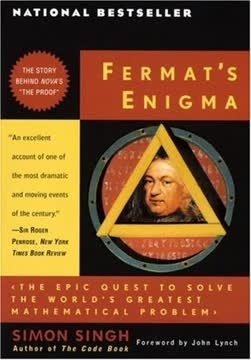
El Último Teorema de Fermat cautiva a los lectores con una narrativa fascinante que recorre la historia de las matemáticas y la apasionante búsqueda por resolver un problema que llevaba 350 años sin solución. Simon Singh entrelaza con maestría las biografías de destacados matemáticos, las explicaciones de conceptos complejos y la emocionante historia de la prueba definitiva de Andrew Wiles. Aunque algunos lectores encontraron desafiantes las explicaciones matemáticas, la mayoría elogió la habilidad de Singh para hacer el tema accesible y apasionante. Este libro es ampliamente recomendado por su combinación de historia, ciencia y perseverancia humana, atrayendo tanto a entusiastas de las matemáticas como a lectores en general.
También leyeron
Preguntas frecuentes
What's Fermat's Last Theorem by Simon Singh about?
- Exploration of Mathematical Mysteries: The book delves into the history and significance of Fermat's Last Theorem, a problem that remained unsolved for centuries until Andrew Wiles's breakthrough.
- Interconnectedness of Mathematics: It connects various mathematical concepts, such as prime numbers and the Riemann Hypothesis, illustrating their interwoven nature and contribution to mathematical thought.
- Cultural and Historical Context: The narrative provides a rich historical backdrop, detailing the lives of mathematicians and societal influences that shaped their work.
Why should I read Fermat's Last Theorem by Simon Singh?
- Engaging Storytelling: Simon Singh presents complex mathematical ideas in an accessible and engaging manner, making it suitable for both mathematicians and general readers.
- Inspiration from Great Minds: The book showcases the dedication and brilliance of mathematicians like Fermat, Wiles, and Riemann, inspiring readers to appreciate the beauty of mathematical exploration.
- Understanding Mathematical Concepts: Readers gain insights into fundamental mathematical concepts, such as prime numbers and the significance of proofs, sparking further interest in mathematics.
What are the key takeaways of Fermat's Last Theorem by Simon Singh?
- Importance of Proof: The book emphasizes the critical role of proof in mathematics, as demonstrated by Wiles's journey to prove Fermat's Last Theorem.
- Interrelation of Mathematical Problems: It shows how various mathematical problems, such as the Riemann Hypothesis, are interconnected, demonstrating the unity of mathematical thought.
- Cultural Impact of Mathematics: The narrative discusses how mathematical discoveries have influenced culture and society, reflecting the broader implications of mathematical inquiry.
What are the best quotes from Fermat's Last Theorem by Simon Singh and what do they mean?
- “The scientist does not study Nature because it is useful; he studies it because he delights in it, and he delights in it because it is beautiful.”: This quote by Henri Poincaré emphasizes the intrinsic motivation behind scientific inquiry, highlighting the beauty and wonder of mathematics.
- “A mathematical problem should be difficult in order to entice us, yet not completely inaccessible, lest it mock at our efforts.”: Hilbert's words reflect the balance between challenge and attainability in mathematics, suggesting that difficult problems drive progress.
- “There is the problem. Seek its solution. You can find it by pure reason, for in mathematics there is no ignorabimus.”: Hilbert's declaration asserts the belief that every mathematical problem is solvable, encouraging a spirit of inquiry and exploration.
What is the Riemann Hypothesis, as discussed in Fermat's Last Theorem by Simon Singh?
- Central Mathematical Problem: The Riemann Hypothesis is one of the most significant unsolved problems in mathematics, concerning the distribution of prime numbers.
- Connection to Prime Numbers: It posits that all non-trivial zeros of the Riemann zeta function lie on a critical line, crucial for understanding prime number patterns.
- Historical Significance: The hypothesis was formulated by Bernhard Riemann in 1859, and its proof remains a major quest in mathematics.
What is the significance of prime numbers in Fermat's Last Theorem by Simon Singh?
- Building Blocks of Mathematics: Prime numbers are described as the "atoms of arithmetic," essential for constructing all other numbers and foundational in number theory.
- Mystery and Chaos: Despite their fundamental importance, prime numbers appear random and unpredictable, captivating mathematicians for centuries.
- Applications in Modern Technology: Prime numbers have practical applications in fields like cryptography, crucial for securing digital communications.
How does Fermat's Last Theorem by Simon Singh relate to modern mathematics?
- Foundation for Number Theory: The book illustrates how Fermat's Last Theorem and the Riemann Hypothesis are cornerstones of modern number theory.
- Influence on Mathematical Research: The quest to solve these problems has inspired generations of mathematicians, shaping research agendas and methodologies.
- Interdisciplinary Connections: Developments in number theory intersect with fields like physics and computer science, underscoring the relevance of mathematical inquiry.
What methods did Andrew Wiles use to prove Fermat's Last Theorem, as discussed in Fermat's Last Theorem by Simon Singh?
- Modular Forms and Elliptic Curves: Wiles's proof involved deep connections between modular forms and elliptic curves, previously thought unrelated.
- Ribet's Theorem: He built upon Ribet's theorem, linking Fermat's Last Theorem to the Taniyama-Shimura-Weil conjecture, providing a pathway for his proof.
- Rigorous Proof Structure: Wiles's meticulous approach ensured every step was validated, culminating in a landmark achievement in mathematics.
What challenges did Andrew Wiles face in proving Fermat's Last Theorem, as discussed in Fermat's Last Theorem by Simon Singh?
- Decades of Work: Wiles spent nearly seven years working in secrecy, facing numerous setbacks and challenges.
- Initial Flaws: After announcing his proof, Wiles discovered a critical flaw, requiring him to rethink and revise his approach.
- Collaboration and Support: He received support from colleagues, particularly Richard Taylor, highlighting the importance of community in mathematical endeavors.
How does Fermat's Last Theorem by Simon Singh illustrate the nature of mathematical discovery?
- Trial and Error: The book emphasizes that mathematical discovery often involves a process of trial and error, central to advancing knowledge.
- Collaboration and Competition: It highlights the collaborative and competitive nature of the mathematical community, fostering innovation and progress.
- Beauty and Aesthetics: Mathematicians are driven by the desire to solve problems and the appreciation of elegance and harmony in mathematics.
What role did computers play in the exploration of the Riemann Hypothesis, as discussed in Fermat's Last Theorem by Simon Singh?
- Computational Power: Computers have enabled mathematicians to calculate vast numbers of zeros of the Riemann zeta function, providing empirical evidence.
- Evidence Gathering: While computers cannot prove the hypothesis, they gather evidence supporting its validity, bolstering belief in its truth.
- Limitations of Computers: Despite their power, computers cannot replace the creative and intuitive aspects of mathematical thinking, serving as tools rather than substitutes.
What is the significance of the prize for proving Fermat's Last Theorem mentioned in Fermat's Last Theorem by Simon Singh?
- Wolfskehl Prize: Established by Paul Wolfskehl, the prize motivated mathematicians to pursue a proof of Fermat's Last Theorem.
- Historical Impact: The prize attracted many mathematicians to Göttingen, contributing to the development of number theory.
- Personal Motivation: For Andrew Wiles, the prize served as a childhood inspiration, illustrating how personal stories intertwine with broader mathematical pursuits.