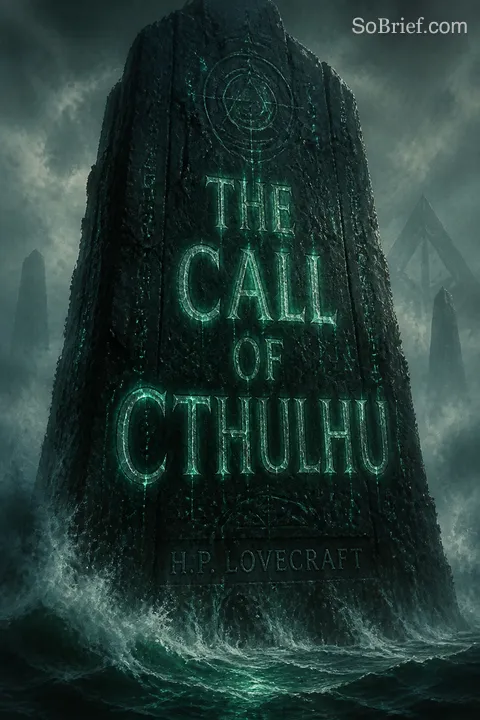
Résumé de l'intrigue
Le Manuscrit Mystérieux
Francis Wayland Thurston, universitaire passionné, découvre un manuscrit singulier laissé par son grand-oncle défunt, le professeur George Gammell Angell. Ce manuscrit rassemble notes, coupures de presse et une petite sculpture représentant une créature monstrueuse. Les recherches d’Angell explorent une série d’événements étranges et d’activités cultuelles centrées autour d’une entité ancienne nommée Cthulhu. Thurston se laisse gagner par une obsession : percer ce mystère, animé à la fois par une curiosité intellectuelle et une peur inexplicable qui semble émaner du manuscrit lui-même.
Rêves d’Épouvante
Thurston met au jour des témoignages de rêves troublants, vécus par des individus particulièrement réceptifs aux quatre coins du monde. Ces rêves sont peuplés de visions d’une cité monstrueuse et d’une créature terrifiante, en écho aux descriptions consignées dans les notes d’Angell. Artistes et poètes sont particulièrement touchés, leurs œuvres reflétant ces images obsédantes. Thurston comprend que ces rêves ne relèvent pas du simple hasard, mais qu’ils sont liés à l’entité antique Cthulhu, dont l’influence semble s’infiltrer dans l’inconscient collectif de l’humanité.
Le Murmure du Culte
L’enquête de Thurston le conduit à découvrir un culte secret voué à la vénération de Cthulhu. Ce groupe, aux racines ancrées dans des civilisations anciennes, croit en l’éveil prochain de leur dieu, endormi sous les flots. Les activités du culte restent enveloppées de mystère, mêlant rituels obscurs et sacrifices humains. Thurston apprend qu’une descente de police a eu lieu lors d’un rassemblement du culte en Louisiane, où des idoles étranges et des chants inquiétants furent saisis, confirmant ainsi l’ampleur mondiale et la nature inquiétante de cette organisation.
L’Idole Ancienne
Parmi les biens d’Angell, Thurston découvre une petite idole grotesque, évoquant la créature des rêves. Faite d’un matériau inconnu, cette idole est un artefact clé dans les rituels du culte. Sa découverte ouvre à Thurston une compréhension plus profonde des croyances du groupe et de l’histoire ancienne de Cthulhu. L’idole incarne un lien tangible entre notre monde moderne et les horreurs antiques tapis dans l’ombre, symbolisant l’influence persistante de Cthulhu sur la civilisation humaine.
L’Éveil de la Bête
Thurston reconstitue le récit d’un marin norvégien, Gustaf Johansen, qui fit la rencontre d’une île mystérieuse dans l’océan Pacifique. Cette île, R’lyeh, est décrite comme le lieu de repos de Cthulhu. L’équipage de Johansen réveille accidentellement la créature, déclenchant une confrontation cauchemardesque. Le bref réveil de Cthulhu provoque chaos et folie, semant la destruction sur son passage. Thurston prend conscience de la terrifiante réalité de l’existence de Cthulhu et de la menace potentielle qu’il fait peser sur l’humanité.
La Folie Déchaînée
L’affrontement avec Cthulhu laisse les survivants dans un état de folie, leurs esprits brisés par l’horreur indicible qu’ils ont vue. Thurston médite sur la fragilité de la raison humaine face à des entités cosmiques incompréhensibles. La folie se propage comme une contagion, touchant ceux qui entrent en contact avec la connaissance de Cthulhu. Thurston lutte avec les implications de cette démence, questionnant les limites de la compréhension humaine et le mince voile qui sépare la réalité du chaos.
Le Secret Sombre de la Mer
Thurston conclut son enquête en réalisant que la mer recèle des secrets bien plus anciens et terrifiants que ce que l’humanité peut concevoir. Cthulhu demeure endormi, mais la menace de son réveil plane constamment. Thurston se sent alors profondément insignifiant face à ces forces cosmiques. L’histoire s’achève sur un rappel glaçant des profondeurs inconnues de l’océan et des horreurs antiques qui pourraient un jour ressurgir, laissant au lecteur un sentiment persistant d’effroi et d’émerveillement.
Personnages
Francis Wayland Thurston
Thurston est le protagoniste, mû par une curiosité insatiable pour percer le mystère du manuscrit de son grand-oncle. Son parcours est une quête intellectuelle, mais aussi un combat personnel contre la peur et la folie qui accompagnent la connaissance de Cthulhu. Son personnage incarne le désir humain de comprendre, même face à l’inconnu terrifiant.
Le Professeur George Gammell Angell
Angell, grand-oncle de Thurston, est à l’origine des recherches sur le mythe de Cthulhu qui déclenchent l’intrigue. Ses notes méticuleuses et sa collection d’artefacts témoignent d’une fascination profonde pour l’occulte et les civilisations anciennes. Il représente l’archétype du savant érudit dont la quête de savoir interdit entraîne des conséquences imprévues.
Gustaf Johansen
Johansen est un marin norvégien qui fait la rencontre de Cthulhu lors d’un voyage fatidique. Son témoignage direct sur l’éveil de la créature constitue une preuve essentielle pour l’enquête de Thurston. Son personnage illustre le thème de la survie face à des forces incompréhensibles et le poids psychologique de la confrontation avec des horreurs cosmiques.
Cthulhu
Cthulhu est la figure centrale du mythe, un être ancien d’une puissance et d’une malveillance immenses. Son influence s’étend jusque dans les rêves et les esprits humains, les poussant à la folie. Il incarne l’ultime inconnu, une force défiant la compréhension humaine et remettant en cause la nature même de la réalité.
Le Culte de Cthulhu
Ce groupe clandestin voue un culte à Cthulhu et à son réveil imminent. Leurs activités, enveloppées de secret, mêlent rituels obscurs et sacrifices. Ils incarnent le thème de la dévotion aveugle à des forces maléfiques et le danger du fanatisme.
Dispositifs Narratifs
Le Manuscrit
Le manuscrit constitue le principal moteur narratif, guidant l’enquête de Thurston sur le mythe de Cthulhu. Il rassemble notes, coupures et artefacts qui reconstituent l’influence de Cthulhu sur l’humanité. Le manuscrit symbolise la quête du savoir interdit et les périls liés à la découverte de secrets anciens.
Rêves et Cauchemars
Les rêves jouent un rôle crucial, servant de vecteur à l’influence de Cthulhu sur l’esprit humain. Ces cauchemars relient des individus à travers le monde, suggérant la puissance omniprésente de la créature. Leur utilisation souligne le thème de l’inconscient et la frontière ténue entre réalité et folie.
L’Idole
L’idole est un artefact clé, incarnant la présence physique de Cthulhu. Elle est au centre des rituels du culte et symbolise l’influence durable de l’entité antique. Ses origines mystérieuses et sa forme grotesque mettent en lumière le thème de l’inconnu et l’attrait des objets interdits.
Analyse
"L’Appel de Cthulhu" plonge au cœur de l’horreur cosmique, explorant l’insignifiance de l’humanité face à des forces anciennes et incompréhensibles. Le récit de Lovecraft remet en question la suprématie humaine, présentant un univers où des entités maléfiques comme Cthulhu existent au-delà de notre entendement. L’histoire met en avant la fragilité de la raison et les dangers de la quête du savoir interdit. Par l’usage des rêves, des cultes et des artefacts antiques, le livre instille un sentiment d’effroi et d’émerveillement omniprésent, invitant le lecteur à méditer sur les mystères de l’univers et les horreurs potentielles tapis sous la surface.
Les lecteurs ont aussi lu
FAQ
Synopsis & Basic Details
What is The Call of Cthulhu about?
- Unraveling a family mystery: Francis Wayland Thurston investigates the death of his grand-uncle, Professor Angell, uncovering a global network of cults and disturbing dreams linked to an ancient, powerful entity.
- Cosmic horror revealed: The story pieces together fragmented accounts of Cthulhu, a being from beyond human comprehension, and its influence on Earth's history and the human psyche.
- A looming threat: The narrative culminates in the realization that Cthulhu is merely dormant, awaiting a cosmic alignment to awaken and reclaim its dominion over the world, leaving humanity vulnerable.
Why should I read The Call of Cthulhu?
- Pioneering cosmic horror: Experience a foundational work of the cosmic horror genre, exploring themes of human insignificance and the terror of the unknown.
- Intricate mystery: Engage with a compelling narrative that unfolds through fragmented accounts, creating a sense of suspense and dread as the truth is gradually revealed.
- Lasting cultural impact: Discover the origins of the Cthulhu Mythos, a rich and influential mythology that has inspired countless works of fiction, art, and gaming.
What is the background of The Call of Cthulhu?
- Early 20th-century anxieties: The story reflects anxieties about societal decay, the limitations of human knowledge, and the potential for ancient, irrational forces to undermine modern civilization.
- Lovecraft's personal influences: The story draws upon Lovecraft's interest in mythology, folklore, and the occult, as well as his own nightmares and feelings of alienation.
- Scientific and historical context: References to archaeological discoveries, anthropological theories, and historical events (like the witch trials) ground the story in a specific time and place, enhancing its sense of realism.
What are the most memorable quotes in The Call of Cthulhu?
- "The most merciful thing...": "The most merciful thing in the world, I think, is the inability of the human mind to correlate all its contents." This quote encapsulates the story's central theme of the fragility of sanity when confronted with cosmic truths.
- "Ph'nglui mglw'nafh Cthulhu R'lyeh wgah'nagl fhtagn": This iconic phrase, chanted by cultists, represents the alien nature of Cthulhu and the incomprehensible language of the Old Ones.
- "That is not dead...": "That is not dead which can eternal lie, And with strange aeons even death may die." This couplet from the Necronomicon suggests the enduring power of Cthulhu and the cyclical nature of cosmic horror.
What writing style, narrative choices, and literary techniques does H.P. Lovecraft use?
- Fragmented narrative: Lovecraft employs a fragmented narrative structure, piecing together the story through manuscripts, reports, and dreams, creating a sense of mystery and uncertainty.
- Atmospheric prose: His writing is characterized by dense, descriptive prose that evokes a sense of dread, decay, and cosmic vastness, immersing the reader in the story's unsettling atmosphere.
- Cosmicism and indirect horror: Lovecraft focuses on the psychological impact of horror, often leaving the true nature of the monstrous entities vague and indescribable, emphasizing the limitations of human perception.
Hidden Details & Subtle Connections
What are some minor details that add significant meaning?
- The name "Angell": Professor Angell's name subtly hints at his role as a messenger or herald of the cosmic horrors, as "angel" is derived from the Greek "angelos," meaning messenger. This connects him to the larger, uncaring cosmic forces at play.
- The specific dates of dream occurrences: The clustering of disturbing dreams between February 28th and April 2nd, coinciding with the earthquake and Wilcox's illness, suggests a direct causal link between cosmic events and human consciousness.
- The description of the stone's material: The "soapy, greenish-black stone with its golden or iridescent flecks and striations" hints at the stone's extraterrestrial origin and its connection to unknown realms of matter and energy.
What are some subtle foreshadowing and callbacks?
- The initial earthquake tremor: The minor earthquake tremor mentioned early in the story foreshadows the eventual rising of R'lyeh and the awakening of Cthulhu, hinting at the instability of the natural world.
- Professor Webb's Greenland tale: The anecdote about the Eskimo cult foreshadows the global reach of the Cthulhu cult and the universality of the fear of ancient, cosmic entities.
- The description of Wilcox's sculpture: The description of Wilcox's sculpture as resembling "an octopus, a dragon, and a human caricature" foreshadows the true form of Cthulhu, preparing the reader for the creature's eventual appearance.
What are some unexpected character connections?
- The connection between Wilcox and Legrasse: The fact that Wilcox dreams of the same imagery as Legrasse encountered in the Louisiana swamp suggests a shared psychic sensitivity to Cthulhu's influence, transcending time and space.
- The link between the stone statuette and the dreams: The stone statuette found in Louisiana and the Greenland devil tablet being rough parallels to Wilcox's bas-relief suggests a common source of inspiration, hinting at the ancient and widespread nature of the Cthulhu cult.
- The narrator's potential connection to the cult: The narrator's growing obsession with the case and his eventual fear for his own life subtly suggest that he, too, may be susceptible to Cthulhu's influence, blurring the line between observer and participant.
Who are the most significant supporting characters?
- Henry Anthony Wilcox: As the dreamer and sculptor, Wilcox serves as a conduit for Cthulhu's influence, demonstrating the power of the Old Ones to reach into the human subconscious.
- Inspector John R. Legrasse: Legrasse's experience with the Louisiana swamp cult provides concrete evidence of Cthulhu's worship and the cult's beliefs, grounding the story in a tangible reality.
- Professor William Channing Webb: Webb's account of the Greenland Eskimo cult offers a crucial link between seemingly disparate cultures, revealing the global reach of the Cthulhu mythos.
Psychological, Emotional, & Relational Analysis
What are some unspoken motivations of the characters?
- Thurston's need for validation: Thurston's relentless pursuit of the truth may stem from a desire to validate his grand-uncle's work and prove his own intellectual worth, seeking recognition for unraveling a profound mystery.
- Angell's fear of ridicule: Angell's initial reluctance to share his findings may be driven by a fear of ridicule from his academic peers, highlighting the conflict between scientific inquiry and societal acceptance.
- Johansen's desire for closure: Johansen's reticence about the events on the island may be a coping mechanism to deal with the trauma and guilt of surviving while his crewmates perished, seeking to bury the horror rather than confront it.
What psychological complexities do the characters exhibit?
- Thurston's growing paranoia: As Thurston delves deeper into the Cthulhu mythos, he experiences increasing paranoia and anxiety, questioning his own sanity and fearing the consequences of his knowledge.
- Angell's obsession and isolation: Angell's intense focus on the Cthulhu cult leads to his isolation from the mainstream academic community, highlighting the dangers of pursuing forbidden knowledge at the expense of personal relationships.
- Johansen's repressed trauma: Johansen's stoicism and reluctance to speak about his experience suggest a deep-seated trauma that he is unable to fully process, highlighting the psychological scars of encountering cosmic horror.
What are the major emotional turning points?
- Thurston's initial dread: Thurston's initial unease upon reading the manuscript marks the beginning of his emotional journey, setting the stage for the fear and obsession that will consume him.
- The realization of the dreams' connection: Thurston's realization that the widespread dreams are linked to Cthulhu marks a turning point, transforming his intellectual curiosity into a sense of impending doom.
- The discovery of Johansen's account: The discovery of Johansen's account and the details of Cthulhu's awakening represents a peak in Thurston's emotional arc, solidifying the reality of the threat and shattering his sense of security.
How do relationship dynamics evolve?
- Thurston's relationship with Angell (posthumously): Thurston's initial skepticism towards Angell evolves into a deep respect and understanding as he uncovers the truth behind his research, forming a bond that transcends death.
- Thurston's relationship with the reader: The narrative creates a sense of shared experience between Thurston and the reader, drawing them into his growing fear and paranoia, blurring the line between fiction and reality.
- The absence of meaningful relationships: The lack of close personal relationships in Thurston's life underscores his isolation and vulnerability, highlighting the theme of human insignificance in the face of cosmic forces.
Interpretation & Debate
Which parts of the story remain ambiguous or open-ended?
- The true nature of Cthulhu's power: The extent of Cthulhu's power and influence over human minds remains ambiguous, leaving the reader to wonder whether the dreams and madness are a direct result of its presence or merely a product of human imagination.
- The fate of the Cthulhu cult: The story does not explicitly state whether the Cthulhu cult is truly defeated or merely driven underground, leaving open the possibility of its resurgence in the future.
- The ultimate meaning of the ending: The ending's ambiguity allows for multiple interpretations, leaving the reader to decide whether Thurston's final fate is a triumph over Cthulhu or a descent into madness and despair.
What are some debatable, controversial scenes or moments in The Call of Cthulhu?
- The depiction of non-white characters: The story's portrayal of non-white characters, particularly the mixed-race cultists, has been criticized for its racist undertones, sparking debate about Lovecraft's personal beliefs and their impact on his work.
- The abrupt ending: The story's abrupt ending, with Johansen ramming Cthulhu, has been criticized as anticlimactic and unsatisfying, leading to debate about Lovecraft's ability to effectively depict direct confrontations with cosmic entities.
- The reliance on exposition: The story's heavy reliance on exposition, particularly through the use of manuscripts and secondhand accounts, has been debated as a stylistic choice that detracts from the immediacy and impact of the horror.
The Call of Cthulhu Ending Explained: How It Ends & What It Means
- Johansen's sacrifice: Johansen's desperate act of ramming the Alert into Cthulhu represents a fleeting moment of human defiance against cosmic horror, but ultimately proves futile in permanently defeating the creature.
- Cthulhu's return to slumber: Cthulhu's return to its underwater city of R'lyeh signifies the cyclical nature of cosmic horror, suggesting that the threat is merely dormant and will inevitably resurface when the stars are right.
- Thurston's impending doom: Thurston's final realization that he knows too much and is likely to meet a similar fate as Angell and Johansen underscores the futility of resisting the cosmic forces and the inevitability of madness or death for those who delve too deep.
Télécharger le PDF
Télécharger l'EPUB
.epub digital book format is ideal for reading ebooks on phones, tablets, and e-readers.








































