


Key Takeaways
The world is a rigged three-tier mountain, not a level playing field

Bhagat's core thesis demolishes the fairy tale of meritocracy. Society, he argues, is a wedding-cake mountain with three classes:
1. Class I, the Elite (roughly 1%): industrialists, politicians, movie stars, and CEOs who control most resources.
2. Class II, the Protectors (roughly 9%): doctors, lawyers, bankers, and managers who serve the Elite and, crucially, keep Class III in its place.
3. Class III, the Drones (roughly 90%): delivery boys, clerks, laborers, and cooks who do the work and stay poor.
Between the tiers stand Iron Gates: English fluency, entrance exams, networking, body language, and connections that block class jumps. The frame lands through Viraj, a 29-year-old postgraduate reduced to delivering paan on a bike, convinced his misery is kismat. Bhagat's counter: it isn't fate, it's a system you can learn to climb.
The model echoes sociologist Pierre Bourdieu's concept of cultural capital: tastes, accents, and manners that quietly gatekeep elite spaces. Bhagat's honesty about now being Class I himself lends credibility, though the tidy 1-9-90 split is impressionistic, not measured. What's bracing is his refusal of the comforting lie that hard work alone suffices. Yet the framing risks fatalism dressed as realism. Economists like Raj Chetty show mobility varies enormously by geography and policy, not just individual grit. Bhagat's virtue is pairing brutal diagnosis with agency: see the mountain clearly, then find the cracks and climb while nobody watches.
Treat fitness as your life laboratory, not vanity
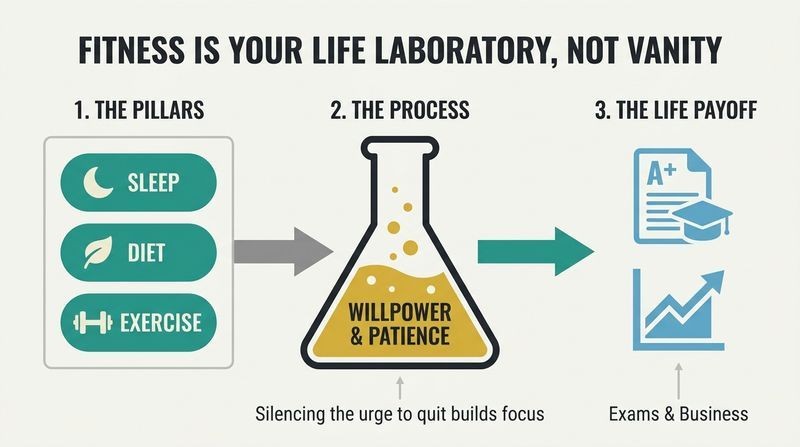
Bhagat ranks fitness as rule number one by a wide margin, but not for the six-pack. He frames exercise as rehearsal for every hard thing life demands. Every workout is net practice: you silence the inner voice that begs you to quit, and that same skill wins entrance exams and builds businesses. Dieting teaches patience and resisting temptation because results take months with nothing visible daily.
He builds fitness on three pillars, listed in order of neglect:
1. Sleep: seven to eight hours, consistent timing, no screens before bed, dark cool room.
2. Diet: count calories, try 16-hour intermittent fasting, eat mostly protein and vegetables.
3. Exercise: 45 to 60 minutes most days, split between cardio and compound lifts.
When Viraj pleads no time, Bhagat shows his screentime: three hours of Instagram daily but supposedly no 45 minutes to run.
The reframe of exercise as psychological training rather than aesthetics aligns with research on self-regulation as a trainable resource. Baumeister's willpower studies and later work on discipline as habit both support the idea that resisting one temptation strengthens capacity elsewhere, though the muscle metaphor is contested. Placing sleep first is quietly radical in hustle culture; Matthew Walker's work confirms sleep governs mood, hormones, and cognition. One caution: intermittent fasting and aggressive calorie deficits are not universally optimal, especially for women or those with medical conditions, which Bhagat acknowledges by urging a doctor's consult. The screentime confrontation is the memorable gut-punch.
Rule your emotions coldly, but read others' emotions warmly

Bhagat splits the brain into a rational frontal region and a primitive limbic lizard brain that fires fast, crude signals: fight-or-flight, hunger, lust, fear. Emotions are these bodily sensations hijacking decisions. His prescription is asymmetric: toughen yourself, soften toward others.
He maps four archetypes on a rational-emotional spectrum: the cold 100% rational robot (undesirable), the rationally dominant person who still feels but lets logic lead (the goal), the emotionally dominant EmDom who acts only when they feel like it (most of humanity, hence most of Class III), and the 100% emotional person who is easily manipulated. Because brains are neuroplastic, you rewire toward rational dominance by repeatedly choosing the hard action over the felt impulse, starting with five straight days of one difficult task. Meanwhile, layer warmth onto others: ask how someone's child is, notice their fatigue.
The lizard brain framing is a useful simplification, though neuroscientists like Lisa Feldman Barrett challenge the triune-brain model, arguing emotion and cognition are not cleanly separable regions but constructed together. Still, the practical upshot is sound and echoes Stoicism, which Bhagat nods to via Epictetus: judgment, not events, governs suffering. The asymmetry (hard on self, soft on others) resembles emotional intelligence research by Daniel Goleman, where self-regulation and empathy are distinct skills. The risk is that instrumentalizing others' emotions to get further with them shades toward manipulation, a line Bhagat draws but which stays uncomfortably thin.
Put yourself first is self-care, not selfishness
Bhagat attacks the Indian habit of self-erasure through people-pleasing. His illustration: an exhausted professional who wants soup and early sleep but caves to the family's mall outing, sacrificing the workout and rest that serve his goals. The voice saying what you want gets drowned out automatically, and you don't even notice.
He distinguishes selfishness (only me) from self-care (me first, then others), invoking the airplane oxygen mask: secure yours before helping others. He confesses his own trap: as a child he memorized jokes to be liked, and as a bestselling author he nearly destroyed his health chasing validation from banker friends who kept asking how much money writing made. Only the Covid pause let him see he was a puppet dancing on strings others didn't even know they held. The fix: set boundaries, and the world adjusts around your stated needs.
This maps neatly onto psychological research on people-pleasing, sometimes called sociotropy, linked to anxiety and burnout. Boundary-setting literature, from Brene Brown to Nedra Tawwab, echoes Bhagat's claim that clear limits actually deepen respect rather than damage relationships. The cultural framing is sharp: collectivist societies often valorize self-sacrifice, especially for women, which Bhagat notes when mentioning property rights surrendered to brothers. The nuance worth adding: put-yourself-first advice can curdle into narcissism without the me-first-then-others qualifier, and caregiving obligations are not always optional. Bhagat's own arc, nearly killing himself for external approval, makes the argument feel earned rather than glib.
In India, weak English keeps you locked out of Class II
Bhagat calls English the single most common Iron Gate in India, a colonial residue that still sorts people by class 75 years after independence. He grades speakers into three tiers: E-0s who cannot speak English and are confined to blue-collar work, E-1s who learned it in school but lack native comfort (most Indians, including his younger self), and E-2s who grew up immersed in English at home and glide into elite circles.
The goal is not Oxford perfection but confident, fluent, simple English, becoming a high-level E-1. His methods are immersion, not courses: order food in English, speak it at home despite ridicule, read voraciously, and crucially think in English rather than translating from your mother tongue, which betrays you through delay and wrong syntax like Myself Chetan Bhagat. He compares learning to swimming: videos cannot substitute for the water.
The observation is uncomfortably accurate about Indian labor markets, where English functions as what economists call a screening signal, filtering candidates independent of actual job competence. Bhagat's honesty that this is a stupid colonial inferiority complex, not a fair standard, keeps him from endorsing the injustice he describes. The think-in-the-target-language advice aligns with second-language acquisition research on automaticity. A gap: he underweights that mother-tongue instruction often produces better conceptual learning, and the global rise of AI translation may erode English's gatekeeping power. But for the ambitious Indian today, his pragmatism (play the game as it is, not as it should be) is hard to fault.
Earn your dopamine through effort; never steal it cheaply
Dopamine, Bhagat explains drawing on Anna Lembke's Dopamine Nation, is the neurochemical of wanting more, not just pleasure. Cheap dopamine (porn, sugar, alcohol, cigarettes, Instagram reels) delivers highs with zero effort, corrupting the brain's effort-reward wiring. Worse, tolerance builds: each high spills your baseline lower, like agitating water out of a container, so smokers eventually smoke just to feel normal, not good.
The antidote is earned dopamine, the satisfaction that follows a hard workout or a finished study session, which never loses potency and creates a virtuous motivational loop. If already addicted, do a dopamine detox: abstain 30 days, ideally tapering 10 to 20% weekly, protecting sleep to replenish baseline. Viraj admits porn leaves him demotivated, wanting only junk food and bed. Bhagat names the loop precisely: high, crash, lower baseline, chase again, deeper hole.
Bhagat popularizes real neuroscience competently, though he simplifies. Lembke's pleasure-pain balance metaphor is more nuanced than water spilling from a container, and the term dopamine detox is scientifically loose; you cannot literally deplete and refill dopamine on a 30-day timer. What holds up is the behavioral core: variable-reward digital products are engineered for compulsion, a point B.J. Fogg and Nir Eyal have documented from the designer's side. The framing of effortless reward as theft is memorable and morally charged in a useful way. The honest touch, Bhagat confessing he still finishes the ice cream and checks WhatsApp fifty times, keeps it from sounding preachy.
Chase hard things daily, or the hard chases you down
Bhagat's parable of Bobby crystallizes this. Bobby, a banker who worshipped pleasure and avoided all discomfort, ate rich food and drank fine whisky nightly, never exercised, and was celebrated for living life to the fullest. He gained 60 kilograms over two decades, developed diabetes and hypertension, and died of a heart attack at 52, some 33 years short of his potential.
The lesson: avoiding hard things does not eliminate hardness, it defers and compounds it. It is hard to study and hard to fail the exam; hard to diet and hard to be sick. Since effort is the only real generator of dopamine, a fulfilled life comes from chasing the right discomfort, not comfort. His three-word mantra is that life is uphill: you climb a little every day or you slide down. Chasing hard does not mean zero fun; it means doing the hard first, then enjoying the reward.
The Bobby fable is effective precisely because it refuses the seductive YOLO narrative that hedonism equals a life well lived. The insight connects to the psychology of delayed gratification, from Mischel's marshmallow studies to modern work on grit by Angela Duckworth. Bhagat's you will face hard either way reframing is philosophically close to the idea that suffering is inevitable but productive suffering is a choice, an echo of both Stoic and Buddhist thought. The caution: not all discomfort is virtuous, and glorifying hardship can mask when quitting is wiser than persisting. Bhagat partly addresses this by insisting fun and rest remain, just second in line.
Eat the elephant: slice giant goals into 500 daily bites
Facing a goal so huge it paralyzes you, Bhagat asks how you eat an elephant. Answer: cut it into tiny pieces and eat one at a time over a long stretch. Humans evolved to excel at short-term tasks (a chimp grabbing bananas) but freeze before long-term projects, because roughly 99% of our DNA still matches our ancestors.
He demonstrates with his IIT preparation. He carved the exam into Physics, Chemistry, and Maths, then into 100-plus topics, then into 500 sub-topic blocks, each masterable in a few days. Two years of five hours a day, five days a week, and an average, distracted student who studied amid domestic chaos cracked All India Rank 326. He repeated the method writing his first novel at one page a day. The hardest part is never the physics; it is the monotonous keeping-at-it. Tackle only one or two elephants at once.
This is classic goal-decomposition, validated across productivity research: subgoals sustain motivation because progress becomes visible, a phenomenon Teresa Amabile calls the progress principle. Bhagat's value-add is emotional honesty about tedium; most productivity gurus undersell how boring sustained effort actually is. The evolutionary framing (good at short-term, bad at long-term) is a useful heuristic even if it flattens the science. His self-positioning as unexceptional but relentless is the democratizing message: this is the tool available to people without money, connections, or genius. One extension worth noting: decomposition works best when the path is known. For ambiguous creative or entrepreneurial goals, the cuts themselves must be discovered iteratively.
Be the cockroach: adapt fast and stay chill about change
Bhagat's most counterintuitive role model is the cockroach, which has survived millions of years by adapting to any environment while dinosaurs, bigger and mightier, went extinct. Invoking a paraphrase of Darwin, he argues nature rewards not the strongest or smartest but the most adaptive. Whole industries (Baygon, HIT) exist to kill cockroaches and fail; the insect even evolves resistance to the spray.
His career is serial adaptation. In Hong Kong he stopped hunting for Indian food, learned American workplace norms, and embraced Chinese cuisine rather than pining for home. When ten publishers rejected his first novel, he swallowed his IIT-IIM-banker ego, sought brutal feedback from writer Shinie Antony, and rewrote the entire book into something funny and gripping. That rewrite became the bestseller adapted into 3 Idiots. His rule: whenever choosing between status quo and change, lean toward change until it stops scaring you.
The Darwin quote is famously misattributed (it does not appear in his writings and likely originated with a management professor), a small crack in an otherwise strong chapter. The substance holds: organizational studies from Clayton Christensen's disruption theory to the fates of Nokia and BlackBerry, both of which Bhagat cites, confirm that incumbents die by failing to adapt to touchscreens and shifting terrain. The ego-swallowing publishing story is the emotional core, illustrating that adaptation often requires surrendering identity, not just behavior. Psychologically this connects to Carol Dweck's growth mindset. The framing of change as adventure rather than threat is a genuinely useful cognitive reframe for the risk-averse.
Your network is your net worth, so make people remember you
Bhagat illustrates with one can of chickpeas. Stuck under a toxic boss at Goldman Sachs during a hiring freeze, he bumped into a former boss, Damien Wood, at a Hong Kong mall and impulsively invited him home for easy canned-chickpea curry. Over mangoes he mentioned his unhappiness, never asking for a job. Two months later Damien offered him one, launching the bank moves that funded his eventual writing career.
Networking, he clarifies, is not friendship or partying; it is maintaining relationships with a wide range of people who will respond if you reach out. Since most connections never pay off, you need many. His method: get in front of more people, then be genuinely, authentically interested in them. Ask open-ended questions using the FORD framework (Family, Occupation, Recreation, Dreams). Treat each person as the star of their own movie. Avoid politics and religion. Never ask for something with nothing to offer.
The chickpea story is a masterclass in what sociologist Mark Granovetter called the strength of weak ties: loose acquaintances, not close friends, most often deliver job opportunities because they bridge into networks you cannot see. Bhagat's insistence on authenticity over scripted hacks aligns with Dale Carnegie's century-old core (become genuinely interested in others) and with research showing people rate conversations higher when asked follow-up questions. His class-aware realism is the sharp addition: Viraj protests that a delivery boy cannot network up, and Bhagat redirects him downward and sideways to restaurant managers and recruitment agencies, accessible nodes that still hold real information. Networking, reframed, is not schmoozing elites but consistent human curiosity.
Say it's my fault, because that hands you the power to fix it
Bhagat's rule of extreme ownership targets the victimhood template: if only others behaved better, my life would be better. As a fat teenager rejected by girls, he blamed them for being evil or stupid rather than doing the runs that might have changed his fate. He calls this mental clutter your EJL, or Excuses and Justifications List, and demands you rip it out.
The logic is pragmatic, not moralistic: even if the blame genuinely lies elsewhere, you cannot control other people, so blame leaves you stuck. Only self-responsibility yields a plan you can act on. He borrows David Goggins's accountability mirror and upgrades it to a Brutal Truth Augmented-Reality Mirror that lists everything wrong in your life. Wipe off the dust of alcohol and social media, read the ugly truths, say it's my fault, and add yet to every deficiency: no six-pack yet, no money yet. Viraj finally sees that Arpita never hurt him; he abandoned his own life.
Bhagat wisely frames ownership as strategically empowering rather than morally superior, dodging the trap of blaming genuine victims. Viraj's own counterexample (what about cancer or a fatal accident?) is raised and answered honestly: some misfortunes are not your fault, but most of your daily condition is. This sidesteps the toxic-positivity critique that plagues extreme-ownership rhetoric popularized by Jocko Willink, whom Bhagat cites. The yet reframe echoes Carol Dweck's growth mindset almost verbatim and is genuinely useful. The deeper psychology aligns with internal locus of control, robustly linked to resilience and achievement. The nuance he preserves matters: ownership as leverage, not as self-flagellation.
Earning is useless without saving and investing the difference
Bhagat contrasts himself with his college friend D, who at 50 lost his finance job and could not stop working because decades of a YOLO lifestyle (harbor-view apartment, luxury car, crystal decanters, club membership) left almost no savings. Bhagat, on identical Hong Kong pay, lived in a cheaper Chinese neighborhood, saving 30% on rent alone, ate at home, and invested from his first paycheck. That safety net, not writing income, let him quit banking at 35 for a 95% pay cut.
His money mantra is ESI: Earn, Save, Invest. He learned investing through painful losses (his entire savings vanished when Peregrine went bankrupt) before adopting diversified index funds, SIPs, and Warren Buffett-style value investing in brands he actually used, like Apple near the first iPhone. He warns that fixed deposits lose to inflation after tax, while stocks compound over the long term. The real reward of wealth is not luxury goods but luxurious choices, above all the freedom to walk away.
The D-versus-Chetan contrast dramatizes what personal-finance research calls the savings rate as the dominant lever, far more than investment returns for most people. Bhagat's emphasis on delayed gratification ties his final rule back to the marshmallow logic running through the whole book. His preference for low-cost index funds and skepticism of crypto and exotic instruments aligns with mainstream evidence from Bogle to Buffett. One blind spot: his frugality story assumes a high finance salary; saving 30% is far harder on a delivery worker's 18,000 rupees a month, a tension the Viraj frame never fully resolves. Still, reframing wealth as optionality rather than consumption is the chapter's durable, quietly radical idea.
Analysis
11 Rules for Life is a self-help book wrapped in a Socratic novella. Chetan Bhagat, India's bestselling English novelist turned motivational entrepreneur, structures the book as eleven daily lunch conversations with Viraj, a fictional heartbroken food-delivery worker, dispensing one rule per meal. This framing device is the book's cleverest move: it converts abstract advice into narrative, gives readers a proxy to argue back through Viraj's objections, and lets Bhagat model vulnerability by disclosing his own abusive father and childhood sexual abuse.
The book's spine is its class thesis. Bhagat rejects meritocracy outright, insisting India is a rigged three-tier mountain guarded by Iron Gates, with English fluency the primary lock. Every subsequent rule is instrumentalized toward one goal: crossing your aukaat, jumping class. This gives the book unusual coherence for the genre; fitness, dopamine, and networking are all reframed as tools for upward mobility rather than free-floating wellness tips.
Intellectually, the book is a competent synthesizer rather than an originator. It repackages Lembke's dopamine science, Goggins's accountability mirror, Willink's extreme ownership, Stoic emotional control, and Buffett's value investing for a young Indian audience that may not encounter these sources directly. That is its genuine service and its limitation. The neuroscience is simplified to the point of occasional inaccuracy, the Darwin quote is apocryphal, and the 1-9-90 class percentages are admittedly guesses.
The book's most bracing quality is its refusal of comfort. Bhagat tells readers the world is unfair, nobody is coming to save them, and their problems are their fault, then insists this is liberating rather than cruel. The most underexamined tension is class itself: advice calibrated for a Goldman Sachs analyst (save 30% of income) sits awkwardly beside Viraj's survival wages. The fairy-tale ending, Viraj owning a cafe chain five years later, papers over how rare such jumps actually are, the very rarity Bhagat's own thesis insists upon.
Review Summary
11 Rules For Life by Chetan Bhagat receives mostly positive reviews, with readers praising its practical advice, relatable storytelling, and accessible writing style. Many find the book motivational and insightful, appreciating Bhagat's personal anecdotes and straightforward approach. Critics note that some content may be familiar to those well-versed in self-help literature. The book's structure, following a food delivery person's interactions with the author, is generally well-received. Overall, readers find value in the 11 rules presented, though opinions vary on the depth and originality of the content.
People Also Read









FAQ
What's "11 Rules For Life: Secrets to Level Up" about?
- Overview: The book is a self-help guide by Chetan Bhagat aimed at helping readers transform their lives by following eleven specific rules.
- Structure: It is structured around a fictional narrative involving a delivery boy named Viraj, who learns life lessons from the author.
- Purpose: The book combines personal anecdotes, motivational advice, and practical tips to help readers achieve success and happiness.
- Target Audience: It is intended for anyone looking to improve their life, particularly those feeling stuck or unfulfilled.
Why should I read "11 Rules For Life: Secrets to Level Up"?
- Practical Advice: The book offers actionable steps and real-life examples to help readers implement changes in their lives.
- Motivational: It provides inspiration through the author's personal stories and experiences, making it relatable and encouraging.
- Comprehensive Approach: It covers a wide range of topics, from fitness and emotional control to financial planning and networking.
- Engaging Narrative: The fictional story of Viraj adds an engaging element, making the advice more relatable and easier to digest.
What are the key takeaways of "11 Rules For Life: Secrets to Level Up"?
- Fitness First: Prioritize physical health as it impacts mental well-being and overall success.
- Emotional Mastery: Control your emotions to make rational decisions and achieve long-term goals.
- Self-Priority: Put yourself first to ensure you are living a life true to your own desires and goals.
- Financial Wisdom: Earn, save, and invest wisely to secure financial freedom and choices in life.
What are the best quotes from "11 Rules For Life: Secrets to Level Up" and what do they mean?
- "Life is uphill": This quote emphasizes that life is inherently challenging, and success requires consistent effort and resilience.
- "It’s my fault": This phrase encourages taking responsibility for one's life, which is the first step toward making positive changes.
- "Be the cockroach": This metaphor highlights the importance of adaptability and resilience in the face of change and adversity.
- "Earn, save and invest": This advice underscores the importance of financial literacy and planning for long-term security and freedom.
How does Chetan Bhagat suggest mastering emotions in "11 Rules For Life"?
- Rational Dominance: Train your brain to prioritize rational thinking over emotional impulses.
- Emotional Awareness: Recognize when emotions are influencing decisions and consciously choose logic instead.
- Practice Control: Regularly engage in activities that require discipline, like exercise, to strengthen emotional control.
- Understand Others: Learn to read and understand the emotions of others to improve interpersonal relationships.
What is the significance of "Eat the Elephant" in "11 Rules For Life"?
- Break Down Goals: The metaphor suggests breaking down large, daunting tasks into smaller, manageable pieces.
- Consistent Effort: Focus on completing one small task at a time to eventually achieve big goals.
- Long-Term Commitment: Understand that significant achievements require sustained effort over time.
- Avoid Overwhelm: By focusing on small steps, you prevent feeling overwhelmed by the enormity of the task.
How does "11 Rules For Life" address the concept of "Cheap Dopamine"?
- Dopamine Understanding: Dopamine is a neurotransmitter that drives motivation and pleasure-seeking behavior.
- Avoid Instant Gratification: The book warns against easy dopamine fixes like junk food, social media, and other instant pleasures.
- Earned Dopamine: Encourage activities that require effort and lead to genuine satisfaction and long-term rewards.
- Dopamine Detox: Suggests a period of abstaining from addictive behaviors to reset the brain's reward system.
What does "Be the Cockroach" mean in the context of "11 Rules For Life"?
- Adaptability: Emphasizes the importance of being adaptable to survive and thrive in changing environments.
- Resilience: Like cockroaches, be resilient and able to withstand challenges and setbacks.
- Embrace Change: View change as an opportunity rather than a threat, and adjust accordingly.
- Survival Strategy: Understand that adaptability is a key factor in long-term success and survival.
How does Chetan Bhagat recommend improving networking skills in "11 Rules For Life"?
- Expand Your Circle: Actively seek to meet and connect with a wide range of people.
- Genuine Interest: Show authentic interest in others to build meaningful relationships.
- Value Exchange: Focus on how you can offer value to others, not just what you can gain.
- Consistent Engagement: Maintain and nurture your network through regular, meaningful interactions.
What role does financial planning play in "11 Rules For Life"?
- Financial Literacy: Emphasizes the importance of understanding financial concepts like saving and investing.
- Long-Term Security: Advocates for building wealth through disciplined saving and smart investments.
- Freedom of Choice: Financial stability provides the freedom to make life choices without being constrained by money.
- Avoiding Debt: Encourages living within means and avoiding unnecessary debt to ensure financial health.
How does "11 Rules For Life" suggest dealing with setbacks and failures?
- Accountability: Take responsibility for failures as a step towards improvement.
- Learning Opportunity: View setbacks as opportunities to learn and grow.
- Resilience Building: Use failures to build resilience and prepare for future challenges.
- Continuous Improvement: Focus on making incremental improvements rather than dwelling on past mistakes.
What is the overall message of "11 Rules For Life: Secrets to Level Up"?
- Self-Improvement: The book is a guide to becoming the best version of yourself through disciplined effort and self-awareness.
- Holistic Success: Success is not just about career achievements but also includes health, relationships, and personal fulfillment.
- Empowerment: Encourages readers to take control of their lives and make proactive changes.
- Practical Wisdom: Offers practical advice that can be applied in everyday life to achieve long-term success and happiness.
About the Author
Other books by Chetan Bhagat









Download PDF
Download EPUB
.epub digital book format is ideal for reading ebooks on phones, tablets, and e-readers.








































